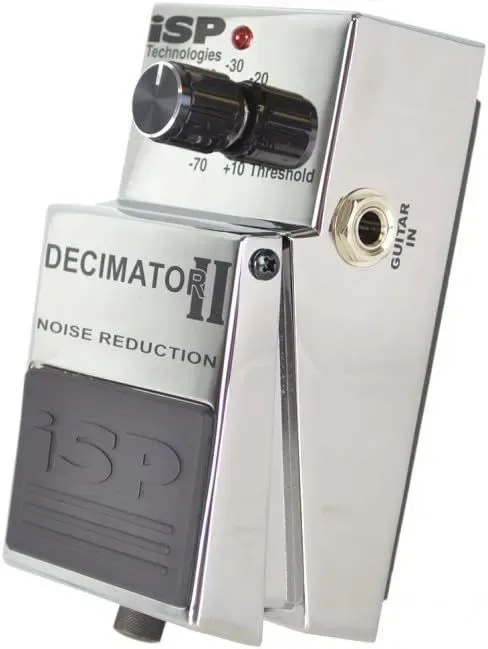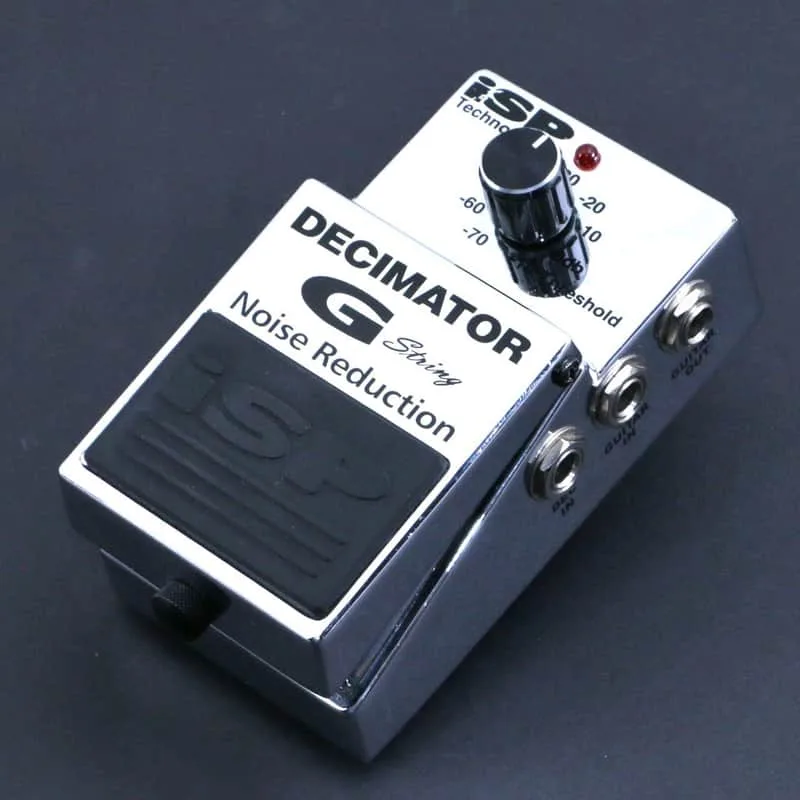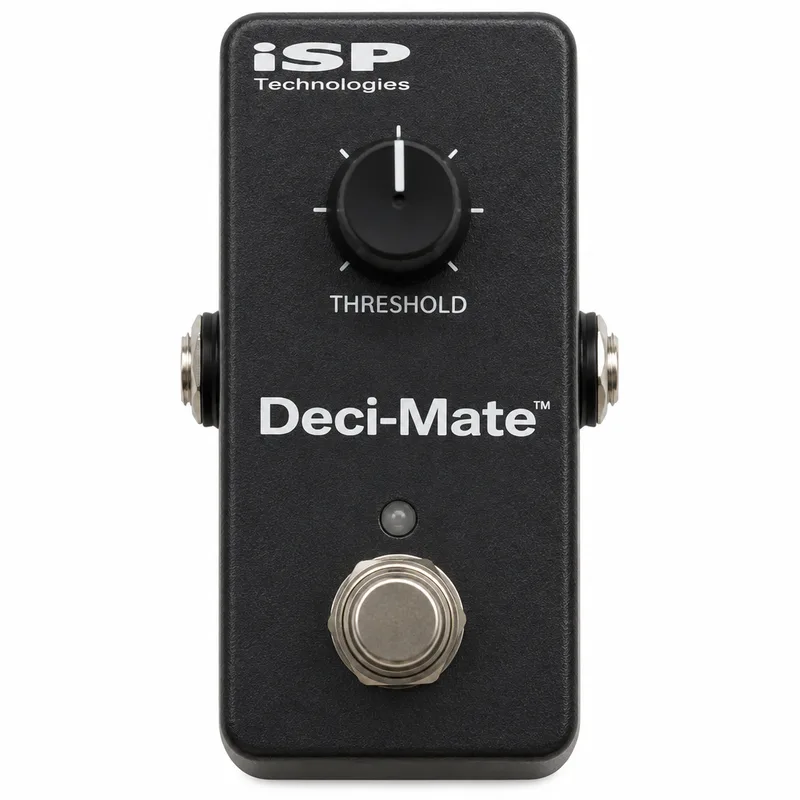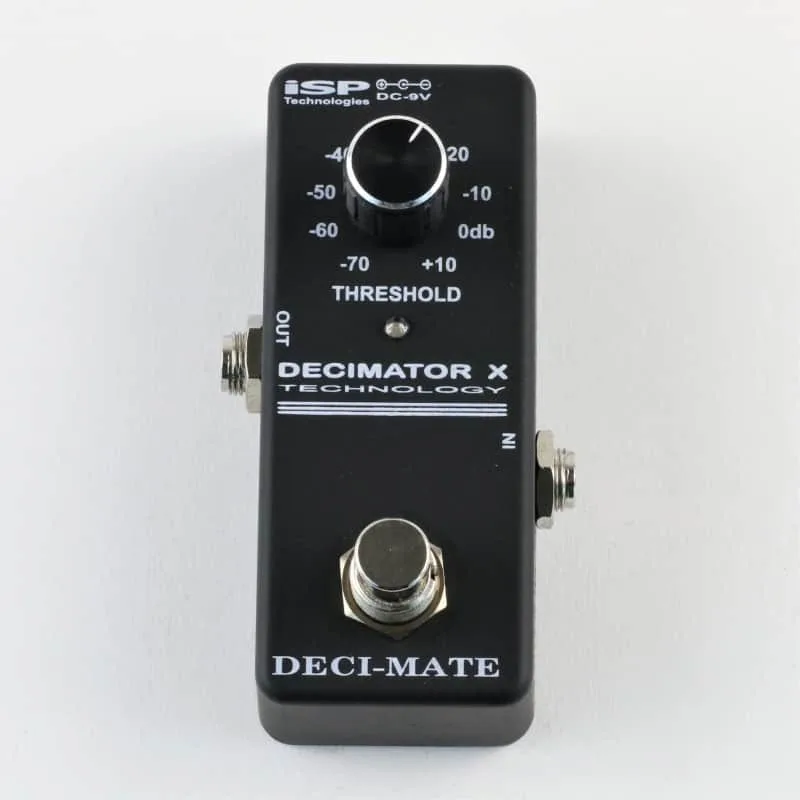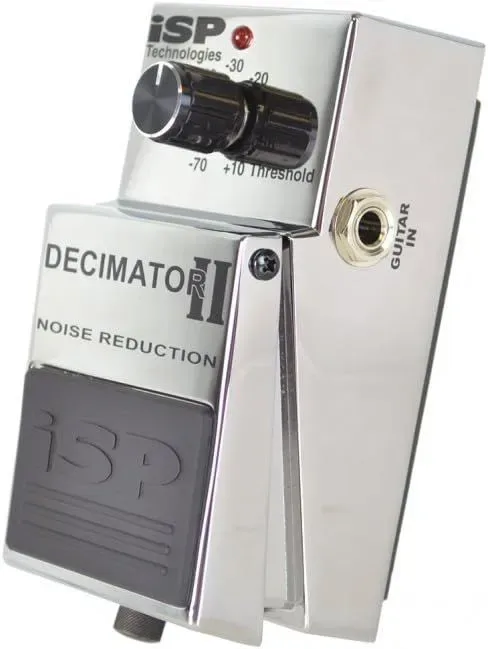


The ISP Decimator II G-String is a guitar noise reduction pedal from ISP Technologies, the second generation of the company's Decimator G String design. What sets it apart from a simple noise gate is its dual-jack layout: it reads the signal straight from your guitar through its own instrument input, and it can gate at a second point in your rig through a loop send and return. That means the noise reduction tracks what your hands are doing, not just the noise sitting at one spot in the chain12.
The pedal was released in June 2013 alongside the plain Decimator II, as an updated version of the earlier Decimator G String pedal. Both new pedals added link connections and improved expander tracking over the originals34.
What it does, and how it differs from the Decimator II
The Decimator II G-String is part of ISP's Decimator line of noise reduction gear, which spans pedals, micro pedals and 1U rack units. The core of the line is expander-based noise reduction: instead of a hard gate that snaps shut, the circuit tracks the signal and reduces it as the level falls. The Decimator II generation uses what ISP calls linearized Time Vector Processing in its expander tracking, which the maker describes as giving smooth sustained-note decay virtually free of release rippling8. Premier Guitar's review of the original G String pedal put the same idea in plainer terms:
"The Decimator uses Time Vector Processing, which instantly and accurately responds to all varieties of note durations."
The difference between the two second-generation pedals is the routing. The Decimator II is a single-point gate: one 1/4" input, one 1/4" output, placed wherever you want noise cut in your chain8. The G-String version adds the second signal path. Guitar World's noise gate buying guide describes the G String as a version of the Decimator that offers send and return connections, at a somewhat higher price9. The payoff is that the pedal can compare the clean guitar signal with what comes back through the loop, and remove noise based on that comparison.
| Decimator II | Decimator II G-String | |
|---|---|---|
| Inputs | 1 x 1/4"57 | 1 x 1/4" (instrument), 1 x 1/4" (loop return)5 |
| Outputs | 1 x 1/4"57 | 1 x 1/4" (main out), 1 x 1/4" (loop send)5 |
| Link jacks | Not listed | 2 x 1/8" (link in/out)5 |
| Expander tracking | Linearized Time Vector Processing8 | Linearized Time Vector Processing8 |
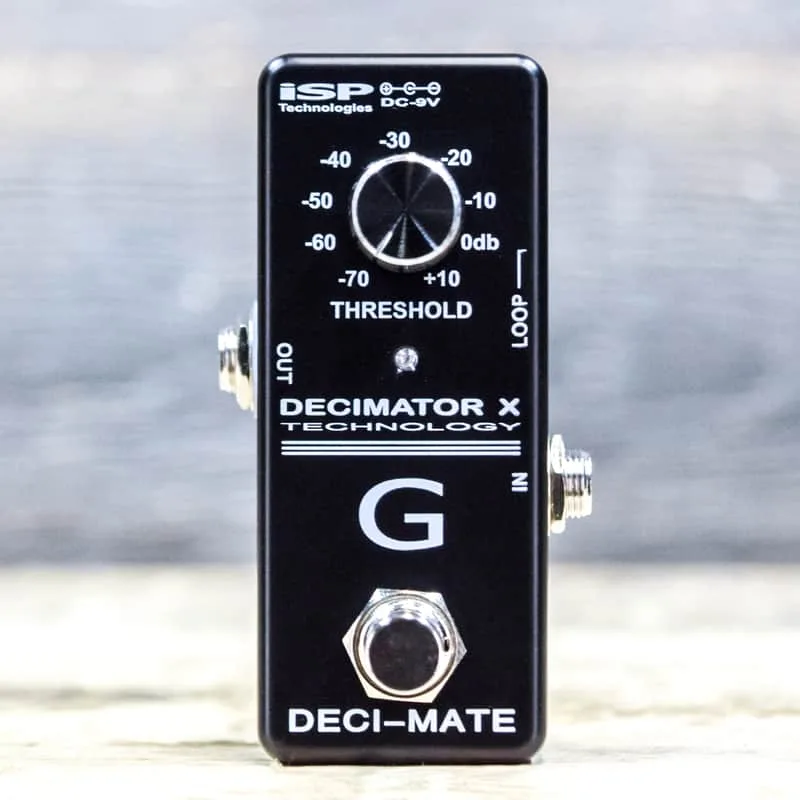
The same tracking-the-guitar approach runs through the wider family. ISP says of its DECI-MATE G Micro Decimator that because the noise reduction directly tracks the guitar output, the threshold needs no adjustment when switching between gain settings2. The later Decimator G String X carries the idea further with patented adaptive noise reduction technology, under US Patent 11,641,1837.
The Threshold knob and the jacks
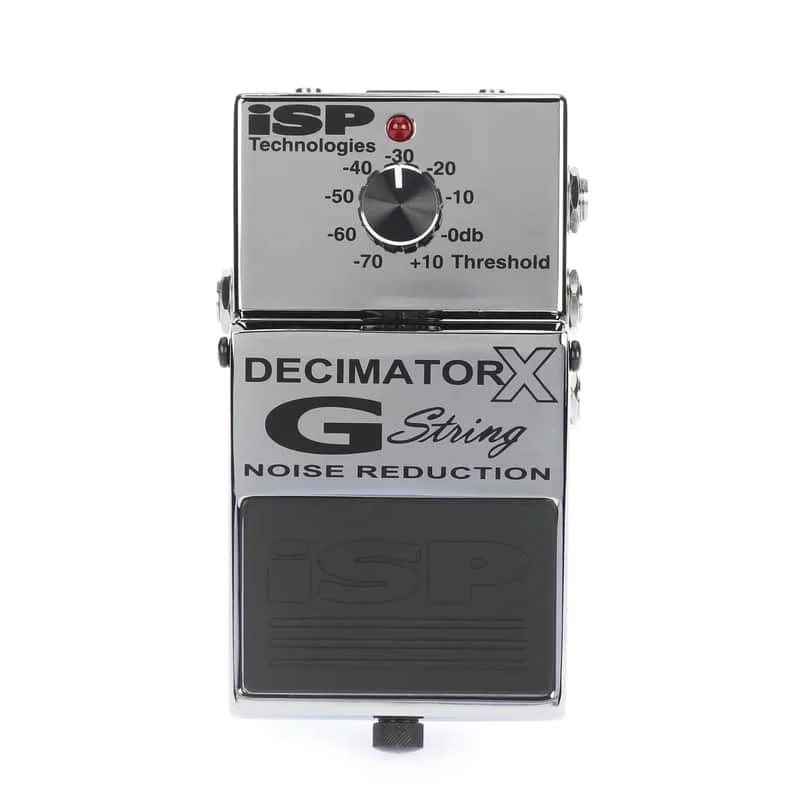
The control set is minimal. The G String design consists of one threshold knob and an active/bypass switch, as Premier Guitar described in its roundup review of the original pedal1. There is no release-time control, no decay knob and no sidechain filter: the Time Vector Processing is meant to handle note decay on its own, so the single knob is the whole user interface.
Setting it up is a two-step process:
- Run your guitar into the instrument input and out of the main output, and connect the loop send and return to the point in your rig where you want the second stage of noise reduction.
- Set the threshold knob until the noise is eliminated to taste6.
The four 1/4" jacks each have a distinct job5:
- Instrument in: your guitar plugs here, and the pedal reads this signal directly to drive its tracking.
- Main out: feeds the next thing in your chain, typically the amp's front input.
- Loop send and loop return: connect to your amp's effects loop send and return, or to another point in the chain, so the pedal can gate there too.
Gearnews's noise gate guide describes this two-place arrangement in the context of the later Decimator X G-String: it gates in two places at once, in front of the amp and inside the effects loop, keyed off the same detection10. The same principle applies to the II G-String's jack layout.
Linking two pedals
The two 1/8" jacks are the link in and link out. ISP Technologies makes both the Decimator II and the Decimator G String II, and the G String II is a noise reduction pedal34. The second-generation pedals were announced in 2013 as updated versions of the earlier Decimator II and Decimator G String pedals4. How the linking function behaves in practice is best checked against ISP's own documentation for the specific pedals you own.
Where it came from
The Decimator II and Decimator G String II come from ISP Technologies3. The G String II is a noise reduction pedal, released as a brand new updated version of both the earlier ISP Technologies Decimator II and Decimator G String pedals4. Reviewers took to the high gain noise reduction: the Decimator II G-String was described as "a dream come true for metal players who love high gain but hate the noise"6.
What reviewers said
Pedal of the Day reviewed the Decimator II G-String in June 2016 and was positive about it. The reviewer found it "a fantastic way to clean up your signal without sacrificing your tone or your ability to change between channels and settings on your amp," and called it "a dream come true for all of the metal players out there who love high gain but hate the noise"6. On the tone question, the same review said the pedal uses the comparison between the guitar signal and the loop signal to remove noise "without killing your sound or your dynamics"6. The review also lists Josh Elmore among the pedal's users6.
That verdict lines up with what Premier Guitar said about the G String line more generally, describing the Decimator G String Noise Reduction pedal as "a welcomed addition to any noisy guitar rig"11.
Videos
Sweetwater
Guitar Lava
Kelster Von Shredster
Questions
What is the difference between the Decimator II and the Decimator II G-String?
The Decimator II is a straightforward noise gate pedal with one 1/4 inch input and one output, placed at a single point in your chain. The G-String version adds a second set of jacks, a loop send and loop return, so it can track your guitar's dry signal while gating elsewhere in the rig, and it costs a bit more. Both share the same Decimator II expander tracking.
Does the Decimator II G-String go in front of the amp or in the effects loop?
It can do both at once. The pedal has an instrument input and main output for the front of the amp, plus a loop send and loop return for the amp's effects loop. The guitar's signal is tracked directly, so the gating follows your playing rather than the noise level at one point in the chain.
Can you link two Decimator G-String pedals together?
Yes. The pedal has two 1/8 inch link jacks, and a standard 1/8 inch phone cord between two Decimators engages the linking function. That gives you two channels of noise reduction or a stereo setup, with both units working from the same detection.
Will a noise gate change my guitar tone?
A gate only removes signal, and the Decimator II G-String was reviewed as cleaning up the signal without sacrificing tone or dynamics. Its Time Vector Processing is designed to respond to note durations, so sustained notes decay smoothly instead of being cut off abruptly.
What is the Dec In jack for?
The 1/4 inch instrument input is where your guitar plugs in. The pedal reads the signal at that jack directly, so the noise reduction tracks what your guitar is actually doing, and the threshold does not need adjusting when you change gain settings on the amp.
Sources (11)
- Stomp on This! 28 Stompboxes Reviewed, Premier Guitar, 2008-10-15
- ISP Technologies, ISP Technologies
- ISP Launches Decimator II & G String II Noise Gates, Premier Guitar, 2013-06-20
- ISP Technologies Release the Decimator II and Decimator G String II Updates, Guitar Interactive Magazine, 2013-06-24
- ISP Technologies, ISP Technologies
- Guest Reviewer Fridays: ISP Decimator II™ G-String, Pedal of the Day, 2016-06-03
- ISP Technologies, ISP Technologies
- ISP Technologies, ISP Technologies
- Best noise gate pedals 2026: clean up your signal, Guitar World, 2021-03-19
- The 7 Best Noise Gate Pedals of 2026: Not Hiss Problem (or Hers), gearnews.com, 2026-07-27
- ISP Technologies G-String Decimator Pedal Review, Premier Guitar, 2008-10-15