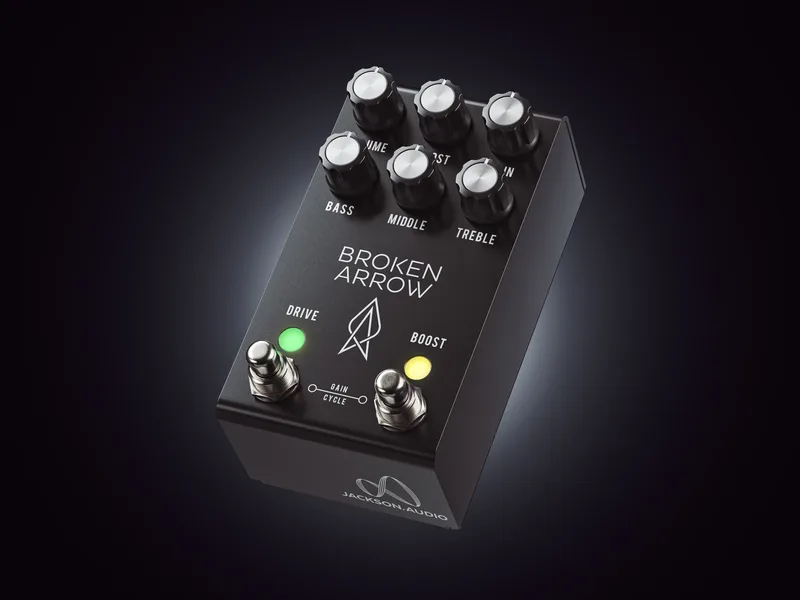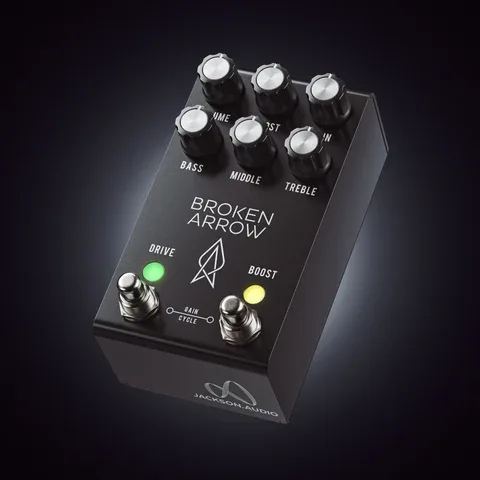


The Jackson Audio Broken Arrow is a programmable soft-clipping overdrive pedal with an independent MOSFET boost circuit built in. Its overdrive circuit is, in Jackson Audio's own words, "a soft clipping overdrive circuit designed in the same vein as the venerable" Tube Screamer, but with four switchable clipping presets, four boost presets, a Gain Cycle feature and an active three-band EQ1. In a Guitar.com interview with Joey Landreth, the pedal was described as "Brad's version of a Tube Screamer-style circuit," referring to Jackson Audio's Brad2.
The current version is the Broken Arrow V2, which adds MIDI control to the original 2019 design. The V2 was billed by the maker as "MIDI, NEW FOR 2020!"13. At launch in 2019 the pedal was listed at $2794; by March 2020 the V2 with MIDI was listed at $2205.
What it is and how it sounds
The Broken Arrow is a Tube Screamer-style soft clipper at heart, but it departs from the TS808 in one important way: there is no fixed mid-hump. The maker states that "there is no set 'mid-hump' in the BROKEN ARROW and the tone is relatively flat when all controls are set at 12:00"1. The V2 product page describes it as "a familiar soft-clipping foundation without a permanently imposed mid hump," with a relatively flat response when the EQ controls are centered6.
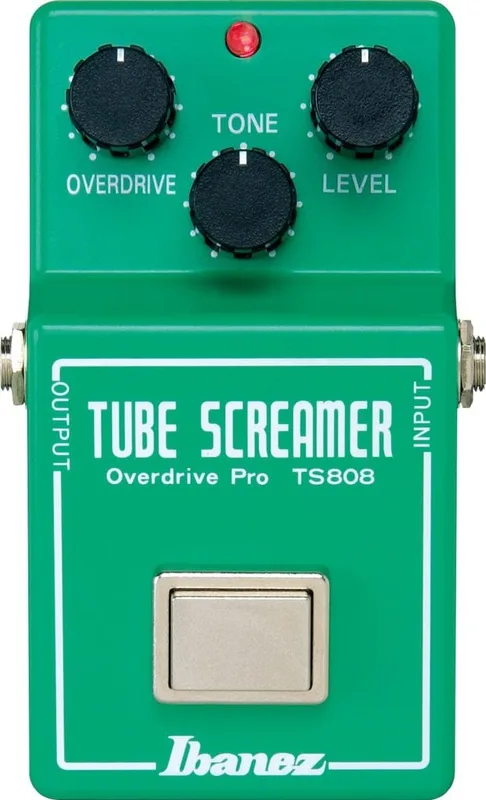
That is a deliberate contrast with the Ibanez TS808 it is modeled on. Technical analyses of the Tube Screamer note that its "frequency response is tailored to emphasize the mid frequencies, creating a hump that helps to keep the guitar sound over the general mix of the band"7, and that the TS808 "creates this mid hump by removing bass, removing treble and amplifying the remaining midrange"8. The Broken Arrow keeps the soft-clipping drive character but hands the tone shaping to the player through its active EQ.
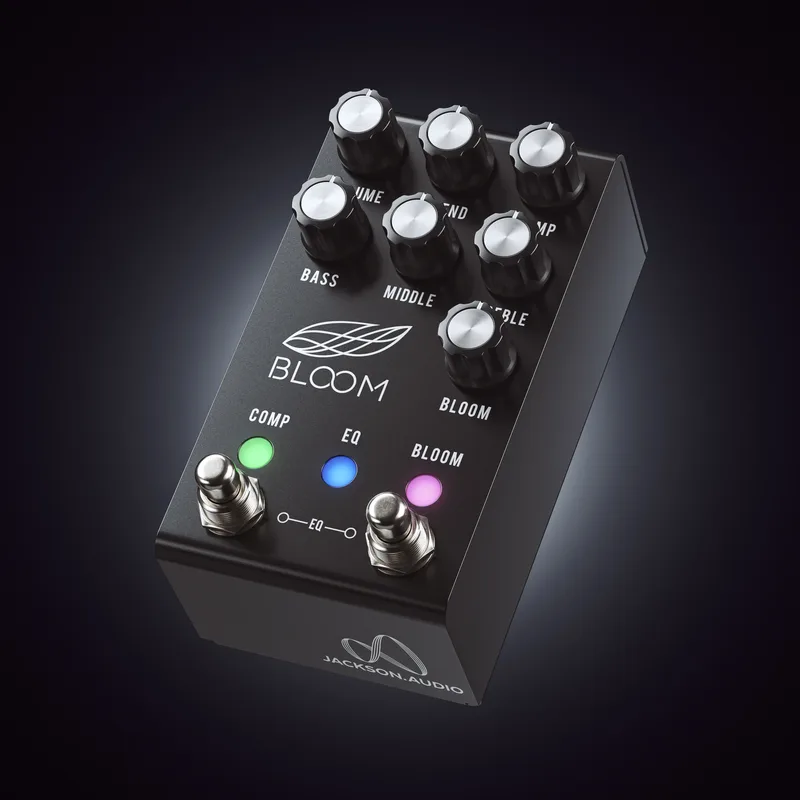
The EQ section is a three-band active design. Delicious Audio's review noted it is "identical to the one found in the company's compressor/boost Bloom"3.
The controls and footswitches
The pedal has two footswitches, Drive and Boost, and makes what Delicious Audio called "clever use" of them3. The knobs and their functions on the V26:
| Control | What it does |
|---|---|
| Gain | Sets the maximum value used by Gain Cycle |
| Volume | Master output for the overdrive circuit |
| Bass | Active low-frequency boost or cut |
| Middle | Active boost or cut centered around 660Hz |
| Treble | Active high-frequency boost or cut |
| Boost | Sets the output of the independent boost |
The footswitches do more than bypass the two circuits:
- Drive footswitch: Turns the overdrive on and off. Holding it opens clipping program mode, where you select one of the four clipping presets3.
- Boost footswitch: Activates and deactivates the boost circuit; press and hold for more than 1 second to enter or exit boost program mode1.
- Both footswitches together: Triggers Gain Cycle4.
Clipping presets
The Broken Arrow offers four clipping diode presets, each with a different diode arrangement and its own LED color. Each preset is level matched on the V2, which the maker says helps you "hear the actual difference in response and character instead of a" simple volume jump6.
| Preset | LED | Clipping | Character |
|---|---|---|---|
| 1 | Green | Two symmetrical silicon diodes | Familiar compression and classic soft-clipping drive6; "Classic Screamer"3 |
| 2 | Magenta | Three asymmetric silicon diodes | A more complex response suited to aggressive rhythm tones6 |
| 3 | Blue | Four symmetrical silicon diodes | A focused and direct clipping response6 |
| 4 | Amber | Two red LEDs, symmetrical | Greater headroom with a more open, less compressed feel6; "Vintage Marshall (high headroom)"3 |
Guitar Pedal X mapped the presets to familiar references at launch: "Green = 2 Symmetrical Silicon Diodes ≈ TS808" and "Magenta = 3 Asymmetric Silicon Diodes ≈ DS-1"4. The selected clipping preset is written to the internal EEPROM on the microprocessor when you exit program mode, so it persists after power cycling3.
Boost presets and using the boost alone
The boost is a MOSFET-based circuit with its own Boost knob, which Delicious Audio described as a way "to slam the front of the overdrive"3. It also works on its own: the boost circuit is in its own true bypass loop, "which means it can be used independently of the DRIVE circuit"3.
What makes the boost unusual is that it has four presets, each EQ'd slightly differently3:
| Preset | LED | Character |
|---|---|---|
| 1 | Yellow | Bright boost; a thinner, brighter response that can add definition to thick overdrive sounds63 |
| 2 | Green | Mid boost; retains more lows than Bright mode while adding a focused midrange push63 |
| 3 | Aqua | Tailored boost; a balanced voice designed to complement a wide variety of overdrive settings63 |
| 4 | Blue | Full range; transparent output with no intentional tonal coloring63 |
Gain Cycle
Gain Cycle is the Broken Arrow's signature gain feature. You set the Gain knob as your maximum, then press both footswitches simultaneously to cycle through four percentages of that setting6:
- 25%: Edge of breakup
- 50%: Defined overdrive
- 75%: Heavy overdrive
- 100%: Maximum saturation of the Gain knob setting6
Guitar Pedal X described it at launch as ramping "up the gain in 25% step increments out of the maximum" set on the dial4. Delicious Audio's reviewer called it "definitely a great way to add dynamics to a performance by using just a compact pedal," while noting that "it remains to be" seen how practical hitting both footswitches mid-performance is3.
Power
The Broken Arrow runs on 9V DC only, center negative, and requires a supply delivering at least 150mA. The manual specifies 9V maximum, and the V2 product page states explicitly not to power the pedal at 18V16. There is no battery option at this current draw.
Input impedance is 1M and output impedance is 100k1.
MIDI and the V2 update
The V2 update, new for 2020, added MIDI control1. Guitar Pedal X noted in a 2020 buying guide that the pedal was "improved even further in the most recent update which makes full use of Midi connectivity"5.
The V2 receives MIDI through the ring connection of a TRS connector, so a MIDI DIN-5 to TRS conversion cable is required16. The pedal ships on MIDI Channel 1; to change channels, hold the Drive footswitch while applying power, then tap Boost to increment the channel6. The MIDI implementation covers five control change messages6:
| CC | Function |
|---|---|
| #1 | Drive on/off (0/127) |
| #2 | Boost on/off (0/127) |
| #3 | Clipping preset 1-4 |
| #4 | Gain Cycle 1-4 |
| #5 | Boost EQ 1-4 |
Where it sits in the Jackson Audio range
The Broken Arrow sits among Jackson Audio's drive pedals as a dynamic overdrive, a type that reads your picking strength and adjusts the drive in response3. Its two footswitches, Drive and Boost, are arranged so the boost circuit lives in its own true bypass loop and can be used independently of the drive circuit3. Reviewers found this layout versatile: Guitar Interactive called it "incredibly versatile" and noted it "makes clever use of its two footswitches"3.
Videos
Jackson Audio
Jackson Audio
Jackson Audio
Questions
Does the Broken Arrow remember its clipping preset after power off?
Yes. When you exit clipping program mode, the selected clipping preset is written to the internal EEPROM on the pedal's microprocessor, so it persists after the pedal is power cycled. You do not need to reselect your clipping voice each time you plug in.
Can the boost on the Broken Arrow be used on its own?
Yes. The boost circuit sits in its own true bypass loop, which means it can be used independently of the drive circuit. The Boost knob sets the output of the independent boost, and you can also use it to slam the front of the overdrive for extra push.
What cable do I need for MIDI on the Broken Arrow V2?
The Broken Arrow V2 receives MIDI information through the ring connection of a TRS connector, so you need a MIDI DIN-5 to TRS conversion cable. A standard five-pin MIDI cable on its own will not connect; the adapter cable is required.
What is Gain Cycle on the Broken Arrow?
Gain Cycle lets you set the Gain knob as your maximum, then press both footswitches simultaneously to cycle through four percentages of that setting: 25% at the edge of breakup, 50% for defined overdrive, 75% for heavy overdrive and 100% for full saturation.
Does the Jackson Audio Broken Arrow have a mid-hump like a TS808?
No. The overdrive circuit is designed in the same vein as the TS-808, but there is no set mid-hump. With all controls at 12:00 the tone is relatively flat, and the active Bass, Middle and Treble controls let you boost or cut each band yourself.
Sources (8)
- Broken Arrow V2 MIDI User Manual, Jackson Audio
- "I’ve never been a huge Tube Screamer guy": Joey Landreth on the Bluesbreaker-inspired Golden Boy, Guitar.com, 2020-07-22
- Jackson Audio, Delicious Audio, 2019-08-21
- Guitar Pedal X, Guitar Pedal X, 2019-05-06
- Guitar Pedal X, Guitar Pedal X, 2020-03-29
- BROKEN ARROW v2, Jackson Audio
- Tube Screamer Analysis, GuitarPCB
- Tech Tips: Adaptive Circuitry Across The Range, Origin Effects (origineffects.com), 2023-07-12
 Joey Landreth