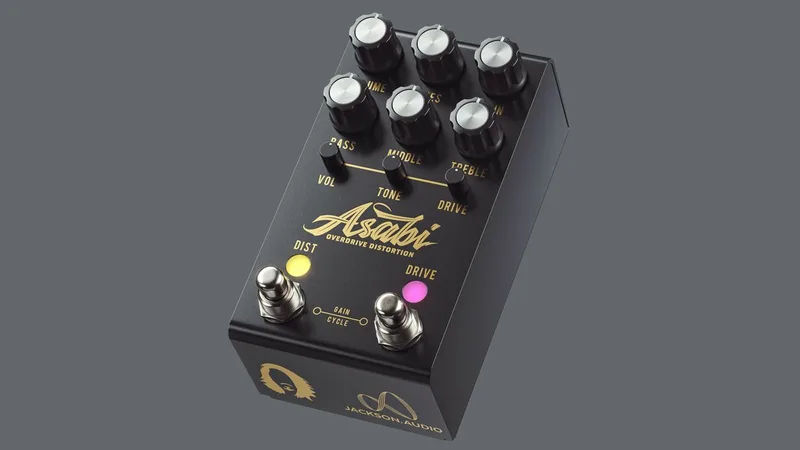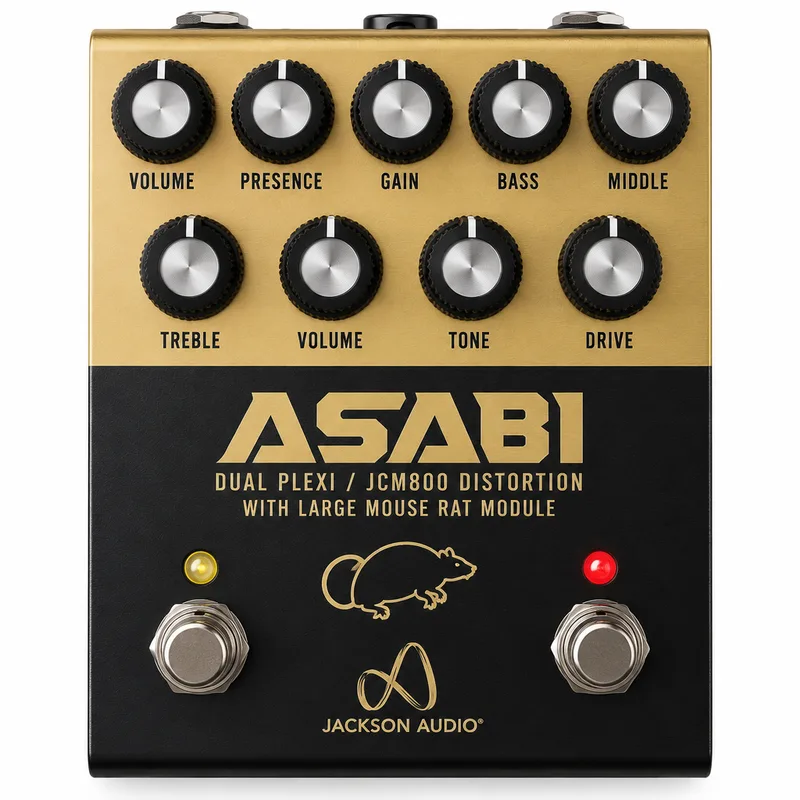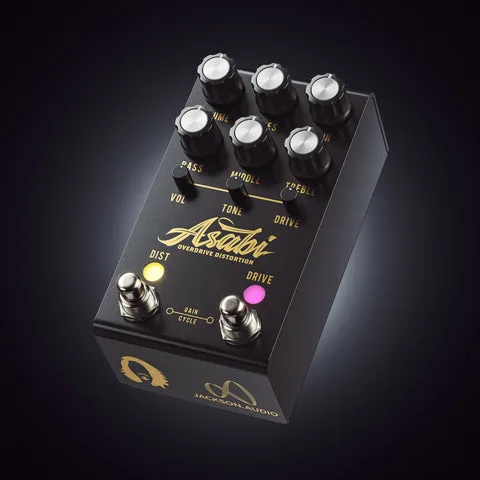


The Jackson Audio Asabi is the signature pedal of LA-based Brazilian guitarist Mateus Asato: a distortion and overdrive pedal in one box, built around two independent circuits12. One side is a transparent overdrive modeled after the classic Marshall Plexi overdrive section; the other is a modular distortion built on a replaceable analog circuit board, so you can swap the whole distortion circuit without buying a new pedal12.
The pedal launched on 22 February 2021 at $349, with extra distortion modules sold separately2. Guitar World's reviewer priced the pedal plus a circuit board at $349 plus $49, and noted it is made in the USA3.
A transparent overdrive and a modular distortion
The two circuits are independent. The overdrive is designed for maximum transparency: Jackson Audio describes it as completely flat in frequency response, with no mid hump or unnatural artifacts, and it sits in its own true bypass loop so it can be used on its own1. The distortion side is where the Asabi does something unusual: its gain circuit lives on a plug-in circuit board, and Jackson Audio developed the technology so you can swap that board for a different distortion circuit rather than buying another pedal1.
The stock module is called the Modern High Gain, a high-gain, hard-clipping circuit based on the Marshall JCM8001. Jackson Audio says it recreates the detail and harmonic complexity of that amplifier, with tones ranging from classic rock to crushing metal5. The distortion also carries a three-band active EQ based on the Baxandall EQ, tailored for guitarists, and both drive circuits share that active three-band EQ12.
An alternate module, the Large Mouse, gives a RAT-inspired distortion; Jackson Audio released it in May 2021, and it can be swapped in place of the JCM800 circuit67. Guitar Pedal X's buying guide lists the resulting configuration as the Asabi Dual Plexi / JCM800 Distortion with Large Mouse Rat Module7.
The controls and footswitches
The Asabi has two footswitches, one per circuit, and three operating modes46:
| Mode | What it does |
|---|---|
| Drive | Transparent overdrive only4 |
| Dist | Modular distortion only4 |
| Stack | Both circuits engaged4 |
Jackson Audio says engaging both circuits pushes the distortion harder, increases sustain and creates a larger lead sound without giving up articulation4. Guitar.com reported that the combination promises the soulful overdriven tones and liquid high-gain tones Asato often uses2.
The knobs cover both circuits. The DRIVE knob sets the maximum gain for the overdrive circuit, and the PRES knob acts as an overall tone control for the distortion, where higher settings give higher gain and a brighter tone1. The BASS knob's 12:00 position is totally flat, with +/- 20 dB of boost or cut on either side of center1. Pressing both footswitches simultaneously advances the Gain Cycle: each press jumps the pedal's gain up 25 percent, stepping through 25, 50, 75 and 100 percent17.
Clipping presets on each channel
Each circuit offers four clipping options, selected in a program mode: press and hold the corresponding footswitch for more than 1 second to enter it, tap to cycle the presets, then hold again to exit12. A level-matching circuit keeps the output volume constant as you change clipping presets on the distortion1.
Overdrive presets1:
| Preset | Clipping |
|---|---|
| Amber | Vintage Marshall: two red LEDs, symmetrical, much higher headroom |
| Green | Classic Screamer: two symmetrical silicon diodes, Tube Screamer-style drive and compression |
| Preset | Clipping |
|---|---|
| Amber | Guv'nor style: two LEDs, symmetrical, higher headroom, more open and less compressed, like a vintage Marshall |
| Green | 808 style: two symmetrical silicon diodes, familiar midrange focus and controlled clipping |
| Blue | Asymmetric high gain: three asymmetric diodes (two silicon, one LED) for a more complex tone and aggressive rhythm textures |
| Magenta | Symmetrical high gain: four symmetric silicon diodes for a focused, even response suited to precise high-gain sounds |
MIDI control
The Asabi offers full MIDI control over clipping presets, gain cycle options, drive EQ options and the on/off state of both circuits1. The manual lists the assignments as CC #1 for distortion on/off (127 = on, 0 = off), CC #2 for overdrive on/off, CC #3 for distortion clipping, CC #4 for gain cycle level and CC #5 for overdrive clipping14.
The pedal ships on MIDI Channel 1. To change it, hold the DIST footswitch while applying power, then press the DRIVE footswitch to increment the channel; the setting is saved to the pedal's internal EEPROM1.
Power
The Asabi runs on 9V DC maximum, center negative, with a minimum current requirement of 120mA1. Input impedance is 1M and output impedance is 100k1.
The 120mA minimum current draw means the Asabi needs a proper power supply rather than a battery, and it is a load to plan for on a small isolated supply.
Mateus Asato's signature pedal
The Asabi is a signature pedal for Mateus Asato, designed in collaboration with Jackson Audio132. The name, which means "of unusual birth," was chosen by Asato because it speaks to the unique nature of the pedal1. The pedal was originally announced under a different name and renamed to the Asabi before launch2.
What reviewers said
Guitar World's Trevor Curwen reviewed the Asabi alongside the Large Mouse module and found the two sides work well together3:
"Independent overdrive and distortion that combine brilliantly make this a very flexible pedal anyway, but interchangeable circuit boards will maintain that flexibility into the future."3
His overall verdict called it "one to watch"3. Delicious Audio described the pedal as a transparent and dynamic drive paired with a British-style high-gain amp-in-a-box6.
Videos
Sweetwater
Jackson Audio
Jackson Audio
News
Questions
What is the Modern High Gain module based on?
The stock Modern High Gain module is a high-gain, hard-clipping circuit based on the Marshall JCM800. Jackson Audio says it recreates the detail and harmonic complexity of that amplifier, with tones ranging from classic rock to saturated modern distortion. It ships installed in the pedal and can be swapped for another module.
Is there a RAT module for the Asabi?
Yes. Jackson Audio released an alternate swappable distortion module inspired by the RAT, called the Large Mouse. You can swap out the stock JCM800-based circuit for it without buying a new pedal, which is the point of the Asabi's modular design.
Can you use the overdrive and distortion at the same time?
Yes. The Asabi has three modes: Drive for the transparent overdrive alone, Dist for the modular distortion alone, and Stack, which engages both circuits. Jackson Audio says stacking pushes the distortion harder, increases sustain and creates a larger lead sound without losing articulation.
Is the Jackson Audio Asabi true bypass?
Yes. Each channel uses relay-based true bypass, and the overdrive circuit sits in its own true bypass loop so it can be used independently of the distortion circuit.
What does Asabi mean?
Asabi means "of unusual birth." Mateus Asato chose the name because it speaks to the unique nature of the pedal, which combines a transparent overdrive with a distortion circuit you can physically swap out.
How do you change the MIDI channel on the Asabi?
The Asabi ships on MIDI Channel 1. To change it, hold the DIST footswitch while applying power, then press the DRIVE footswitch to increment the channel. The setting is saved to the pedal's internal EEPROM, so it persists after power cycles.
Sources (7)
- ASABI User Manual, Jackson Audio
- Mateus Asato teams with Jackson Audio for the Asabi Overdrive/Distortion, Guitar.com, 2021-02-22
- Jackson Audio Asabi & Large Mouse review, Guitar World, 2021-04-29
- ASABI - Mateus Asato Signature Overdrive Distortion - Jackson Audio, Jackson Audio
- Jackson Audio upgrades Mateus Asato signature drive with replaceable distortion circuits, Guitar World, 2020-11-05
- Jackson Audio Asabi Mateus Asato Signature Modular Distortion/Overdrive, Delicious Audio, 2021-05-10
- Guitar Pedal X, Guitar Pedal X, 2024-08-30