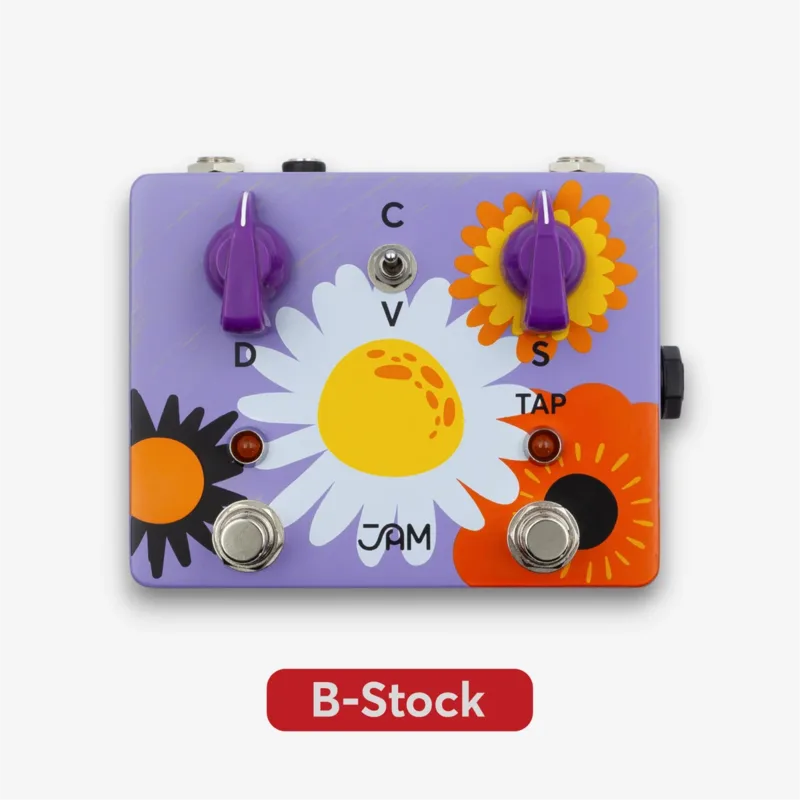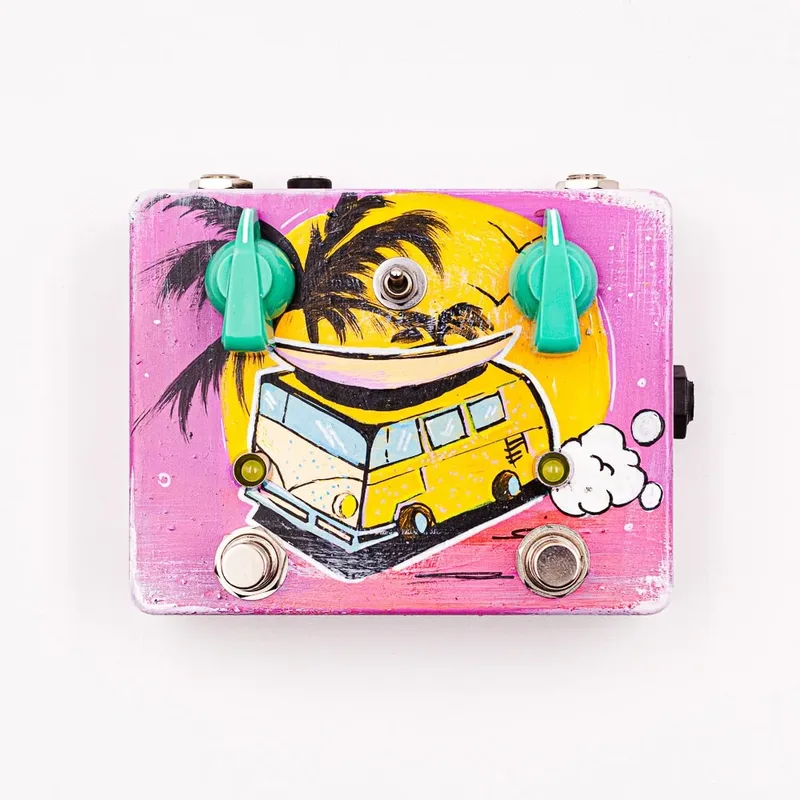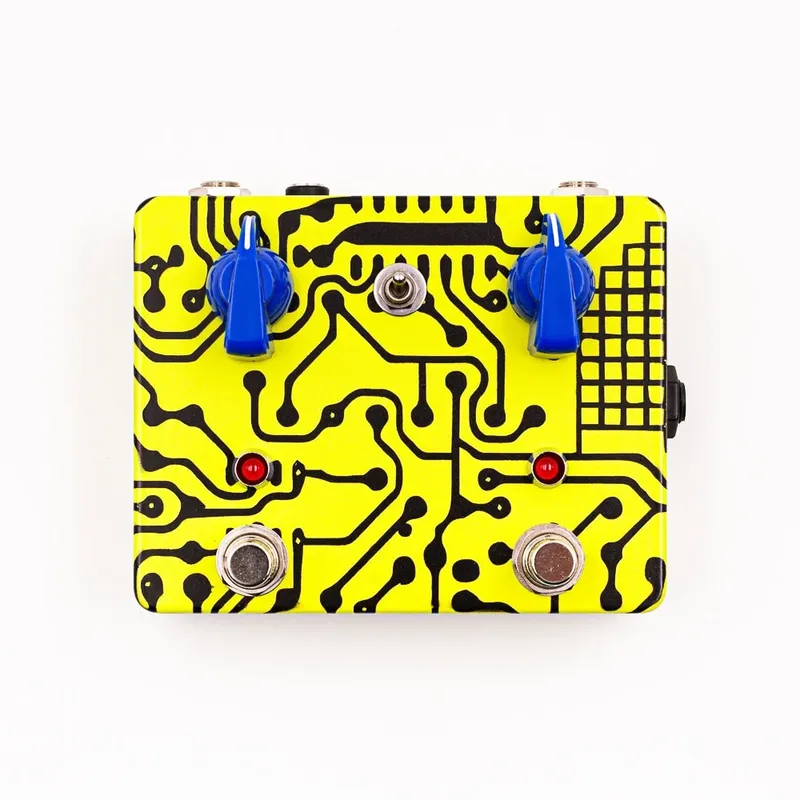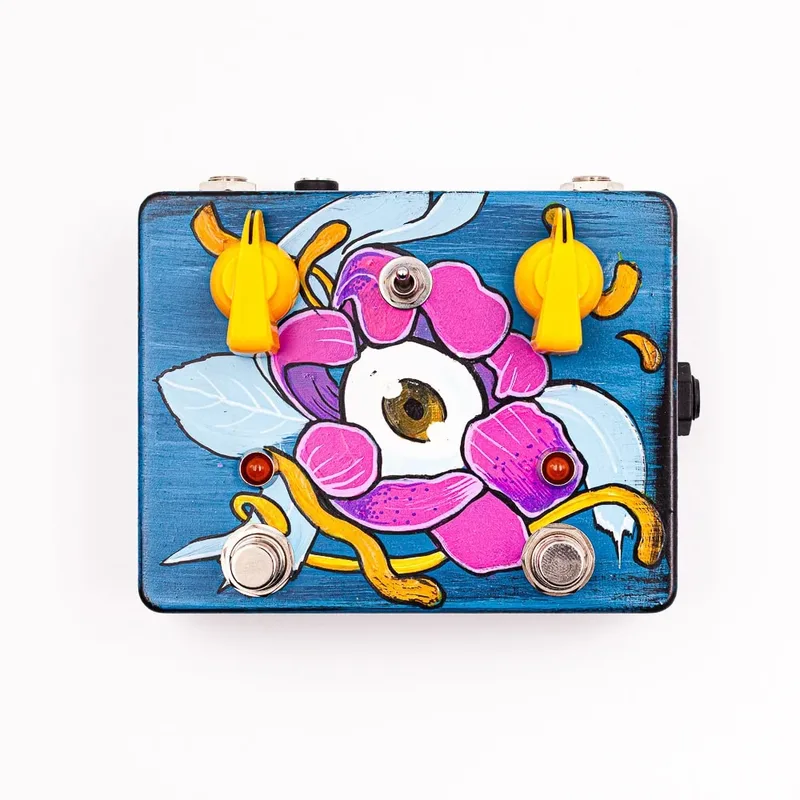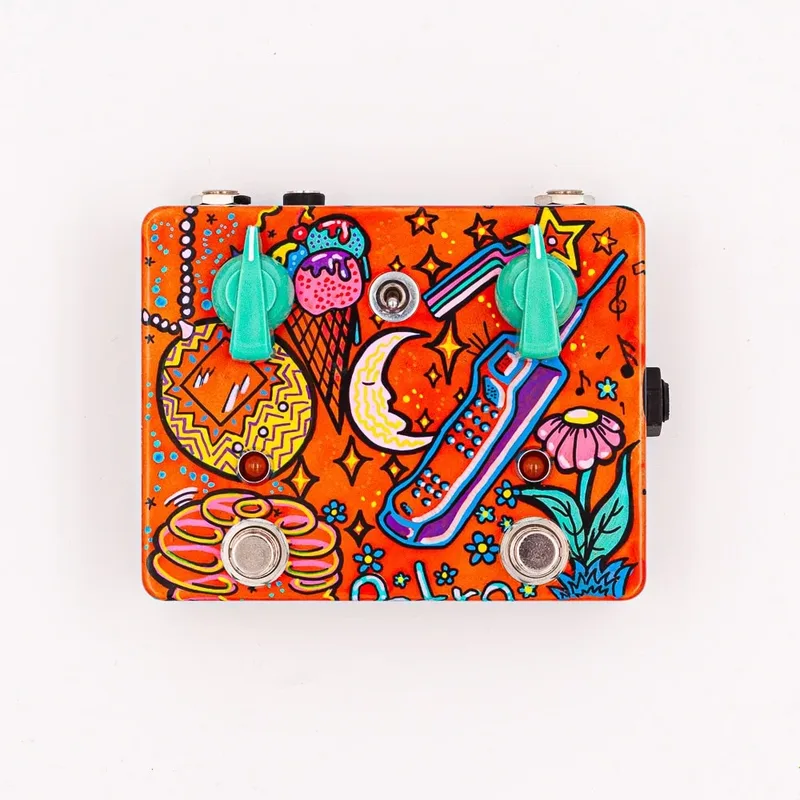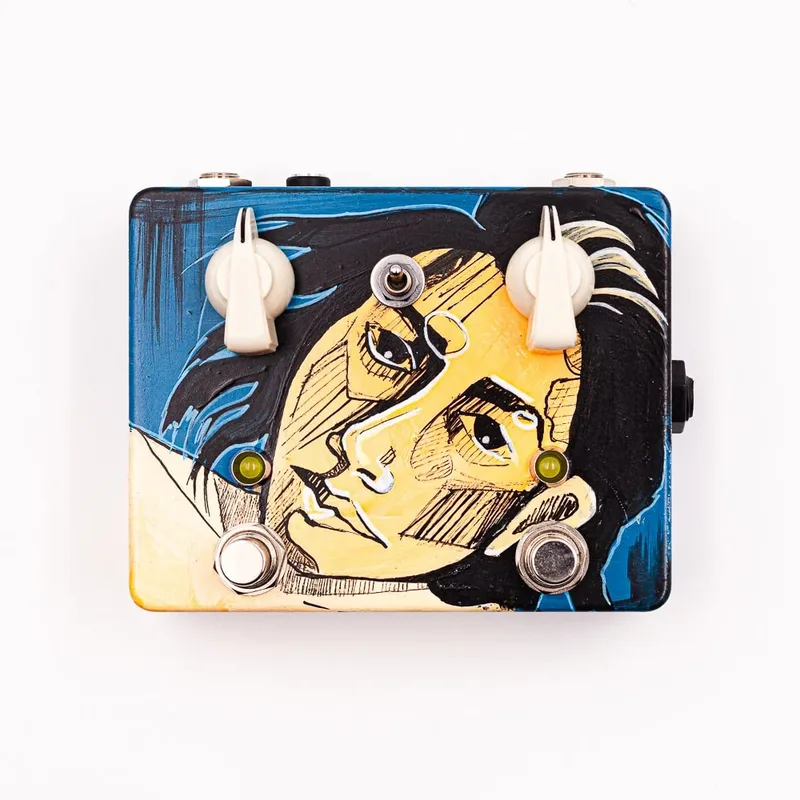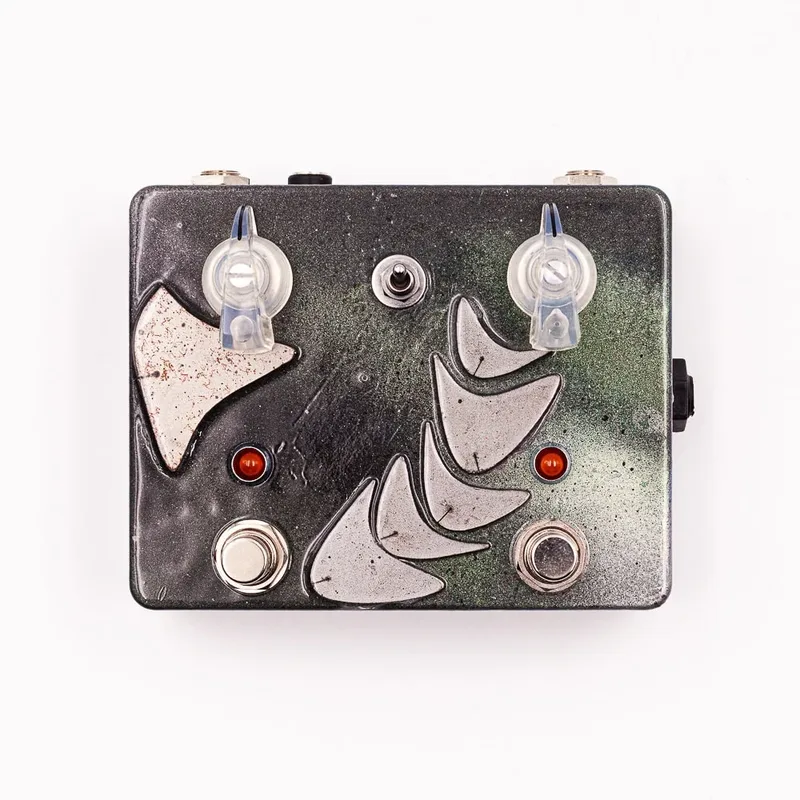


The JAM Pedals "Fishbone" RetroVibe mk.4 is a hand-painted edition of the RetroVibe mk.4, JAM Pedals' all-analog Uni-Vibe-style modulation pedal. It delivers two effects in one box: a toggle selects Chorus, which JAM Pedals describes as "the classic pulsing phase character," or Vibrato, for "pitch-focused movement"1. That two-mode layout follows the original Uni-Vibe recipe, where the chorus setting mixes the modulated signal with the dry signal and the vibrato setting leaves the pitch wobble on its own.
What it does to your sound
The RetroVibe mk.4 sits in the chorus and vibrato family, but its character comes from the Uni-Vibe tradition rather than a modern boutique chorus. In Chorus mode the effect gives the throbbing, phase-like sweep the original Uni-Vibe was known for; flip the toggle to Vibrato and the dry signal drops away, leaving pure pitch modulation. The LFO, the circuit that drives the sweep, runs from 0.5 to 9.5 Hz, which spans slow, swampy swirl up to fast warble1.
The mk.4's headline feature is its second footswitch, labeled TAP/RAMP:
| Control | What it does |
|---|---|
| Toggle | Selects Chorus (pulsing phase character) or Vibrato (pitch-focused movement)1 |
| TAP/RAMP footswitch | Tap to set modulation speed; hold to ramp to a second speed. While holding, Speed sets the destination and Depth sets the travel time2 |
| TRS expression input | Accepts a standard passive 10 kΩ expression pedal for continuous Speed control1 |
| TS input | Accepts an external tap-tempo switch1 |
The ramping function is what sets the mk.4 apart from simpler vibe pedals: hold the footswitch and the effect glides from its current speed to a second speed you have dialed in, with the Depth knob controlling how long the transition takes. Delicious Audio's Paolo De Gregorio summed up the appeal of the tap side of the switch345:
"The addition of a Tap Tempo footswitch (with an external input) brings essential rhythmic precision, allowing you to sync the modulation speed to a song."
Power and connections
The Fishbone RetroVibe mk.4 runs on 9V DC with a center-negative plug, drawing up to 120 mA1. That current draw is on the high side for an analog modulation pedal, so it is worth planning for on a compact power supply: a typical 100 mA isolated output would be short of headroom. The pedal uses true bypass, so it leaves your signal chain untouched when disengaged1.
Connection-wise, the pedal carries three inputs besides the output: the instrument input at 67 kΩ input impedance, the TRS expression jack, and the TS jack for an external tap switch1. Output impedance is under 10 kΩ1.
The expression input is specified for a standard passive 10 kΩ expression pedal1. If you already own an expression pedal, check its pot value before assuming it will work.
The mk.4 and its hand-painted artwork editions
The Fishbone is one of several custom artwork versions of the same mk.4 circuit. JAM Pedals lists the editions as "same sound, different artwork"725, so choosing between them is purely a visual decision:
- "Camper" RetroVibe mk.4
- "Fishbone" RetroVibe mk.4 (this page)
- "Paths" RetroVibe mk.4
- "Pink Eye" RetroVibe mk.4
- "Popped Art" RetroVibe mk.4
- "Skin" RetroVibe mk.4
Every one of these is a one-of-a-kind hand-painted piece, and JAM Pedals notes that the pedal you receive will differ in detail from the photos shown1. Two Fishbone units will not look identical, which is the point of the artwork line: the circuit is standard, the finish is individual.
The RetroVibe itself is part of a broader JAM Pedals modulation family that includes the WaterFall chorus and its artwork and bass variants, such as the WaterFall Bass and the "Bewitched" WaterFall. Where the WaterFall pedals chase a classic chorus, the RetroVibe chases the Uni-Vibe86.
Background and buying details
The Fishbone edition is priced at £459.00, tax included, on JAM Pedals' own store1. The maker ships it DDP with 20% UK VAT and all duties included, so there are no extra charges on delivery, and offers a 30-day money-back guarantee with a no-questions-asked refund1.
Videos
JAM pedals
JAM pedals
Shawn Tubbs
Questions
Does the Fishbone RetroVibe sound different from other mk.4 editions?
No. JAM Pedals lists the Fishbone alongside the Camper, Paths, Pink Eye, Popped Art and Skin editions as custom artwork versions of the same RetroVibe mk.4 circuit, with the same sound and different artwork. The only difference is the hand-painted finish on the enclosure.
Can I use an external tap tempo switch with the RetroVibe mk.4?
Yes. A separate TS input on the pedal accepts an external tap-tempo switch, so you can set the modulation speed from a remote switch on your board while the onboard TAP/RAMP footswitch still handles tapping and speed ramping.
What expression pedal works with the RetroVibe mk.4?
The TRS expression input accepts a standard passive 10 kΩ expression pedal, which gives continuous control over the Speed setting. Active expression pedals, or ones with a different pot value, are outside what JAM Pedals specifies.
Is the RetroVibe mk.4 analog?
Yes. JAM Pedals lists the circuit as all analog. It is a Uni-Vibe-style modulation pedal, and the mk.4 generation adds tap tempo, a ramping function and an expression input over the earlier Mk3.
Sources (8)
- "Fishbone" RetroVibe mk.4, JAM Pedals (jampedals.com)
- "Paths" RetroVibe mk.4, JAM Pedals (jampedals.com)
- "Camper" RetroVibe mk.4, JAM Pedals (jampedals.com)
- "Popped Art" RetroVibe mk.4, JAM Pedals (www.jampedals.com)
- "Pink Eye" RetroVibe mk.4, JAM Pedals (jampedals.com)
- Jam RetroVibe Mk4, Delicious Audio, 2026-02-11
- "Skin" RetroVibe mk.4, JAM Pedals (www.jampedals.com)
- RetroVibe, JAM Pedals (jampedals.com)