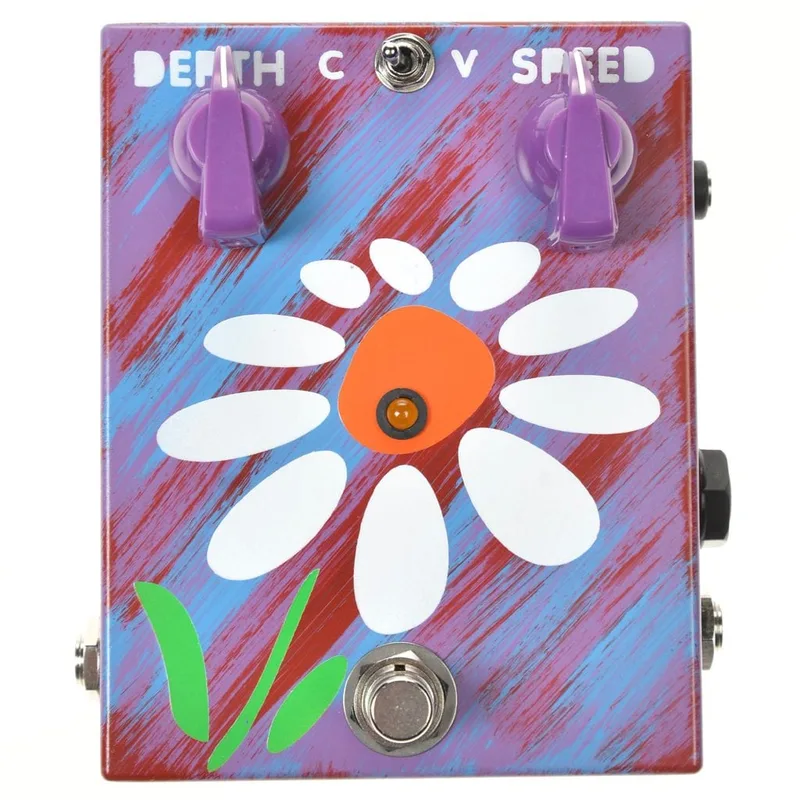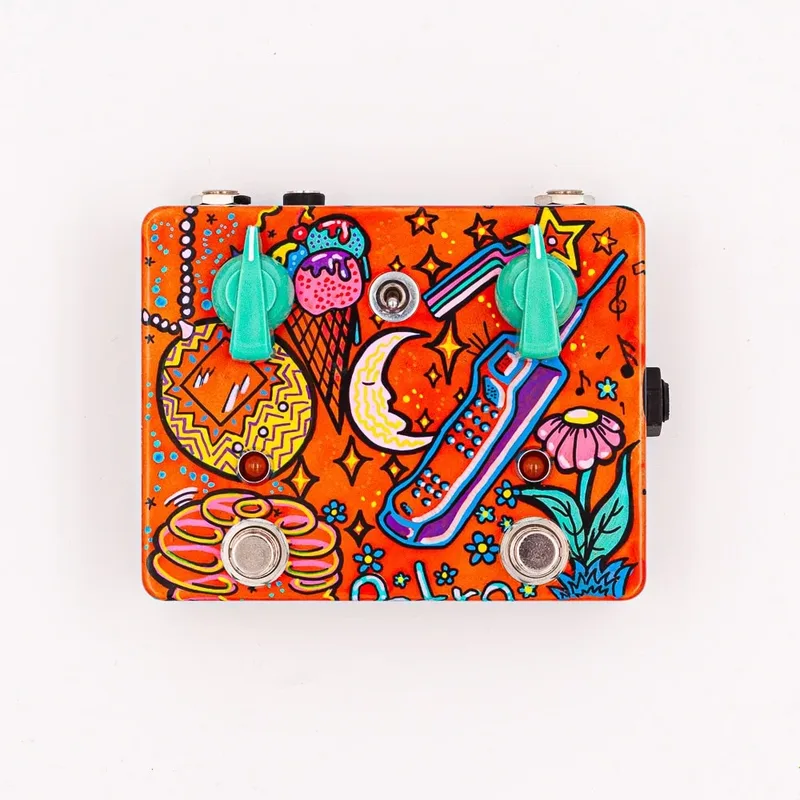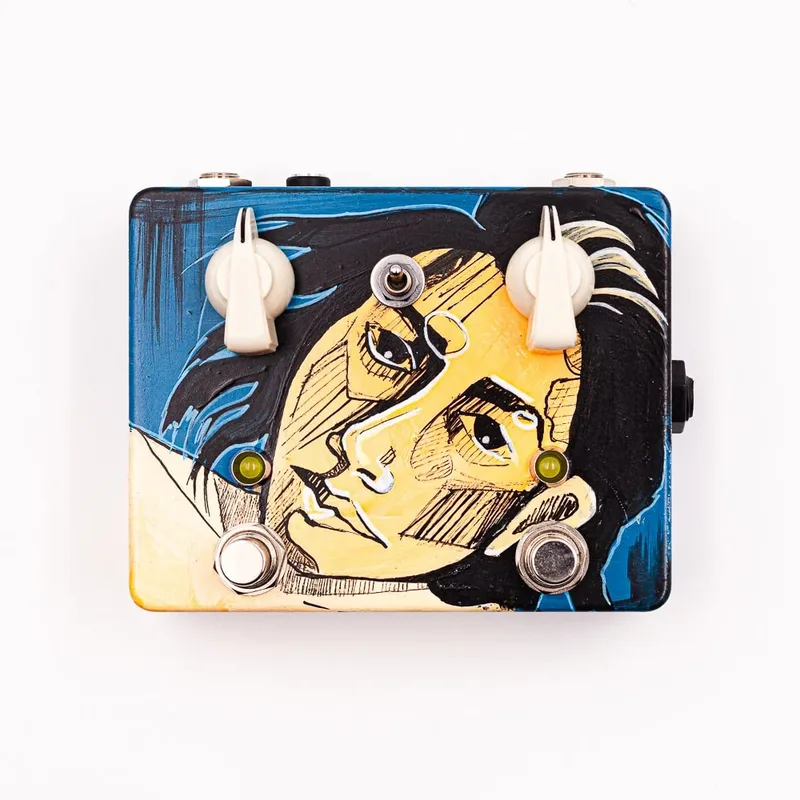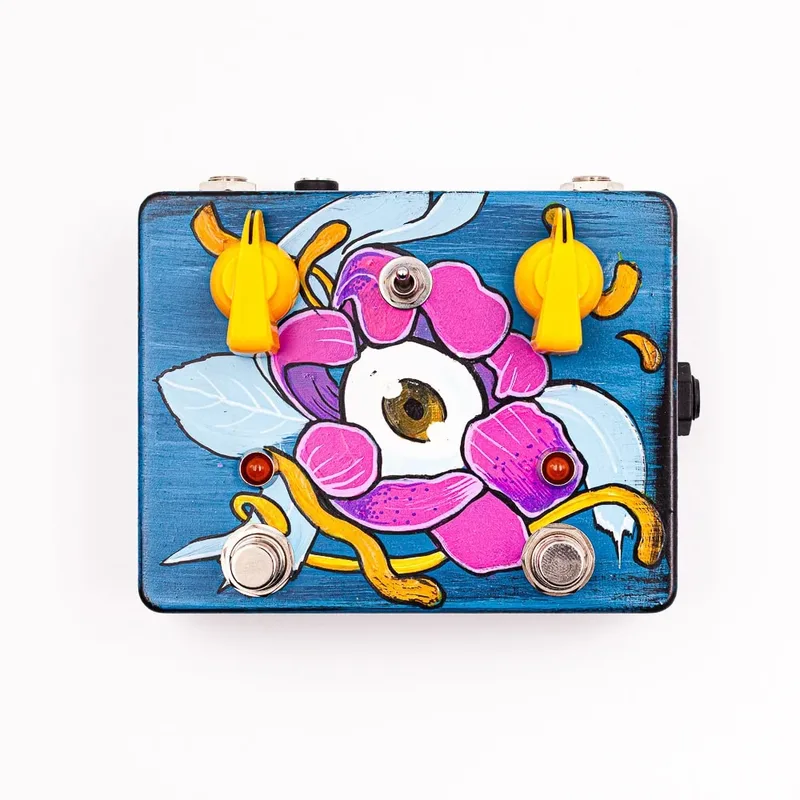


The JAM Pedals "Pink Eye" RetroVibe mk.4 is a hand-painted artwork version of the RetroVibe mk.4, an all-analog Uni-Vibe-style modulation pedal from Greek builder JAM Pedals. It produces two related effects: Chorus, which JAM Pedals describes as "the classic pulsing phase character" of the original Uni-Vibe, and Vibrato, a pitch-focused movement, selected by a toggle on the face of the pedal1. The Pink Eye is a limited artwork pedal, and every one is a one-of-a-kind hand-painted piece, so the pedal you receive will differ in detail from the photos1.
The mk.4 generation is the most expressive version of the RetroVibe so far. JAM Pedals says it "preserves the soul of the original RetroVibe while making it far more expressive in performance"2, and RockBoard's PedalPedia credits it with a wider Depth and Speed span than previous versions, plus new tap tempo and ramping functions3. Delicious Audio covered the Mk4 as a significant update to the line, adding tap tempo, a ramping function and an expression input over the Mk34.
Chorus and Vibrato modes
The RetroVibe mk.4 is built around the Uni-Vibe concept: a modulated filter circuit that sits between a plain chorus and a phaser in character. A single toggle on the pedal chooses between the two modes. In Chorus, JAM Pedals says the pedal gives "the classic pulsing phase character"; in Vibrato, the dry signal is dropped and what you hear is "pitch-focused movement"1. RockBoard's PedalPedia describes the two modes as covering "everything from slow, liquid waves to fast, rotary-like spins"3.
The speed of that movement is set by the pedal's low-frequency oscillator, which runs from 0.5 to 9.5 Hz1. At the bottom of that range the effect is a slow, swelling pulse; near the top it approaches the fast spin of a rotary speaker.
The TAP/RAMP footswitch and expression control
The mk.4's headline feature over earlier RetroVibes is its second footswitch, labeled TAP/RAMP. It works in two ways1:
- Tap it to set the modulation speed, in time with the music.
- Hold it to ramp to a second speed. While holding, the Speed knob sets the destination speed and the Depth knob sets how long the ramp takes to travel there.
That ramping behavior lets a player start a passage at a slow swirl and accelerate into a fast spin, or the reverse, without bending down to turn a knob. A separate TS input on the pedal accepts an external tap-tempo switch, so the tap function can live anywhere on your pedalboard1.
For continuous foot control, a TRS input accepts a standard passive 10 kΩ expression pedal wired for Speed1. Between the expression input, the external tap switch and the ramping hold function, the mk.4 gives a player three hands-free ways to manipulate the modulation while playing, which is what JAM Pedals means by calling it "far more expressive in performance" than the original2.
Power and connections
The RetroVibe mk.4 runs on 9V DC, center-negative, with a maximum current draw of 120 mA1.
At 120 mA maximum draw, this pedal needs more current than a typical analog stompbox and more than a standard 9V battery or a low-current daisy-chain output can supply. Plan for an isolated or adequately rated power supply output.
Signal connections are conventional: instrument in, output to your amp, plus the TRS expression input and the TS tap-tempo input on the side of the enclosure. Input impedance is 67 kΩ and output impedance is under 10 kΩ1. The enclosure measures 12 x 10 x 5 cm (4.7 x 3.9 x 1.9 in) including jacks, controls and footswitches, and weighs 350 g (0.77 lb)1. Bypass is true bypass, so the signal passes unbuffered when the pedal is off1.
The hand-painted artwork versions
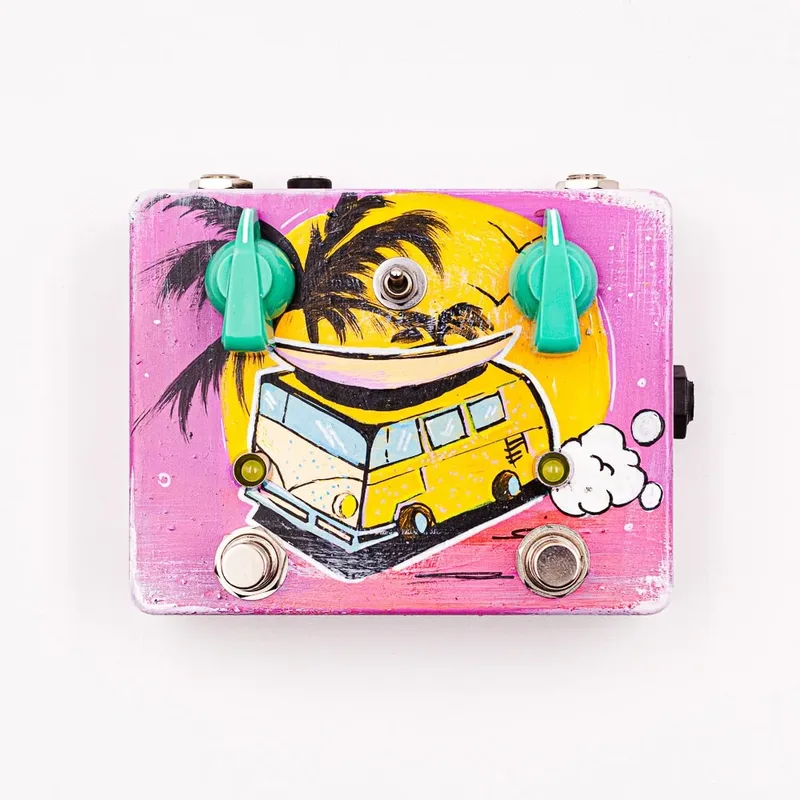
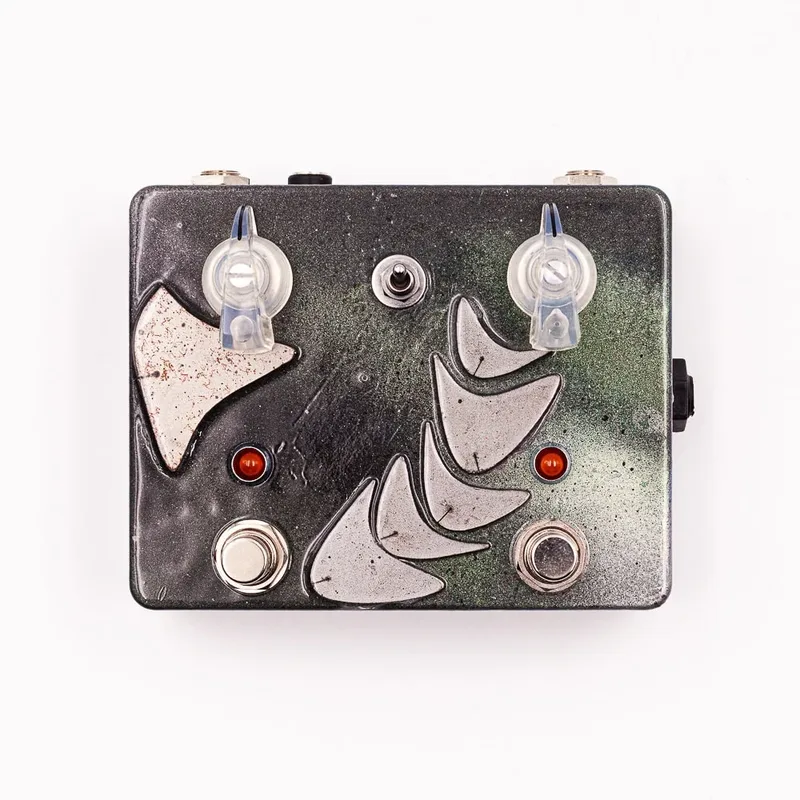
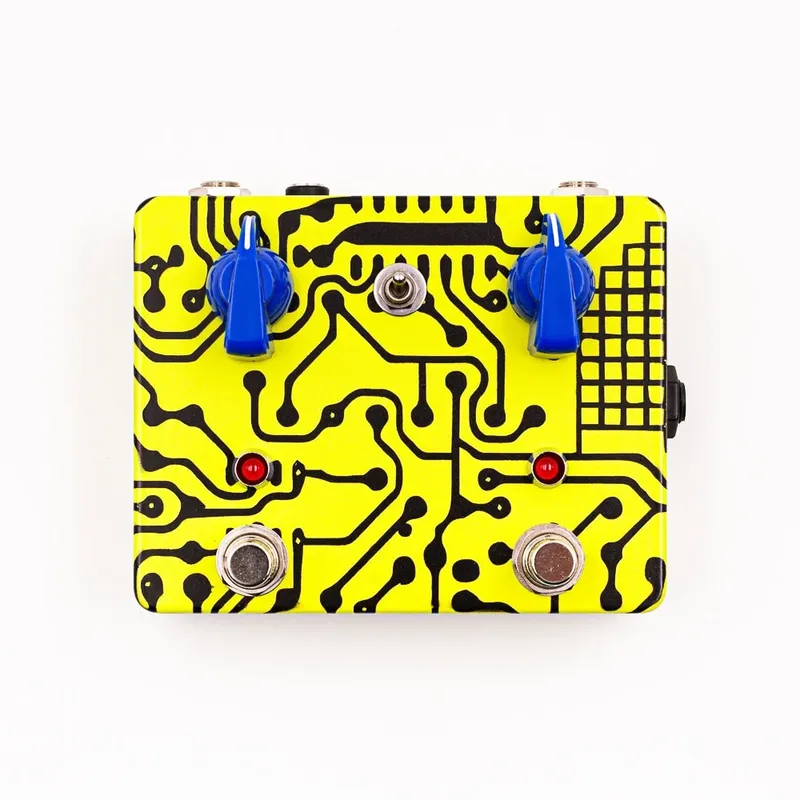
The Pink Eye is one of six custom artwork versions of the same RetroVibe mk.4 circuit. JAM Pedals lists the Camper, Fishbone, Paths, Popped Art and Skin versions alongside it, all with the same sound and different artwork1. The specs are identical across the range: all analog, true bypass, the same 0.5 to 9.5 Hz LFO range and the same expression and tap inputs2.
| Version | Circuit | Sound | Artwork |
|---|---|---|---|
| Pink Eye | All-analog RetroVibe mk.4 | Same as all versions | One-of-a-kind hand-painted1 |
| Camper | All-analog RetroVibe mk.4 | Same | One-of-a-kind hand-painted567 |
| Fishbone | All-analog RetroVibe mk.4 | Same | One-of-a-kind hand-painted567 |
| Paths | All-analog RetroVibe mk.4 | Same | One-of-a-kind hand-painted567 |
| Popped Art | All-analog RetroVibe mk.4 | Same | One-of-a-kind hand-painted5 |
| Skin | All-analog RetroVibe mk.4 | Same | One-of-a-kind hand-painted7 |
Because each is painted by hand, JAM Pedals notes that the pedal you receive will differ in detail from the photos shown895. The choice between them is purely visual: a player who wants the RetroVibe mk.4 sound picks the artwork they like, or waits for a design that suits their board.
The Popped Art version is associated with guitarist Paul Gilbert, who is listed on JAM Pedals' artist page for that artwork7.
Where it came from
The "Pink Eye" RetroVibe mk.4 is the current version of JAM Pedals' RetroVibe, and its published specifications come from the maker: 9V DC center-negative power with a maximum current draw of 120 mA, an input impedance of 67 kΩ, an output impedance under 10 kΩ, and a housing measuring 12 x 10 x 5 cm (4.7 x 3.9 x 1.9 in) including jacks, controls and footswitches, weighing 350 g (0.77 lb)1. The maker lists it at a regular price of £459.00, tax included1.
Videos
JAM pedals
JAM pedals
Tone Factory
Questions
Is the JAM Pedals RetroVibe mk.4 true bypass?
Yes. JAM Pedals lists the RetroVibe mk.4, including the Pink Eye artwork version, as true bypass, so with the pedal switched off your signal passes through without active buffering.
Is the RetroVibe mk.4 analog or digital?
It is all analog. JAM Pedals describes the circuit as all analog, a Uni-Vibe-style modulation design with a low-frequency oscillator running from 0.5 to 9.5 Hz driving the effect.
Can I use an expression pedal with the RetroVibe mk.4?
Yes. A TRS input on the pedal accepts a standard passive 10 kΩ expression pedal for continuous control of the Speed parameter, so you can sweep the modulation rate with your foot while playing.
What is the difference between the Pink Eye and the other RetroVibe mk.4 artwork versions?
The circuit and sound are identical. The Pink Eye, Camper, Fishbone, Paths, Popped Art and Skin versions are all the same RetroVibe mk.4 with different hand-painted artwork, and each is a one-of-a-kind piece that will differ in detail from the photos.
What is the speed range of the RetroVibe mk.4?
The low-frequency oscillator runs from 0.5 to 9.5 Hz, covering slow, liquid waves through to fast, rotary-like spins. RockBoard's PedalPedia notes the mk.4 has a wider Depth and Speed span than previous versions.
What does the TAP/RAMP footswitch do?
Tap it to set the modulation speed in time with your playing. Hold it and the pedal ramps to a second speed: while holding, the Speed knob sets the destination speed and the Depth knob sets the travel time of the ramp.
Sources (9)
- "Pink Eye" RetroVibe mk.4, JAM Pedals (jampedals.com)
- RetroVibe, JAM Pedals (jampedals.com)
- RetroVibe Mk.4 “My Mind’s Room” by Jam Pedals, RockBoard PedalPedia, 2026
- Jam RetroVibe Mk4, Delicious Audio, 2026-02-11
- "Camper" RetroVibe mk.4, JAM Pedals (jampedals.com)
- "Paths" RetroVibe mk.4, JAM Pedals (jampedals.com)
- "Popped Art" RetroVibe mk.4, JAM Pedals (www.jampedals.com)
- "Skin" RetroVibe mk.4, JAM Pedals (www.jampedals.com)
- "Fishbone" RetroVibe mk.4, JAM Pedals (jampedals.com)