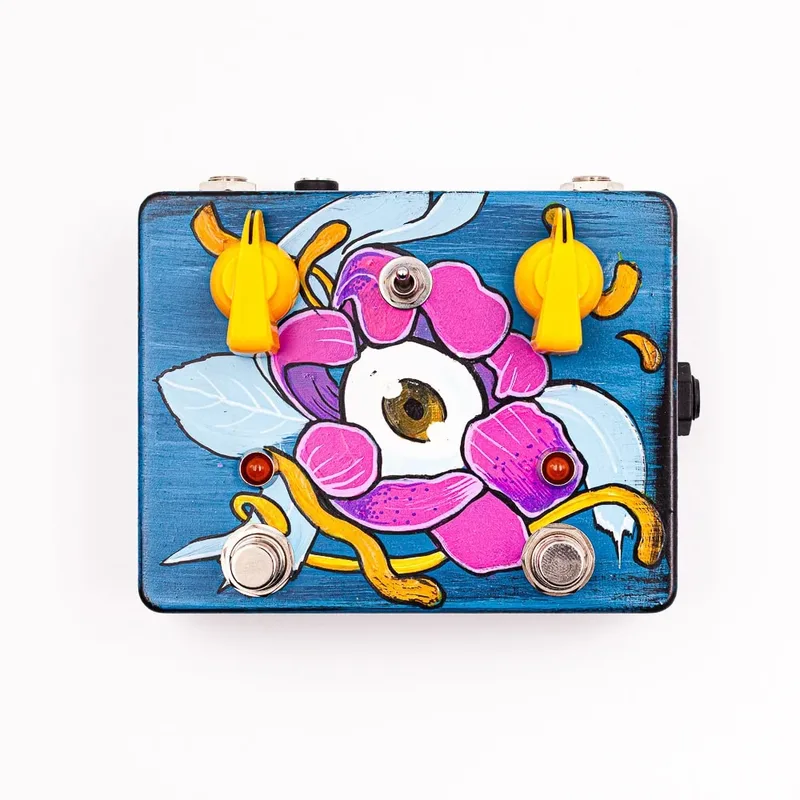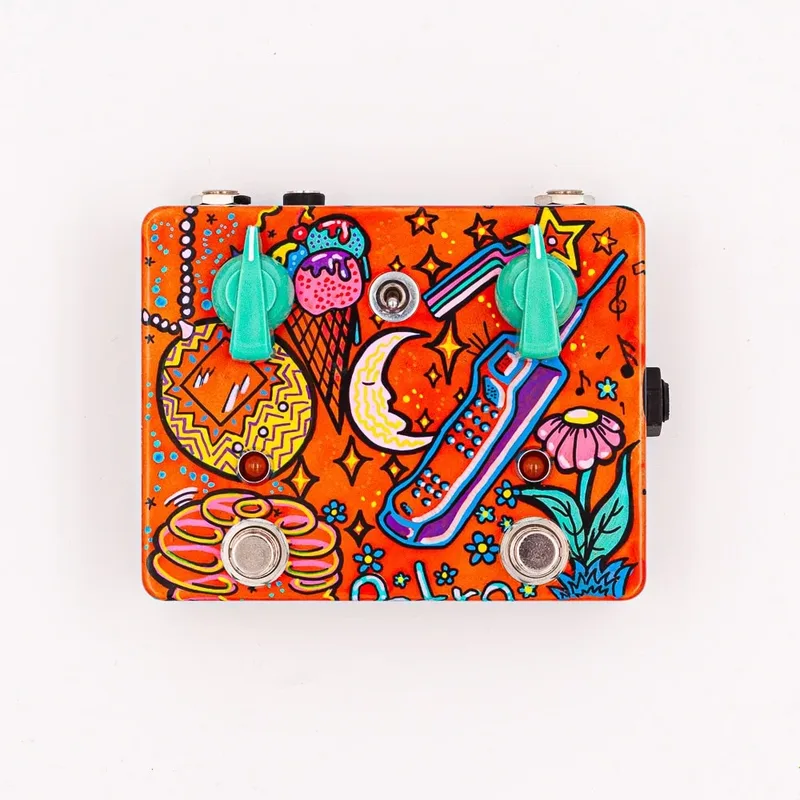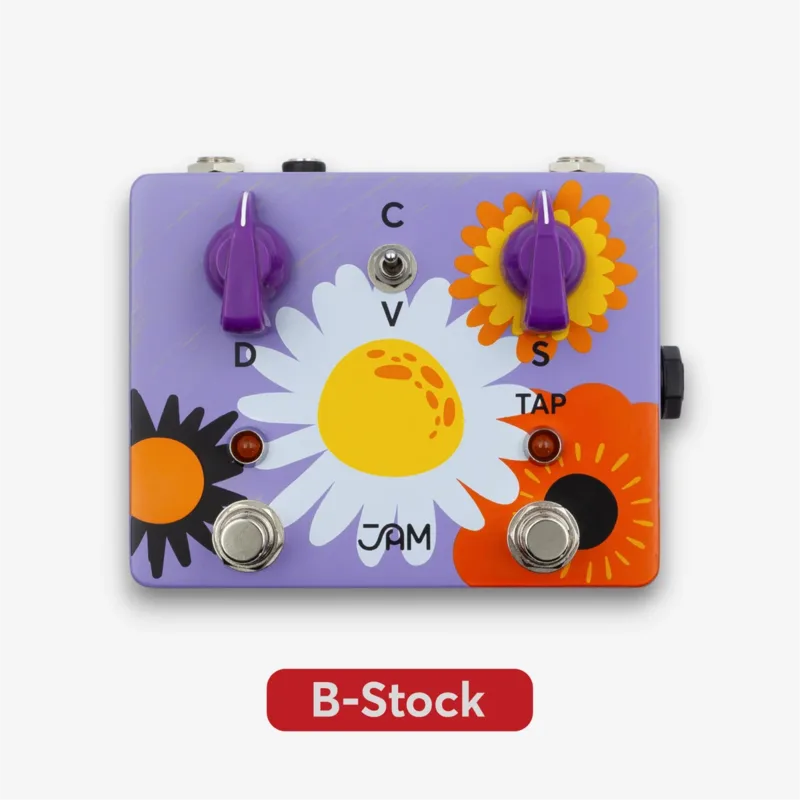
The JAM Pedals Retrovibe B-Stock is the maker's own discounted route into the Retrovibe, a vibe pedal that covers both chorus and vibrato territory in one all-analog box. A toggle selects Chorus, which JAM Pedals describes as "the classic pulsing phase character," or Vibrato for "pitch-focused movement"1. The B-Stock designation means the pedal is brand new with cosmetic blemishes only, sold at a reduced price: the regular price is £329.00 and the sale price £389.00 as listed1.
The Retrovibe B-Stock is an all-analog unit from JAM Pedals, sold at a regular price of £329.00 with a sale price of £389.00 listed1. It runs on 9V DC, center-negative power, with a maximum current draw of 120 mA1.
What B-stock means here
B-stock, in JAM Pedals' own wording, is "Brand new, cosmetic blemishes only"1. The circuit, controls and functionality are those of the regular Retrovibe; the discount reflects the finish, not the build. The maker also notes that "the pedal you receive will differ in detail from the photos shown, making it uniquely yours"1.
A few practical points from the maker's listing:
- The pedal ships DDP, with 20% UK VAT and all duties included, and no extra charges on delivery1.
- Shipping is free1.
- There is a 30-day money-back guarantee, with a refund "no questions asked" if you are not satisfied within 30 days of receiving the product1.
Chorus and Vibrato in one pedal
The Retrovibe is a vibe pedal, a category descended from the rotary-and-photocell designs of the late 1960s, and it splits that character into two modes. The mode toggle selects Chorus, for the classic pulsing phase character, or Vibrato, for pitch-focused movement1. In practice, Chorus mode mixes the modulated signal with your dry sound for a swirling, phased feel, while Vibrato modulates pitch only for a warble without the dry signal.
The modulation engine is all analog, with an LFO range of 0.5 to 9.5 Hz1. That spread covers slow, liquid waves at the bottom of the range through fast, rotary-like spins at the top, the two extremes RockBoard's PedalPedia entry for the RetroVibe Mk.4 points to when describing what the two modes can explore2.
Controls, connections and setup
The control surface centers on Speed and Depth knobs plus the mode toggle, and the mk.4 generation adds a second footswitch that expands what the pedal can do live1.
| Control or jack | What it does |
|---|---|
| Mode toggle | Selects Chorus or Vibrato1 |
| Speed | Sets modulation speed, and the ramp destination while holding TAP/RAMP1 |
| Depth | Sets modulation depth, and travel time while holding TAP/RAMP1 |
| TAP/RAMP footswitch | Tap to set modulation speed; hold to ramp to a second speed1 |
| TS input | Accepts an external tap-tempo switch1 |
| TRS expression input | Accepts a standard passive 10 kΩ expression pedal for continuous Speed control1 |
| Internal trimmer | Sets maximum output level1 |
The ramping function works like this, in order:
- Hold the TAP/RAMP footswitch to ramp to a second speed1.
- While holding, adjust Speed to set where the ramp lands1.
- While holding, adjust Depth to set the travel time of the ramp1.
Release the footswitch and the modulation returns to its base speed. This gives you a two-speed setup reachable with one foot press, without bending down mid-song1.
The power-on state can also be toggled: insert power while holding the ON footswitch, and the pedal changes whether it comes up engaged or in bypass1.
The Retrovibe draws up to 120 mA at 9V DC, center-negative1. That is beyond what a typical 9V battery or a low-current daisy chain output is comfortable supplying, so plan on an isolated or adequately rated supply.
Specifications
| Specification | Value |
|---|---|
| Circuit | All analog1 |
| Bypass | True bypass1 |
| Power | 9V DC, center-negative1 |
| Maximum current draw | 120 mA1 |
| LFO range | 0.5 to 9.5 Hz1 |
| Input impedance | 67 kΩ1 |
| Output impedance | <10 kΩ1 |
| Dimensions | 12 x 10 x 5 cm / 4.7 x 3.9 x 1.9 in1 |
| Weight | 350 g / 0.77 lb1 |
Players and the artwork versions
JAM Pedals lists Paul Gilbert among the guitar players associated with the Retrovibe, linking to his artist page from the product listing1.
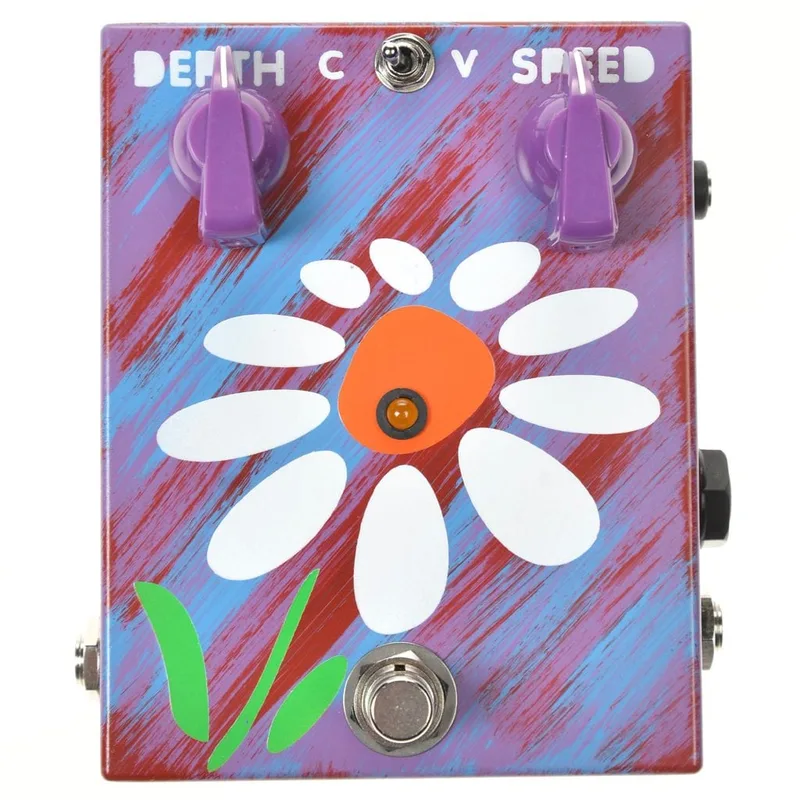
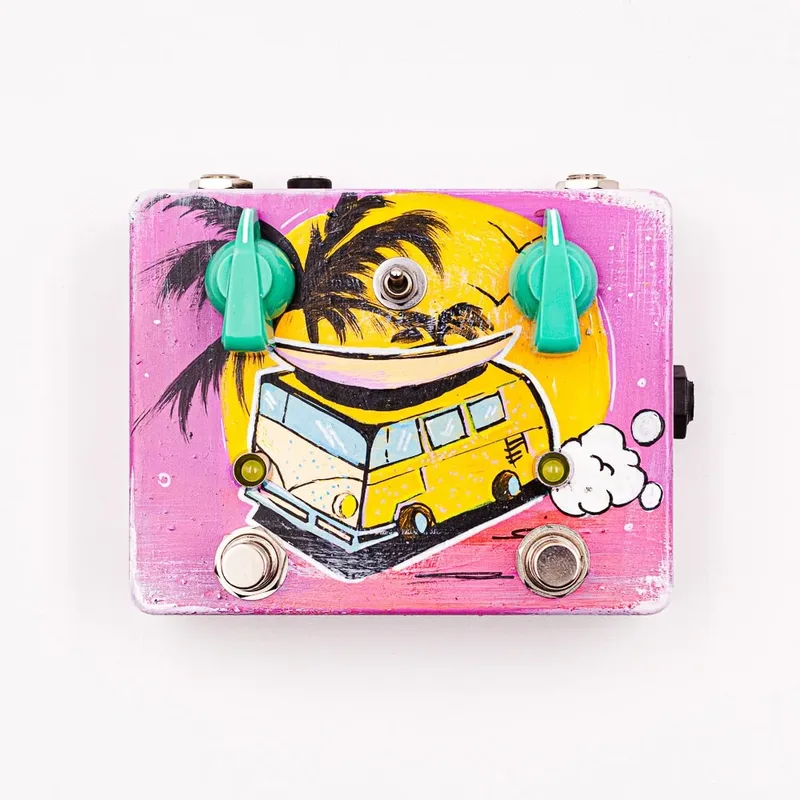
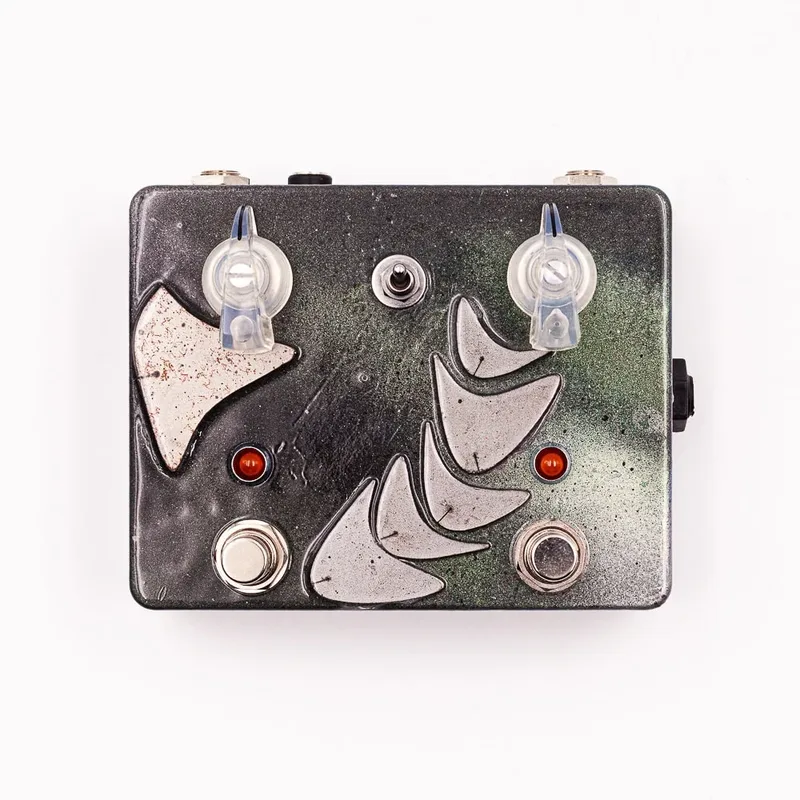
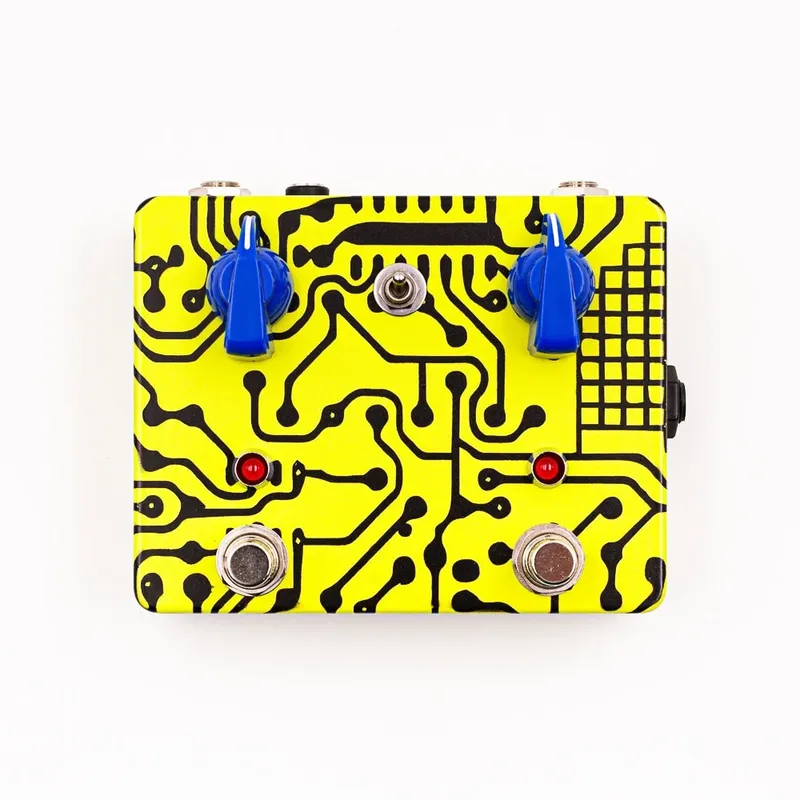
If the B-Stock finish is not for you, the same circuit is available in six custom artwork versions of the RetroVibe mk.4, which JAM Pedals describes as "Same sound, different artwork"1:
- JAM Pedals "Camper" RetroVibe mk.43
- JAM Pedals "Fishbone" RetroVibe mk.44
- JAM Pedals "Paths" RetroVibe mk.45
- JAM Pedals "Pink Eye" RetroVibe mk.46
- JAM Pedals "Popped Art" RetroVibe mk.47
- JAM Pedals "Skin" RetroVibe mk.48
Each of these carries the same Chorus and Vibrato modes selected by toggle457638. Beyond the standard finishes, every limited artwork pedal is a one-of-a-kind hand-painted piece1.
The maker
JAM Pedals is a Greek effects builder. The Retrovibe sits in a catalog that also includes the WaterFall chorus family, such as the JAM Pedals WaterFall and the JAM Pedals WaterFall Bass, alongside overdrive, fuzz and delay pedals.
Questions
What is a B-stock pedal?
A B-stock pedal is brand new and fully functional but carries cosmetic blemishes only, such as small flaws in the finish. JAM Pedals sells the Retrovibe B-Stock at a reduced price for that reason. The pedal you receive will also differ in detail from the photos shown, so each one is unique.
Is the JAM Pedals Retrovibe B-Stock true bypass?
Yes. JAM Pedals lists the Retrovibe B-Stock with true bypass, so with the effect switched off your signal passes through without active buffering.
Does Paul Gilbert use a JAM Pedals Retrovibe?
Yes. JAM Pedals lists Paul Gilbert among the guitar players associated with the Retrovibe, with a link to his artist page on the maker's site.
What does the internal trimmer do on the Retrovibe?
The internal trimmer sets the maximum output level. Adjusting it lets you cap how loud the pedal gets when engaged, useful for matching bypassed volume or limiting a boost into the front of your amp.
Can I add an external tap-tempo switch to the Retrovibe?
Yes. A separate TS input on the pedal accepts an external tap-tempo switch, so you can set the modulation speed with your foot while playing. A TRS input also accepts a standard passive 10 kΩ expression pedal for continuous Speed control.
How do I change the power-on state of the Retrovibe?
The power-on state can be toggled by inserting power while holding the ON footswitch. This sets whether the pedal comes up engaged or in bypass when you first power your board.
Sources (8)
- Retrovibe B-Stock, JAM Pedals (www.jampedals.com)
- RetroVibe Mk.4 “My Mind’s Room” by Jam Pedals, RockBoard PedalPedia, 2026
- "Camper" RetroVibe mk.4, JAM Pedals (jampedals.com)
- "Fishbone" RetroVibe mk.4, JAM Pedals (jampedals.com)
- "Paths" RetroVibe mk.4, JAM Pedals (jampedals.com)
- "Pink Eye" RetroVibe mk.4, JAM Pedals (jampedals.com)
- "Popped Art" RetroVibe mk.4, JAM Pedals (www.jampedals.com)
- "Skin" RetroVibe mk.4, JAM Pedals (www.jampedals.com)