
Paul Gilbert is a guitarist known for his technical playing with Racer X and Mr. Big and a long solo career, and he was voted number 4 on GuitarOne magazine's list of the "Top 10 Greatest Guitar Shredders of All Time"12. For players interested in effects, he is a useful artist to follow because his approach is specific: a clean amp, distortion from pedals, and a small set of signature boxes designed around his own ears, which is a story in itself.
The sound Paul Gilbert is known for
Gilbert's tone is often associated with slightly pushed mid frequency profiles, and Guitar Pedal X noted that it makes sense his signature distortion is tailored around those principles9. His influences run back to fast players: he says he was 11 when he got the first Van Halen album and Frank Marino and Mahogany Rush Live for Christmas, and both those players were fast and really good, so he wanted to do what they did3. He also grew up listening to Alex Lifeson, and he has placed chorus before distortion for over 40 years, following what he believed Lifeson did3.
One of the more unusual threads in his sound story is his hearing. JHS states plainly that "Paul has extreme hearing loss at certain frequencies"10, a result of tinnitus11. That condition shaped the design of his signature pedal, and it explains why a mid-focused distortion ended up being his project rather than a fuzz or a boost.
His earliest sound memory, told in the JHS introduction video, involves a childhood amp that could not keep up: he plugged in a guitar with a high output pickup, like a super distortion, and the amp shut off because it could not handle the power, then faded back in3. That struggling, fading response is what he later wanted recaptured in a pedal: the feeling of an amp sagging because it could not handle the signal3.
Amp distortion or pedals?
Gilbert runs his amp clean and takes distortion from pedals. In an October 2019 session with Martin Miller, he detailed the whole chain:
Gilbert's own answer to the amp-versus-pedals question has shifted toward pedals. For his signature overdrive with JHS Pedals, the PG-14 released in 2020, he drew on two existing JHS circuits he already used, the Superbolt and the Haunting Mids, and the two were combined and tweaked to push the frequencies his hearing loss affects. On That Pedal Show, Josh Scott explained the thinking: "he loved the super bolt and he loved the haunting mids and he has really extreme hearing loss and we combined this and then tweaked them in a way where it pushes those frequencies"8. Guitar World described the PG-14 as an amp-like pedal, and the design speaks to Gilbert's practical view of distortion: rather than relying on a cranked amp, he shapes gain at the pedalboard, in his case around a very specific need, since he has extreme hearing loss at certain frequencies due to tinnitus8.
That Instagram post, answering a fan's question about his amp, is what confirmed a JHS signature overdrive was in the works8. Guitar World had also noted that with his album Behold Electric Guitar out, his pedalboard appeared to be undergoing an overhaul8.
His board has changed over the years. Guitar Pedal X observed that he is not readily connected to specific effects pedals, that like most players he tends to chop and change regularly, and that besides the MojoMojo mainstay an assortment of Catalinbread, JHS, MXR, Supro and Xotic Effects pedals has been seen over the years9. Guitar World published a rig rundown video in December 2017 in which Gilbert, guitarist of Mr. Big, toured his live rig for the band's show at the Budokan in Tokyo, showing his pedals and how exactly he uses them12. A 2008 rig rundown from the Guitar.com archives documents an earlier snapshot of his guitars, amps and pedals13.
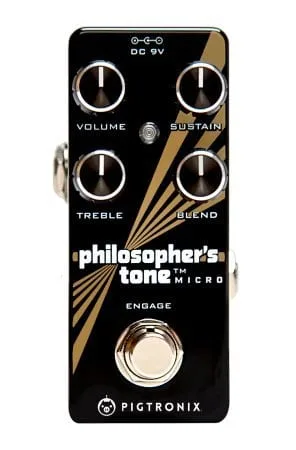
On the compression side, Gilbert has demoed the Pigtronix Philosopher's Tone Micro pedal, explaining how he uses its compression to help him make his "Rock Face"14.
Signature pedals
Gilbert's signature pedals span overdrive, distortion, EQ, flanger and fuzz. Here they are side by side:
| Pedal | Maker | Type | Notes |
|---|---|---|---|
| PG-14 | JHS Pedals | Distortion / FET overdrive | Released January 2020, his main dirt pedal315 |
| Detox EQ | Homebrew Electronics | Underdrive-style EQ | Can turn a distorted sound clean1617 |
| MojoMojo Paul Gilbert Edition | TC Electronic | Signature overdrive | High-gain version of the MojoMojo518 |
| AF2 Airplane Flanger | Ibanez | Flanger | An earlier signature pedal159 |
| Fuzz Universe | Majik Box | Fuzz | Developed for Gilbert from two Majik Box circuits19 |
The JHS PG-14
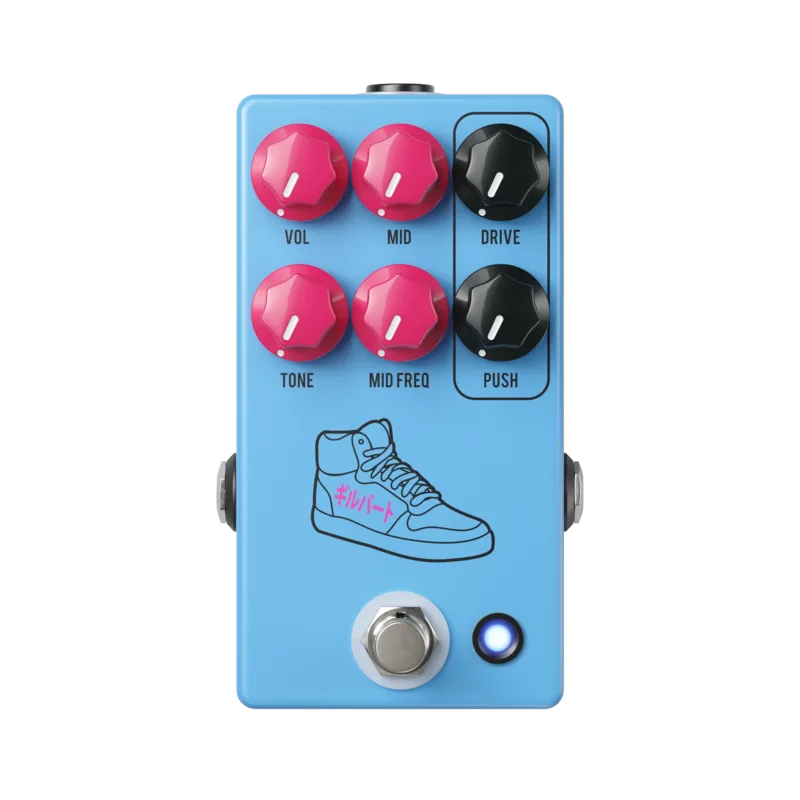
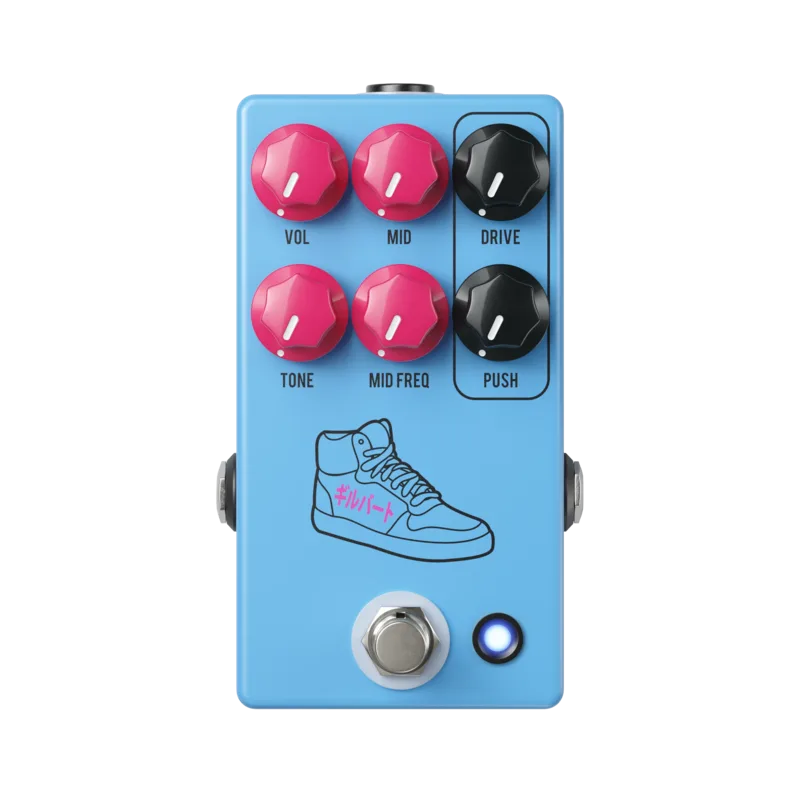
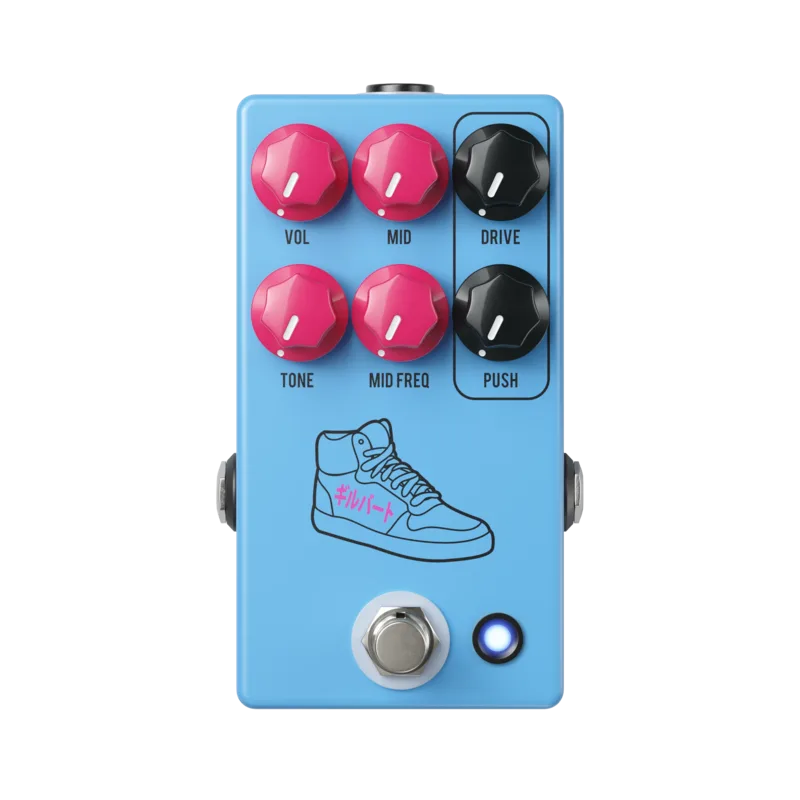
The PG-14, introduced by JHS in January 2020, is a distortion pedal designed to Paul Gilbert's specifications320. Press coverage describes it variously as a distortion pedal, a tube-like FET overdrive, and a distortion and overdrive pedal that adds a dirt channel to your amplifier41521. The name is simple: PG-14 stands for Paul Gilbert 14, his shoe size, which is why a shoe icon appears on the pedal22.
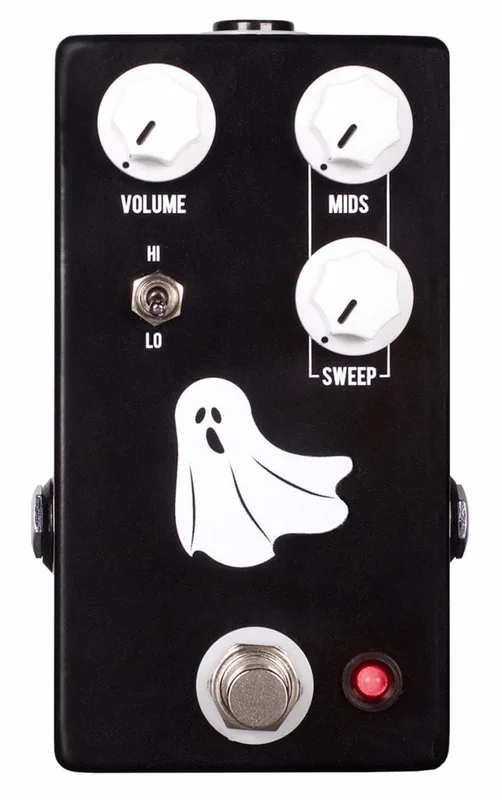
The circuit has a specific origin. Josh Scott of JHS explains that Gilbert has extreme hearing loss in certain frequencies, and that when they discussed doing a signature circuit, Gilbert had always searched for versatility and a push in certain frequencies related to his hearing. The pedal was derived from two existing JHS circuits, the SuperBolt and the Haunting Mids: the volume, tone and drive controls come from the SuperBolt side, with the Haunting Mids, a mid-range tone manipulator that is one of Gilbert's favorite stomps, folded in1123. Scott says Gilbert sent his actual hearing chart, and they used real frequency curves to shape the pedal22. Gilbert's response to hearing the result was that it was like having a therapy dog for his ears22.
What he likes about how it behaves is the sag. Scott says Gilbert loves the pedal because as you start pushing it, the FETs in the drive section give up and sag like a tube amp, and Gilbert describes wanting that suffering-amp quality made dialable so it sounds good in a real rock and roll situation11. Gilbert's own verdict on its range: "It has more variety of how it sounds and how it feels than any distortion pedal I've ever played through"4. Scott calls it "the ultimate dirt channel box for a clean amp"4.
Published reviews were positive. GuitarPlayer's Art Thompson wrote that "Paul Gilbert's signature overdrive pedal is compact, powerful and a blast to play, and earns an Editor's Pick award"24. Pedal of the Day described it as a unique distortion and overdrive pedal designed specifically to Paul's specs2118.
A demo worth watching, in which Scott walks through the circuit and Gilbert joins by phone:
In that video Scott says that of all the JHS pedals he has released, the PG-14 does so many things that no single demo could show it all, and that while it can sound just like Paul Gilbert, it does a whole lot more11.
The TC Electronic MojoMojo and the Paul Gilbert Edition
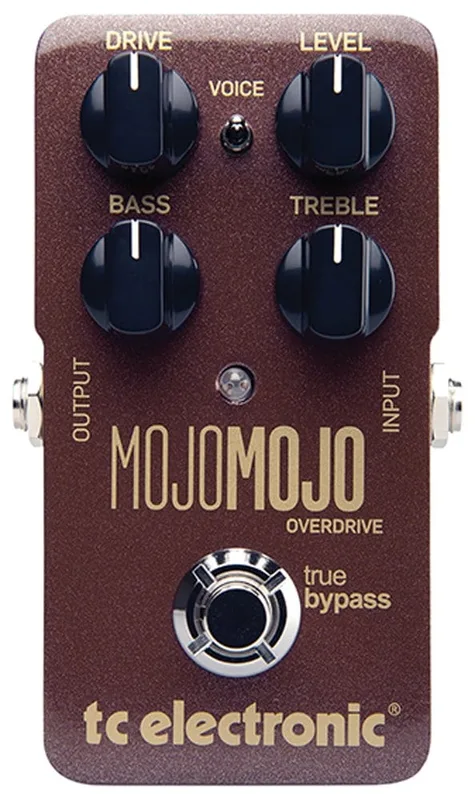
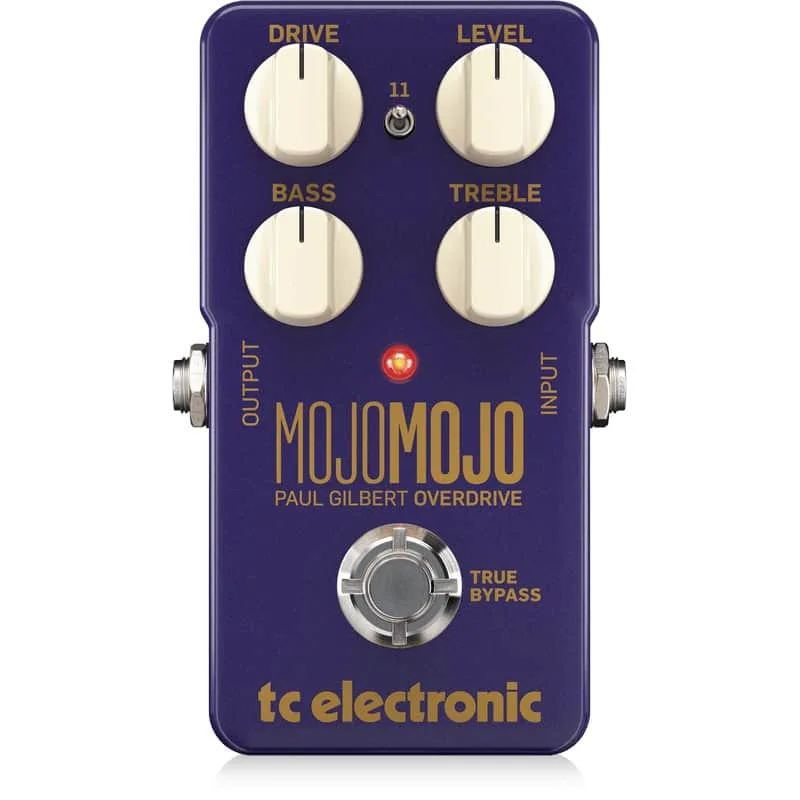
Gilbert's connection to the MojoMojo runs long: he has been a long-time user of the pedal, though he always used the same voice setting on the original5. TC Electronic and Gilbert later put their heads together on a high-gain signature version of the MojoMojo overdrive, the MojoMojo Paul Gilbert Edition5.
He uses it with the same settings always, and he still uses it even in conjunction with the PG-14183. Gearnews noted in 2020 that he had one on his pedalboard to this day6, and Josh Scott called it a pedal Gilbert uses extensively to get his drive tones25.
That association led to a signature edition. TC Electronic asked Gilbert to work on a special edition of the pedal bearing his name1, and the result, the MojoMojo Paul Gilbert Overdrive, is a high-gain signature version designed to reproduce the same tone Gilbert uses on his own personal MojoMojo518. Because Paul always uses the same settings on his MojoMojo, there was no need for the Voice switch found on the original version; it was swapped for a new Eleven toggle1826. Pedal of the Day reviewed the edition in August 2024, noting it is built on the MojoMojo circuit with the 11 switch replacing the Voice switch and a stepped-up circuit board voltage27.
The HomeBrew Detox EQ
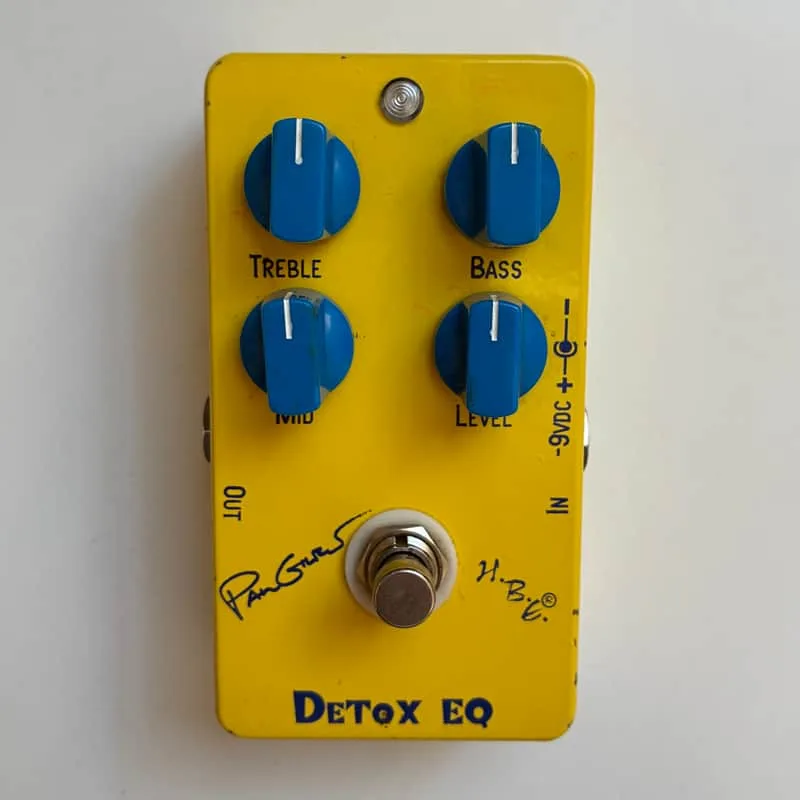
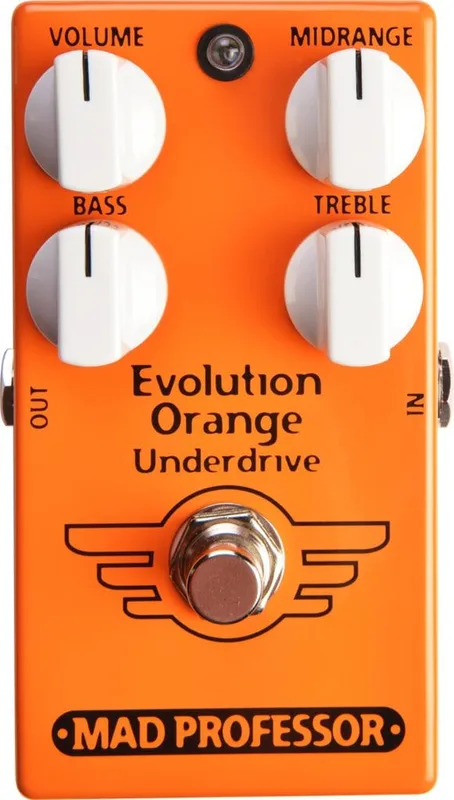
The Detox EQ, from US firm Homebrew Electronics, is a Paul Gilbert signature pedal with a party piece: it can turn a distorted rock sound into a clean sound17. MusicRadar, reviewing it alongside the Mad Professor Evolution Orange Underdrive, describes it as an underdrive-style pedal doing a similar job16. Where a normal drive pedal pushes an amp harder, an underdrive-style box pulls the input back so a dirty amp cleans up, which suits a player like Gilbert who builds his sound from pedals in front of a clean amp. Guitar World listed the Detox EQ among his earlier collaborations, alongside the Ibanez Airplane Flanger8.
Other signature pedals
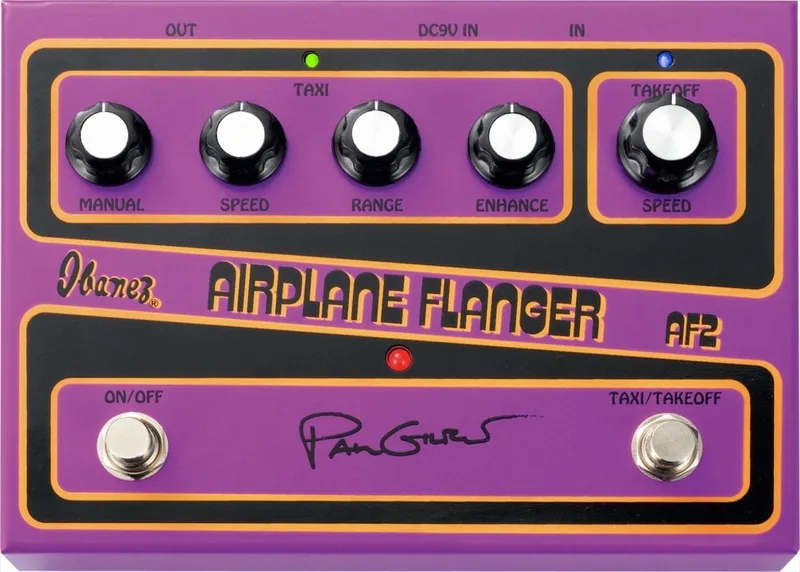
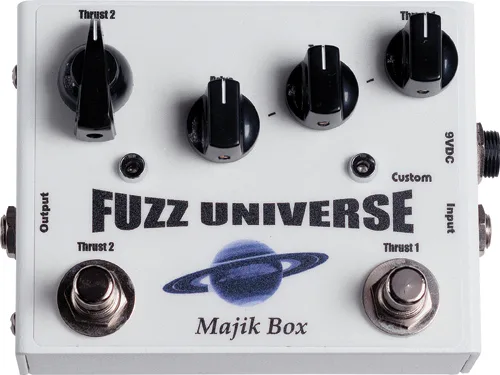
Before the PG-14, Gilbert had a signature flanger with Ibanez, the AF2 Airplane Flanger159. On the fuzz side, the Majik Box Paul Gilbert Fuzz Universe was developed for Gilbert by combining the Majik Box Body Blow, set to Paul's favorite settings (Modern voicing and a bassier low-cut, plus a custom tone control sweep), with the Majik Box Venom Boost19.
Modulation on the board: the JAM RetroVibe
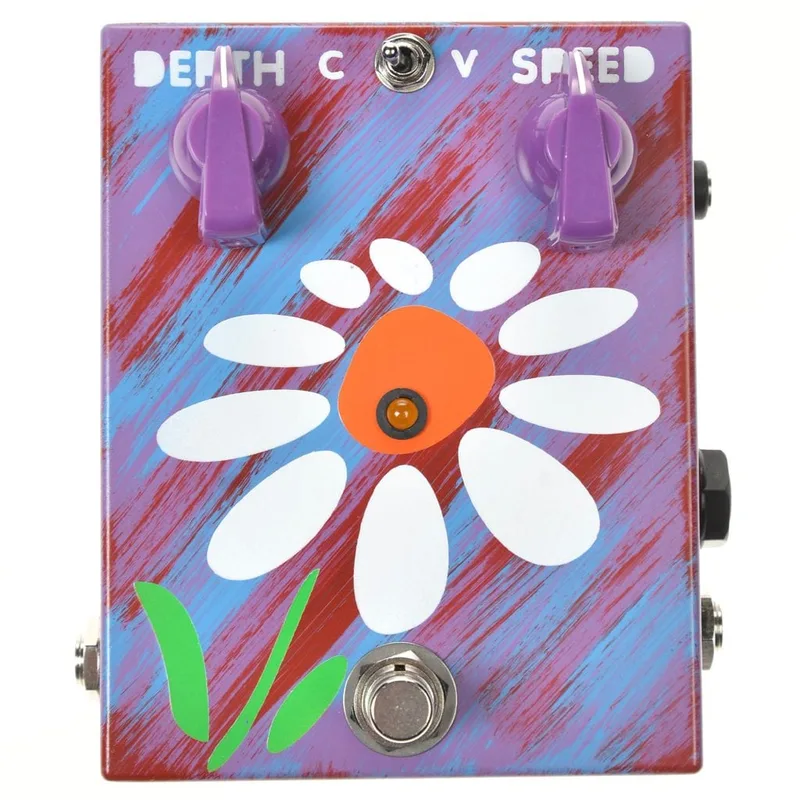
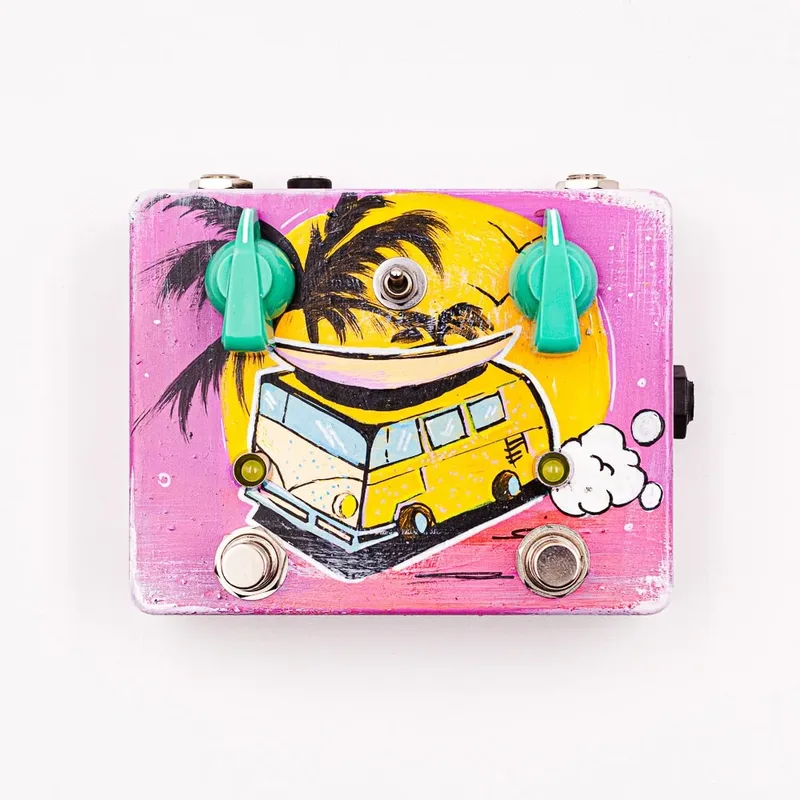
Gilbert's modulation pedal is the JAM Pedals RetroVibe, and JAM Pedals says it is proud that the RetroVibe has found a home on his pedalboard, with Gilbert part of the JAM pedals family2. The RetroVibe is JAM's version of the classic Univibe circuit, and on That Pedal Show the makers explained that the original goal was to achieve the sound of a vintage Univibe, after which they took it a few steps further, using photocells as the pulsating life source of its unique and recognizable stage phasing sound, along with 2SC828 transistors and carbon comp resistors7.
Gilbert's endorsement, quoted by JAM Pedals, covers the practical details a working player cares about:
"The RetroVibe gets all the details right. Great Hendrix/Trower style tones, simple intuitive controls, 9 volt power, good footswitch clearance (so my big foot doesn't bump the knobs), and awesome paint job!"
The RetroVibe mk.4 is listed with Gilbert among its players, and the hand-painted mk.4 editions include "Paths", "Popped Art", "Camper" and "Fishbone", plus a B-stock listing293031323334. For players chasing that part of his board, the RetroVibe sits in the vibrato and phaser family of sounds, and Gilbert's own history with the effect goes back further: he says he has always had chorus after distortion, though he also still runs one before it, a habit traced to Alex Lifeson3.
Guitars and the rest of the rig
Gilbert is an Ibanez endorsee8. On the Werewolves Of Portland album sessions he used a variety of his signature Ibanez Fireman models and vintage Ibanez electrics including the Artist, Roadstar II and Ghostrider5. He also brought and modified a '60s Epiphone Olympic, a guitar he used to play in the early days of Racer X5. In the JHS video he plays his signature FRM300, which has magnets installed to hold metal slides11. Guitar World also flagged Yamaha's tiny THR5 desktop amp as his other secret weapon8.
Taken together, the picture is consistent: a clean amp, a mid-focused FET distortion built around his own hearing, a long-trusted overdrive, and a Univibe-style pedal for modulation, with the rest of the board changing as his projects do.
News
Questions
What distortion pedal does Paul Gilbert use?
His main distortion pedal is the JHS PG-14, his signature pedal with JHS Pedals, released in January 2020. It grew out of two JHS circuits, the SuperBolt and the Haunting Mids, combined and tweaked to push the frequencies Gilbert wanted. He also runs the TC Electronic MojoMojo overdrive, a staple of his board for years, alongside it.
Does Paul Gilbert use amp distortion or pedals?
Pedals, into a clean amp. In an October 2019 session he described running a Marshall 1959HW head clean on its second channel and taking his distortion from three pedals in order: a JHS Bonsai on sometimes, a JHS prototype signature pedal on most of the time, and an Xotic Effects AC Booster on all the time.
What is the HomeBrew Detox EQ?
It is a Paul Gilbert signature pedal from US firm Homebrew Electronics, described by MusicRadar as an underdrive-style pedal. Its party piece is that it can turn a distorted rock sound into a clean sound, the opposite job of most drive pedals, by cutting the input level rather than adding gain.
What vibe pedal does Paul Gilbert use?
He uses the JAM Pedals RetroVibe, JAM's version of the classic Univibe circuit. Gilbert praises its Hendrix and Trower style tones, its simple intuitive controls, its 9 volt power, the footswitch clearance that keeps his big foot from bumping the knobs, and the paint job on the hand-painted editions.
Why did Paul Gilbert make an EQ pedal?
The PG-14 came out of Gilbert's hearing. He has extreme hearing loss at certain frequencies, and JHS founder Josh Scott says Gilbert sent his actual hearing chart, and the pedal's mid section was built around real frequency curves to push the frequencies he was missing. Gilbert called it a therapy dog for his ears.
Sources (34)
- TC Electronic MojoMojo Paul Gilbert Edition, Delicious Audio, 2021-06-28
- Paul Gilbert, JAM Pedals (www.jampedals.com)
- Introducing the JHS Pedals PG-14... Paul Gilbert Artist Signature Pedal, JHS Pedals (YouTube), 2020-01-10
- NAMM 2020: The JHS Effects PG-14 Paul Gilbert signature distortion is here, MusicRadar, 2020-01-11
- TC Electronic unveils Paul Gilbert signature edition of the MojoMojo overdrive on the day Gilbert's new album Werewolves Of Portland is released, MusicRadar, 2021-06-04
- 8 more cheap pedals every guitarist needs to try, www.gearnews.com, 2020-09-12
- TPS Pick'N'Mix, That Pedal Show (YouTube), 2017-10-09
- Paul Gilbert is working with JHS Pedals on an incredible-sounding signature overdrive, Guitar World, 2019-10-14
- Guitar Pedal X, Guitar Pedal X, 2020-01-11
- OUR MOST VERSATILE DISTORTION: PG-14, JHS Pedals
- Our Most Versatile Distortion: Paul Gilbert PG-14, JHS Pedals (YouTube), 2022-10-14
- Paul Gilbert Shows Off His Live Rig, Guitar World, 2017-12-15
- Rig Diagram: Paul Gilbert (2008), Guitar.com, 2020-09-01
- Watch Paul Gilbert Demo Pigtronix Philosopher's Tone Micro Pedal, Guitar World, 2016-06-22
- TC Electronic Paul Gilbert MojoMojo, gearnews.com, 2021-06-03
- Mad Professor Evolution Orange Underdrive review, MusicRadar, 2015-11-22
- Homebrew Electronics Detox EQ review, MusicRadar, 2014-07-12
- TC Electronic announces Paul Gilbert signature MojoMojo overdrive pedal, Guitar World, 2021-06-04
- Majik Box Paul Gilbert Fuzz Universe Pedal Review, Premier Guitar, 2010-12-16
- PG-14 - JHS Pedals, JHS Pedals
- JHS Pedals PG-14 Paul Gilbert Signature Distortion, Pedal of the Day, 2020-08-27
- The PG-14 has a lot of heart 💙💗 @paulgilbert_official, JHS Pedals (YouTube), 2023-07-19
- JHS PG-14 Review, Premier Guitar, 2020-06-22
- JHS Pedals PG-14 Review, GuitarPlayer (www.guitarplayer.com), 2020-04-23
- NAMM 2020: JHS Paul Gilbert PG-14 tube-like FET overdrive pedal, gearnews.com, 2020-01-11
- TC Electronic Unveils New Paul Gilbert Signature MojoMojo Overdrive Pedal, GuitarPlayer, 2021-06-04
- TC Electronic MojoMojo Overdrive (Paul Gilbert Edition), Pedal of the Day (www.pedal-of-the-day.com), 2024-08-29
- JAM pedals, JAM pedals
- RetroVibe, JAM Pedals (jampedals.com)
- "Paths" RetroVibe mk.4, JAM Pedals (jampedals.com)
- "Popped Art" RetroVibe mk.4, JAM Pedals (jampedals.com)
- "Camper" RetroVibe mk.4, JAM Pedals (jampedals.com)
- "Fishbone" RetroVibe mk.4, JAM Pedals (jampedals.com)
- Retrovibe B-Stock, JAM Pedals (jampedals.com)