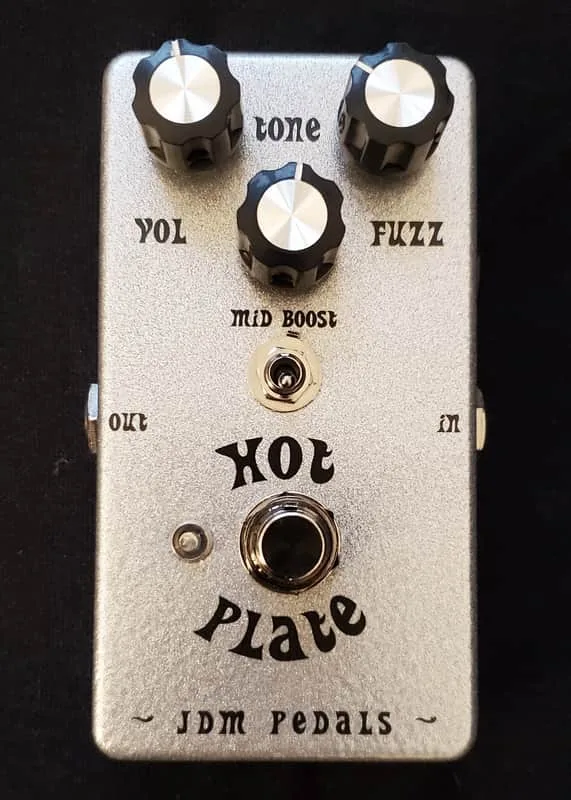


The JDM Pedals Hot Plate Fuzz is a fuzz pedal built on the Tonebender Mk3 circuit, one of the classic 1960s fuzz designs. The maker describes it as "a modern take on the Tonebender Mk3 with a few extras", and it was new for December 20201. It uses vintage PNP germanium transistors, the transistor type of the original era, and adds an onboard analog voltage inverter so it can share a standard 9V supply with the rest of a board1.
What it does to your sound
The headline modification is a passive mid-bump switch, which the maker calls the main change to the original circuit. Engaged, it thickens the tone and allows it to cut through a dense mix1. With the mid boost in, JDM Pedals describes the result as "a thick lead guitar sound with extremely long sustain that fits beautifully into the mix"1.
The designer's own account of the pedal's origin explains where that came from:
"It sounded great at rehearsals and always fit in the mix when recording. The 'Aha!' moment came when we spliced in a passive mid bump circuit."
Controls
| Control | What it does |
|---|---|
| Tone knob | Ranges from "truly skanky early 60's buzzfuzz to Led Zep thickness", with the mid control taking that to what the maker calls "a subtly cool other place"1 |
| Mid-bump switch | Passive mid boost that thickens the tone and helps it cut through a dense mix1 |
Power and daisy chaining
PNP germanium fuzzes traditionally run on positive ground, which normally keeps them off a shared pedalboard supply. The Hot Plate Fuzz solves that with an onboard analog voltage inverter, so it can be daisy chained with pedals running on +9V DC1. Battery power is also possible1.
The voltage inverter is what makes standard daisy chaining work. Without it, a PNP germanium fuzz usually needs its own power output on a shared supply.
How it compares
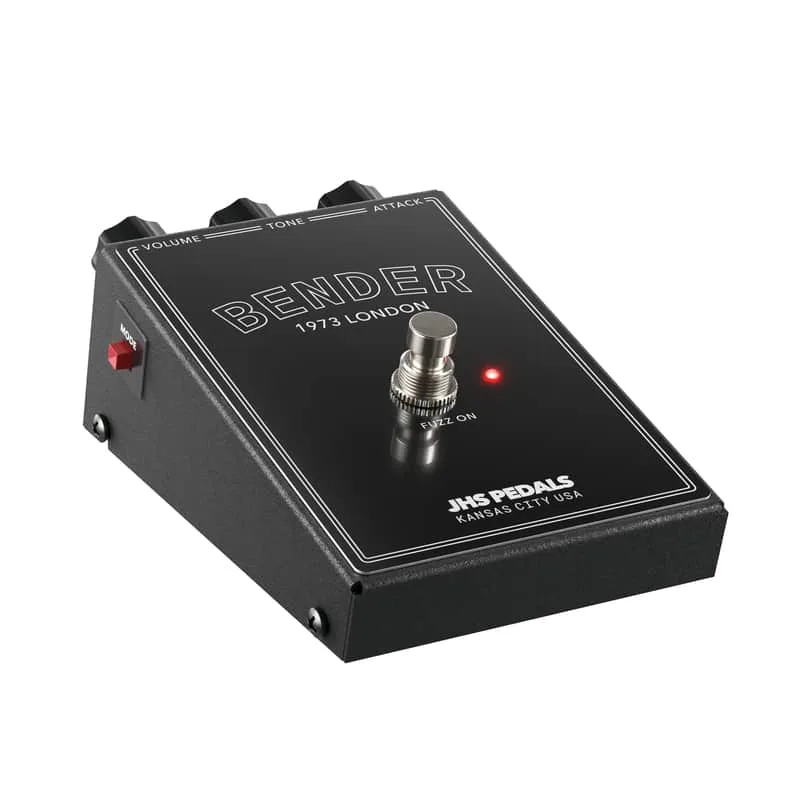
As a Tonebender Mk3 design, the Hot Plate sits in the same family as other MK3-style silicon and germanium fuzzes, such as the JHS Bender 1973 London, which Neural DSP modeled as the MK3 Silicon Fuzz2. What sets the Hot Plate apart, in the maker's description, is the passive mid-bump switch and the voltage inverter, two practical additions to the original formula1.
Videos
gearmanndude
Fret Junkies
gearmanndude
Questions
Does the JDM Hot Plate Fuzz run on a battery?
Yes. Alongside standard 9V DC power, battery power is possible, as the maker notes on the product page. Because the pedal uses vintage PNP germanium transistors, it also carries an onboard analog voltage inverter, which lets it share a standard negative-center 9V supply with your other pedals rather than needing its own isolated output.
Can the Hot Plate Fuzz be daisy chained with a 9V power supply?
Yes. JDM Pedals added an onboard analog voltage inverter specifically so the fuzz can be daisy chained with other pedals running on +9V DC. That addresses the usual problem with positive-ground germanium fuzzes, which normally need their own power output on a shared supply.
What does the mid-bump switch do on the Hot Plate Fuzz?
The main modification to the original Tonebender Mk3 circuit is a passive mid-bump switch. Engaged, it thickens the tone and allows it to cut through a dense mix. The maker describes the result with the mid boost as a thick lead guitar sound with extremely long sustain that fits into the mix.
What transistors are inside the Hot Plate Fuzz?
The Hot Plate Fuzz features vintage PNP germanium transistors, according to the maker's product page. Germanium is the transistor type used in the original 1960s Tonebender fuzzes, and it is part of why the pedal includes a voltage inverter for standard 9V daisy chaining.
Is the Hot Plate Fuzz a Tone Bender MK3 clone?
It is based on the Tonebender Mk3 circuit, but the maker describes it as a modern take with a few extras rather than a straight copy. The main mod is a passive mid-bump switch, and it also adds an onboard voltage inverter for daisy chaining. The tone knob still covers the classic range, from early 60s buzzfuzz to thicker lead tones.
Sources (2)
- JDM Pedals Hot Plate Fuzz, Delicious Audio, 2021-05-18
- Quad Cortex Development Update #37, Neural DSP, 2023-06-07