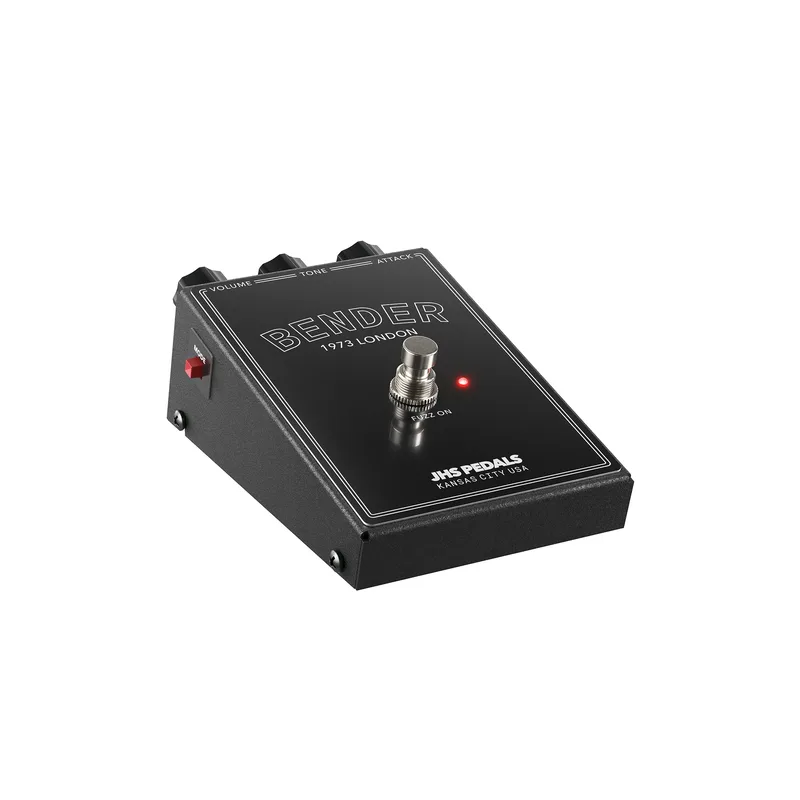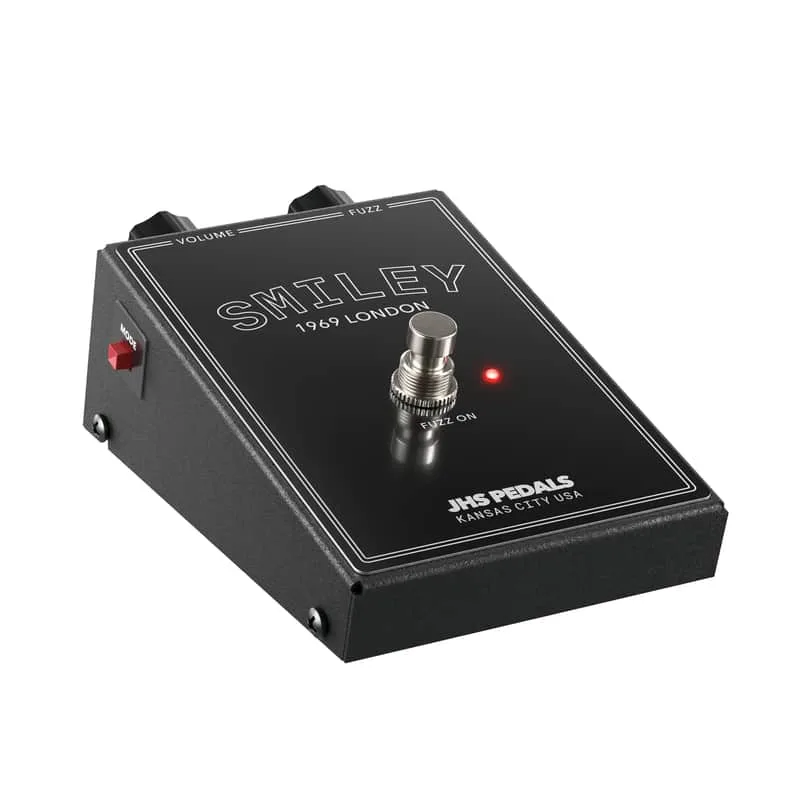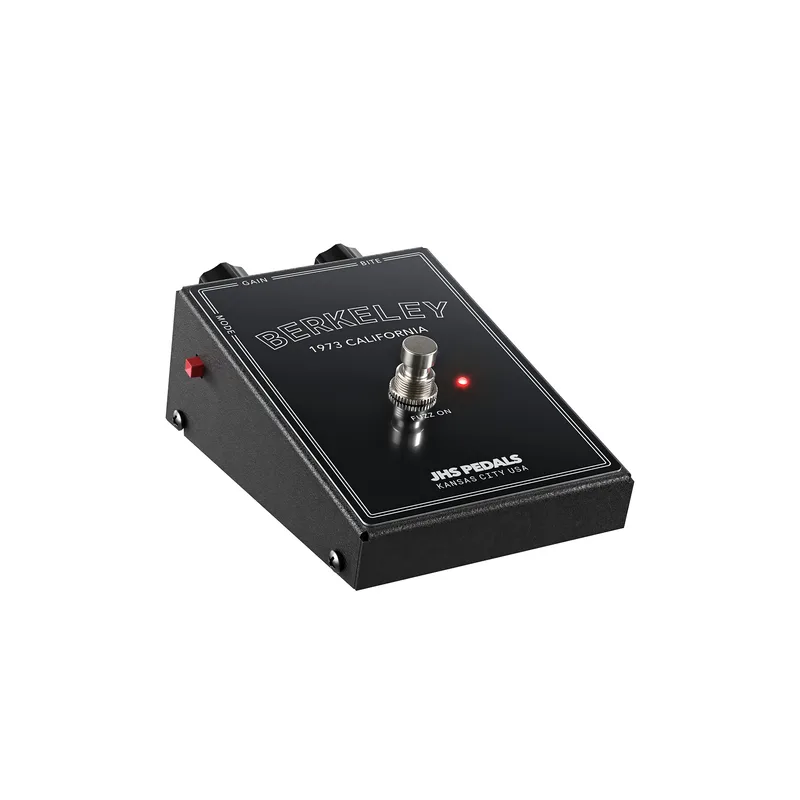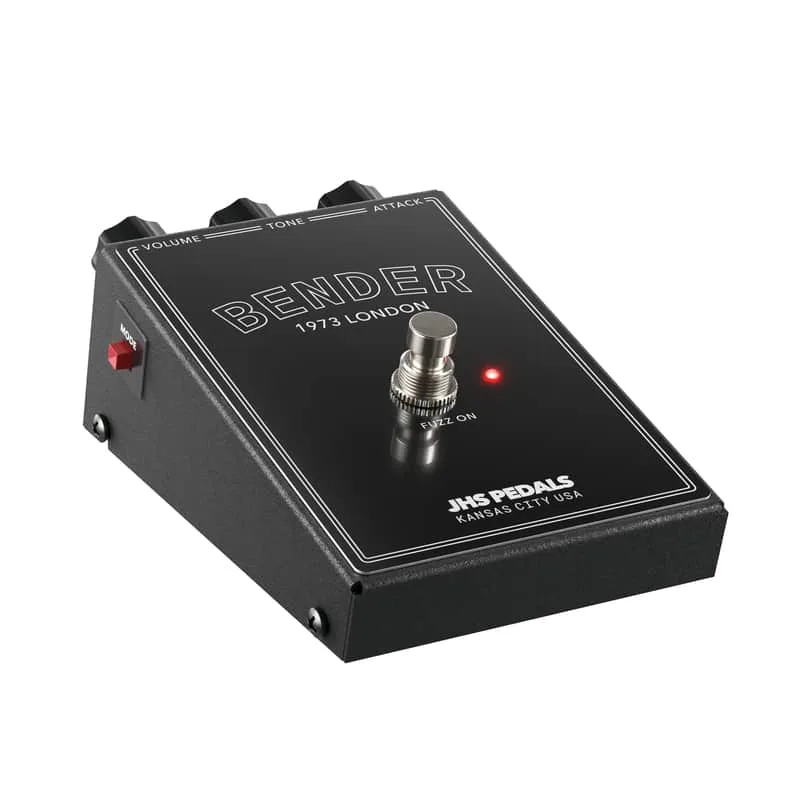


The JHS Legends of Fuzz Bender is a fuzz pedal from JHS Pedals, part of Josh Scott's tribute series to "some iconic but hard to find fuzz tones"1. It takes its circuit from what Scott calls the most prized Tone-Bender in his collection, a silver-and-orange 1973 Sola Sound Tone-Bender Mk3, rebuilt on a modern PCB with silicon transistors2. It sells for $179 street2.
GuitarPlayer's reviewer Dave Hunter described the result as "a thick, meaty, aggressive vintage-toned fuzz" that "cleans up surprisingly well from a guitar's volume controls"2.
The controls: Attack, Tone, Volume and the JHS mode
The pedal keeps the three-knob layout of the original Tone-Bender, with a fourth function on a side switch2.
| Control | What it does |
|---|---|
| Attack | Fuzz level2 |
| Tone | Dials between a cutting, bright voicing and a warm, mellow one2 |
| Volume | Output level2 |
| Red side push-button | Engages JHS mode: added gain and a midfrequency boost2 |
The attack control covers a wide range. Guitar.com, which named the pedal among its best affordable effects of 2021, found it "powerful but manageable with the 'attack' control maxed out, and every bit as likeable at minimum"1. The tone control was singled out by Hunter as useful in its own right, moving between a bright, cutting voicing and a warmer, mellower one2.
The red JHS mode is the one departure from the vintage circuit. Hunter listed the "bonus gain mode" as a plus in his review2. On That Pedal Show's fuzz comparison, Dan and Mick also checked whether the pedal cleans up when rolling back the guitar's volume control, a behavior the review confirmed23.
History: the 1973 Sola Sound Tone-Bender Mk3
The Bender's ancestor is the Tone-Bender line from Sola Sound, a British maker. The original Tone Bender fuzz box dates to 1965 and is now given the "MKI" designation4. Those early Tone Benders used a three-transistor fuzz circuit based on Gibson's 1962 Maestro Fuzz-Tone5, and JHS's own buying guide calls it "the first really great three transistor fuzz," a modified version of the Fuzz-Tone6.
By the time of the Mk3 that the Legends of Fuzz Bender copies, the circuit had moved on from those roots. Delicious Audio's history of the Tone-Bender notes that "building on the foundation of the American-made 1962 Maestro Fuzz Tone, Gary expanded what fuzz could do"72. Original 1973 units like the silver-and-orange Mk3 in Scott's collection are prized and hard to find, which is the gap the Legends of Fuzz series fills21.
JHS's modern version makes some practical changes to the original: silicon transistors in place of the vintage parts, true-bypass switching, an LED indicator, and a nine-volt DC converter input alongside the internal battery clip2.
What reviewers said
Dave Hunter's GuitarPlayer review, which covered the Bender alongside the Legends of Fuzz Smiley, was positive overall. On the pedal's character:
"the pedal yields a blend of razory bite and slightly raspy edge that gives cutting power to this fuzz's thick, snarling core tonality, all of which combines to embody a familiar classic-rock sound of the early to mid '70s"2
Dave Hunter, GuitarPlayer2
He also found it "works equally well with the Strat and Les Paul," and that the volume-knob cleanup allows "a textured enhancement" beyond full-on fuzz2. His verdict summary listed the bonus gain mode as a plus2.
Guitar.com's 2021 affordable-pedals feature echoed the view, calling it powerful but manageable at maximum attack and "every bit as likeable at minimum"1. That Pedal Show compared the Legends of Fuzz pedals against its hosts' current favorite fuzzes in a full episode on the "four pillars of fuzz"3.
Videos
DiSanto Sound
Buddy Blues
Fede Kajganić
Questions
Is the JHS Legends of Fuzz Bender true bypass?
Yes. The pedal uses true-bypass switching, along with an LED indicator and a nine-volt DC converter input. When it is switched off, the signal passes through without the circuit in the way.
Does the Bender use silicon or germanium transistors?
It uses silicon transistors. JHS rebuilt the original Tone-Bender Mk3 circuit on a modern PCB with silicon transistors rather than the germanium parts the 1970s originals used, which makes for a more consistent and available pedal.
What does the red JHS mode switch do?
A red push-button switch on the side of the pedal engages a JHS mode that adds gain and a midfrequency boost. It gives the pedal a hotter, more forward voicing than the stock Mk3-style circuit.
Can the Legends of Fuzz Bender run on a battery?
Yes. Alongside the nine-volt DC converter input there is an internal nine-volt battery clip, so the pedal can run on a standard nine-volt battery for old-school power.
Where is the JHS Legends of Fuzz Bender made?
It is assembled in the USA by JHS Pedals, the Kansas City area effects maker run by Josh Scott.
Sources (7)
- Gear Of The Year: Best Affordable Effects Pedal of 2021, Guitar.com, 2021-12-10
- JHS Legends of Fuzz Bender and Smiley Fuzz Pedals Review, GuitarPlayer (www.guitarplayer.com), 2021-03-22
- The Four Pillars Of Fuzz Guitar Tones JHS Legends vs Our Current Faves, That Pedal Show, 2020-06-05
- Tone Bender 'MKI' players list • Fuzzboxes, fuzzboxes.org, 2026-02-22
- Gary Hurst Tone Bender 'MKI' • Fuzzboxes, fuzzboxes.org, 2021-05-20
- HOW TO FIND THE FUZZ YOU NEED, JHS Pedals
- JHS Pedals Bender Fuzz, Delicious Audio, 2020-10-12