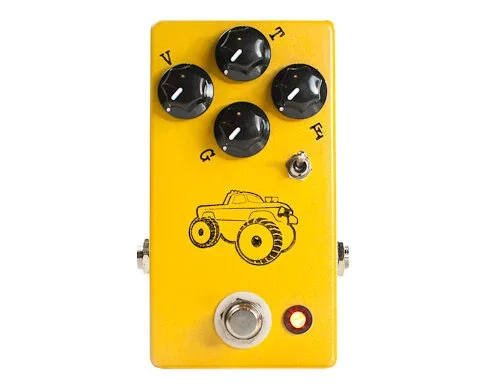


The JHS 4 Wheeler is a bass fuzz pedal from JHS Pedals, built to cover a wide spread of fuzz territory for bass players. JHS describes the V2 as giving "the ability to do everything from 60's jam band to modern electronic fuzz"1, and RockBoard's write-up calls it "a pedal that can handle a variety of bass fuzz sounds, from 60's jam band sounds to modern electric fuzz sounds, with plenty of volume/headroom for any size stage"2.
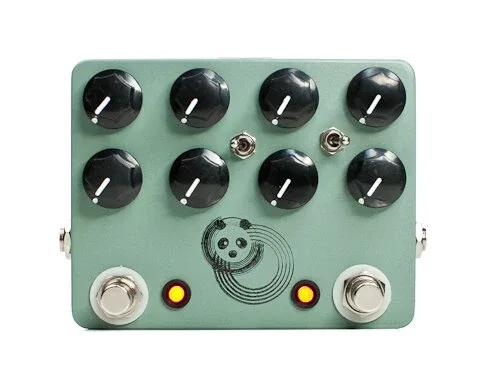
The pedal is discontinued: the V2 sits in the discontinued and rare section of the JHS catalog2, and the product pages list it at $0.00 USD, the placeholder JHS uses for gear that is no longer sold3. Its circuit survives in the current lineup, though: the right side of the JHS Pandamonium is the 4 Wheeler Fuzz, which JHS says "can dish out almost any fuzz tone your bass desires"4.
From 60s jam band to modern electronic fuzz
JHS pitches the 4 Wheeler as a do-it-all bass fuzz rather than a one-sound box. The maker's own framing spans two very different eras: the warm, loose fuzz associated with 60s jam band bass, and the tighter, more aggressive character of modern electronic fuzz1. RockBoard echoes the same range and adds that the pedal has enough volume and headroom for any size stage2.
JHS also says there is "enough volume/headroom to shake any stage, as well as drive your amp as hard as you would ever need"3, so the Volume control is not just a level trim, it can push the amp itself.
The controls
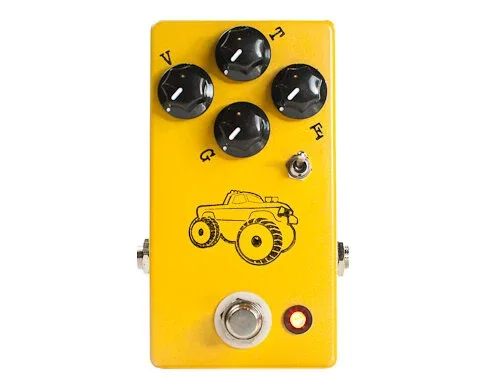
The V2 front panel holds four knobs and one toggle. JHS sums it up: "With Volume, Tone, Fuzz and a specially tuned Gate control, the ability to tweak away is at your fingertips"3.
| Control | What it does |
|---|---|
| Volume | Sets overall level, with enough headroom to drive the amp hard56 |
| Tone | Shapes the fuzz voicing, described as extremely flexible across the full knob range2 |
| Fuzz | Sets fuzz amount, also described as extremely flexible across its range2 |
| Gate | Specially tuned gate for synth break-offs or jab on a riff3 |
| Hi/Lo toggle | Switches between a deeper, low-end focused range and the normal V1 settings1 |
The Gate knob is the control that sets the 4 Wheeler apart from a standard fuzz. JHS says it "can give you those much desired synth break-offs or just the right amount of jab for that perfect riff"3. RockBoard adds that Tone and Fuzz, "when combined with the Gate control, are perfect for playing synth-like sounds and riffs"2. In practice the gate cuts the fuzz signal abruptly rather than letting it decay, which is what produces those synth-like stabs.
The Hi/Lo switch is the V2's added feature. JHS describes it plainly: "The 'Hi/Lo' toggle switch lets you go from a deeper, more low-end focused range of tones to the normal V1 settings"1. For bass players who found the original too thin on the bottom, the deeper position keeps the low end intact under heavy fuzz.
V1, V2 and the Hand Paint edition
The 4 Wheeler went through two versions, and JHS's own product pages record the differences536:
| Version | Enclosure | Changes |
|---|---|---|
| V1 | Brown enclosure, yellow knobs | Original release3 |
| V2 | Mustard enclosure | Hi/Lo switch added3 |
The V2's Hi/Lo switch is the only functional change JHS lists between versions, so a V1 in a brown box gives you the same core fuzz without the deeper low-end option3.
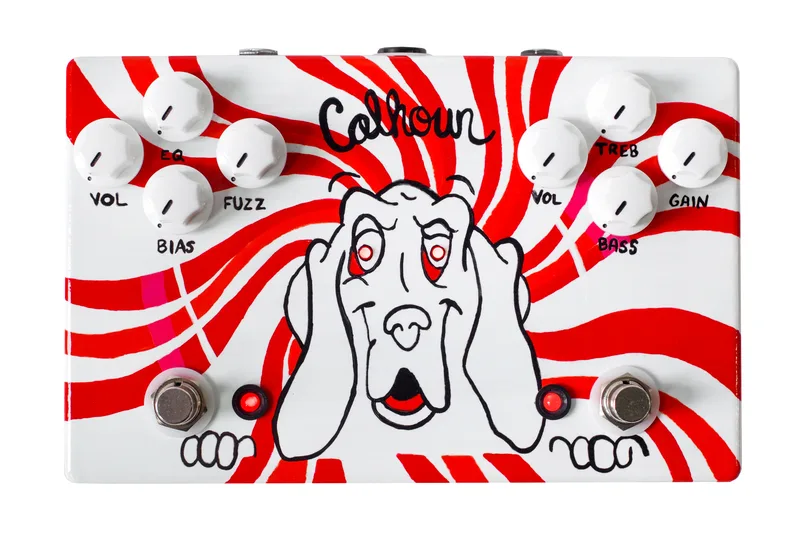
JHS also produced a Hand Paint edition of the 4 Wheeler, a hand-painted version of the same circuit with the same control set: Volume, Tone, Fuzz, the specially tuned Gate, and the Hi/Lo toggle6. Hand-painted enclosures are a recurring JHS practice; the company has released hand-painted runs of other pedals such as the JHS Calhoun V2, which Gearnews reported as a limited edition of 100 units with a hand-painted design instead of the standard red version7.
The 4 Wheeler V2 is discontinued and listed among JHS's rare products2. The circuit is still available new inside the Pandamonium, whose right side is the 4 Wheeler Fuzz4.
Power and specs
The V2 runs on 9V DC with a center negative plug and draws 100mA2. That current draw is on the high side for an analog fuzz, so it is worth accounting for on a pedalboard power supply rather than assuming it shares a low-current output with simple transistor fuzzes.
- Circuit type: Analog2
- Voltage: 9V DC, center negative2
- Current draw: 100mA2
- Product type: Bass fuzz pedal2
Videos
Eirik Stordrange
Prymaxe
Eirik Stordrange
Questions
What does the Gate knob on the JHS 4 Wheeler do?
The Gate control is specially tuned for the pedal, and JHS describes it as giving synth break-offs or just the right amount of jab for a riff. RockBoard notes that Gate combined with the Tone and Fuzz controls is suited to synth-like sounds and riffs, so it works like a noise gate that chops the fuzz decay short.
Does the JHS 4 Wheeler work on guitar?
The 4 Wheeler is designed and marketed as a bass fuzz, with a Hi/Lo switch that shifts between a deeper, low-end focused range and the normal V1 settings. JHS does not describe a guitar-specific use for it, so players wanting a guitar fuzz from JHS would look at other models in the range.
How much current does the JHS 4 Wheeler draw?
The 4 Wheeler V2 draws 100mA, running on 9V DC with a center negative plug. That draw is high for a fuzz pedal, so it is worth planning for on a shared power supply.
Is the JHS 4 Wheeler discontinued?
Yes. The V2 is listed under discontinued and rare products on the JHS site, and the product pages show a $0.00 price, which is how JHS lists gear no longer for sale. Secondhand units are the way to find one now.
Is the JHS 4 Wheeler analog?
Yes, the 4 Wheeler V2 is an analog fuzz pedal. Its circuit also lives on in the JHS Pandamonium, where the right side is the 4 Wheeler Fuzz.
Sources (7)
- 4 WHEELER, JHS Pedals
- 4 Wheeler V2 by JHS, RockBoard (www.rockboard.de), 2026
- 4 WHEELER PRINTED, JHS Pedals
- PANDAMONIUM, JHS Pedals
- 4 WHEELER HAND PAINT, JHS Pedals
- 4 WHEELER HAND PAINT, JHS Pedals
- JHS new Calhoun V2 and The Milkman pedals: Some drive, a dog and a bit of echo, www.gearnews.com, 2017-04-26