

The JHS Kilt is an overdrive, distortion and fuzz pedal from JHS Pedals, designed in collaboration with Stu G, the guitarist, writer, producer and founding member of UK band Delirious. Released in 2015, it was built as what JHS calls "the ultimate dirt pedal": a do-it-all drive box that Stu G wanted for studio work and touring, covering gain levels from clean boost to full saturation12.
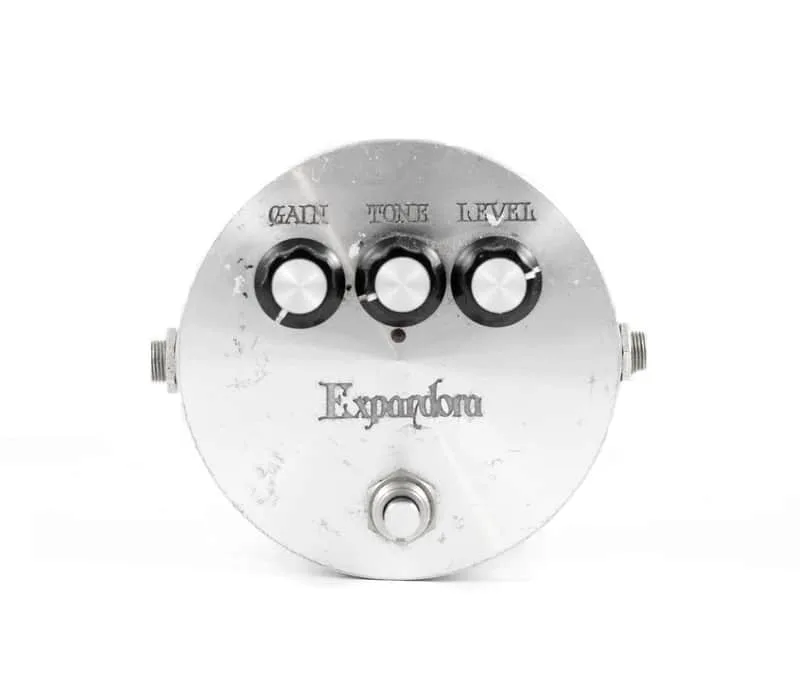
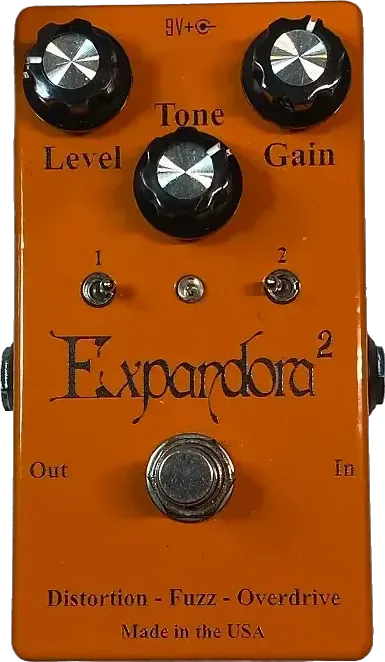
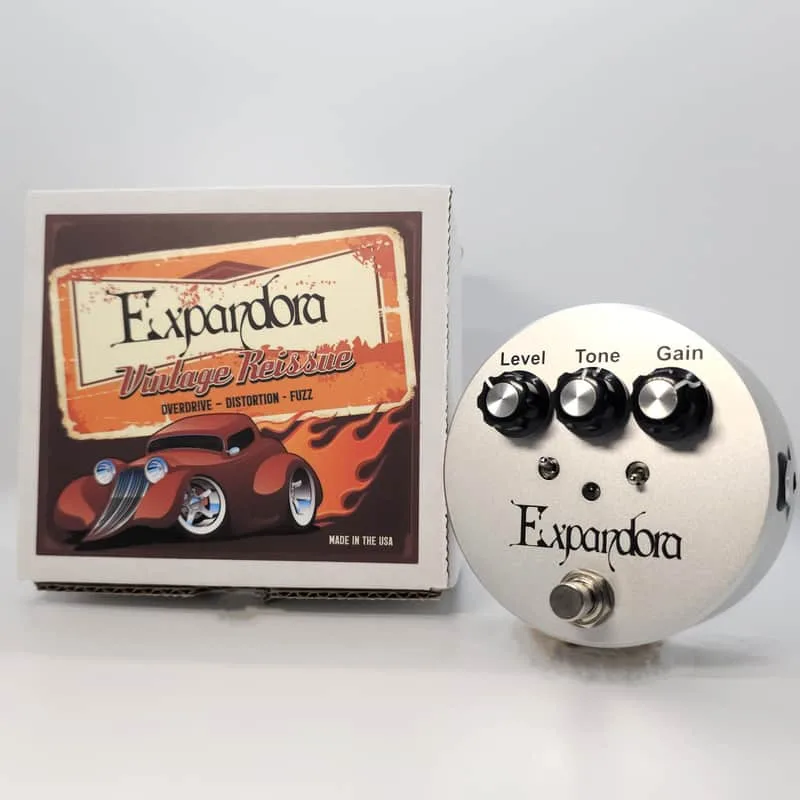
The circuit is JHS's take on the vintage Japanese-made Bixonic Expandora, a pedal whose own four modes run from Crunch through Overdrive and Distortion to Fuzz3. Where the Expandora hid its gain settings on internal switches, the Kilt brings them to the surface as two front-panel toggles, G1 and G2, so a player can move from amp-like breakup to gated fuzz without opening the box4.
An Expandora-style dirt box
JHS describes the Kilt V2 as "a heavily tweaked Expandora style dirt box that gives you more tonal options than you might ever be able to use"1. The independent circuit archive Aion FX goes further, calling the Kilt "the most notable commercial clone of the Expandora, designed in collaboration with Stu G"8. Guitar Pedal X notes the lineage in its control naming: the Expandora's D1/D2 switches are renamed G1/G2 on the Kilt, "essentially working much the same"9.
The original Bixonic Expandora Squared produces Crunch, Overdrive, Distortion and Fuzz modes10, and the Kilt mirrors that ladder. On the Kilt 10, Delicious Audio describes the range as "covering territory from transparent overdrive to saturated distortion and sputtering fuzz"5. The Expandora itself has since returned as a vintage reissue with an improved-headroom schematic and an optional NOS TL071 chip set for a warmer, lower-gain tone11, so players comparing the Kilt against its inspiration can now buy both new.
The controls: gain, G1/G2 and the cut toggle
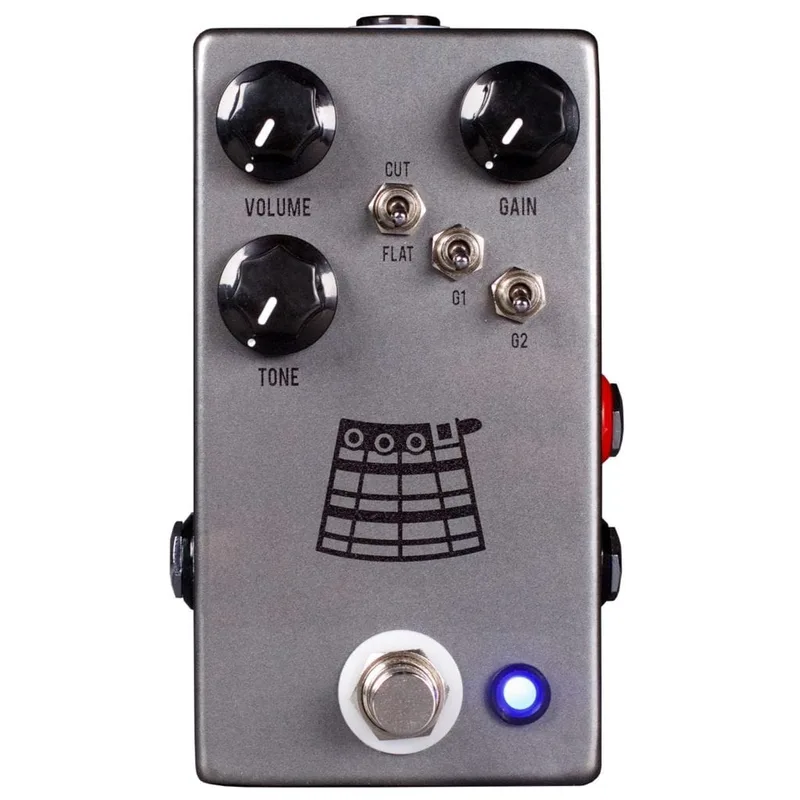
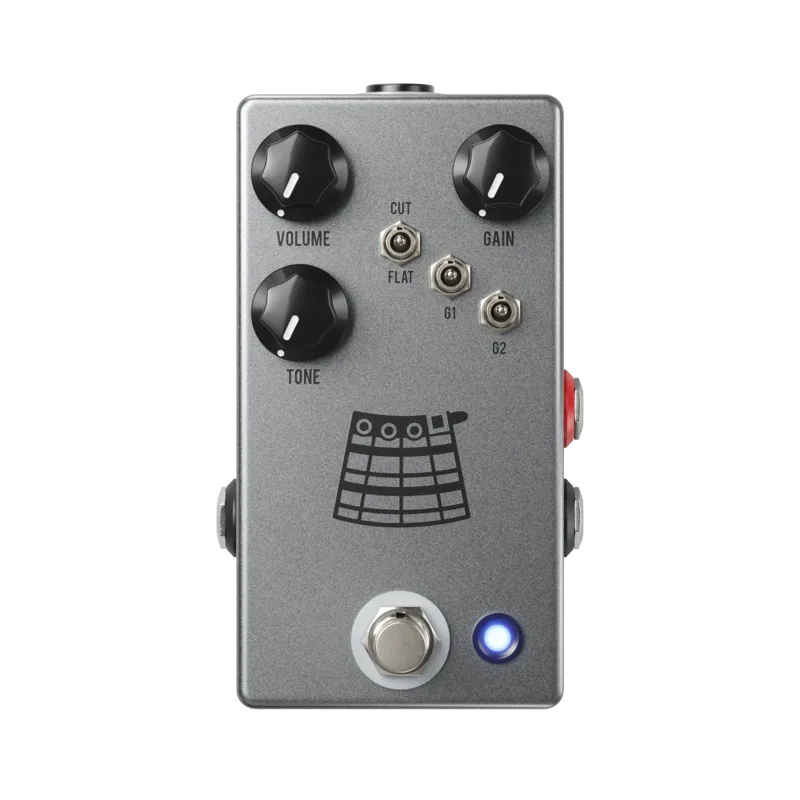
The Kilt V2 keeps the control set compact: three knobs and three toggles3. The knobs are Volume, Gain and Tone; the toggles are the G1 and G2 clipping switches and a Cut/Flat EQ switch9.
| Control | What it does |
|---|---|
| Gain | Sets the amount of drive or distortion; left is less, right is more2 |
| Volume | Sets the output level |
| Tone | Shapes the high end12 |
| G1 (up/down) | Clipping toggle; engaged gives more overdrive, a "stage two" vibe7 |
| G2 (up/down) | Clipping toggle; engaged gives full-on distortion, a high-gain mode7 |
| Cut / Flat | Cuts low-end frequencies to sit in the mix; Flat leaves the bass response much beefier than the original Expandora's1 |
The two G toggles work together to give four resistance clipping options. JHS lays it out plainly: both toggles down is the lightest gain setting, with amp-like chimey breakup; G1 up adds more overdrive; G2 up adds more fuzz; both up gives the heaviest gated fuzz the pedal offers12. Guitar Pedal X names the four positions on the Kilt 10 as Crunch, Overdrive, Distortion and "Forbidden Fuz"13.
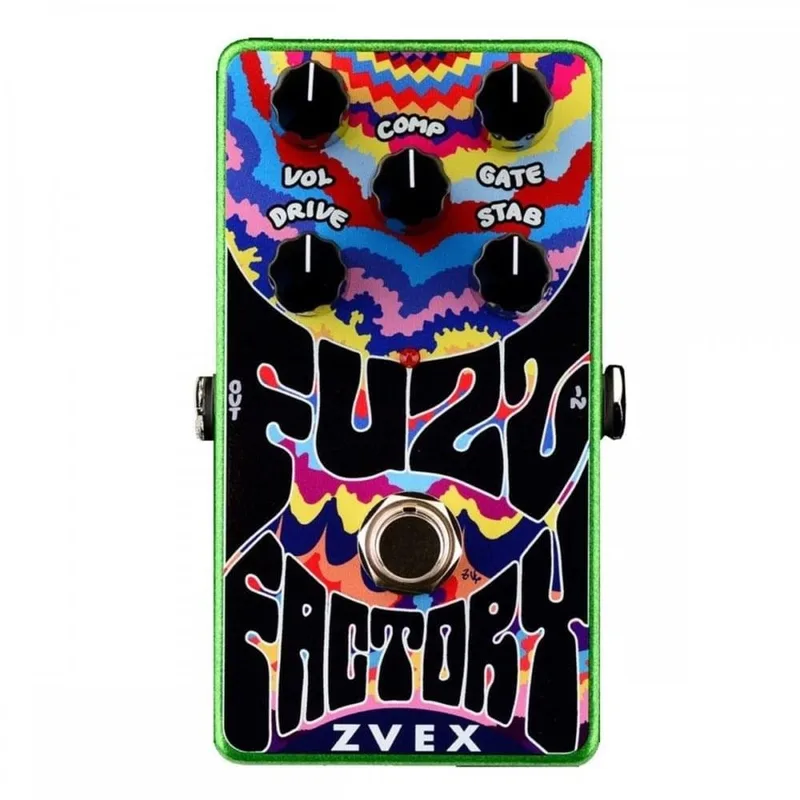
On the V2, Josh Scott of JHS walked through the sounds in the company's own video: the lowest setting is a very transparent overdrive he compares to an accurate Morning Glory sound with single coils, a mid gain setting can land a JTM plexi sound, G1 down with G2 engaged lands more of a Rat sound, and both toggles up is "kind of like a ZVEX Fuzz Factory"7. The G2 high-gain mode he describes as going "nuclear," with natural sustain7.
The cut toggle is a low-end, bass cut. In the Flat position, JHS says the V2's bass response is much beefier than the original Expandora's17. Under the hood, the V2 uses a specifically chosen op-amp that JHS says offers super low noise and an improved slew rate for a smoother structure1.
The boost circuit and order toggle (Kilt V1)
The original 2015 Kilt was a different layout: a larger enclosure with two footswitches, an independent boost on the right side, and four knobs and four toggles2. The second footswitch ran what Josh Scott calls the "mini bomb boost," so the pedal handled its own on/off plus a boost7. Pedal of the Day's 2015 review described it as an overdrive boost pedal with an independent boost circuit, where the boost knob controls the volume level of the boost and does not directly affect the main circuit14. The fourth toggle on the V1 was an order toggle for the boost14.
History and versions: V1, V2 and the Kilt 10
JHS launched the Kilt in 2015 with Stu G, and the maker says it has been one of its best-selling overdrive/distortion pedals year after year since2. In a 2024 interview, Josh Scott noted the pedal had run two versions in nine years and was still selling strongly4.
| Version | Year | What changed |
|---|---|---|
| Kilt V1 | 2015 | Larger enclosure; two footswitches; independent boost on the right side; four knobs and four toggles2 |
| Kilt V2 | 2017 | Smaller enclosure; three knobs and three toggles; Red Remote system added; EQ tuned slightly darker than the brighter V127 |
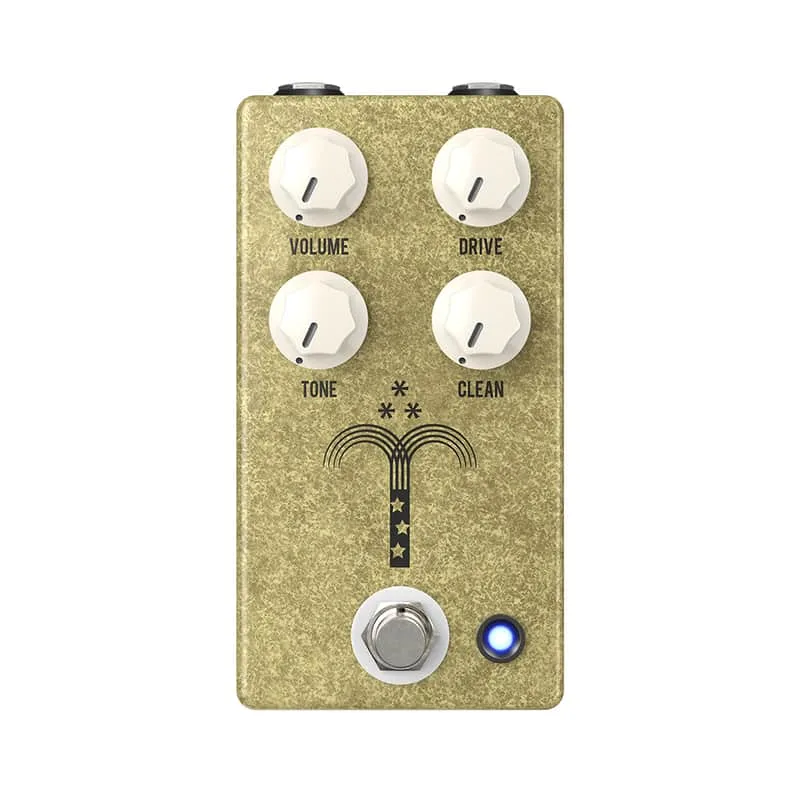
| Kilt 10 | 2025 | 10-year anniversary special edition; polished aluminum finish with Expandora-style knobs; refined G1/G2 gain staging25 |
The Kilt 10, announced in November 2025, is a comprehensive revision of the circuit rather than a third standard version. Delicious Audio reports that the G1 and G2 toggles were refined for more musical gain staging across the four clipping options, and Gearnews adds that they now provide a more touch-sensitive playing feel, increased compression, more intense distortion and a softer attack53. With G1 down and G2 up, JHS says the Kilt 10 acts like a higher gain stage boost, suited to pushing an amp's front end or stacking with fuzz2. The finish returns to polished aluminum as a tribute to the V1, with an updated Scottish flag-inspired icon2. The Kilt 10 is available to order3.
The Red Remote
The V2's headline addition was JHS's proprietary Red Remote system3. The pedal carries a red jack: plug in a Red Remote and it remotely activates G2 as if the toggle were flipped on the pedal itself7. On the Kilt 10, a Red Remote connected with a plain TS cable switches G2 between its two states, letting a player jump between overdrive and distortion, or distortion and fuzz, mid-song213. The same remote system appears on other JHS pedals, including the Morning Glory and the SuperBolt V27.
The Kilt V2 and Kilt 10 both require standard 9V DC center negative power and consume 64mA. JHS warns against using more than 9V DC on the Kilt 10: damage may occur and the warranty will be voided12.
Why it is called the Kilt
The name comes from Stu G himself. As Josh Scott tells it, "The name kilt kind of comes from uh this thing where he wore a kilt on stage all the time"7. The G in the G1 and G2 toggle names pulls double duty: it nods to Stu G and also stands for gain7.
What reviewers said
Reviewers have consistently praised the Kilt's range. Pedal of the Day's 2015 review found that "while most pedals that claim to be versatile have maybe one or two 'sweet spots,' the Kilt is special all the way through"14. The same review noted the toggles and knobs let a player dial in anything from clean to full-out gated fuzz14. Stu G himself, in the JHS interview, said that at low gain through a loud Fender amp "it kind of did a morning glory thing better than a morning glory"4.
For the Kilt 10, Guitar Pedal X's Stefan Karlsson called it "much more in line with the warm and expansive nature of JHS's Morning Glory" than the V2 it replaces, and in the site's 2025 round-up named it a Silver runner-up among the year's new boost and overdrive pedals, judging the new version "improved in every way" over the former V2 model1315. Guitar World covered the launch as a retooled special edition with mini toggles for clipping and controls for Gain, Volume and Tone12, and MusicRadar framed it against its ancestor: "Think of the Kilt and you might think of the Expandora, the pedalboard cult classic that inspired it"16.
Videos
JHS Pedals
JHS Pedals
JHS Pedals
Questions
What do the G1 and G2 switches do on the JHS Kilt?
G1 and G2 are clipping toggles that work together to give four resistance clipping options. Both down is the lowest gain setting, G1 up adds more overdrive, G2 up adds more fuzz, and both up gives the heaviest gated fuzz the pedal offers. JHS describes the pair as Crunch, Overdrive, Distortion and Forbidden Fuzz modes.
What is the difference between the JHS Kilt V1 and V2?
The V1 (2015) used a larger enclosure with two footswitches, an independent boost on the right side, and four knobs and four toggles. The V2 (2017) moved to a smaller enclosure with three knobs and three toggles and added the Red Remote system. The V2's EQ was tuned slightly darker than the brighter V1.
Is the JHS Kilt a clone of the Bixonic Expandora?
It is JHS's take on the vintage Japanese-made Bixonic Expandora, and Aion FX calls it the most notable commercial clone of that circuit. JHS describes the V2 as a heavily tweaked Expandora-style dirt box, with the Expandora's internal switches brought to the surface as the G1 and G2 toggles.
How does the Red Remote work on the Kilt V2?
The Kilt V2 has a red remote jack that lets a JHS Red Remote switch, connected with a plain TS cable, remotely activate the G2 toggle as if you had flipped it on the pedal. This allows on-the-fly changes between overdrive and distortion, or distortion and fuzz, with a tap of the foot.
Why is the JHS Kilt called the Kilt?
The name comes from Stu G, the guitarist it was designed for, who wore a kilt on stage all the time. The G in the G1 and G2 toggle names also nods to Stu G, while doubling as shorthand for gain.
How much current does the JHS Kilt V2 draw?
The Kilt V2 consumes 64mA and requires a standard 9V DC center negative power supply. The Kilt 10 carries the same figures, and JHS warns not to use more than 9V DC on it, as damage may occur and the warranty will be voided.
Sources (16)
- KILT V2 - JHS Pedals, JHS Pedals
- KILT 10 - JHS Pedals, JHS Pedals
- JHS Pedals Kilt 10: Expanding The Expandora, gearnews.com, 2025-11-26
- StuG's Experimental Tones Explained (Zvex FuzzProbe, Digitech Whammy, Talker, Expandora, Line6 DL4), JHS Pedals (YouTube), 2024-05-07
- New Pedal: JHS Kilt 10 Overdrive, Delicious Audio, 2025-11-26
- JHS Pedals The Kilt 10 Overdrive Distortion, Pedal of the Day, 2025-11-25
- Most Versatile JHS Drive Pedal: The Kilt Overdrive / Distortion / Fuzz / Boost And Red Remote, JHS Pedals (YouTube), 2023-07-03
- Dynamo Reactive Distortion / Bixonic Expandora, Aion FX, 2023-07-03
- Guitar Pedal X, Guitar Pedal X, 2021-08-23
- Expandora Squared Overdrive/Distortion/Fuzz, Delicious Audio, 2021-09-07
- Expandora Pedals Vintage Reissue Overdrive Distortion Fuzz, Pedal of the Day, 2026-04-05
- JHS Pedals retools the underrated Kilt distortion, Guitar World, 2025-11-26
- Guitar Pedal X, Guitar Pedal X, 2025-11-28
- JHS Pedals Kilt Overdrive Boost, Pedal of the Day, 2015-09-19
- Guitar Pedal X, Guitar Pedal X, 2025-12-04
- In 2015, JHS Pedals released what it called the “ultimate dirt pedal”, MusicRadar, 2025-11-26