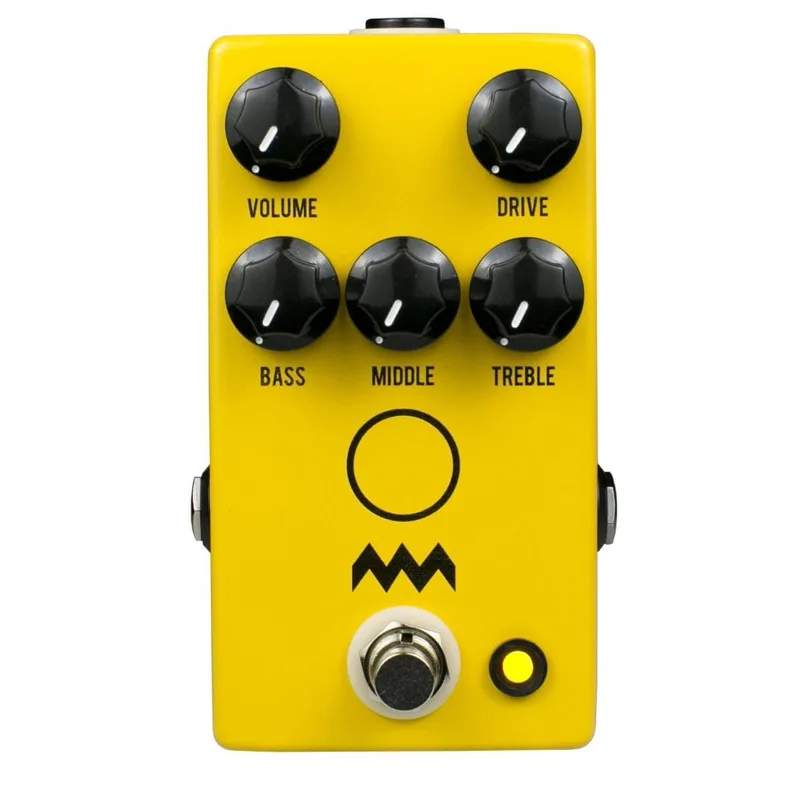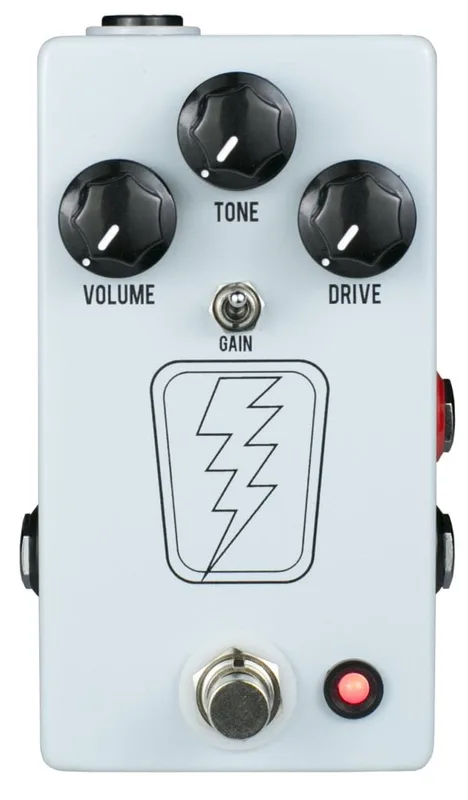


The JHS Pedals SuperBolt V2 is an analog overdrive pedal from JHS Pedals that aims to put sixties-era Supro amp tones on a pedalboard. JHS describes it as delivering "the clear and gritty tones of sixties Supro tube amps"1, and Premier Guitar's reviewer found it "manages to replicate the sounds of the Silvertone, Supro, Harmony, and Oahu amps Valco built in the early '60s"2. The original SuperBolt was released in 20121, and the V2 revision updated its switching and added a remote boost option.
What makes it unusual among overdrives is how it gets its dirt. Instead of clipping the signal with diodes, the circuit replaces tubes with JFET transistors and generates all of its saturation from those transistors34. The result is a pedal that behaves more like a small amp being turned up than a typical overdrive stomping on your signal.
Sixties Supro amp tones in a pedal
The SuperBolt's reference point is the Valco-built amplifier family of the early sixties. JHS positions the pedal against "the go-to combos for players like Jimmy Page, Brian Setzer, and Switchfoot's Drew Shirley"1, and Premier Guitar ties the design more specifically to "the sound of the Supro S6420 Thunderbolt allegedly used on early Zeppelin records"2. A Coda Effects circuit analysis traces the lineage to the Supro 16T, "a small 5W amplifier from the late 60s"3.
The original press launch described the character in amp terms: "From its touch-sensitivity to the way the pedal sags with tube rectifier color at higher gain settings"5. Vintage Guitar's reviewer summed up the goal as re-creating "the sound of '60s Supro (and Valco) amps," a project attributed to Josh Scott7. In JHS's own demo video, Josh noted that "It does the Supro thing really well, but it also does a lot more"8.
The controls: Volume, Tone, Drive and the Gain toggle
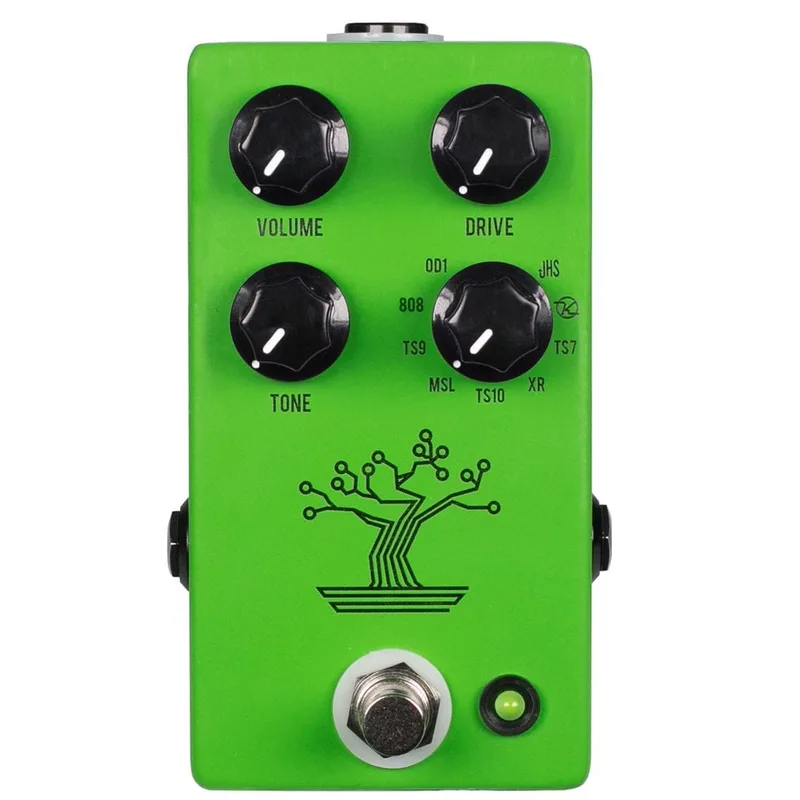
The V2 front panel keeps the three-knob layout of the original, with a toggle for the gain boost15.
| Control | What it does |
|---|---|
| Volume | Overall output volume control6 |
| Tone | Brightens or darkens the signal6 |
| Drive | Overall gain or dirt saturation of the circuit6 |
| Gain toggle | Switches the Gain boost circuit on and off1 |
The Drive knob is the heart of the pedal. JHS says it "acts in a similar fashion to the volume controls on the old amplifiers"1, and Premier Guitar's reviewer put it the same way: "The drive knob works like a Valco's volume knob, the higher the setting, the more break up"2. Pedal of the Day's Mike B found its range wide, covering "anything from jazz leads and chords to barely crunched amp sounds to sustaining, lush, vintage rock and roll"9. The Tone control "keeps the lows clear and the highs mellow"9.
On the original SuperBolt, the toggle was a Hi/Lo switch that "reflects the different inputs of many classic amplifiers, resulting in 2 completely differing tones"9. Vintage Guitar described the two positions: "Hi provides more headroom and upper mids, while Low goes to a darker, mellow tone"7. V2 replaced that with the switchable Gain boost1, which Aion FX describes as "a separate boost stage that goes before the main circuit to push it into overdrive more easily"10.
Power and connections: 9V in, 18V inside
The pedal runs on a standard 9V DC center negative supply and draws only 3mA1. Inside, an on-board charge pump converts that 9V to 18V to run the circuit10. Vintage Guitar described the benefit when the original launched: "Internally, the circuit converts the 9-volt juice to 18 volts for more punch and headroom"7.
The SuperBolt requires 9V DC center negative power1. There is no battery option, so it needs a power supply or an isolated output on your pedalboard power brick.
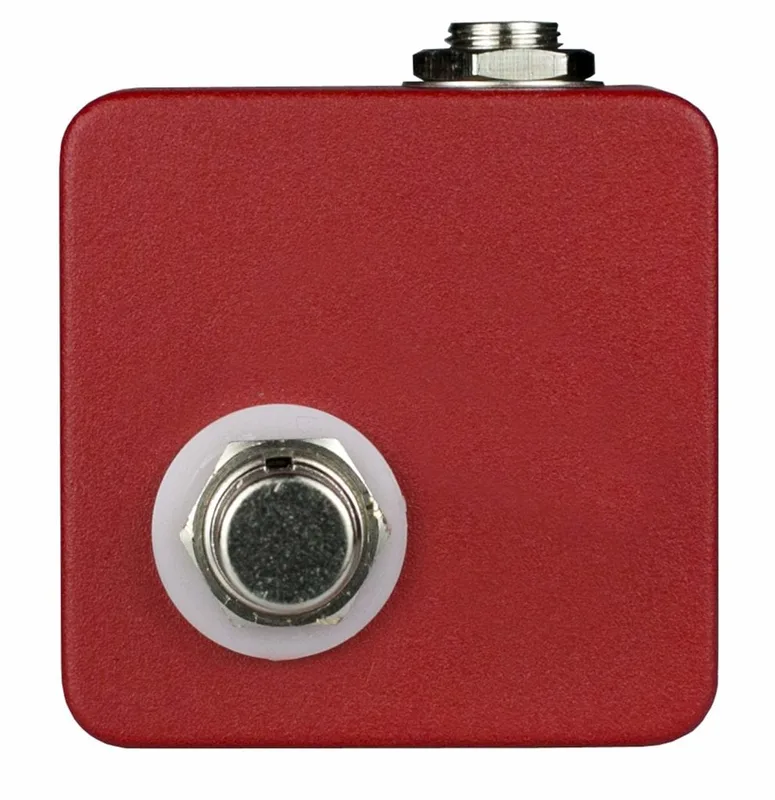
Connections are an instrument input, an output, and a Red Remote jack that connects to the gain toggle6. The Red Remote footswitch itself is sold separately1.
How the circuit works: JFETs instead of tubes
The SuperBolt is a tube amp simulation built from JFET transistors. JHS describes the original Super Bolt as "a FET simulation of a tube amp"11, and the same circuitry later formed the basis of the volume, tone and drive sections of the JHS PG-14 distortion11.
The design descends from the runoffgroove Supreaux, a DIY Supro-style amp sim. Aion FX notes that the JHS version "changed a couple of values to bias the JFETs for 18V operation, as well as adding an on-board charge pump for 18V operation from a 9V supply"10. Coda Effects' analysis agrees: "it is basically the same circuit, with an added voltage doubler"3.
The key difference from most overdrives is the absence of clipping diodes. As Coda Effects puts it: "All the saturation of this circuit is based on the saturation of these transistors: you can see that there are no diodes"4. Internally, each transistor stage has a 100k trimpot that sets its bias and maximum gain, one adjusting the DC current on the drain of Q1 and the other setting Q2's saturation along with a 2k7 resistor3.
V1 versus V2
| SuperBolt V1 | SuperBolt V2 | |
|---|---|---|
| Controls | Three knobs, Hi/Lo toggle1 | Three knobs, Gain toggle1 |
| Toggle function | Hi/Lo gain modes19 | Switchable Gain boost1 |
| Remote | None | Red Remote system (remote sold separately)1 |
| Volume taper | Original | Improved over version one6 |
The second version arrived in 2016, when Aion FX notes JHS "changed the 'Hi/Lo' toggle into a switchable gain boost"10. In JHS's demo video, Josh highlighted that V2 "has a better volume control taper"6.
What reviewers said
Vintage Guitar reviewed the original in November 2013 at a $199 price and called it "a musical overdrive solution, providing plenty of dynamics," with "cool sounds from sultry to blistering"7. Premier Guitar's later review, at a $199 street price, concluded:
"An alternative to the same old overdrives. Classic-sounding, but not so retro that you can't tread new ground."
JHS's own demo video walks through each control and the Red Remote connection6:
In the video, Josh of JHS Pedals runs through the Volume, Tone and Drive controls, explains the gain toggle and the Red Remote jack, and notes the improved volume taper over the first version6.
Videos
Guitar Interactive Magazine
Eirik Stordrange
Questions
Is the JHS SuperBolt true bypass?
Yes. The original SuperBolt was introduced as a true-bypass analog overdrive, and JHS has carried the true-bypass design forward. With the pedal off, your signal passes straight through without the circuit coloring it, which suits players who leave the pedal bypassed for long stretches of a set.
Does the SuperBolt V2 come with the Red Remote footswitch?
No. The Red Remote is sold separately. V2 gives you access to the Gain boost circuit through the front-mounted toggle on the pedal itself, or through the JHS Red Remote footswitch plugged into its remote jack, so you can switch the boost mid-song without leaning down to the pedal.
What is the difference between SuperBolt V1 and V2?
V1 had three controls and a Hi/Lo toggle, with early stamped units showing a three-stage lightning bolt icon and most a four-stage one. V2 replaced the Hi/Lo toggle with a Gain toggle, added the Red Remote system, and improved the volume control taper. The second version's changes date from 2016.
Does the SuperBolt have clipping diodes?
No. All of the saturation in the circuit comes from transistor saturation, with tubes replaced by JFET transistors and no diodes in the signal path. That is a key difference from most overdrives, which clip the signal with diodes, and it is a big part of why the pedal behaves like a small amp being pushed.
Which Supro amp is the SuperBolt based on?
JHS says the tones are based on sixties Supro tube amps generally, and Premier Guitar describes the pedal as based on the sound of the Supro S6420 Thunderbolt allegedly used on early Zeppelin records. A Coda Effects circuit analysis traces the design to the Supro 16T, a small 5W class A amplifier from the late sixties.
Sources (11)
- SUPERBOLT V2, JHS Pedals
- JHS Pedals SuperBolt Overdrive Review, Premier Guitar, 2013-08-23
- Coda Effects, Coda Effects, 2026
- Coda Effects, Coda Effects, 2015-07
- JHS Launches SuperBolt & Prestige Overdrive Pedals, Premier Guitar, 2012-12-14
- JHS Pedals SuperBolt V2, JHS Pedals, 2016-01-22
- JHS’ SuperBolt and Morning Glory Pedals, Vintage Guitar magazine, 2014-10-07
- JHS Pedals "SuperBolt" (Supro, Valco), JHS Pedals (YouTube channel), 2012-10-25
- JHS Pedals Superbolt Overdrive, www.pedal-of-the-day.com, 2015-07-17
- Runoffgroove Supreaux / Supro® 16T, Aion FX, 2020-06-05
- OUR MOST VERSATILE DISTORTION: PG-14, JHS Pedals