| Maker | Gibson, under its Maestro brand name1 |
| Released | 19621 |
| List price | $40 retail1 |
| Circuit | three germanium transistors7 |
| Power | two 1.5-volt batteries (3 volts total)7 |
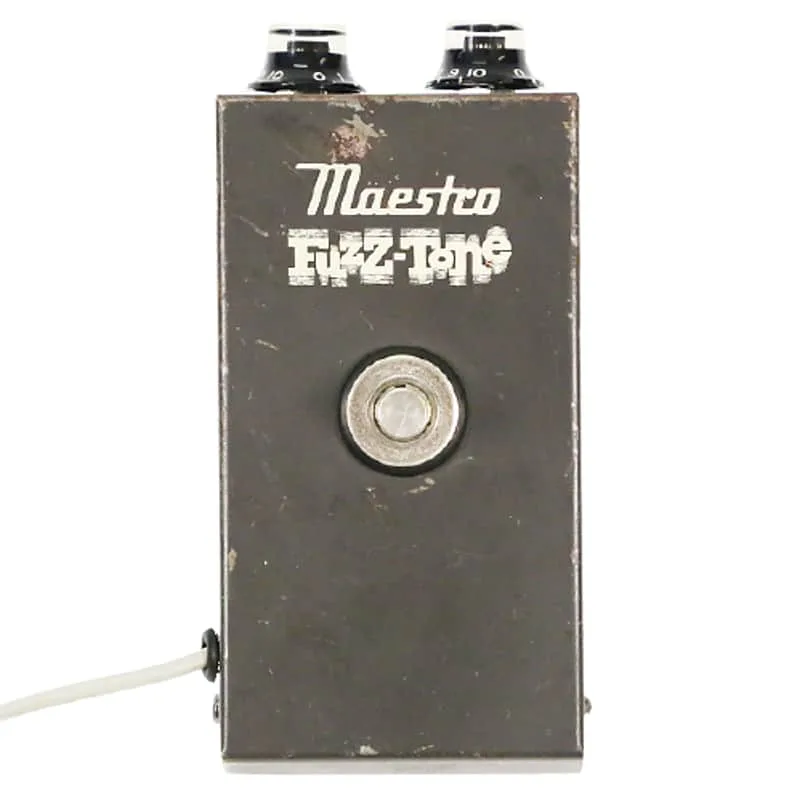
| Controls | two knobs, plus an on/off switch on top of the pedal58 |
| Made in | Kalamazoo, Michigan1 |
| Maker | Maestro (Gibson)5 |
| Released | 20225 |
| Launch price | $1496 |
| Circuit | all-analog8 |
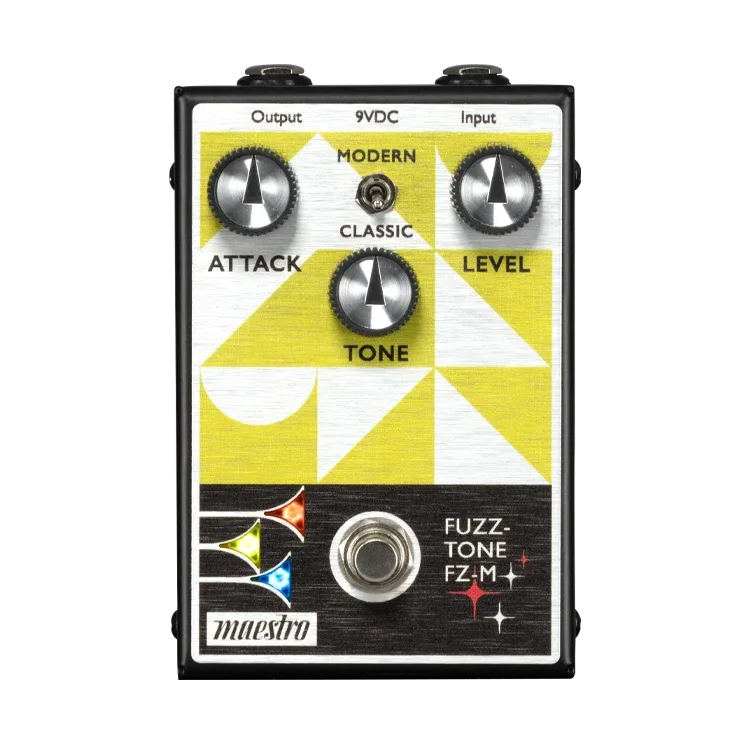
| Controls | Attack, Tone, Level, plus a Classic/Modern mode toggle89 |
| I/O | front-mounted input, output and power-supply jacks5 |
The Maestro Fuzz-Tone is the circuit that put fuzz on the map. Gibson launched the FZ-1 pedal under its Maestro brand name in 1962, and it is credited as the world's first fuzz pedal and the first transistor distortion pedal12. The pedal ran a very simple germanium three-transistor circuit on just 3 volts, and it became famous when Keith Richards used it on the guitar riff of the Rolling Stones' "(I Can't Get No) Satisfaction"3.
The original models are no longer in production, and vintage Fuzz-Tones are now sought after by collectors and musicians, with vintage units selling for over $60034. Gibson revived the Maestro brand in 2022 with a series of pedalboard-friendly stompboxes, including the FZ-M Fuzz-Tone, an all-analog reissue that adds a Tone control and a second, more modern fuzz voicing to the original design56.
Where the Fuzz-Tone came from
The fuzz sound itself came before the pedal. In the early 1960s, the fuzz sound moved from busted amps into the pedal platform with the Gibson Maestro Fuzz-Tone10. The origin story centers on Glenn Snoddy, an engineer at Owen Bradley's Quonset Hut recording studio in Nashville. A faulty preamp circuit caused a distorted sound during a recording session, and that accident became the fuzz effect players know today3.
Snoddy then took that sound and made a little box to recreate it in real time2. MusicRadar's account adds a detail about the name: the pedal took its name from Grady Martin's instrumental song "The Fuzz," so-named for the sound Martin got from the faulty preamplifier used to record it11. Snoddy designed the pedal with engineer Revis V. Hobbs, and the two worked out the details of the Fuzz-Tone together, filing a patent application on May 3, 19621. Guitar World credits the pair as the designers, describing Snoddy as a recording engineer and Hobbs as an engineer7.
The patent application described the goal in period language: to provide a tone modifying attachment and circuit for electrically produced signals that would permit stringed musical instruments to simulate other instruments such as trumpets, trombones and tubas1. That brass-instrument marketing carried through to the product itself. The FZ-1 was originally marketed to make your guitar achieve tones similar to those of a brass instrument7.
"the first commercially available fuzz pedal was the FZ-1 Fuzz-Tone introduced by Maestro in 1963. Originally marketed as a device to make electric guitars sound like brass instruments"
Note the date: most sources, including Gibson's own history and Vintage Guitar magazine, place the launch in 196213, while Guitar Player's 2005 retrospective gives 196331314.
Sales tell the story of the pedal's fortunes. After an initial production run of five thousand units, sales almost completely dried up, according to Guitar World's Huw Price. Then came "Satisfaction," and Gibson was soon selling FZ-1s in their tens of thousands15. The pedal was an American product, predominantly sold in the United States16.
How the circuit works: three germanium transistors on three volts
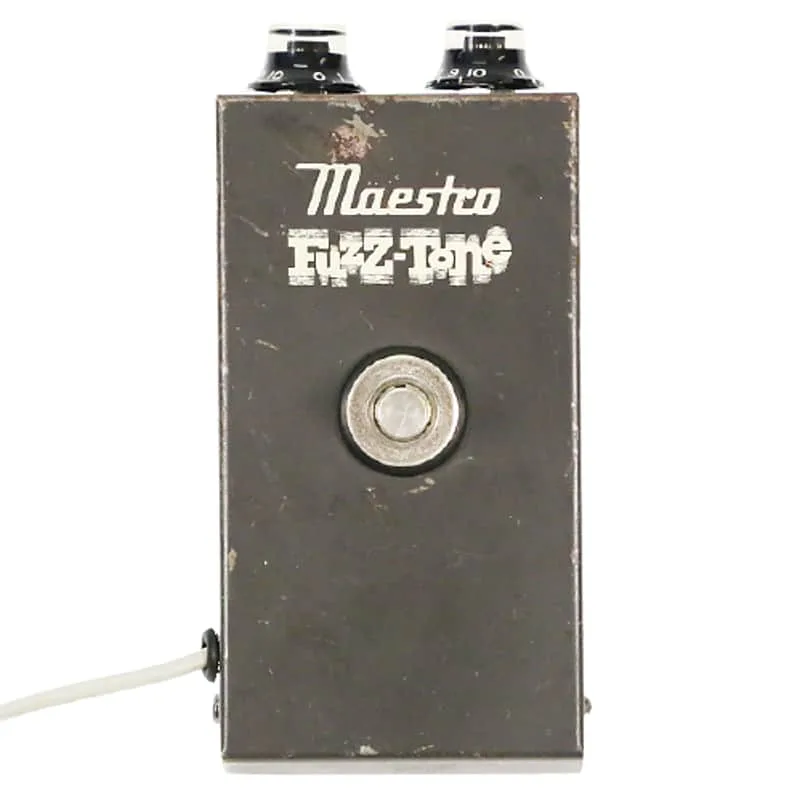
The FZ-1 contained a three-germanium transistor circuit powered by two 1.5-volt batteries7. Vintage Guitar magazine confirms that the FZ-1 and FZ-1A used largely the same circuitry with three germanium transistors1. Premier Guitar has described it as a very simple germanium three-transistor circuit, and referred to the original as a 3-volt, AA-battery powered pedal17.
How the fuzz happens: Snoddy and Hobbs' circuit worked by clipping the signal's sine wave to a square wave1. That hard clipping is what turns a guitar's smooth waveform into the harmonically rich, sustaining growl players call fuzz. Germanium transistors were the standard of the day, and they appear in a few classic effects beyond the Fuzz-Tone, including the early-period Arbiter Fuzz Face and the Dallas Rangemaster18.
The low voltage matters to the character. Two 1.5-volt batteries in series give the circuit only 3 volts to work with, which is part of why the original FZ-1 behaves the way it does, and why later redesigns moved to higher supplies. The pedal's controls were minimal: a two-knob box, with an on/off switch added to the top of the pedal so musicians could change the tone from clean to dirty5814.
FZ-1, FZ-1A, FZ-1B and later versions
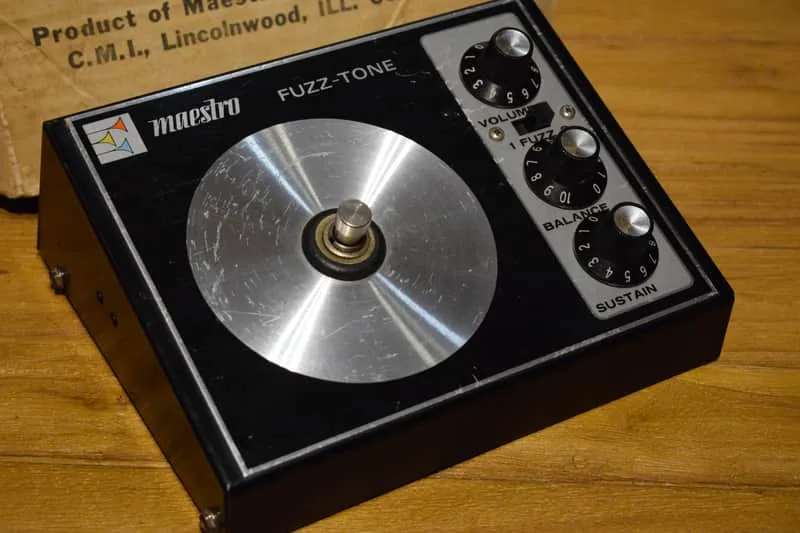
Gibson did not leave the FZ-1 alone. The first follow-up models were the FZ-1A and the FZ-1B, which had some improvements and changes in circuitry3. The FZ-1A was refined in 1965 and had a smoother sound, while the FZ-1B was more aggressive313. Maestro also released several variations of the Fuzz-Tone, including the FZ-1S, the FZ-1S "Big Box," and others3.
| Version | Transistors | Power | Notes |
|---|---|---|---|
| FZ-1 (1962) | Three germanium | Two 1.5-volt batteries | Original, $40 retail17 |
| FZ-1A (1965) | 2N2614 or 2N2613, three germanium | A single 1.5-volt battery | Smoother sound3713 |
| FZ-1B (1968) | Two or four silicon, depending on date of manufacture | Nine-volt power supply | More aggressive; designed by Robert Moog37 |
| FZ-1S and others | Varies | Varies | Later variations, including the "Big Box"3 |
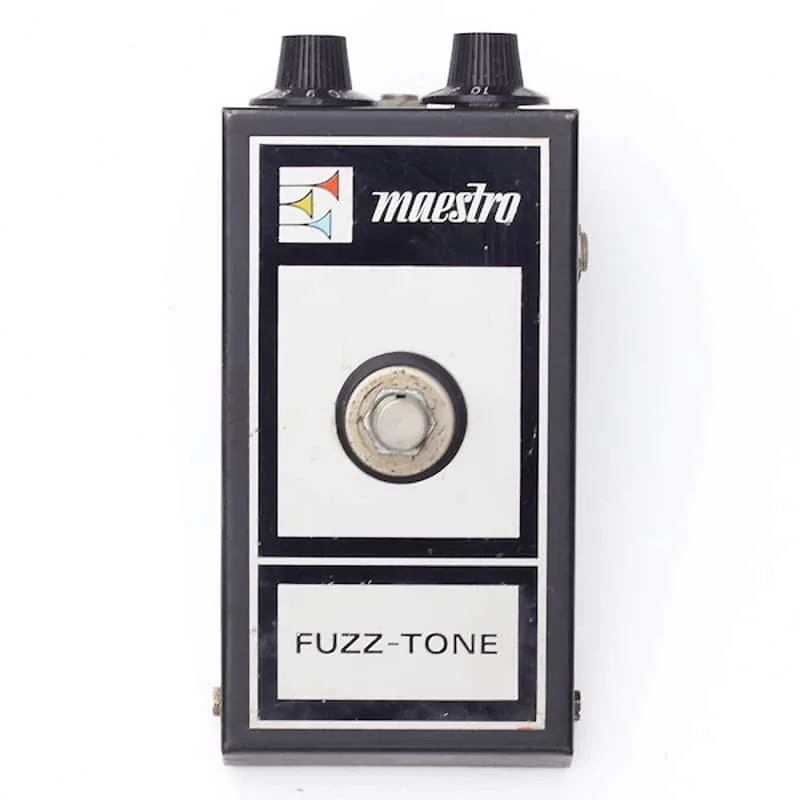
The FZ-1B redesign in 1968 is notable for who did it: legendary synthesizer engineer Robert Moog crafted a circuit using a nine-volt power supply that powered two or four silicon transistors, depending on the date of manufacture7. The FZ-1S Super-Fuzz, a later model, was designed by Tom Oberheim19.
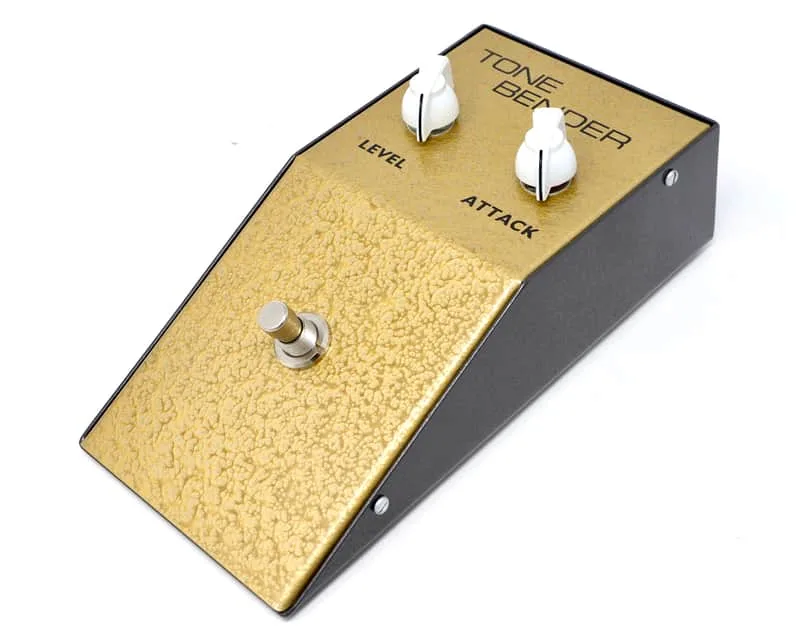
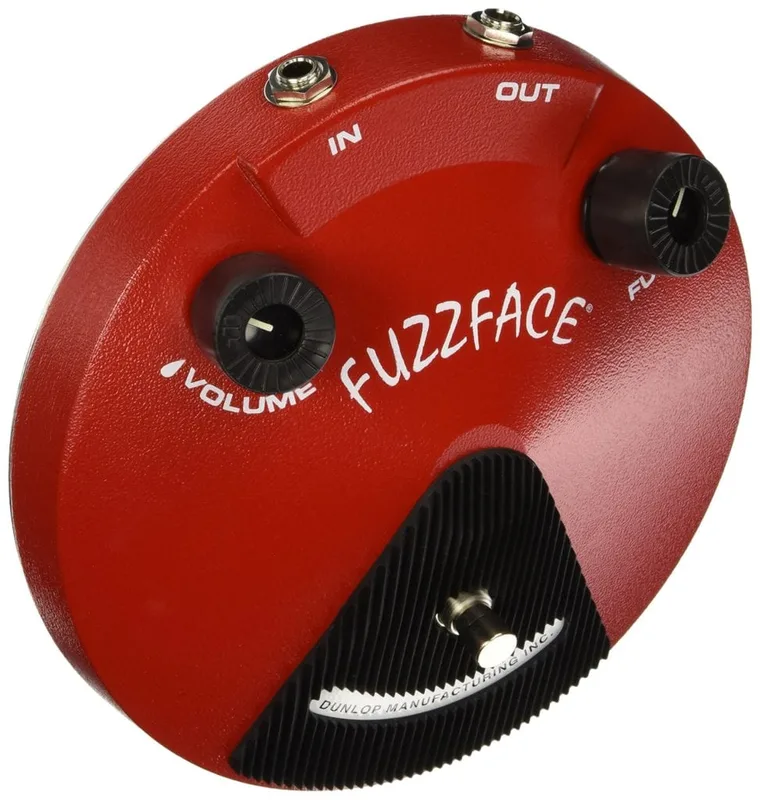
The Fuzz-Tone's influence spread quickly. After its 1965 success, the Fuzz Face and Tone Bender pedals would emerge, and fuzz claimed its place atop the pantheon of guitar effects4. The Tone Bender story begins with the Fuzz-Tone directly: Gary Hurst was approached by James Bond theme guitarist Vic Flick to modify his existing Maestro FZ-1 Fuzz-Tone pedal in order to get more sustain, which led Hurst to design his own circuit20. Those early Tone Benders were built with a three-transistor fuzz circuit based on Gibson's 1962 Maestro Fuzz-Tone16. Kit Rae's technical analysis traces the lineage further: the Fuzz Face most likely originated as a modification of a Colorsound Tonebender, which was itself an evolution of the Maestro Fuzz-Tone circuit21. You can read more about those circuits on the Tone Bender and Fuzz Face pages.
The Gibson reissues
Gibson has returned to the Fuzz-Tone more than once. Gibson released three reissue Fuzz Tones in the '60s and '70s, all differing from the original 1962 units, and briefly reissued the pedal as the FZ-1A in the 1990s14. That 1990s FZ-1A reissue has since been discontinued7.
The original Maestro Fuzz-Tone models are no longer in production, and the 1990s Gibson FZ-1A reissue is also discontinued37. The current production version is the FZ-M, part of Gibson's 2022 revival of the Maestro brand.
The 2022 revival is the big one. Gibson revived Maestro, the name under which it released the legendary Fuzz-Tone FZ-1 pedal in 1962, as a fully fledged pedal brand with five new stompboxes6. The FZ-M Fuzz-Tone is the only pedal in the 2022 Maestro series based on anything Maestro had previously done5. The line's lead designer is Craig Hockenberry, Gibson's director of engineering5.
The FZ-M: Classic and Modern modes
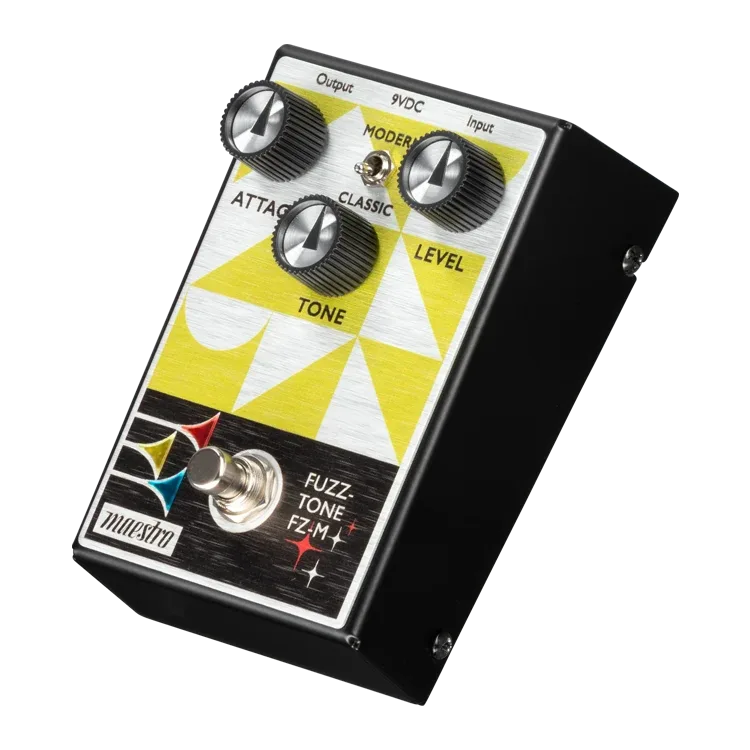
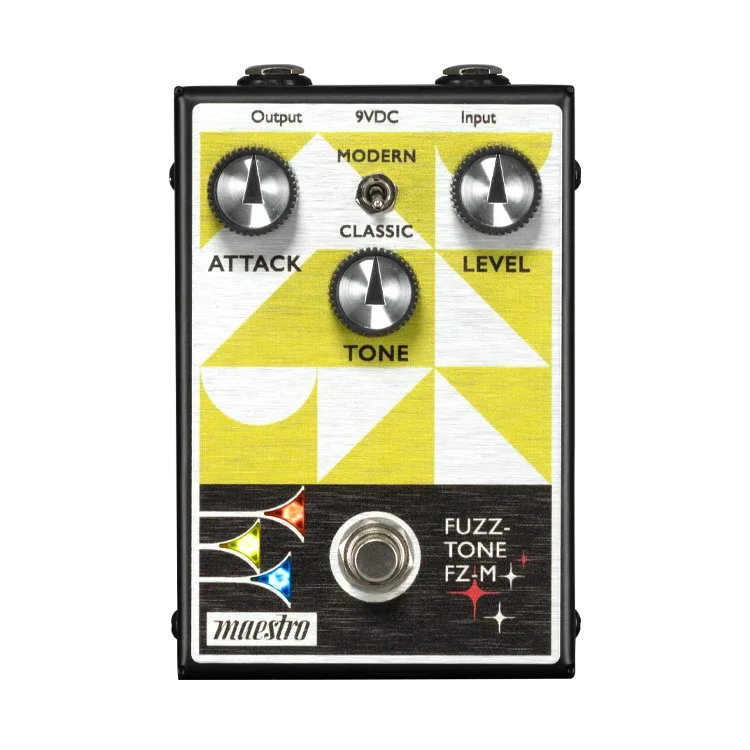
The FZ-M is an update of the FZ-1 that harks back to the original's wedge-shaped enclosure22. It is an all-analog fuzz pedal with modern and classic modes and a three-control layout8. GuitarPlayer's review describes it as a good all-around fuzz that can deliver circa-'60s tones as well as heavy rock grind5.
The headline feature is the Mode toggle switch, which provides two pedals in one functionality: an FZ-1 inspired fuzz sound in Classic mode and a thicker, more modern fuzz tone in Modern mode89. Delicious Audio's take is that the pedal replicates the vintage unit's tone in Classic mode but also offers a more aggressive, thicker sound in Modern mode23.
| Control | What it does |
|---|---|
| Attack | Controls the amount of fuzz9 |
| Tone | Lets you adjust the timbre9 |
| Level | Sets the output volume; it can go way beyond unity gain when desired8 |
| Mode toggle | Selects the FZ-1 inspired Classic fuzz or the thicker Modern fuzz9 |
Hockenberry explained the design choices to GuitarPlayer: the sound is based on the FZ-1A in Classic mode, and it uses discrete transistors, but it is actually more like a silicon version of the Maestro Fuzz-Tone called the FZ-S5. In Classic mode, the FZ-M sounds like an early Fuzz-Tone, with its slightly scooped response and frazzy fuzz sound5.
Reviews were positive. Guitar.com's review scored the FZ-M 9/10:
"Gutsy and distinctive, this multi-voiced fuzz is much more than just a straight retro reboot."
GuitarPlayer's verdict listed its strengths as delivering vintage-style Maestro tone plus modern fuzz5. The FZ-M launched at $1496; Guitar.com's review listed the UK price as £13922, and Gibson's own product page currently lists it at £110 including VAT with free shipping8.
Pedals based on the FZ-1
The FZ-1 circuit has a long afterlife in other makers' pedals, both vintage and modern. Some early British makers borrowed the shape as well as the idea: the Carlsbro Fuzz-Tone is shaped like a Maestro Fuzz-Tone and is part of that first generation of pedals, but it has its own circuit altogether, a three-transistor fuzz that runs off nine volts24. The WEM-Rush Pep Box's circuit is loosely based on the three-transistor Maestro Fuzz-Tone but has only two transistors24.
Modern makers keep returning to the design:
- PedalPCB Mister Fuzz: a DIY build compared to the Maestro FZ-1 Fuzz-Tone25
- Drunk Beaver Fuzzmaster: a modern take on the vintage Maestro FZ-1S fuzz tone circuit26
- Lectric-FX Fuzz Tang: a pedalboard-friendly PCB of the vintage Maestro MFZT-1 Fuzztain Compressor/Fuzz pedal circuit27
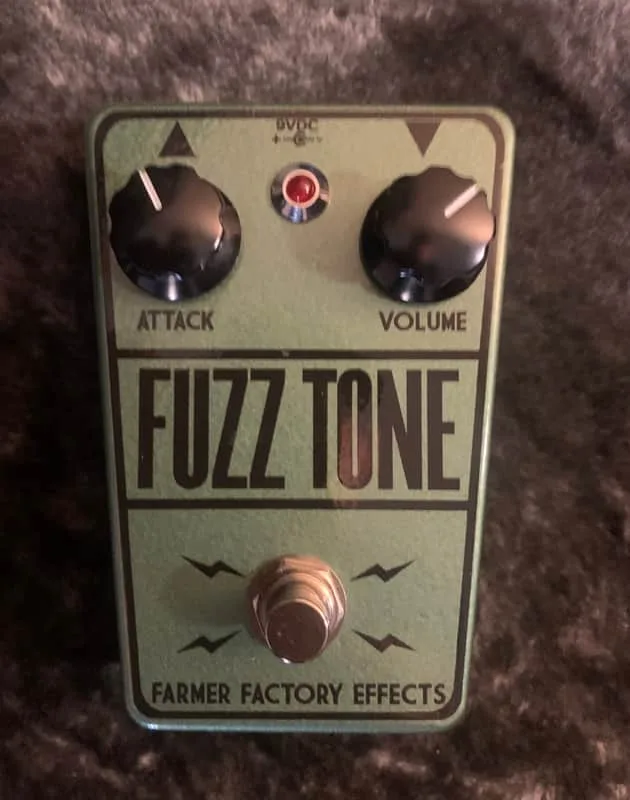
- All Pedal Love Machine: a modern take on the vintage Maestro Fuzz-Tone FZ-128
The DIY world has embraced the circuit too, with stripboard layouts published for the FZ-1A and the FZ-1S Super Fuzz among home builders.
Pedals on this page
Sources (28)
- Maestro Fuzz-Tone, Vintage Guitar magazine, 2015-12-08
- HISTORY OF DISTORTION PART 1, JHS Pedals
- The Maestro Fuzz-Tone, tru-fi.com
- The Best Maestro FZ-1 Fuzz Tone Clones & Evolutions In 2023, Delicious Audio, 2023-05-15
- Maestro FZ-M Fuzz-Tone Review, GuitarPlayer, 2022-04-06
- Gibson revives Maestro as a fully-fledged pedal brand with five new stompboxes, Guitar.com, 2022-01-18
- The history and origins of the iconic Maestro FZ-1 Fuzz-Tone, Guitar World, 2021-10-20
- Maestro Fuzz-Tone FZ-M, Gibson (www.gibson.com)
- Fuzz-Tone FZ-M by Maestro, RockBoard PedalPedia, 2026
- FUZZCYCLOPEDIA : A Side-by-Side Comparison of EQD Fuzz Boxes, EarthQuaker Devices, 2021-08-10
- 5 fuzz pedals guitar players need to try, MusicRadar, 2021-03-16
- FUZ-1 | Guitar Player (October 2005) | Demeter Amplification, Guitar Player, 2005-10
- BALTIC BLUE FUZZ (OC-BBFn), One Control USA
- The new Maestro Electronics Fuzz-Tone promises to give you Satisfaction!, gearnews.com, 2022-01-06
- Fuzz pedals: how the wildest drive of all conquered the radio, Guitar World, 2023-06-14
- Gary Hurst Tone Bender 'MKI' • Fuzzboxes, fuzzboxes.org, 2021-05-20
- Crazy Tube Limelight Review, Premier Guitar, 2019-09-30
- Germanium vs. Silicon Transistors, Keeley Electronics Guitar Effects Pedals, 2013-09-11
- Maestro™ FZ-1S™ Super-Fuzz™ Clone: Schematic & Layout, General Guitar Gadgets, 2014-05-14
- Tone Bender History, britishpedalcompany.com, 1965
- David Gilmour Tone Building, Kit Rae (kitrae.net), 2022-05
- The Big Review: Maestro Original Collection pedals, Guitar.com, 2022-02-10
- Maestro Fuzz Tone FZ-M, Delicious Audio, 2022-01-25
- Five Rare British Vintage Fuzzboxes (That Aren't Tone Benders or Fuzz Faces!), GuitarPlayer, 2021-08-31
- Mister Fuzz, PedalPCB.com
- Fuzzmaster by Drunk Beaver, RockBoard PedalPedia, 2026
- Fuzz Tang- Compression & Fuzz, Lectric-FX (lectric-fx.com)
- All Pedal Love Machine Octave Fuzz, Delicious Audio, 2023-08-28