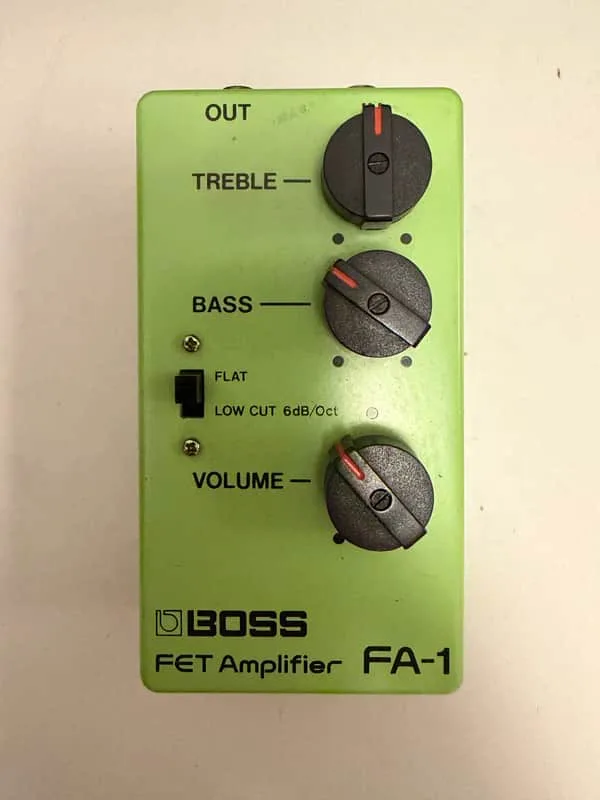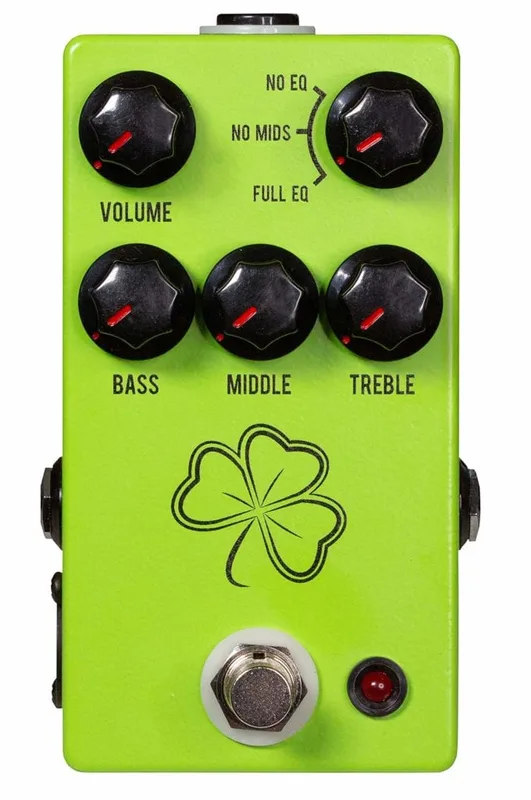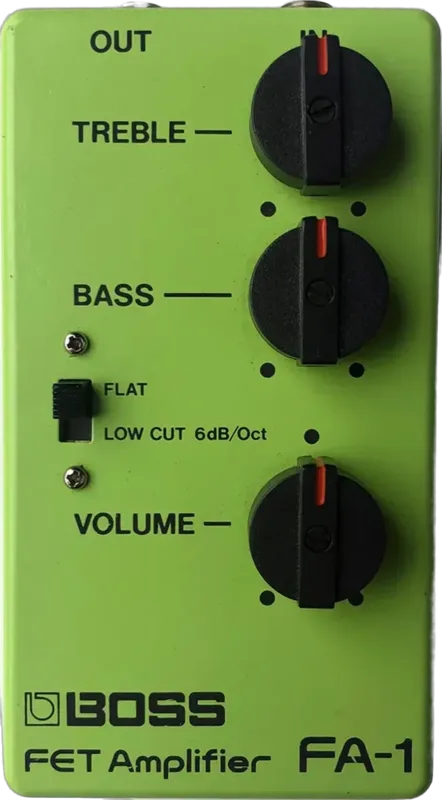


The JHS Clover is a preamp and boost pedal from JHS Pedals, built on a circuit most players have never met: the Boss FA-1 FET Preamp from 1984, part of Boss's Pocket Series. JHS describes the pedal as "our faithful interpretation of the FA-1"12. The FA-1 is a rare and rarely discussed unit, and the Clover is JHS's way of putting that circuit back in front of players in pedal form23.
What it does to your signal
Because the Clover is a preamp as well as a boost, it does more than add volume. JHS positions it as a tone-shaping preamp with a full three-band EQ, and the FA-1 heritage means it is a FET design rather than an op-amp boost. Delicious Audio's Christopher Scapelliti, writing when the pedal appeared at NAMM 2019, described it as "a FET design with some added features that JHS included to make the circuit even better"4.
Guitar World, reviewing a different preamp, still pointed to the Clover as a reference point for the FA-1 sound, saying that if you want "a pedal that also carries the spirit of the Boss FA-1 preamp, the JHS Clover will be right up your" street5. That is as close as published reviewers come to a verdict on its character: an FA-1-style preamp with versatile EQ and plenty of level on tap.
The controls and EQ modes
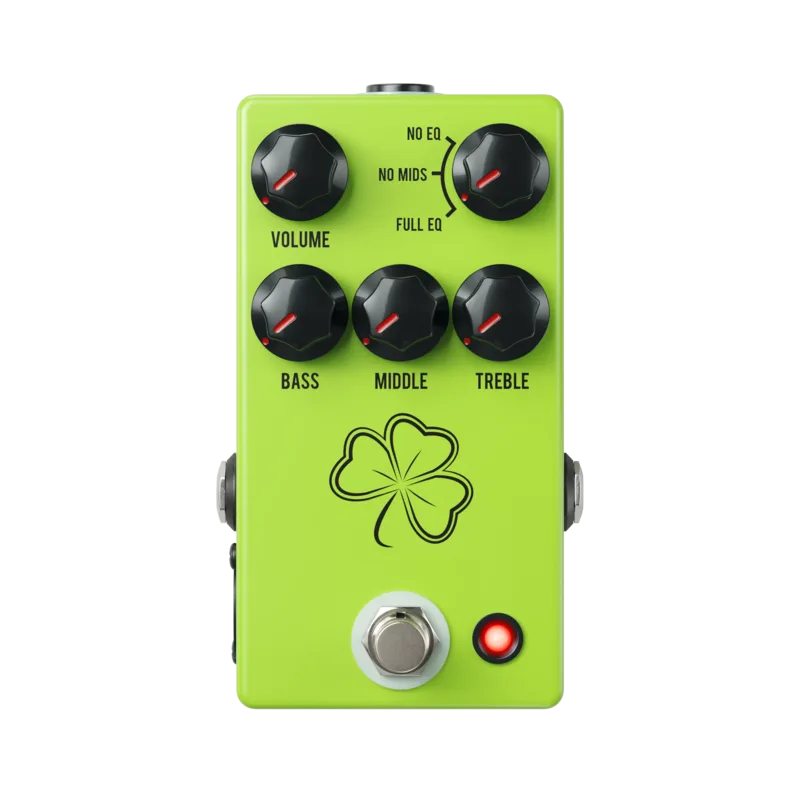
The Clover keeps the control layout simple: a Volume control and a three-knob EQ section covering Bass, Mids and Treble, each of which can cut or boost its band143. What sets it apart from a straightforward EQ boost is the rotary switch that selects how the EQ section behaves4:
| Mode | What it does |
|---|---|
| Full EQ | All three EQ controls are in operation, giving full control over the full range of EQ available1 |
| No Mids | The mids are fixed and only the High and Low knobs are active, taking the midrange out of the tone so you can dial in Bass and Treble as needed43 |
| No EQ | The tone section is taken out entirely, turning the pedal into a straight boost4 |
gearnews put the same idea another way when the pedal was announced: "Here, the EQ or just the middle can be completely taken out, or just everything in it"2. For a player, the switch is the difference between three pedals in one box: a full three-band preamp EQ, a mid-scooped shaping tool, and a clean volume push.
The XLR output and acoustic or bass use
The feature that most clearly marks the Clover as a preamp rather than just a guitar boost is its output section. Alongside the standard 1/4-inch input and output, the Clover carries an XLR output, which JHS says is "for using as an acoustic or bass preamp"1. Delicious Audio describes the balanced XLR output as working in tandem with the standard output, so the signal can run to a mixer or interface while the 1/4-inch side feeds an amplifier4.
There is also a ground lift, which JHS includes for cases where you experience some hum when using the XLR output1. That matters in live and recording situations, where ground loops between an amp and a mixing desk are a common source of noise. Players looking at the Clover for acoustic or bass duty should note that this puts it in different company from most boosts on the site's boost and bass pages, few of which carry a balanced output.
Where it came from
The Clover was announced at NAMM 2019, with Delicious Audio covering it in January of that year4 and gearnews following in April2. Pedal of the Day reviewed it in January 2020, framing it as JHS revamping "yet another long-lost, obscure and intriguing" circuit3. The FA-1 itself dates to 1984, when Boss released it as an FET preamp in its Pocket Series12. Pedal of the Day placed the Clover in a line of JHS revivals of obscure circuits, naming pedals such as the JHS Germanium Boost and, more recently, the JHS Fumble3.
Videos
Eirik Stordrange
We As A Company
R.J. Ronquillo
Questions
What is the JHS Clover based on?
JHS describes the Clover as its faithful interpretation of the Boss FA-1 FET Preamp, a preamp from 1984 that was part of Boss's Pocket Series and is rarely talked about today. Delicious Audio calls it a preamp based on the rare Boss FA-1, and Pedal of the Day notes that JHS revamped another long-lost, obscure and intriguing circuit with this pedal.
What does the EQ rotary switch do on the Clover?
The rotary switch selects between three EQ settings. Full EQ puts all three tone controls, Bass, Mids and Treble, in operation for control over the full range. No Mids keeps the mids fixed and leaves only the High and Low knobs active, taking the midrange out of the tone so you can dial in bass and treble as needed. No EQ takes the tone section out entirely, turning the pedal into a straight boost.
Can the JHS Clover be used with acoustic guitar or bass?
Yes. In addition to the standard 1/4-inch input and output, the Clover has an XLR output that JHS says is for using the pedal as an acoustic or bass preamp. Delicious Audio describes the balanced XLR output as working in tandem with the standard output, so the signal can run to a mixer or interface while the 1/4-inch output feeds an amp.
Does the JHS Clover have an XLR output?
It does. The Clover carries a balanced XLR output alongside its standard 1/4-inch input and output, intended for use as an acoustic or bass preamp. There is also a ground lift switch for cases where you experience hum while using the XLR output.
Is the JHS Clover a FET design?
Yes. Delicious Audio describes the Clover as a FET design with some added features that JHS included to make the circuit even better. The FET topology comes from the Boss FA-1 preamp the pedal is based on, which was itself an FET preamp.
Sources (5)
- CLOVER - JHS Pedals, JHS Pedals
- NAMM 2019: JHS Clover and Whitey Tighty preamp and compressor pedals, gearnews.com, 2019-01-25
- JHS Pedals Clover Preamp EQ Boost, Pedal of the Day, 2020-01-23
- JHS Pedals The Clover Peramp/Boost, Delicious Audio, 2019-04-04
- Attic Audio Putty Saturation Preamp review, Guitar World, 2026-08-13
 The Edge