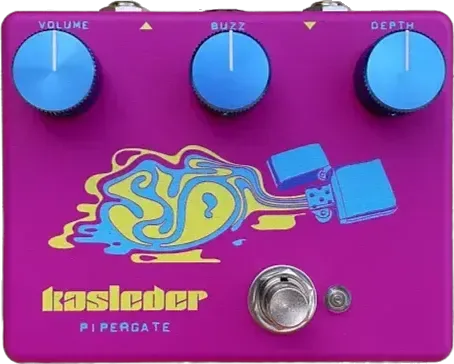



The Kasleder Pipergate is an analog fuzz pedal built around three extremely rare, matched germanium transistors. RockBoard's PedalPedia describes it as a homage to the guitar tone of Syd Barrett, the psychedelic rock pioneer, and his sound presumably using the Selmer Buzz Tone booster/fuzz pedal1. It sits in the fuzz and distortion family, alongside other fuzz pedals on the site.
From the Selmer Buzz Tone to 9V power
The pedal the Pipergate honors has a history of its own. The Selmer Buzz Tone was already being presented at the British Musical Instrument Industries Trade Fair in August of 1966, according to the independent reference Fuzzboxes.org3. There is a long-standing rumor that Syd Barrett used the Buzz Tone during his brief period with Pink Floyd, though Fuzzboxes.org notes there is no direct evidence to substantiate it3. GuitarPlayer's history of rare British vintage fuzzboxes adds a practical detail: the original "came with a clip shaped for a 9-volt battery"4.
Kasleder's version updates the old circuit for a modern pedalboard. While faithful to the three-transistor topology of the original pedal, RockBoard's PedalPedia says it has improved the circuit so that today's guitars work with it, and "the pedal runs now on standard DC9V instead of the 3V of the originals"1. Delicious Audio, covering the pedal in June 2023, put the same point plainly: "it's in a much smaller enclosure and runs at 9v instead of 3v!"2.
The differences between the vintage original and the Kasleder version come down to a few practical points:
| Selmer Buzz Tone (original) | Kasleder Pipergate | |
|---|---|---|
| Circuit | three-transistor topology1 | three-transistor topology, three matched germanium transistors1 |
| Power supply | 3V1 | 9V DC, center negative1 |
| Current draw | not comparable | 5mA1 |
| Bass gain range | fixed | adjustable via the Buzz knob1 |
| Enclosure | full-size vintage unit2 | much smaller enclosure2 |
The original Selmer Buzz Tone ran at 3V, so vintage-unit power figures do not apply to the Pipergate. The Kasleder pedal takes a standard 9V DC, center negative supply1.
Controls
The Pipergate keeps its control set small. The main addition is the Buzz knob, which allows the user to adjust the bass gain range1. That gives the player a way to shape how much low end the germanium fuzz section pushes forward, something the original circuit did not offer.
| Control | What it does |
|---|---|
| Buzz | adjusts the bass gain range1 |
Circuit and power
RockBoard's PedalPedia lists the Pipergate as an analog circuit in the fuzz and distortion category1. The three germanium transistors are matched, which matters for a fuzz because germanium units vary unit to unit and matching keeps the three-transistor topology behaving as intended1. Power needs are modest: 9V DC, center negative, at 5mA1, low enough that any standard isolated supply output can run it.
What the maker says it changed from the original circuit:
- improved so that today's guitars work with it1
- runs on standard DC9V instead of the 3V of the originals1
- built with three extremely rare, matched germanium transistors1
- housed in a much smaller enclosure2
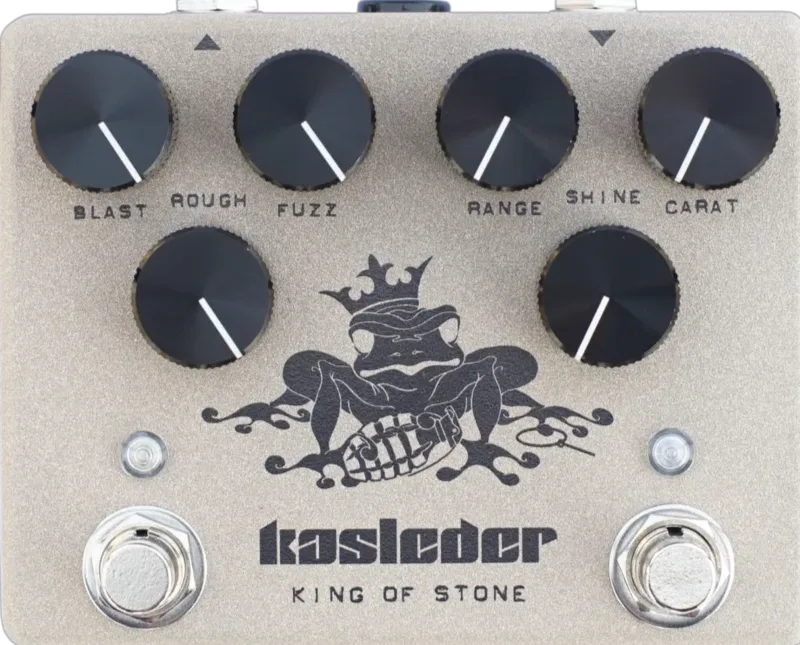
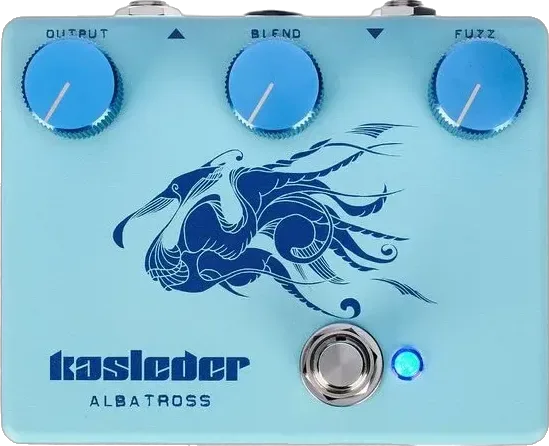
Kasleder also builds other pedals, including the Kasleder King Of Stone and the Kasleder Albstros.
Videos
Kris Barocsi
Buddy Blues
Bibl Rocks - Guitars & Gear Show
Questions
What is the Kasleder Pipergate based on?
Kasleder describes the Pipergate as a homage to the guitar tone of Syd Barrett, the psychedelic rock pioneer, and his sound presumably using the Selmer Buzz Tone booster/fuzz pedal. The circuit follows the three-transistor topology of the original pedal, with improvements so it works with today's guitar setups, including standard 9V power and a Buzz knob that adjusts the bass gain range.
Does the Kasleder Pipergate use germanium transistors?
Yes. Kasleder built the Pipergate around three extremely rare, matched germanium transistors, keeping the three-transistor topology of the original Selmer Buzz Tone circuit it is based on.
What power supply does the Kasleder Pipergate need?
The Pipergate runs on a 9V DC, center negative supply. That is a change from the originals it is modeled on, which ran at 3V, so a standard pedalboard supply works. Its 5mA current draw is low enough for almost any supply.
Is the Kasleder Pipergate analog?
Yes. Kasleder lists the Pipergate as an analog circuit, in the fuzz and distortion category.
How much current does the Kasleder Pipergate draw?
Kasleder lists the current draw at 5mA, which is very low by pedal standards and well within what any standard 9V pedalboard power supply can provide.
Sources (4)
- Pipergate by Kasleder, RockBoard (www.rockboard.de), 2026
- Kasleder Pipergate (Buzz Tone / Syd Barrett-Inspired), Delicious Audio, 2023-06-22
- Selmer Buzz Tone • Fuzzboxes, Fuzzboxes.org, 2021-05-13
- Five Rare British Vintage Fuzzboxes (That Aren't Tone Benders or Fuzz Faces!), GuitarPlayer, 2021-08-31