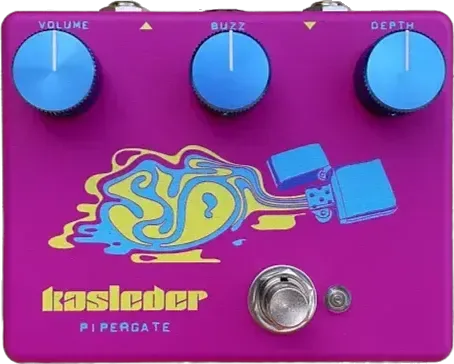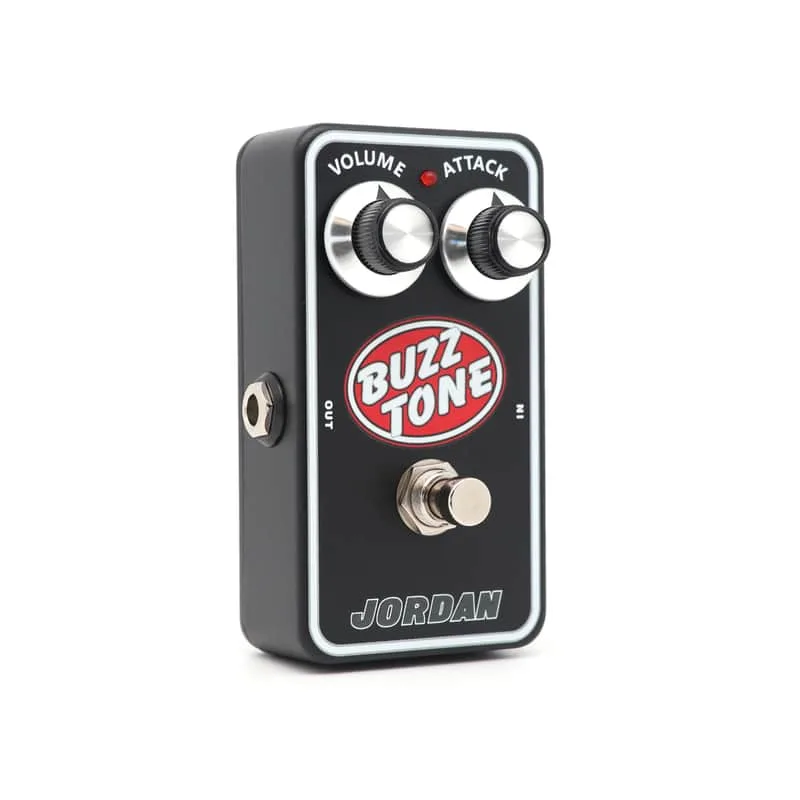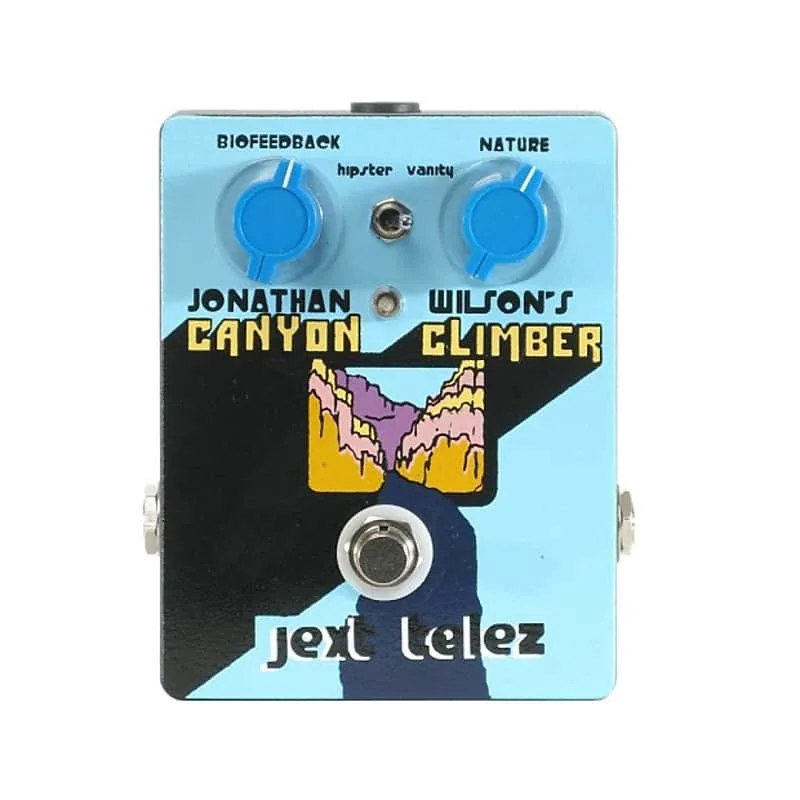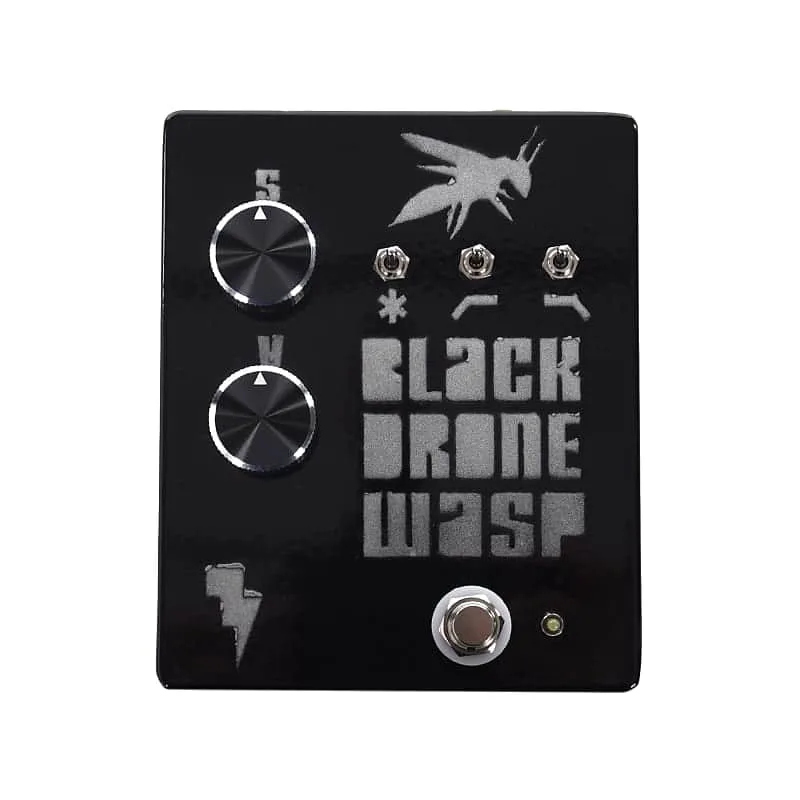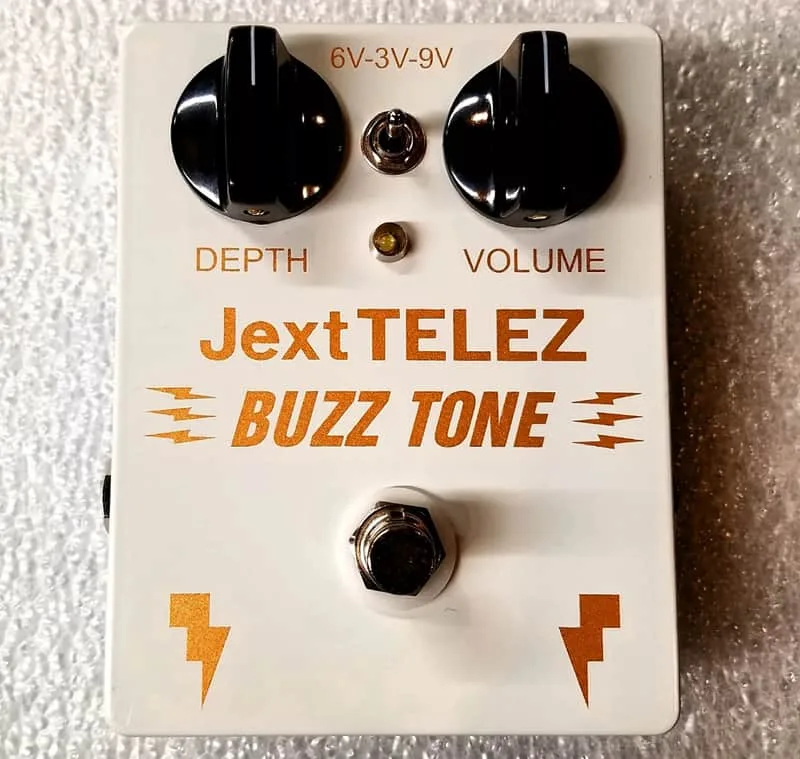



The Jext Telez Buzz Tone is a germanium fuzz pedal built around a piece of British fuzz history. Premier Guitar describes it as a clone of the mid-'60s Selmer Buzz Tone circuit1, and Pedal of the Day sums up its character as "Part Fuzz Face/Uni-Tone, part Tone Bender and all gnarly and nasty"2. It is not a high-gain pedal: Premier Guitar's reviewers found it "pretty noisy, but it is thick, dynamic, detailed, raunchy, and plenty trashy when the occasion demands it"1, and Pedal of the Day calls it "a germanium fuzz that also has trace elements of overdrive packed right in"2, noting it works as a cool overdrive when you back off the gas.
Where the circuit came from
The Selmer Buzz Tone was an early British fuzz box design, according to Fuzzboxes.org3. Its basic fuzz circuit was eventually redesigned and found its way into Selmer's more sophisticated fuzz-wah pedal, introduced in 19683. The circuit sits in the same low-voltage vintage territory as fuzzes like the Maestro FZ-1, which Premier Guitar groups alongside the Selmer Buzz Tone when describing lower voltage vintage fuzzes4. The original Tone Bender line grew from similar roots: Guitar World notes the original Tone Bender was based on a modified Maestro Fuzz-Tone circuit and relatively low voltage5.
The Buzz Tone circuit has been revisited often. Guitar Pedal X observes that "every other brand has its own 'Buzz Tone' variant out there", including JHS's Legends of Fuzz take, and describes the Jordan Buzz Tone as based on the 1967 original6. PedalPCB likewise sells a Buzz Tone Fuzz project described as comparable to the Selmer Buzz Tone7.
The Syd Barrett connection
The stated aim of the Jext Telez version is specific. Pedal of the Day writes that "the goal of the Buzz Tone was to emulate the Syd Barrett/early Pink Floyd tones"2.
"the goal of the Buzz Tone was to emulate the Syd Barrett/early Pink Floyd tones"
The original Selmer has its own legend attached: Fuzzboxes.org notes a long-standing rumor that Syd Barrett used the Buzz Tone during his brief period with Pink Floyd, but that there is no direct evidence to substantiate it3. Delicious Audio describes the Selmer original's gritty and raspy tone and slightly chaotic character as perfectly complementing Barrett's whimsical playing8.
One documented player of the Jext Telez pedal is Premier Guitar's Charles Saufley, who says it "is often my go-to now"1.
Controls and the 3-volt setting
The pedal keeps its control layout simple:
- Depth: sets how much fuzzy drive is mixed into the signal path2
- Easy overall controls: described by Pedal of the Day as a front for a wide dimension of tones2
- 3-volt setting: the pedal's lower-voltage mode, described by Premier Guitar's Charles Saufley as its "even-lower-gain (and vintage-correct) 3-volt setting"1
Pedal of the Day explains that the Depth knob "gives you the chance to set how much fuzzy drive you want mixed into your signal path"2. The same review singles out what it calls the secret weapon: a setting that "pushes the envelope on what a vintage fuzz could and should sound like"2.
That secret weapon is the 3-volt setting. Running the circuit at this lower voltage is what produces the lower-gain, vintage-correct response. For comparison, the Jordan Buzz Tone reissue takes a similar idea further with a "No Clipping" option on its Mods switch6.
The 3-volt mode is described as the vintage-correct setting by Premier Guitar's reviewer1. Players comparing the Buzz Tone with other Selmer-style builds should expect a lower-gain pedal than most modern fuzz designs.
How it sits among fuzzes
Players shopping this territory have several routes to a Selmer-style sound:
| Route | Maker | Notes |
|---|---|---|
| Buzz Tone | Jext Telez | Germanium fuzz, vintage era-correct transistors2 |
| Jordan Buzz Tone | Jordan | Reissue based on the 1967 original, with a "No Clipping" Mods option6 |
| Buzz Tone Fuzz project | PedalPCB | DIY board described as comparable to the Selmer Buzz Tone7 |
| Legends of Fuzz take | JHS | Guitar Pedal X counts it among the many Buzz Tone variants6 |
Jext Telez also builds other vintage-inspired fuzzes:
Videos
Reverb
Pedal of the Day
overcometheidiots
Questions
What is the Jext Telez Buzz Tone based on?
Premier Guitar describes the Buzz Tone as a clone of the mid-'60s Selmer Buzz Tone circuit, an early British fuzz box. Pedal of the Day characterizes the design as part Fuzz Face and part Tone Bender, and notes that the pedal's stated goal was to emulate the Syd Barrett and early Pink Floyd tones.
Does the Jext Telez Buzz Tone use germanium transistors?
Yes. According to Pedal of the Day, the germanium transistors used in the Buzz Tone are vintage and era-correct, which is part of how the pedal pursues its vintage Selmer sound.
Can the Jext Telez Buzz Tone get Syd Barrett tones?
That was the design goal: Pedal of the Day states the goal of the Buzz Tone was to emulate the Syd Barrett and early Pink Floyd tones. The Selmer original it is based on has long been rumoured, without direct evidence, to have been used by Barrett, and Premier Guitar's Charles Saufley calls the pedal often his go-to now.
Is the Jext Telez Buzz Tone a high-gain fuzz?
No. Premier Guitar's reviewers describe it as low-gain but thick, dynamic, detailed, raunchy and trashy when the occasion demands, and Pedal of the Day calls it a germanium fuzz with trace elements of overdrive packed right in, noting it works as a cool overdrive when you back off the gas.
Sources (8)
- The Fuzz Boxes That Fuel PG Staff’s Meanest Musical Moments, Premier Guitar, 2025-05-12
- Jext Telez Buzz Tone Germanium Fuzz, Pedal of the Day, 2018-01-24
- Selmer Buzz Tone • Fuzzboxes, Fuzzboxes.org, 2021-05-13
- Electro-Harmonix Bender Royale Review, Premier Guitar, 2026-02-22
- Is ThorpyFX's Boneyard Fuzz the ultimate take on the Tone Bender?, Guitar World, 2022-03-02
- Guitar Pedal X, Guitar Pedal X, 2025-04-17
- Buzz Tone Fuzz, PedalPCB.com
- Kasleder Pipergate (Buzz Tone / Syd Barrett-Inspired), Delicious Audio, 2023-06-22