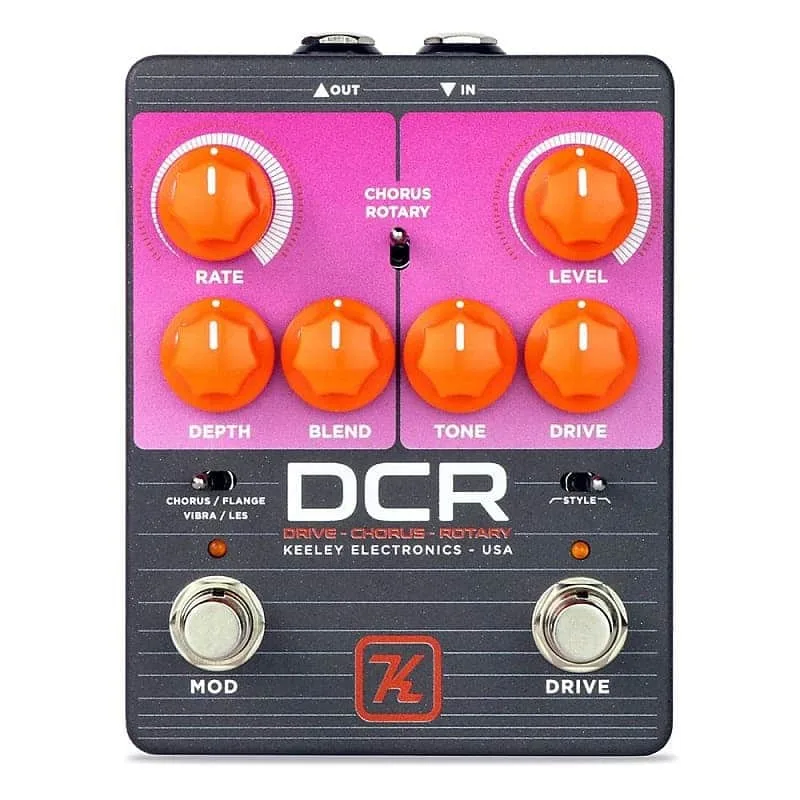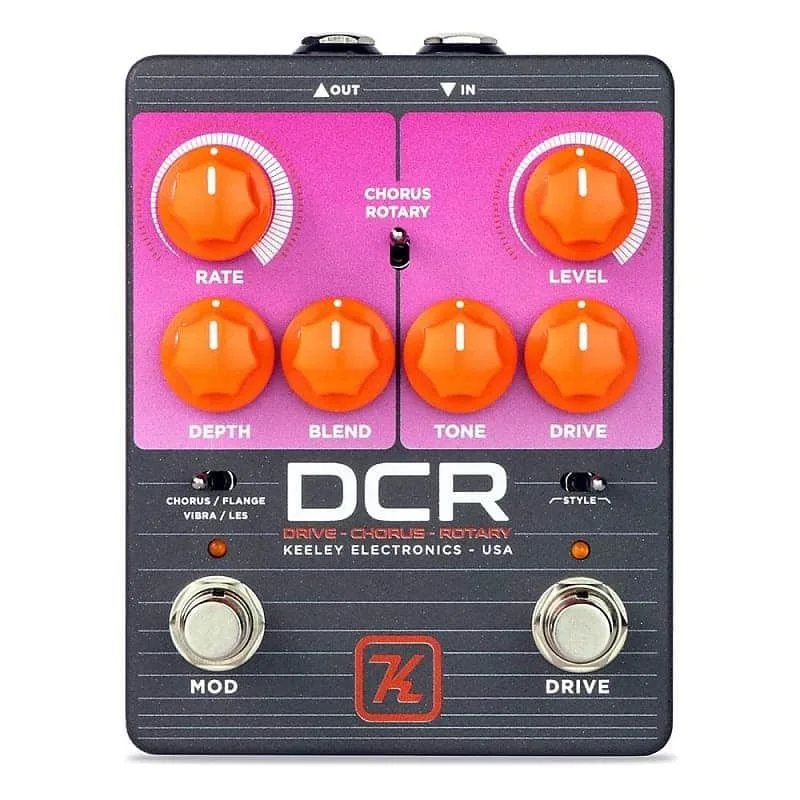


The Keeley DCR Drive + Chorus + Rotary is a two-channel pedal from Keeley Electronics: a high-saturation drive on the left side and a modulation section on the other that covers chorus, flanger, rotary-speaker swirl and vibrato1. Each half has its own footswitch, so you can run the drive alone, the modulation alone, or stack the two together, and the drive channel feeds into the modulation section when both are on12.
Keeley announced the DCR in September 2019 as an offshoot of its DDR pedal, retailing at $1792. It is a Keeley Kustom Shop exclusive, designed and manufactured in Oklahoma, USA1.
A drive and a chorus or rotary in one pedal
The DCR is built around a simple idea: overdrive and modulation have long lived together, and this pedal puts both in one compact enclosure with top-mounted jacks for easy pedalboard fitting3. Delicious Audio called it "one colorful and toneful small effects pedal"1.
The drive side offers two profiles. One is full-range and highly saturated, letting you push the gain hard. The other combines a slight shelf filter with a low-pass filter, a mode Keeley describes as delivering tube warmth and thickness12. Keeley characterizes the drive as a "highly saturated, perfectly compressed, tube-gain tone"2. Pedal of the Day found the two profiles "work perfectly for warming up or thickening any guitar, amp and rig you could think of"3.
The modulation side gives you a choice of chorus or flanger, or rotary speaker-swirl2. The chorus/flanger switch selects between what Delicious Audio describes as "a thick, doubling chorus or a syrupy, slick flanger tone"1. The rotary side has Vibra and Les modes for creating a vintage organ tone, and Keeley's rotary speaker tones are described as "lush and EQ'd in a way that captures the magic of those 3D mechanical choruses"1.
Delicious Audio also noted a design lineage: in a visual nod to the Ibanez Sesh-Man, the DCR combines the drive-and-chorus combo experience of that pedal with the thick modulated tone of the old TC line-cord chorus/flanger, plus the tone-stamp of a rotary speaker1.
"These two stack so well, it's not a matter of do they work well together, it's a matter of how awesome they sound together."
How it relates to the DDR
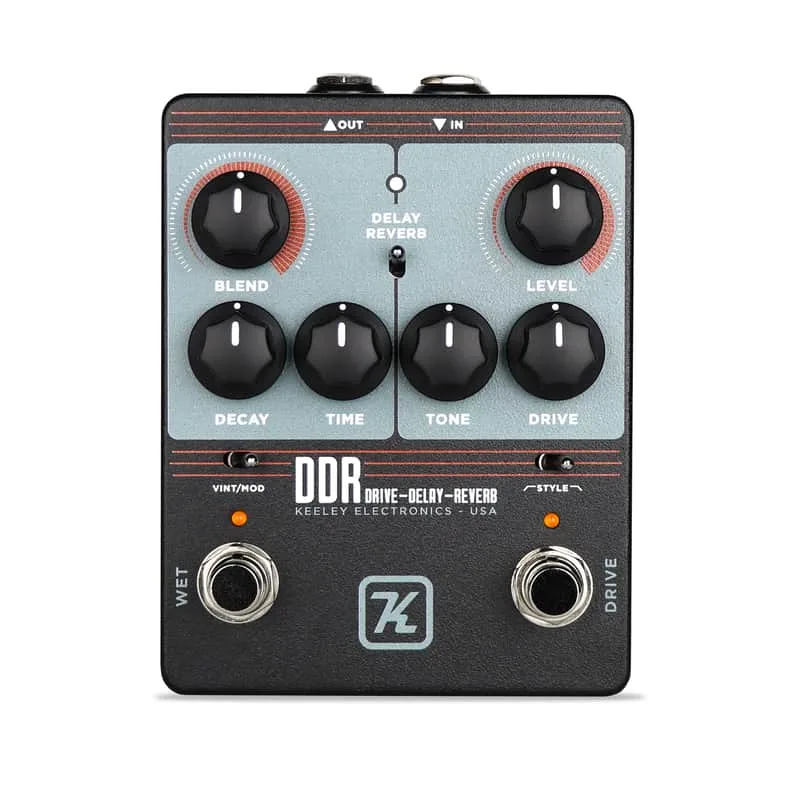
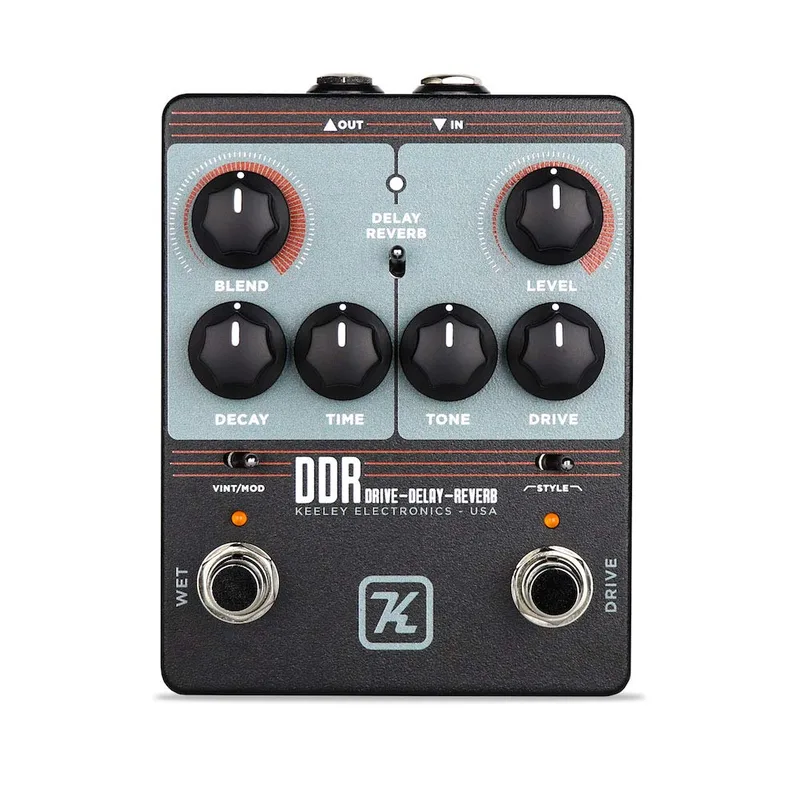
The DCR follows a similar principle to the Keeley DDR, which combined overdrive, delay and reverb in one enclosure2. Where the DDR covers time-based effects, the DCR covers modulation: chorus, flanger, rotary and vibrato alongside the drive. Players comparing the two are really choosing between delay and reverb on one hand and chorus and rotary swirl on the other.
The controls
The DCR's front panel divides into a drive channel and a wet (modulation) channel, each with its own footswitch1.
| Control | What it does |
|---|---|
| DRIVE channel | High-saturation stacked drive with Volume, Drive and Tone controls1 |
| STYLE switch | Selects Tube-amp Crunch or Lead-channel Sustain1 |
| WET channel | Chorus or Rotary, with a Chorus/Flange switch and Vibra/Les rotary swirl1 |
| Drive footswitch | Engages the drive channel independently1 |
| Modulation footswitch | Engages the modulation channel independently1 |
The STYLE switch shapes the drive's character between a lower-gain tube-amp crunch and a lead-channel sustain sound1. On the wet side, the Chorus/Flange switch picks the modulation flavor, and the Vibra/Les switch sets the rotary mode1.
The TRS insert loop
One of the DCR's most useful features is its insert loop. The Input and Output jacks double as TRS inserts, allowing you to patch any effect in between the drive and the chorus13. In practice this means you can place a delay, fuzz or any other pedal after the drive but before the modulation, all without repatching your board, since the drive channel feeds into the modulation section in the DCR's normal signal flow2.
Power, bypass and build
The DCR runs on 9V DC at 100 mA and has no battery option, so it needs a spot on your power supply1. It is true bypass, which Pedal of the Day noted means "your original tone remains intact even when the effect is bypassed"3.
The DCR draws 100 mA and takes no battery. Make sure your power supply has an output that can cover it before building it into a board.
Build quality drew praise from reviewers. Pedal of the Day wrote that "the build quality coming from the Keeley Electronics folks is second-to-none, which also means that your DCR" will most likely outlast its owner3. The pedal is designed and manufactured in Oklahoma, USA12.
What reviewers said
Reviewers were positive about the DCR's concept and construction:
- Delicious Audio highlighted how well the drive and modulation stack, calling the pairing a matter of "how awesome they sound together"1.
- Pedal of the Day called it a 3-in-1 effect whose sounds "will get all your creative juices a-flowin'" and praised the top-mounted jacks for pedalboard fitting3.
- MusicRadar reported the September 2019 announcement, noting the $179 price and the USA manufacture2.
Related pedals
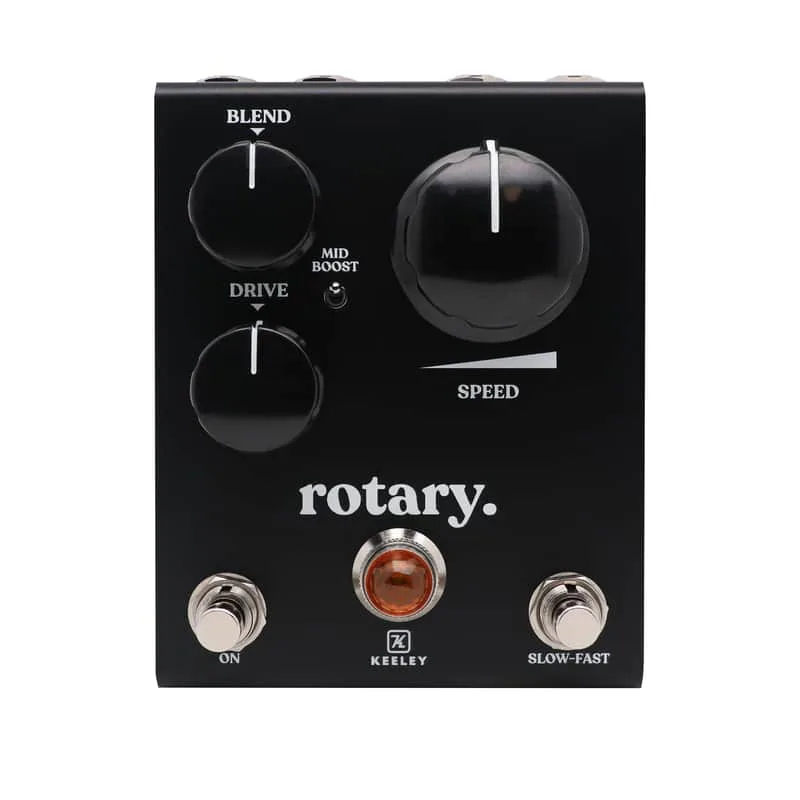
If you are shopping the modulation side of this pedal separately, Keeley's later Rotary pedal covers rotary-speaker simulation in a standalone stereo format. For the effect types themselves, see the site's pages on chorus, flanger, vibrato and overdrive pedals.
Videos
Mike Hermans
Pedal of the Day
Sean Pierce Johnson
Questions
Does the Keeley DCR take a battery?
No. The DCR runs on a 9V DC power supply only, drawing 100 mA, with no battery option. You will need a center-negative 9V supply or an isolated output on your pedalboard power brick to run it.
Can I put another pedal between the drive and modulation on the DCR?
Yes. The Input and Output jacks double as TRS inserts, so you can patch any effect you like between the drive channel and the modulation channel. That lets you, for example, insert a delay or fuzz after the drive but before the chorus or rotary swirl.
Is the Keeley DCR true bypass?
Yes. The DCR uses a true-bypass switching circuit, so your original guitar signal passes through untouched when both the drive and modulation channels are switched off.
Does the DCR do flanger as well as chorus?
Yes. The modulation side offers a Chorus/Flange switch, giving what Delicious Audio describes as a thick, doubling chorus or a syrupy, slick flanger tone. There is also a rotary-speaker mode with Vibra and Les settings.
How is the DCR different from the Keeley DDR?
The DCR follows the same principle as the DDR, which combined overdrive, delay and reverb in one enclosure, but the DCR swaps the delay and reverb for modulation: chorus, flanger, rotary speaker swirl and vibrato, alongside its drive channel.
Sources (3)
- Keeley DCR Drive + Chorus + Rotary, Delicious Audio, 2020-11-04
- Keeley Electronics invites drive, chorus and rotary to the party with the DCR pedal, MusicRadar, 2019-09-03
- Keeley Electronics DCR Drive Chorus Rotary, Pedal of the Day, 2020-04-25