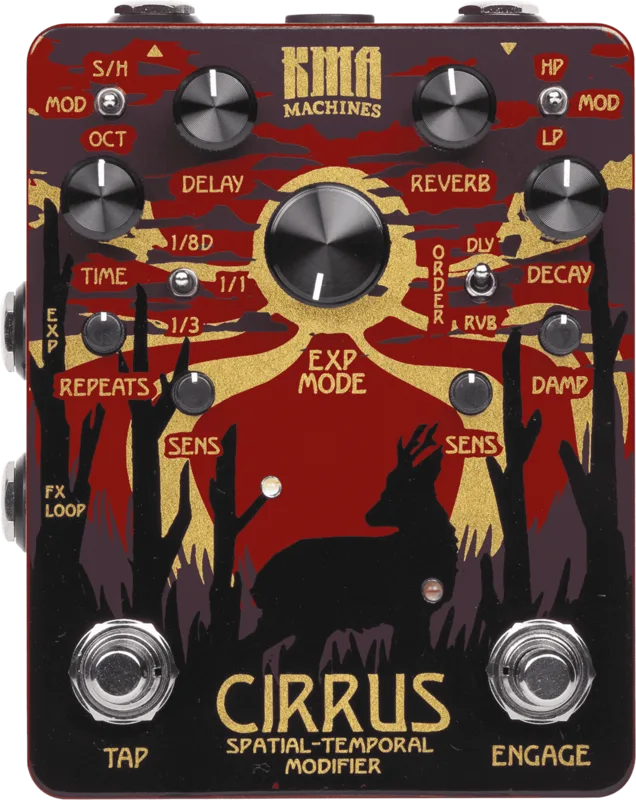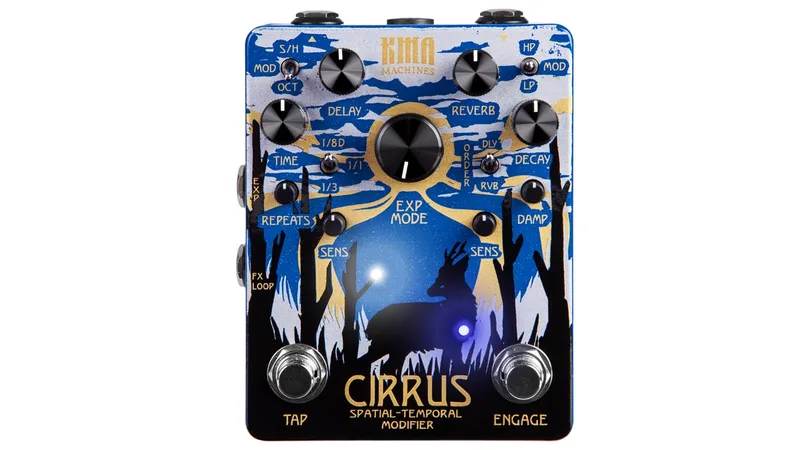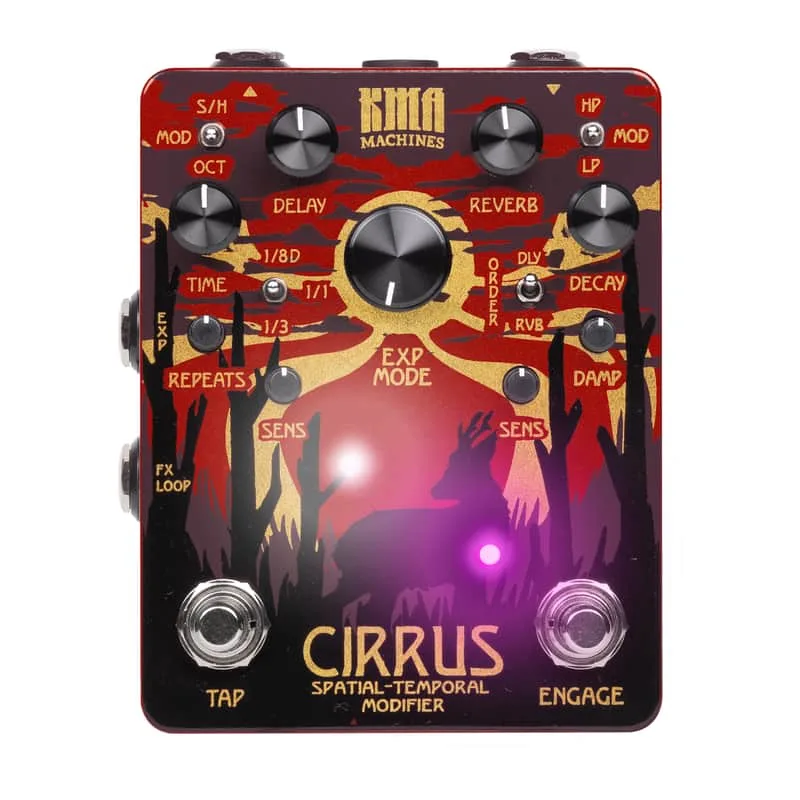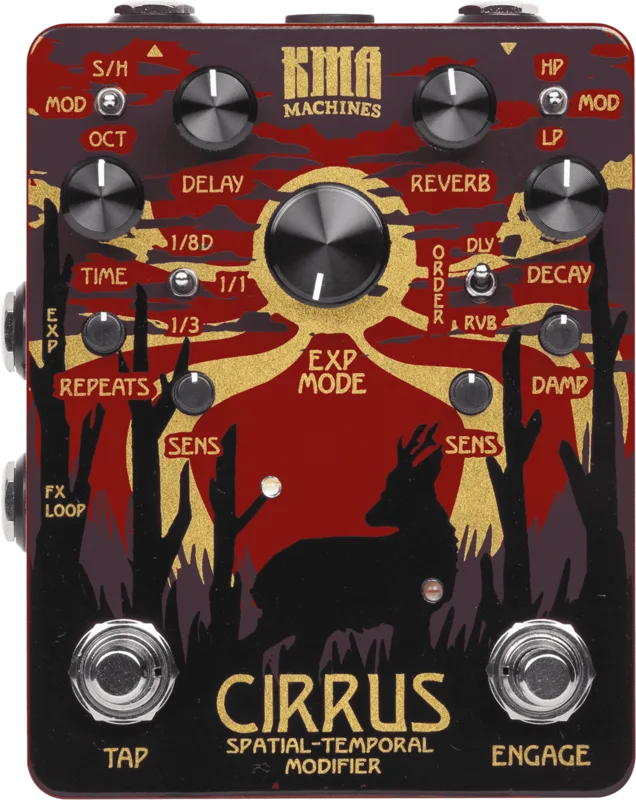


The KMA Machines Cirrus is a digital delay and reverb pedal in one box, with a Tap-Tempo footswitch on the left and an Engage/Bypass switch on the right1. KMA describes it as the company's first step into the fully digital realm1. The delay side includes a modulated mode that KMA says fluctuates the delay signal for a tape echo-inspired modulation, from subtle sways to pitch-bends, while the reverb side has dynamic low-pass and high-pass modes that respond to how hard you pick1. It listed at $229.99 USD, £185 GBP2.
What sets the Cirrus apart from a simple two-in-one ambient pedal is dynamic sensitivity: every delay and reverb mode has a sensitivity control that lets the effect respond to your picking attack, so the character of the repeats and the reverb can shift with how hard you play13.
What the Cirrus does
The pedal splits its face into two halves. The left side is the delay, with Time (up to 1.5 seconds), Repeats and its own mix control; the right side is the reverb, with Decay and Damp and its own mix control14. Between them sits a large middle knob, and an Order Toggle sets whether the delay runs into the reverb or the other way around15.
An internal switch can turn the reverb and delay trails on or off, so you can choose whether the ambience cuts abruptly or rings out when you bypass the pedal1. There is also an FX loop that lets you insert any pedals before the delay and reverb sounds, which opens up options like feeding an overdrive or filter into the repeats5.
Two footswitches sit at the bottom: a tap tempo switch on the left and an engage/bypass switch on the right1. Both have secondary functions. Holding the tap switch keeps the repeats going as long as it is held down, and the bypass switch similarly holds the reverb decay; when the pedal is off, holding the bypass switch engages it momentarily for sudden bursts of ambience12.
The modes
Each side offers three modes, and all six share the sensitivity feature that lets pick attack alter the effect14.
| Side | Mode | What it does |
|---|---|---|
| Delay | MOD | Fluctuates the delay signal with tape echo-inspired modulation, from subtle sways to pitch-bends1 |
| Delay | S/H | Adds a sequencer-like filter in front of the delay line, for synthy textures1 |
| Delay | OCT | Blends in a high octave as notes decay, for shimmery dimensions1 |
| Reverb | MOD | Decorates the trails with smooth movement1 |
| Reverb | LP | An opening low-pass filter: harder picking opens the filter and brings in shimmering highs1 |
| Reverb | HP | A closing high-pass filter: harder picking cuts lower frequencies for lo-fi textures1 |
The filter modes are where the dynamic sensitivity is most audible. In the reverb's LP mode, the harder you pick, the more the low-pass opens up; in HP mode, picking harder closes the high-pass and thins the sound out1. Gearnews described the delay side's Mod mode as tape echo-style modulation and the Sample & Hold mode as a way to create synth-like textures6.
The controls
Beyond Time, Repeats, Decay and Damp, each side has a Sensitivity knob. On the delay side it controls the sensitivity of the envelope features in each mode; on the reverb side it sets modulation depth and frequency cut-offs, behaving differently depending on the mode5. The Damp knob sets the high-frequency response of the reverb5. Each side also has its own mix control, so the two effects can be balanced independently1.
For external control, the Cirrus has an expression pedal input using a standard TRS connection, with a selector switch to choose which parameter it drives1. Time, Repeats, Sensitivity, Damp and Decay can all be controlled externally via an expression pedal and the large middle knob5.
Power and connections
The Cirrus draws up to 220 mA at 9 V DC, center negative, on a 2.1 mm plug1. That is well beyond what a typical 9V battery or a low-current daisy chain output supplies, so plan on an isolated or adequately rated power supply.
Connections are a standard input, a standard output, an FX loop and the expression input2. The pedal measures 90 mm wide by 120 mm deep, so it occupies a comparable footprint to other dual-effect pedals of its type1.
Versions and where it came from
The Cirrus is KMA Audio Machines' first step into the fully digital realm1, and it listed at $229.99 USD, £185 GBP2. Both footswitches carry secondary functions: holding the tap switch keeps the repeats going as long as it is held down, and the bypass switch keeps the reverb decay going, with a momentary function when the pedal is off to bring the effect in and out2. The Engage switch can also be held while the pedal is off to engage it momentarily for sudden bursts of ambience1.
What reviewers said
Guitar World's Trevor Curwen reviewed the Cirrus and summarized it as:
"A great resource for creating complex ambient textures that can also supply conventional delay and reverb when you are feeling less experimental"2
Pedal of the Day was more effervescent, writing that "Cirrus is an incredible machine that will be talked about for years to come"5. At launch, Guitar World called it "a soundscaper's dream"3.
Videos
The Pedal Zone
Rabea Massaad
TheGuitarGeek
Questions
Is the KMA Cirrus true bypass?
Yes. KMA Machines lists the Cirrus bypass type as true bypass, so with the pedal disengaged your dry signal passes through without active processing. The bypass footswitch also has a secondary function that holds the reverb decay, and when the pedal is off you can hold it for a momentary burst of ambience.
Can you change the order of delay and reverb on the Cirrus?
Yes. An Order Toggle lets you run the delay into the reverb, or flip it so the reverb feeds the delay. Reviewers noted that putting reverb into delay gives a more experimental, out-there effect, while the default order behaves more conventionally.
How long is the Cirrus delay time?
The Time control on the delay side reaches up to 1.5 seconds, and there is a tap tempo footswitch on the left of the pedal for setting the time in rhythm. Repeats are set with their own control on the same side.
Does the KMA Cirrus have an expression pedal input?
Yes. The Cirrus has an expression pedal input using a standard TRS connection, with a selector switch that chooses which parameter it controls. Time, Repeats, Sensitivity, Damp and Decay can all be driven externally.
Where is the KMA Machines Cirrus made?
The Cirrus is made in Germany. KMA Machines is a German effects maker, and the Cirrus was its first fully digital pedal, following a line of analog distortion and filter designs.
Sources (6)
- CIRRUS - Spatial-Temporal Modifier | KMA Machines, KMA Machines
- KMA Machines Cirrus review, Guitar World, 2020-09-11
- The KMA Audio Machines Cirrus delay and reverb is a soundscaper's dream, Guitar World, 2019-09-20
- KMA Machines launches limited-edition Cirrus ICE reverb and delay pedal, Guitar World, 2020-11-10
- KMA Machines Cirrus Spatial-Temporal Modifier, Pedal of the Day (www.pedal-of-the-day.com), 2020-06-02
- KMA Audio Machines Cirrus: A mindbending Spatial-Temporal Modifier pedal, gearnews.com, 2019-09-20