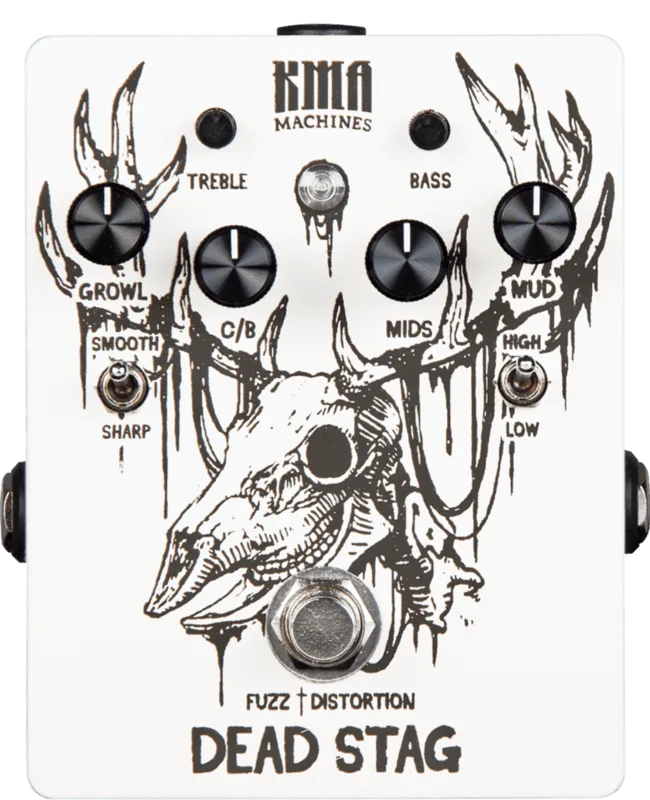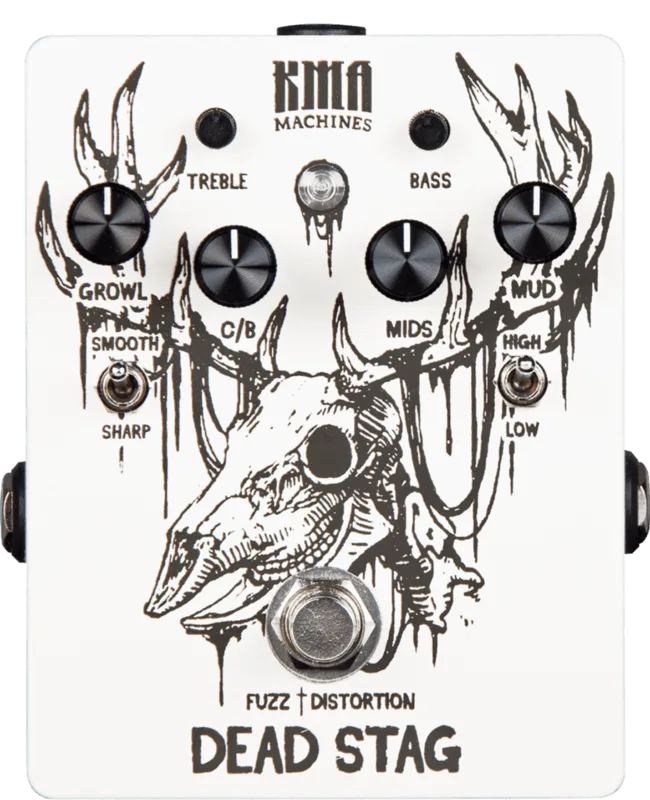


The KMA Machines Dead Stag is a distortion and fuzz pedal built around the Big Muff family of circuits. KMA describes it as "based on one of the most classic discrete fuzz/distortion circuits in pedal history," reworked into "a Big Muff style pedal, but one with many more tonal options and smart features"1. Pedal of the Day put the same idea in plainer terms: "The Dead Stag is a Distortion, yes, but it's also a Fuzz, so you get the best of those two worlds in one slick enclosure"2.
The pedal is discontinued. KMA lists it as a legacy product and states plainly on its product page that "This legacy product is DISCONTINUED"1, so anyone wanting one is looking at the used market.
A Big Muff-family distortion and fuzz
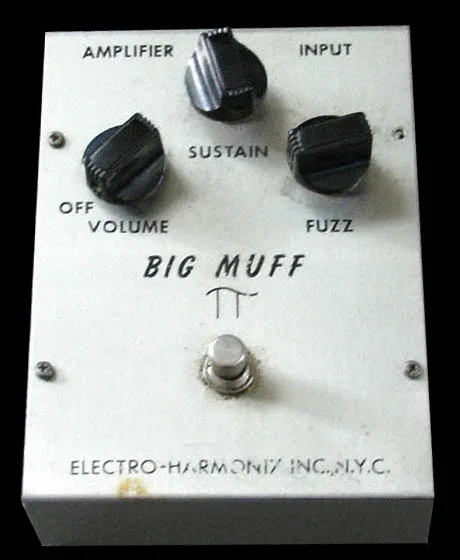
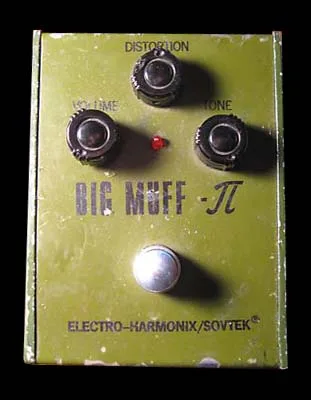
The Big Muff circuit the Dead Stag draws on has a long history. Electro-Harmonix catalogs its Big Muff-family pedals, from the Triangle Big Muff Pi reissue to the Sovtek Deluxe and Deluxe Big Muff Pi, all as "Fuzz / Distortion / Sustainer"3, and the Big Muff Pi itself is described as a distortion/sustainer435. KMA Machines calls the Big Muff one of the most classic discrete fuzz/distortion circuits in pedal history1, and the Dead Stag is built on that circuit: a Big Muff style pedal with more tonal options and smart features, a distortion that is also a fuzz1.
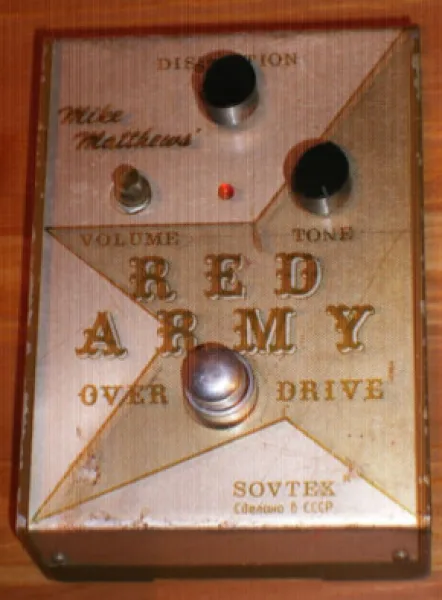
KMA's take on that circuit is not a straight clone. In an interview with guitar.com, KMA's Enrico Preuss described the Dead Stag as featuring "a Red Army Overdrive-based circuit"6, pointing at the Russian-made branch of the Big Muff family rather than the familiar New York versions. What KMA built on top of that foundation is an EQ section that goes well beyond the classic three-knob Muff: active treble and bass controls, a fully parametric mid band, and internal bandwidth shaping12.
Pedal of the Day's review captured the appeal in its own words:
"this beast stays true to the sounds of the vintage effects, but give you a modernized, options-filled machine that lets you dial in the exact sound you need"2
The controls: six knobs
The Dead Stag puts nearly everything on the top of the pedal. KMA notes that "Apart from the internal Q Bandwidth control, every EQ control is on top of the pedal"1. Two footswitchable toggles sit alongside the knobs.
| Control | What it does |
|---|---|
| Growl | Overall output volume12 |
| Treble | Active treble control, +/-15dB of boost or cut2 |
| Bass | Active bass control, +/-15dB of boost or cut2 |
| Mids | Sets the center frequency of the parametric mid control, from 400Hz to 2.4kHz2 |
| C/B | Sets the amount of mid cut or boost, +/-12dB2 |
| Internal Q Bandwidth | Sets the bandwidth of the mid-band EQ: narrow, medium or wide2 |
The two toggles shape the character of the gain itself:
- High/low gain switch: KMA says it lets you "choose between two gain levels"1. Pedal of the Day describes the choice as "either a low gain or a thick, high gain type of distortion"2, and Delicious Audio's roundup of Big Muff-family pedals says the high setting "cranks up the distortion to extreme levels"7.
- Smooth/sharp switch: KMA describes it as giving "your high mids a boost at the end of the circuit"1, which Delicious Audio frames as "a high mids boost for added clarity"7.
The parametric mid section is the feature that most separates the Dead Stag from a stock Big Muff. A classic Muff scoops the mids and offers no way to change that; here, the Mids knob picks where the mid band sits between 400Hz and 2.4kHz, the C/B knob cuts or boosts that band by up to 12dB, and the internal Q control narrows or widens the band itself12. For a player whose Muff-style tone disappears in a band mix, that mid control is the working answer.
Power and setup
The Dead Stag's Gain toggle lets you choose either a low gain or a thick, high gain type of distortion7, so it covers both lighter crunch and heavier saturation without touching the rest of the controls.
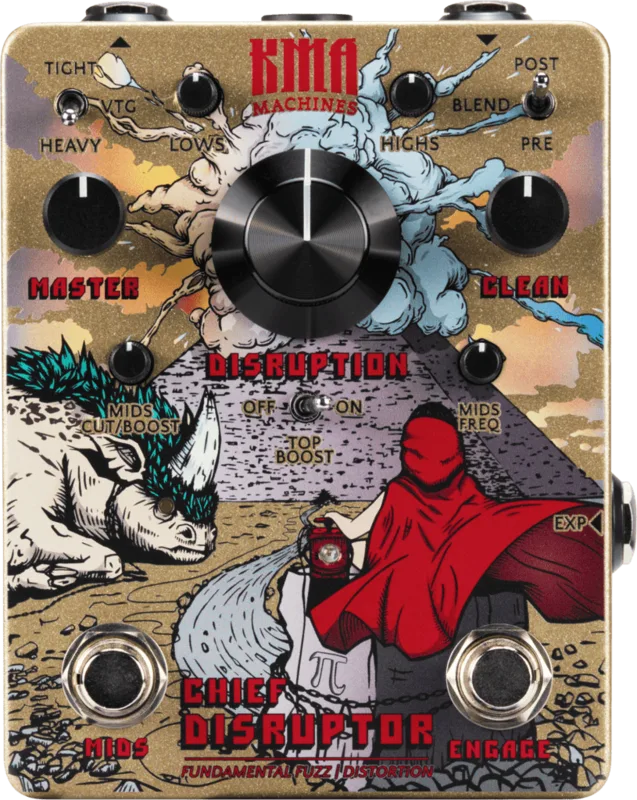
The Dead Stag is discontinued1. KMA has continued in the same territory with later pedals, including the Chief Disruptor, a Big Muff-style fuzz/distortion with three gain modes and a parametric mid EQ of its own7.
Where it sits among KMA's other pedals
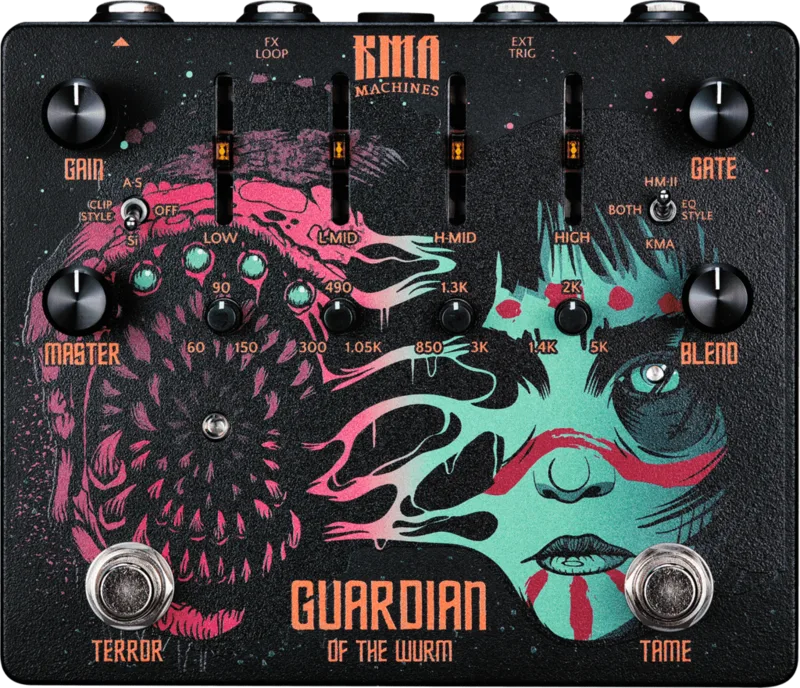
The Dead Stag was part of a run of KMA Machines high-gain pedals built around classic circuits. The company's later Guardian of the Wurm and Wurm 2 pedals take the Boss HM-2 circuit as their starting point instead of the Big Muff, and the Chief Disruptor, which followed the Dead Stag, is KMA's own expanded interpretation of the Muff format7. Against those, the Dead Stag remains the one aimed squarely at players who want a Muff-style fuzz and distortion with a full parametric mid EQ and switchable gain levels12.
Videos
KMA Machines
MrExcane
MrExcane
Questions
Is the KMA Machines Dead Stag discontinued?
Yes. KMA Machines lists the Dead Stag as a legacy product and marks it as discontinued on its product page. It is no longer in production, so finding one means looking at the secondhand market rather than new retail stock.
What circuit is the KMA Dead Stag based on?
The Dead Stag is based on the Big Muff family of circuits. KMA describes it as built on one of the classic discrete fuzz and distortion circuits in pedal history, and in an interview with guitar.com, KMA's Enrico Preuss described it as featuring a Red Army Overdrive-based circuit, a Russian-made Big Muff relative.
What does the Mud knob do on the Dead Stag?
The Dead Stag does not have a knob called Mud. Its six top-panel controls are Growl for overall output volume, active Treble and Bass controls, a Mids knob that sets the parametric mid center frequency, and a C/B knob that sets the amount of mid cut or boost.
What frequency range does the Mids knob cover on the Dead Stag?
The Mids knob defines the center frequency of the parametric mid control, and it sweeps from 400Hz to 2.4kHz. The paired C/B knob then applies up to 12dB of cut or boost at that frequency, and an internal control sets the bandwidth to narrow, medium or wide.
Sources (7)
- Dead Stag, KMA Machines
- KMA Machines Dead Stag Fuzz Distortion, Pedal of the Day, 2020-03-31
- Sovtek Deluxe Big Muff Pi, Electro-Harmonix
- Triangle Big Muff Pi, Electro-Harmonix (ehx.com)
- Deluxe Big Muff Pi, Electro-Harmonix (ehx.com)
- Interview: Enrico Preuss of KMA Audio Machines, guitar.com, 2019-03-11
- Best Big Muff Pedals In 2025: Reissues, Clones & Evolutions, Delicious Audio, 2025-04-07