

The Triangle Big Muff Pi is a fuzz / distortion / sustainer pedal from Electro-Harmonix, a reissue of the very first Big Muff, the Version 1 model made from around 1969 to 1973123. The original got its nickname from the layout of its Volume, Sustain and Tone knobs, which form a triangle on the enclosure, and Electro-Harmonix brought that circuit back in 2018 as a limited release commemorating the company's 50th anniversary (1968-2018)1. The maker says the reissue "nails that creamy, violin-like sustain and musical tone" of the original1.
The reissue keeps the three classic controls but adds things the 1970 pedal never had: an LED, true bypass switching, and 9V power supply operation2. It sits in the standard EHX nano-sized die-cast chassis, a much smaller box than the folded sheet metal original142.
The first edition of 1970
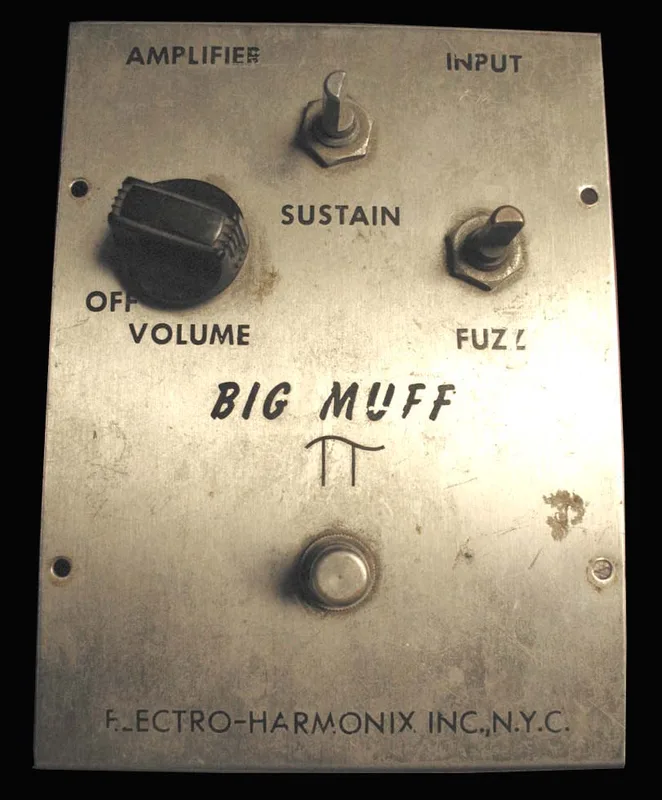
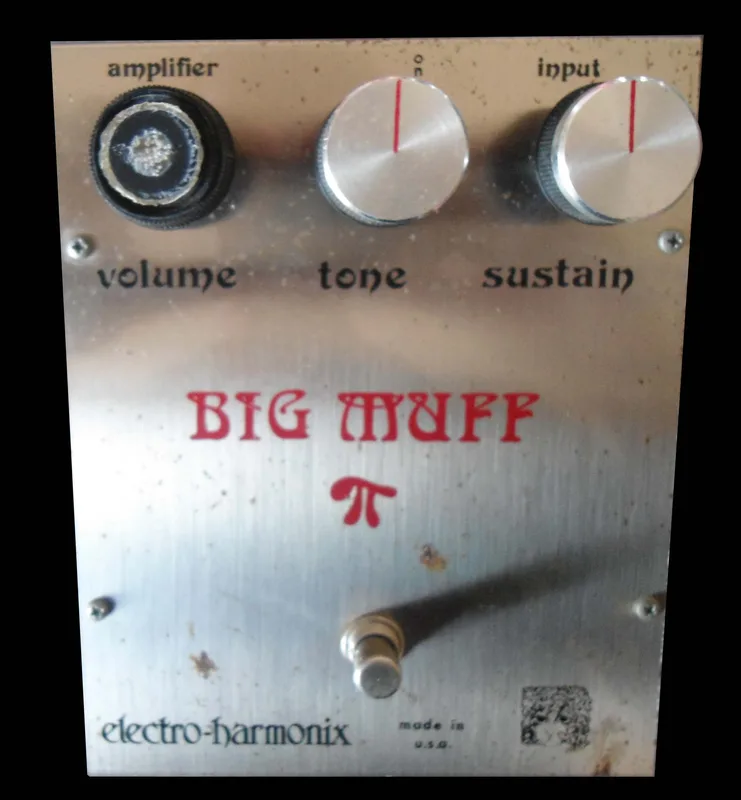
The Big Muff Pi Version 1 was designed by Bob Myer, with modifications by Mike Matthews, and released under the Electro-Harmonix label as model number EH-30032. Matthews wanted a three-knob distortion unit in a bigger enclosure, one with a lot of sustain, and Myer assembled a four-stage silicon transistor circuit: two transistors as input and output amplifiers, and two distortion clipping stages2. The clipping came from silicon soft-clipping diodes, assumed to be 1N914/1N4148 equivalents2.
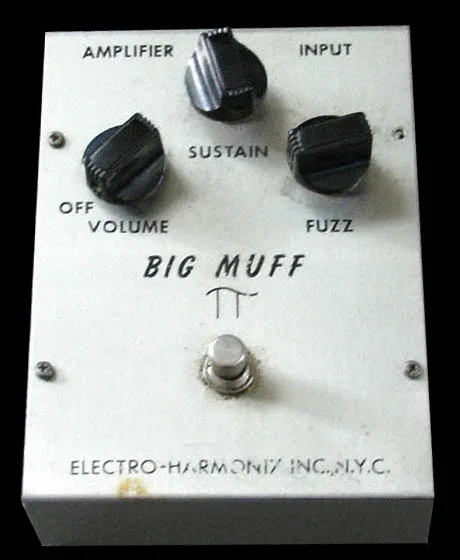
The first edition, manufactured circa late 1969, was hand wired on a perforated (perf) board with NPN 2N5133 transistors2. Its controls were a Volume knob with the on/off switch built into the potentiometer, a Sustain knob, and a tone knob labeled FUZZ, later changed to TONE2. The tone knob was oriented with treble counterclockwise and bass clockwise2. There was no LED and no DC connector; power came from a 9V battery only, drawing approximately 3 mA2.
The enclosure was a simple folded sheet metal two-piece box, 6" x 4 1/2" x 1 3/8" (short end) x 2" (long end), with a rubber skid pad on the bottom and a standard Carling SPDT foot switch2. The list price was $39.95, though original owners report finding it for $30 to 35 retail, and a kit version you assembled yourself sold for $26.952. It became Electro-Harmonix's best seller, with the company selling around 3000 units a month2.
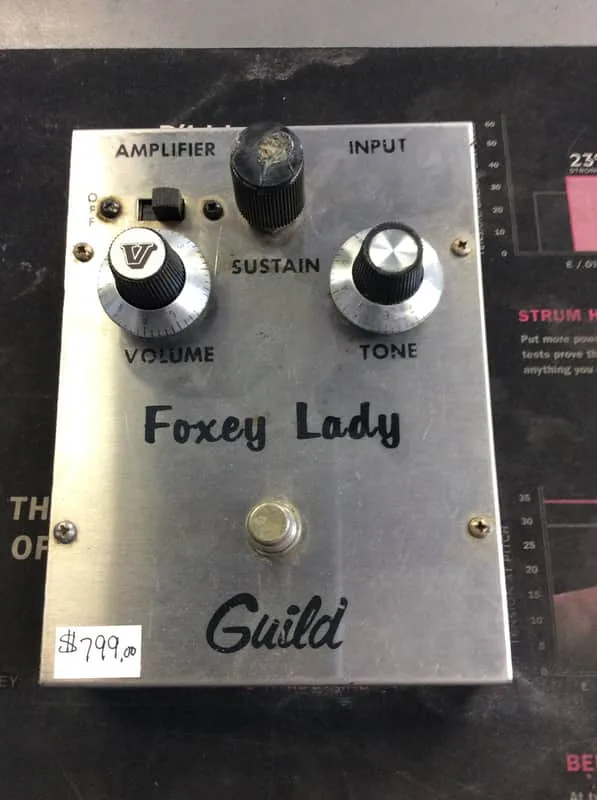
Early Big Muffs were used by Jimi Hendrix, Carlos Santana, John Lennon, Robert Fripp, and Steve Howe3. Steve Howe recorded with one in 1971, and Robert Fripp was recording with one in the Guild Foxey Lady enclosure the same year2. Tony Peluso recorded the solos for The Carpenters' "Goodbye to Love" in 1972 with a Big Muff, a Gibson guitar direct into the recording board with no amplifier2. Ernie Isley played the famous Big Muff solo on the Isley Brothers' "(Who's) That Lady" in 1973, recorded direct into the mixing board with a Strat, Roger Mayer Octavia, and a V1 Big Muff2.
The second edition and the circuit variants
A second edition arrived in early 1970 with a separate on/off switch, added to the left of the sustain knob on top of the pedal, and a printed/etched circuit board pattern26. A receipt from Manny's Music dated 9/25/1970 documents a second edition purchase2. The word TONE replaced FUZZ on the panel2.
What makes the V1 complicated for players chasing "the" Triangle sound is that there was never one circuit. Kit Rae, whose history of the Big Muff is the standard reference, counts at least 18 different circuit variants used in the V1, and notes that none of the three first-edition perf board circuits he documents have identical components or values62. Component values differed from one Muff to another, giving each a slightly different sound2. Matthews himself said that five Big Muffs from the same 1973 production line would probably all sound different2.
The most common circuit variant had very scooped mids, exceptional sustain, moderate gain and low end6. The very early and rare perf board circuits had a unique sound in the low end and lower mid range, with smooth, long sustain and fat, warm bass, but were not especially high gain62. Most V1 variants cut through a band mix well, are articulate for leads, and have a warm crunch for power chords and palm muting62. The same circuit was also common in some Version 2 "Ram's Head" enclosures2.
Stomp Under Foot's Matthew Pasquerella, who builds Triangle reproductions, describes the 1970-1971 Muffs as retaining "the huge, wooly character of the earlier pedals but were less mid-scooped"7, and of the versions he documents:
- V1: "a monstrous, throaty, wooly fuzz with strong breakup on the low notes and a clear, full, smooth lead tone"7
- V2: very close to V1, with a little more top end and a touch more mids7
- V3: considerably more high end, giving upper notes an almost glassy quality7
- V4: overly bass-heavy, balanced out with the tone control around two o'clock7
- V5: gnarly, wooly, gritty fuzz, with lead notes so saturated they almost border on octave fuzz7
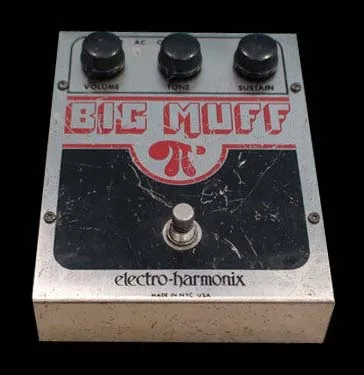
A rare 1972-1973 Triangle transition pedal bridges the Triangle and Ram's Head eras, with circuits very close to the early Violet, Blue, and Black Ram's Head versions but with slight capacitor differences that give a warmer, fuller tone8. The V1 was made in this style until 197339.
Controls and circuit
The reissue carries the same three controls as the classic Big Muff4:
| Control | What it does |
|---|---|
| Volume | Sets the output level1 |
| Sustain | Adjusts the amount of sustain and distortion1 |
| Tone | Provides a range of sounds from high treble to deep bass1 |
The footswitch toggles between effect and bypass, with the effect active when the LED is lit1.
Under the hood, the Big Muff circuit is built in five stages: an input/gain stage, a first clipping stage, a second clipping stage, a tone stage, and an output stage10. The typical circuit is 46 components: 4 transistors, 22 resistors, 13 capacitors, 4 diodes, and 3 potentiometers10. The input section is a transistor buffer that adapts the guitar's impedance to the first distortion stage and amplifies the signal, with a potentiometer wired as a variable resistor setting the gain of the whole pedal11. Two diodes are placed back-to-back in the feedback loop of each of the two clipping stages, creating soft clipping12. Coda Effects notes that, technically, the Big Muff is not a fuzz but a distortion, with most of the saturation coming from diodes, though its two distortion stages produce the heavily compressed, saturated sound players associate with fuzz13.
The tone stack is a passive circuit of just 5 components: two RC filters, a high pass and a low pass, blended by the tone potentiometer1415. On a stock Big Muff, both filters still affect the midrange with the knob at 12, which produces the signature mid scoop1214. The Triangle's tone stack values (R5: 22k, R8: 22k, C8: 0.01uF, C9: 0.004uF) put its cutoff frequencies at 723 and 1809 Hz, compared with 482 and 1206 Hz for the 1973 Ram's Head14. The output stage then boosts the signal back up after the tone control's filters cut it down1211.
The 2018 Triangle Big Muff π reissue
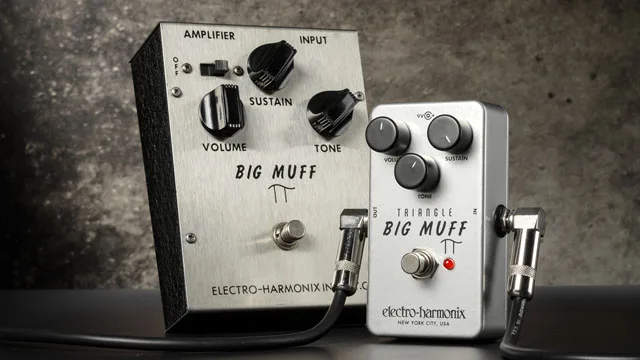
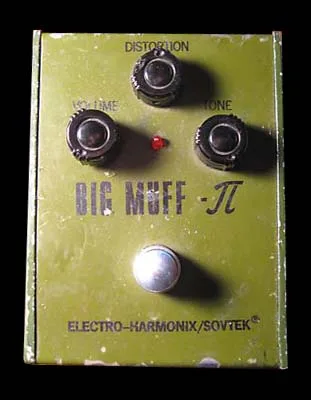
Electro-Harmonix announced the reissue in September 2018416. Founder Mike Matthews framed it as an anniversary release: "I wanted to commemorate EHX's 50th Anniversary by re-releasing V1, the very first Big Muff that started it all"17. It was technically the fifth reissue of the Big Muff, following others in the nano line including the Green Russian and the Op-Amp (designed in conjunction with Billy Corgan)45.
"A re-creation of the original and dripping with vintage Electro-Harmonix DNA and tone. Dubbed the Triangle Big Muff because of the layout of its Volume, Sustain and Tone controls, this is the one that started it all circa 1969."
The reissue was engineered by Gino Maisano, based on Bob Myer's original design, on PCB number EC-D171 REV A4. Because the originals varied so much, the final circuit was a blend of component values from a rare perfboard V1 and a circa-1970 PCB V1 used for research and development, replicating the sound of a few of the more common V1 circuit variants4. Guitar World's Alex Lynham reported that the reissue was specifically based on a unit owned by Kit Rae18. The reissue uses BC547 transistors, with through-hole transistors, capacitors and diodes and small surface-mount resistors4. It is assembled and tested in Long Island City, New York4.
A few details differ from the 1970 pedal: the nickname "Triangle" appears in the graphics, and the triangular knob layout is in reverse of the original V14. The original's Volume on/off switch is gone, leaving the three controls players actually use16. The box is a 2-color corrugated cardboard carton with "Your original pi" printed on the inside lid flap4.
Kit Rae's own comparison found it "probably the loudest and most aggressive Big Muff in the EHX nano line," brighter and higher gain than the Green Russian reissue and the Nano Big Muff, with tight bass and a scooped-mids overall sound, though it can sound very smooth with the sustain dialed down, especially on a neck pickup4. Guitar.com's buying guide describes a smoother, slightly less saturated sound at max settings, but one that can still deliver the huge violin-like sustain the pedal is known for12. Premier Guitar's reviewer found "cutting but singing treble tones" and that it "sounds bold where some Muffs disappear," testing it with a Telecaster Deluxe, Jaguar, Stratocaster, and a '68 Bassman19. Total Guitar rated it 4.5 out of 518.
Power and connections
Plug your instrument or another effects pedal into the ¼" input jack, and connect the ¼" output jack to your amplifier or another pedal1. The reissue runs on the included 9V battery or an optional power supply: the maker lists an optional 9.6VDC-200mA adapter (not included), and Kit Rae's teardown notes the EHX 9.6DC-200BI supply, the same type used by Boss and Ibanez, or other adapters delivering at least 30mA14. Current draw is 3mA per the maker's page1.
The 1970 original is a different story for power. It runs on a 9V battery only, with no DC connector, and while most V1 Big Muffs are negative ground (NPN) circuits, some are positive ground (PNP), which cannot be daisy chained with standard negative center pedals2. A 9V battery snap adapter can connect an original to a standard negative center supply2.
Price
The maker's current list price is $112.501. At launch in September 2018 the US street price was $992017, and Premier Guitar listed an $80 street price in its 2023 review42120. Original Version 1 pedals now sell for hundreds of dollars17.
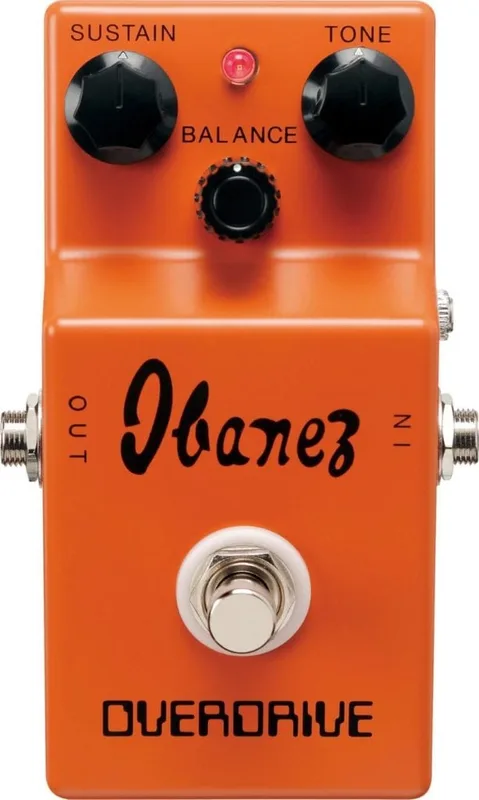
For players who want the fuzz without the reissue, the Big Muff circuit has been copied widely: Kit Rae's list of V1-influenced pedals includes the Jordan Creator (circa 1971), the Ibanez OD-850/Maxon OD-801 (circa 1979), the BYOC Large Beaver, Stomp Under Foot Tri Fuzz, Barber Trifecta, and Wren and Cuff Tri Pi 70, among others2.
Videos
Premier Guitar
EHX
gilmourish
Questions
When was the first Big Muff π made?
The first Big Muff Pi, the Version 1 "Triangle" model, was made around 1969, with the first edition built on perforated circuit board in late 1969 and a second edition with a separate on/off switch arriving in early 1970. It stayed in production until 1973, when Electro-Harmonix moved on to the Version 2 Ram's Head enclosure.
Why is it called the Triangle Big Muff?
Because of the layout of its three control knobs. The Volume, Sustain and Tone knobs sit in a triangular arrangement rather than in a line, and players nicknamed the Version 1 Big Muff the "Triangle" for that layout. Electro-Harmonix later put the nickname right into the reissue's graphics.
How can you tell a first edition Triangle Big Muff?
A first edition has no separate power switch, is hand wired on a perforated circuit board (some have a printed circuit board), and carries a Volume knob with the on/off switch built into the potentiometer. The tone knob is labeled FUZZ rather than TONE. Both editions share the triangular knob layout.
Is the Triangle Big Muff reissue the same circuit as the original?
Electro-Harmonix describes it as a faithful re-creation of the original circa 1969 circuit. Because the originals varied so much, the final reissue blended component values from a rare perfboard V1 and a circa-1970 PCB V1, replicating the sound of some of the more common V1 circuit variants rather than one specific unit.
Sources (21)
- Triangle Big Muff Pi, Electro-Harmonix (ehx.com)
- The Big Muff History of All Versions Part 1, Kit Rae (kitrae.net), 1970
- Big Muff Pi, Stompbox Book, 2020-03-21
- The Big Muff History of All Versions Part 1, Kit Rae (www.kitrae.net), 2018-12
- Electro-Harmonix Triangle Big Muff Pi Review, Guitar.com, 2018-12-20
- Big Muff Versions_Quick Identifier, Kit Rae (kitrae.net), 2026
- 1970-1971 Triangle, Stomp Under Foot, 2026-07-18
- 1972-1973 Transition Triangle, Stomp Under Foot, 2026-07-18
- Stomp Under Foot Recreates The '72 Tri Muff V6 Fuzz, Delicious Audio, 2018-04-23
- BIG MUFF TRANSISTORS AND OTHER COMPONENTS, Kit Rae (kitrae.net), 2012-07
- Coda Effects, Coda Effects, 2026
- A guide to the best Big Muff-style pedals, from classic reissues to boutique oddities, Guitar.com, 2025-07-30
- Coda Effects, Coda Effects, 2015-05
- Coda Effects, Coda Effects, 2026
- beavis audio research, beavis audio research
- Electro-Harmonix reissues the Triangle Big Muff Pi, 50 years after its debut, gearnews.com, 2018-09-07
- Electro-Harmonix Announces Triangle Big Muff Reissue, Guitar World, 2018-09-06
- Electro-Harmonix Big Muff round-up, Guitar World, 2020-03-24
- Quick Hit: Electro-Harmonix Triangle Big Muff Review, Premier Guitar, 2019-01-01
- Electro-Harmonix reissues the classic Triangle Big Muff Pi, Guitar.com, 2018-09-10
- Electro-Harmonix reissues the Triangle Big Muff Pi, MusicRadar, 2018-09-06