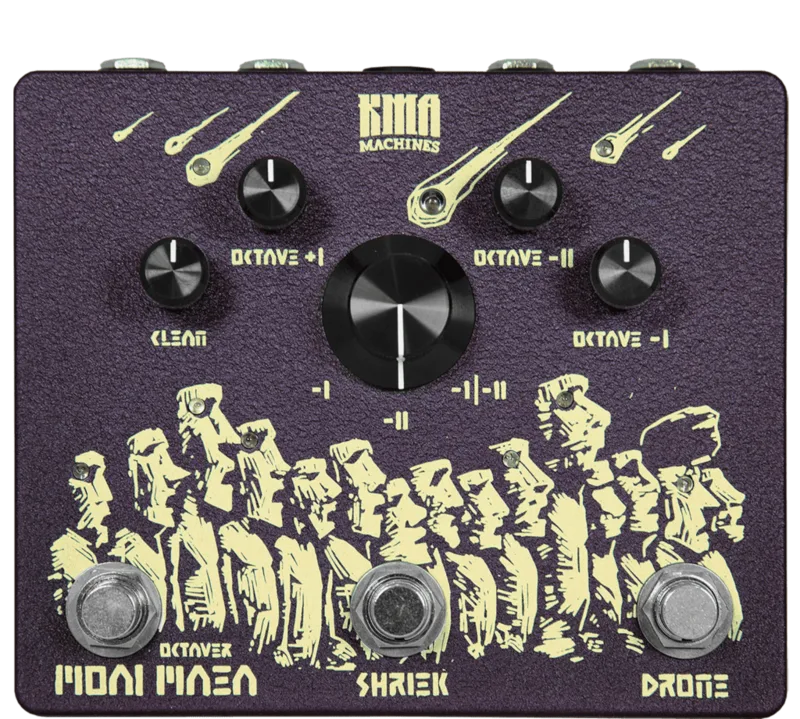


The KMA Machines Moai Maea is an analog octave pedal that generates one higher octave and up to two sub-octaves, which KMA describes as a way to "create massive walls of synthy sound" from your instrument1. It is the company's homage to the analog octaver tones of earlier decades, and it is built and designed in Berlin12.
Because it is analog, it is monophonic: it tracks one note at a time, so it is played with single lines rather than chords1. Pedal of the Day called it "an octave pedal, to be sure, but one like no other we've encountered"3.
One octave up, two octaves down
The pedal has two octave sections. The upper octave section, called Shriek, has what KMA describes as "an edgy and fuzzy character which is reminiscent of the iconic late '60s early '70s octave-up tones"1. The lower section offers three sub-octave settings, chosen with a rotary switch: the first octave down (-I), the second octave down (-II), or both together (-I/-II)1.
Pedal of the Day noted that the pedal lets you create an individual mix of each generated octave and the original signal, so you can balance the dry tone against each octave rather than getting a fixed blend3.
| Section | What it generates | Character |
|---|---|---|
| Shriek (upper) | One octave up | Edgy, fuzzy, late '60s / early '70s octave-up character, per KMA1 |
| Drone (lower) | First sub-octave (-I), second (-II), or both (-I/-II) | Selected by rotary switch1 |
| Clean | Dry signal | Controlled by the Clean knob to preserve your core tone1 |
Controls and footswitches
Each octave section is foot-switchable, so you can bring the sub-octaves and the upper octave in and out independently while playing13. Pedal of the Day described the layout plainly: you turn the higher octave on and off with the SHRIEK switch, and the sub-octave with the DRONE switch3.
The Clean knob controls the amount of dry signal in the pedal's output, which KMA says helps preserve your natural core tone underneath the generated octaves1. A left bypass footswitch puts the whole pedal in bypass and kills both octaves simultaneously1.
In a 2019 guitar.com interview, Enrico Preuss of KMA pointed to "the footswitchable octave sections and mixing controls on the Moai Maea" as central to the design, calling the pedal "a beast when it comes to analogue octaving sounds"5.
Power and setup
There is no battery option. The Moai Maea runs on a standard 9V DC power supply with a center negative 2.1mm barrel plug, drawing more than 20 mA at maximum1. Plan on a pedalboard power supply rather than a battery clip.
The pedal is true bypass, so with it disengaged your signal passes through without active circuitry in the path1.
Where it came from
Gearnews reported the Moai Maea in September 2016 as a Berlin-built analog octave pedal, noting that its circuit is based on an old '80s pedal, the Pearl OC-7 octave pedal, with an RRP at the time of €219 plus shipping2. KMA Machines describes the pedal as its homage to "the powerful analog octaver tones of yesteryear"1.
In October 2023, KMA built a one-off Lilac and Aubergine Moai Maea as a giveaway pedal, while the standard version remained available from the KMA webstore for $249.994.
How it relates to the Queequeg and the Mandrake
Guitar Pedal X's Stefan Karlsson described the Moai Maea as "a sort of extended range or super-charged Queequeg"4. The Queequeg 2 is KMA's dedicated sub-octave pedal: two ultra-fast tracking analog mono sub octaves with three switchable settings (I, II, I/-II) chosen by a mini-toggle6. The Moai Maea covers the same sub-octave territory but adds the octave-up Shriek section on top.
The Shriek circuit has since had a life of its own. When KMA launched the Mandrake Octo-Shrieker in November 2023, Guitar World described it as built on "the brand's Shriek circuit, which is lifted from KMA's Moai Maea Octaver"7.
"There's no doubting the prowess of this pedal - which can be seen as a sort of extended range or super-charged Queequeg"
Videos
KMA Machines
Alberto Barrero
EytschPi42
Questions
Is the KMA Machines Moai Maea polyphonic?
No. KMA Machines states that the Moai Maea is an analog octaver and therefore works monophonic only. Like other analog octave pedals, it tracks one note at a time, so chords will not produce clean octave shifts. Play single lines for the best tracking.
Is the Moai Maea true bypass?
Yes. KMA Machines lists the Moai Maea's bypass type as True Bypass, so with the pedal off your signal passes through without active buffering. The left bypass footswitch puts the pedal in bypass and kills both octave sections at once.
Does the Moai Maea run on a battery?
No battery option is given. The pedal is powered by a standard 9V DC power supply with a center negative 2.1mm plug, drawing more than 20 mA at maximum. You will need a pedalboard power supply or a dedicated 9V adapter.
Where is the Moai Maea made?
The Moai Maea is built and designed in Berlin, Germany, by KMA Audio Machines. Gearnews reported this when the pedal was announced in September 2016, and KMA Machines remains a Berlin-based effects maker.
How is the Moai Maea related to the Queequeg?
Guitar Pedal X describes the Moai Maea as a sort of extended range or super-charged Queequeg. The Queequeg line covers sub-octave generation, while the Moai Maea adds an octave-up Shriek section on top of its two sub-octaves. The Mandrake Octo-Shrieker later lifted the Shriek circuit into its own pedal.
Sources (7)
- MOAI MAEA, KMA Machines
- Go deep with KMA Machines Moai Maea analogue octave pedal, gearnews.com, 2016-09-06
- KMA Machines Moai Maea Analog Subsonic Octaver, Pedal of the Day, 2021-02-25
- Guitar Pedal X, Guitar Pedal X, 2023-10-13
- Interview: Enrico Preuss of KMA Audio Machines, guitar.com, 2019-03-11
- QUEEQUEG 2, KMA Machines
- “We didn't want to just make a one trick pony octave up device”: Jimi Hendrix, Tony Iommi and Josh Homme all championed the octave pedal, Guitar World, 2023-11-08