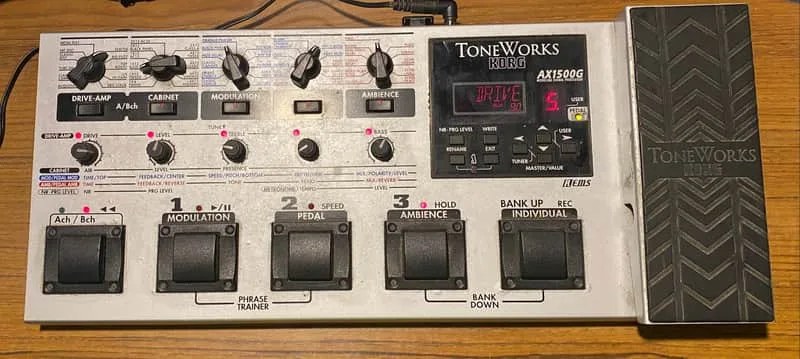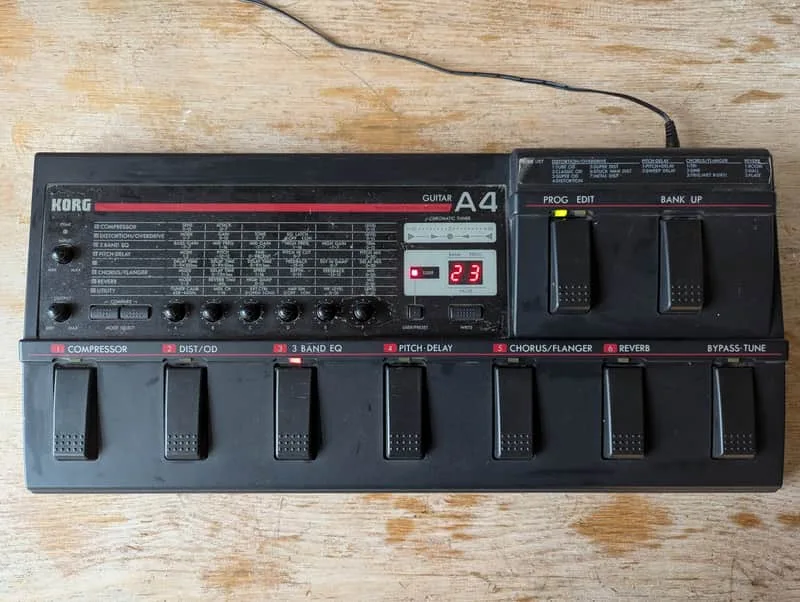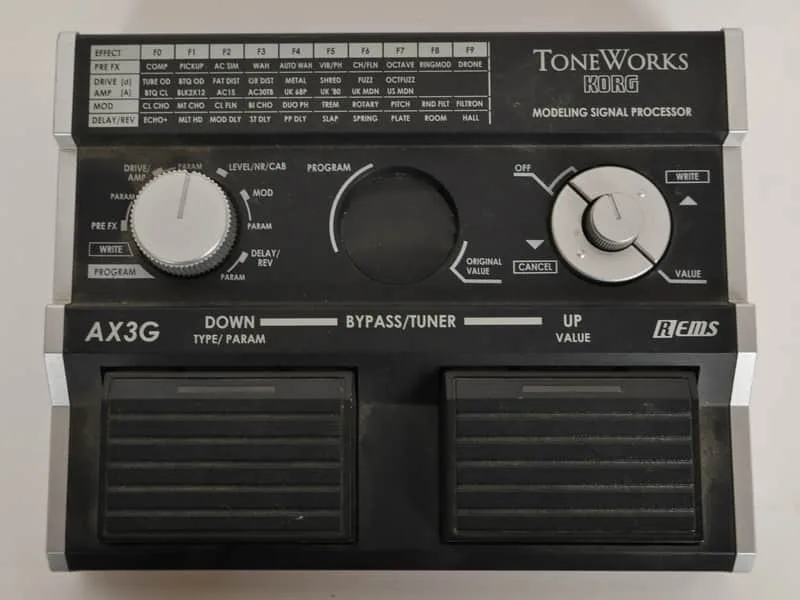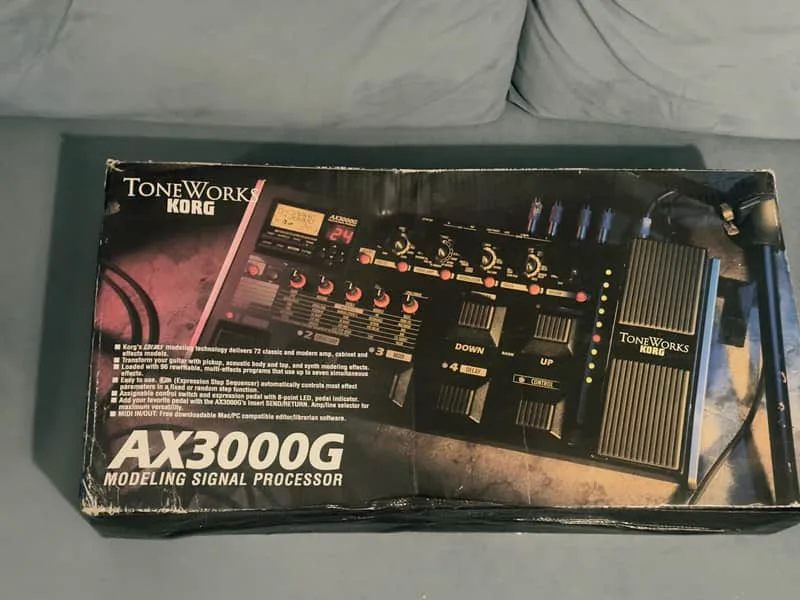
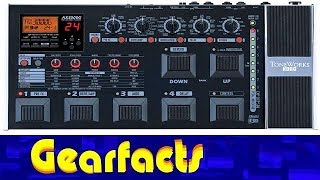


The AX3000G is a pedalboard multi-effects unit from Korg: a floor unit whose control panel MusicRadar likened to "a cross between an amplifier and a row of stompboxes." It builds on the basic design of the earlier AX1000G and AX1500G, with a few adjustments, refinements and new features, and MusicRadar credited Korg with providing "the only serious competition to DigiTech and BOSS in the world of pedalboard multi-effects units."1
Controls and layout
Editing is organized around five chicken-head knobs, one for each of the effects modules. Each knob selects the active effect from its module, and a "matrix" display is used for setting the various parameters.1
| Knob | Effects module |
|---|---|
| 1 | Pre FX |
| 2 | Drive/Amp |
| 3 | Modulation |
| 4 | Delay |
| 5 | Reverb |
The footswitch layout follows the patch structure. The first four footswitches in the front row select from the four patches in each bank, which pairs with the 96-location memory: 24 banks of four patches, chosen directly from the front row.1
Expression pedal
The built-in expression pedal is a central part of the design. MusicRadar found that almost all of the available parameters for the various effects modules can be controlled via the expression pedal, and that its sweep can be fine-tuned by setting maximum and minimum values. That means a player can assign the pedal to a chosen parameter, such as a delay time or a modulation depth, and set the range it covers.1
The idea carried over from the earlier ToneWorks AX1500G, which Vintage Guitar described in 2002 as having "an expression pedal (allowing real-time control of 11 effects)," alongside amp and cabinet simulations built on Korg's proprietary REMS technology.2
Standard and Individual modes
As with the AX1500G, there are two basic modes of operation:
- Standard mode: sounds are stored as patches, with a total of 96 memory locations divided into 24 banks of four, selected from the front-row footswitches.1
- Individual mode: the second of the two basic modes of operation carried over from the AX1500G.1
What reviewers said
MusicRadar's verdict was strongly positive on value:
"At only £249, the AX3000G is a bargain, and probably gives the best value for money of any of the large pedalboard multi-FX units available."
For comparison, the AX1500G it builds on had offered 96 programs (48 preset, 48 user) at a list price of $350 when Vintage Guitar reviewed it in June 2002.2
MusicRadar's £249 figure is a UK price as reviewed; no US price for the AX3000G is given here. The earlier AX1500G had listed at $350 in 2002.12
Videos
Gearfacts
NecroPolo
OldGuitarMonkey
Questions
How many presets does the Korg AX3000G have?
In standard mode, sounds are stored as patches, with a total of 96 memory locations divided into 24 banks of four. The first four footswitches in the front row select from the four patches in each bank, so a player can move between the four sounds of a bank without touching anything else.
What are the AX3000G's standard and Individual modes?
As with the AX1500G, there are two basic modes of operation: standard mode and Individual mode. In standard mode, sounds are stored as patches across 96 memory locations arranged as 24 banks of four, and the front-row footswitches select among the four patches in each bank.
Can the expression pedal control effect parameters on the AX3000G?
Yes. According to MusicRadar's review, almost all of the available parameters for the various effects modules can be controlled via the expression pedal, and you can fine-tune its sweep by setting maximum and minimum values for the parameter you assign to it.
What did the AX3000G cost?
MusicRadar's review listed the AX3000G at £249 in the UK, and called it a bargain that probably gives the best value for money of any of the large pedalboard multi-FX units available. No US price is given here; the earlier AX1500G had listed at $350 in 2002.
How does the AX3000G differ from the AX1500G?
MusicRadar describes the AX3000G as building on the basic design of the earlier AX1000G and AX1500G, with a few adjustments, refinements and new features. Like the AX1500G, it runs in standard and Individual modes, but its expression pedal can sweep almost any parameter of its effects modules.
Sources (2)
- Korg AX3000G review, MusicRadar, 2008-01-02
- ToneWorks AX1500G, Vintage Guitar magazine, 2003-07-01