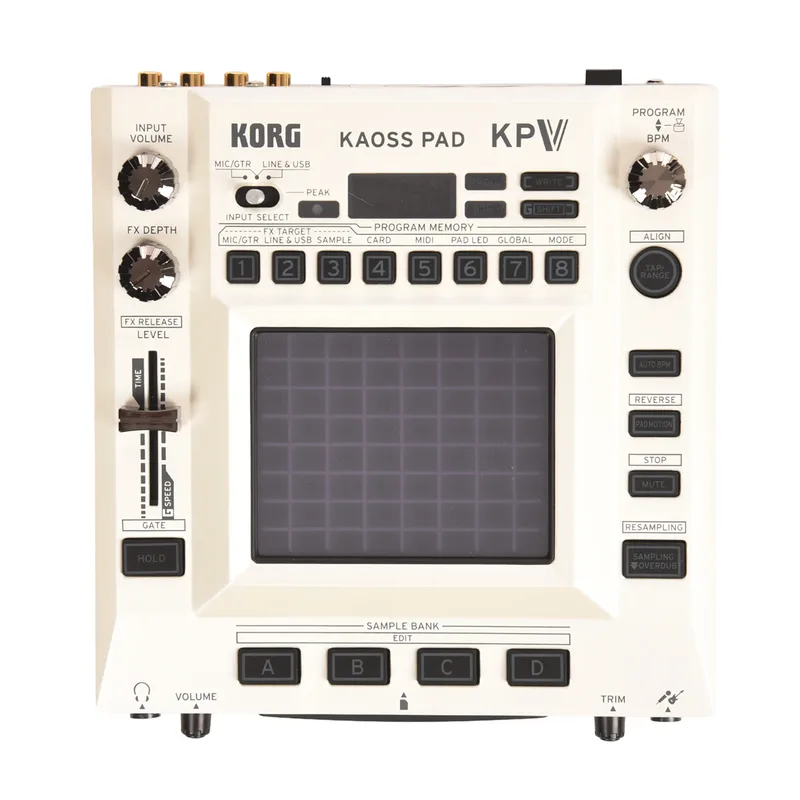


The headline change over earlier Kaoss Pads is dual-touch operation. Korg describes it as letting you "move various parameters at once to build evolving" textures, which means two fingers on the pad can drive separate aspects of an effect at the same time rather than one at a time1.
A dynamic effect and sampler with a touch pad
The Kaoss Pad concept has always been the pad itself: as Tony Grund put it in his MusicPlayers.com review of the earlier KP3, you "place your finger on the touchpad, and move it around to change effect parameters in real time"3. The KPV keeps that model and adds the dual-touch layer, so a single gesture can bend one parameter while a second finger holds another1.
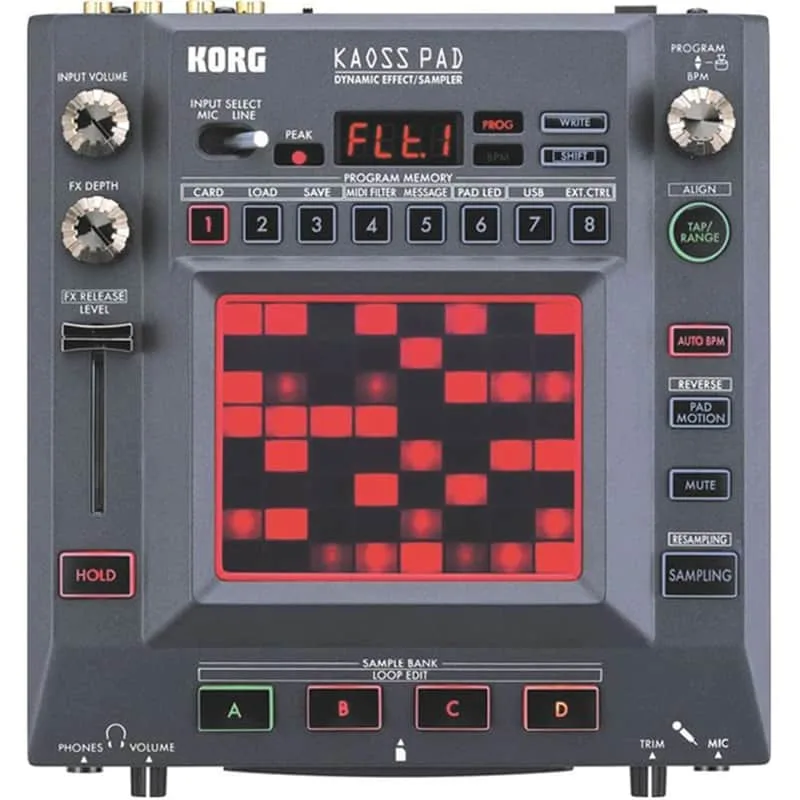
The manual describes the unit as a "Dynamic Effect/Sampler," and its controls reflect both halves of that job4:
| Control | What it does |
|---|---|
| Touch pad | Changes effect parameters in real time as you move a finger across it |
| PAD MOTION button | Turns pad motion on and off |
| LEVEL fader | Adjusts sample playback volume; in Gate mode, sets how long the touch pad stays on automatically, as a percentage |
| PROGRAM MEMORY buttons 1 to 8 | Store the program status and recall stored programs |
| INPUT SELECT switch | Switches the input source |
| CARD button (SHIFT MODE) | Load and save data from the SD card, and format the card |
The PROGRAM MEMORY buttons are the working memory for live use: eight slots to store and recall program status4. The full program count is much larger, 270 programs split into 170 presets and 100 user programs2, so the eight buttons are quick access to a subset of what the unit holds.
Inputs, outputs and storage
For a player, the important input is the MIC/GUITAR IN jack, a 6.3mm TRS phone jack that runs unbalanced for guitar and balanced for a microphone2. The INPUT SELECT switch chooses the source, and its center position takes audio from the mic/guitar jack, the LINE IN jack and USB audio input together, so you can process a guitar and a backing track from a computer at once4.
The full connection set from the manual:
- (Microphone/Guitar) jack for a microphone or guitar
- LINE IN jack and LINE OUT jack
- Headphone jack
- SD card slot
- MIDI IN and OUT jacks
- USB jack
- DC 9V jack
- Functional grounding jack4
On the spec sheet the outputs are OUTPUT L/R on pin jacks, with a 6.3mm stereo headphone jack for private monitoring2. The unit measures 210 (W) x 226 (D) x 49 (H) mm and weighs 1.3 kg without the adapter, and its operating temperature range is 0 to +40 °C, non-condensing2.
Storage is by SD card. The KPV supports SD and SDHC cards up to 32GB, with Class 10 or higher recommended, though Korg notes this does not guarantee operation with all cards2. Card operations, loading, saving and formatting, sit behind the CARD button in SHIFT MODE4. In the box you get the AC adapter and a Quick Start Guide4.
MIDI, USB and updates
The KPV has MIDI IN/OUT and USB Type B4. The global MIDI channel is settable from CH01 to CH164, and USB carries audio input as well as data, since the INPUT SELECT center position mixes USB audio with the other inputs4.
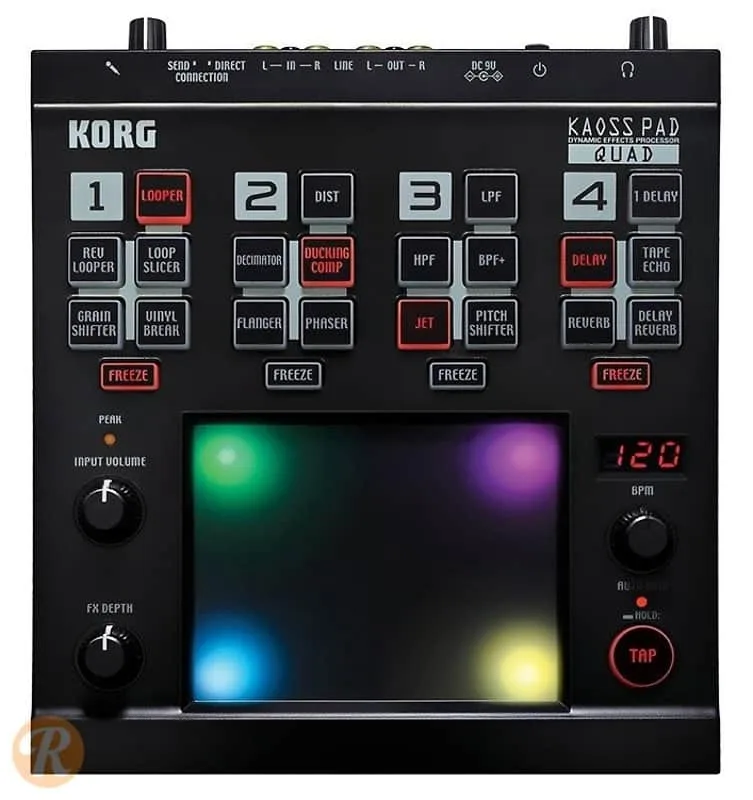
This is a real difference from some earlier models. MusicRadar's review of the Kaoss Pad Quad found that "the lack of USB and MIDI is a disappointment," and counted no USB or MIDI and no balanced outputs among that unit's drawbacks5. The KPV's spec sheet addresses the first two of those directly.
Korg has kept the unit current with two updates:
| Date | Update |
|---|---|
| 19 May 2026 | KORG KPV Audio Driver v1.0.1 for Windows released2 |
| 10 September 2026 | KAOSS PAD V System Updater v1.40 released2 |
So yes, there is a Windows driver, v1.0.1, and the System Updater v1.40 handles firmware261.
Where it sits in the Kaoss Pad line
Videos
KORG
loopop
BoBeats
Questions
Can I plug a guitar into the Kaoss Pad V?
Yes. The unit has a MIC/GUITAR IN jack, a 6.3mm TRS phone jack that runs unbalanced when used for guitar and balanced for a microphone. The INPUT SELECT switch chooses the input source, and its center position mixes the mic/guitar jack, LINE IN and USB audio together.
How many programs does the Kaoss Pad V store?
It holds 270 programs in total: 170 preset programs and 100 user programs. PROGRAM MEMORY buttons numbered 1 through 8 store the current program status and recall stored programs, so you can keep favorite settings ready for a set.
What SD cards does the Kaoss Pad V support?
It supports SD cards and SDHC cards up to a maximum capacity of 32GB. Korg recommends Class 10 or higher, while noting that this does not guarantee operation with all cards. A CARD button in SHIFT MODE handles loading, saving and formatting.
Does the Kaoss Pad V have MIDI and USB?
Yes. The specifications list MIDI IN/OUT jacks and a USB Type B jack. The global MIDI channel can be set from CH01 to CH16. USB also carries audio input, which can be mixed with the mic/guitar and line inputs.
What power does the Kaoss Pad V need?
It runs on a DC 9V supply through a dedicated DC 9V jack, using the AC adapter that ships in the box. There is no battery option in the specifications, so it needs the adapter or an equivalent 9V DC source.
Is there a Windows driver for the Kaoss Pad V?
Yes. Korg released the KORG KPV Audio Driver v1.0.1 for Windows on 19 May 2026. A System Updater, v1.40, followed on 10 September 2026 for updating the unit's firmware.
Sources (6)
- KAOSS PAD V, Korg, 2026-05-19
- Specifications, Korg, 2026-09-10
- Korg KAOSS Pad KP3, MusicPlayers.com, 2007-01-07
- KAOSS PAD KPV Owner's Manual, Korg, 2026-03
- Korg Kaoss Pad Quad review, MusicRadar, 2011-03-18
- KAOSS PAD V - DYNAMIC EFFECT / SAMPLER | KORG (USA), Korg (www.korg.com)