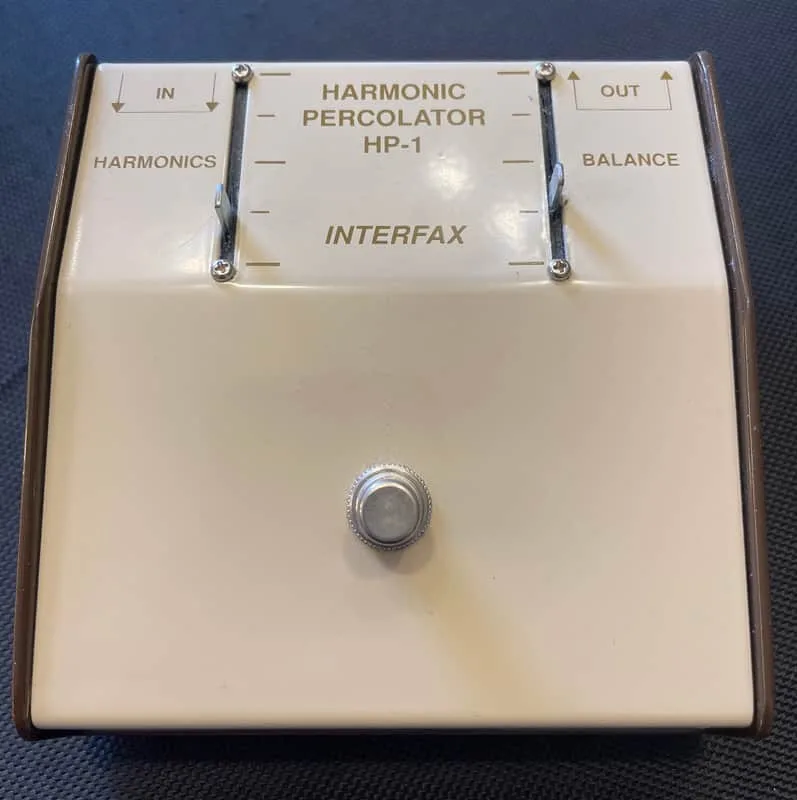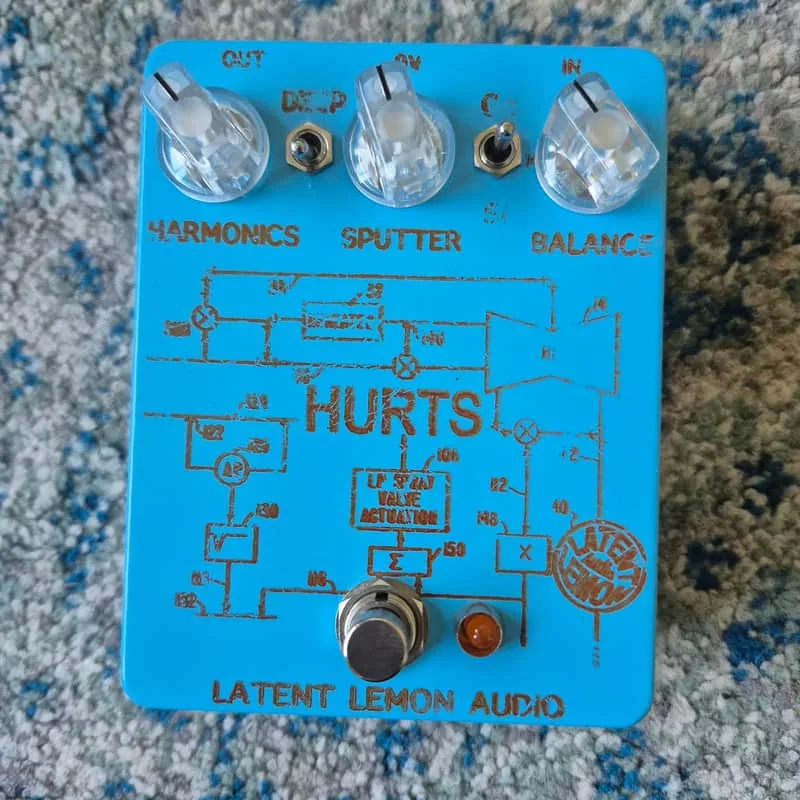


The Latent Lemon Audio Hurts is an analog fuzz pedal built on the Harmonic Percolator circuit, the design originally made famous by the InterFax HP-1 and by Steve Albini's recordings. RockBoard's PedalPedia describes it as "the infamous Harmonic Percolator circuit tuned for maximum tone," and lists it as covering fuzz, distortion, overdrive and booster duties in one box1. Delicious Audio calls it "definitely more than just a fuzz," capable of "filthy sub octave and willful feedback, through to just a hint of grit, or an amp slamming transistor booster"2.
The pedal was inspired by the tones of Steve Albini, the legendary noise rock producer whose use of the original Percolator shaped what players expect from this circuit2. Guitar Pedal X's Stefan Karlsson counts the Hurts among his key percolator acquisition targets and calls it "probably the most universally acclaimed of all of these," noting that its legions of fans claim it is the closest output profile to the InterFax original3.
A Harmonic Percolator fuzz
The Harmonic Percolator is a fuzz format that several builders make pedals around. Guitar Pedal X describes the circuit itself as "a pretty visceral and 'nasty' sounding circuit, very textural"4. The Hurts is a take on the germanium-based Percolator fuzz with added tone sculpting features, using both germanium and silicon transistors carefully selected and graded for both sound and gain, as in the original HP-12.
Where a conventional fuzz pedal piles on saturation, the Percolator format is known for a specific, textured, half-distorted character. The Hurts leans into that: Delicious Audio's Paolo De Gregorio writes that it ranges from a hint of grit to heavily clipped, feedback-prone sub-octave grind, and that it can also serve as an amp-slaming transistor booster with the diodes bypassed2.
The Albini connection is central to the pedal's identity. Latent Lemon Audio says the Hurts Fuzz V2 was "inspired by the tones of legendary noise rock producer Steve Albini"2, and the builder says its Sputter control, which alters the transistor bias, "lets you go from classic dad-rock tones to Mr Albini and beyond"2. Guitar Pedal X's survey of Percolator-style pedals names the Hurts as "one of my key percolator acquisition targets"3.
The controls
The Hurts carries five external controls plus internal trimmers. Guitar Pedal X lists the control set as Harmonics, Deep On/Off, Sputter, Clipping Ge/Si, and Balance3.
| Control | What it does |
|---|---|
| Harmonics | Fuzz/distortion gain2 |
| Balance | Output volume2 |
| Sputter | Biases one of the transistors, shifting from classic tones to edgy, noisy ones25 |
| Clipping Ge/Si | Switches between germanium and silicon diodes; the middle position bypasses the diodes for a loud transistor booster that pushes an amp's front end12 |
| Deep On/Off | A bass mod, offered as an optional extra at £10 on the V22 |
Inside the pedal there are two trimmers: one to tune in the octave "sweet spot" and one for gain compensation in case of oscillation12.
The Sputter knob is the character control. Delicious Audio explains that it "lets you alter the transistor bias so you can go from classic tones to more edgy and noisy ones," and describes the range as going "from classic dad-rock tones to Mr Albini and beyond"2. In practice it moves the pedal between conventional fuzz and the sputtering, gated, unstable textures the Percolator is known for.
The diode switch deserves its own note. In the germanium position it uses 1N695 germanium diodes, the same type as the original HP-1. The silicon position is slightly louder. The middle position bypasses the diodes entirely, making the pedal a loud transistor booster that really pushes the front end of an amp12.
The builder states he has bought up the last of the best quality 1N695 diodes he can find, which he says bring out the octave effect while ensuring adequate output from the vintage pedal circuit2.
Is the Hurts good on bass?
Two features point bass players toward this pedal. RockBoard's PedalPedia notes that the silicon diode position is "my favourite on bass"1, and the Deep toggle is explicitly described as a bass mod, optional at £10 extra on the V22. The pedal's capability for filthy sub octave, in the maker's own description, also suits low-tuned instruments1. Bass players comparing Percolator-style circuits can find more options on the bass pedals page.
Versions and history
The pedal now called Hurts was originally named 1000 Hurts. The name changed but the circuit stayed exactly the same. The builder created it in 2012, after what he describes as more breadboard experimentation and research than is probably healthy2. The V2, reported by Delicious Audio on 28 November 2022, added the Sputter control and the other tone sculpting features2.
The V2 runs on 9V power from either a standard Boss style power supply or a 9V PP3 battery, not included2. The maker's current listed spec gives 9V DC center negative at 33mA1.
What reviewers and demos said
Guitar Pedal X's Stefan Karlsson, in his May 2024 survey of the format, wrote of the Hurts:
"I feel this one is probably the most universally acclaimed of all of these."
He adds that its legions of fans claim it is the closest output profile to the InterFax original overall, and lists it as one of his own key percolator acquisition targets3.
Coverage of the Hurts in the press has been limited, but it has drawn attention from Percolator specialists. In Guitar Pedal X's survey of Harmonic Percolator-style pedals, the author names the Latent Lemon Audio Hurts Distortion as "one of my key percolator acquisition targets"3, alongside pedals from builders including BSRI Audio, Fredric Effects and Bowman Audio Endeavors.
Videos
latentlemon
latentlemon
latentlemon
Questions
Does the Latent Lemon Hurts take a battery?
Yes, the V2 takes a 9V PP3 battery, which is not included, or a standard Boss style 9V power supply2. The maker's current spec lists 9V DC center negative at 33mA1.
What does the Sputter knob do on the Hurts?
Sputter biases one of the transistors5. Delicious Audio describes it as letting you "alter the transistor bias so you can go from classic tones to more edgy and noisy ones," ranging from "classic dad-rock tones to Mr Albini and beyond"2.
Is the Hurts good on bass?
RockBoard's PedalPedia calls the silicon diode position a favorite on bass1, and the Deep toggle is offered as a bass mod2. The pedal is also described as capable of filthy sub octave1.
What diodes does the Latent Lemon Hurts use?
It uses 1N695 germanium diodes, as in the original HP-1, with a switch to silicon diodes that are slightly louder. The switch's middle position bypasses the diodes for a loud transistor booster mode12.
Sources (5)
- Hurts by Latent Lemon Audio, RockBoard PedalPedia, 2026
- Latent Lemon Audio Hurts Fuzz V2, Delicious Audio, 2022-11-28
- Guitar Pedal X, Guitar Pedal X, 2024-05-13
- Guitar Pedal X, Guitar Pedal X, 2022-05-16
- 9 Best Harmonic Percolator Fuzz Clones & Evolutions In 2023, Delicious Audio, 2023-05-03
 Steve Albini