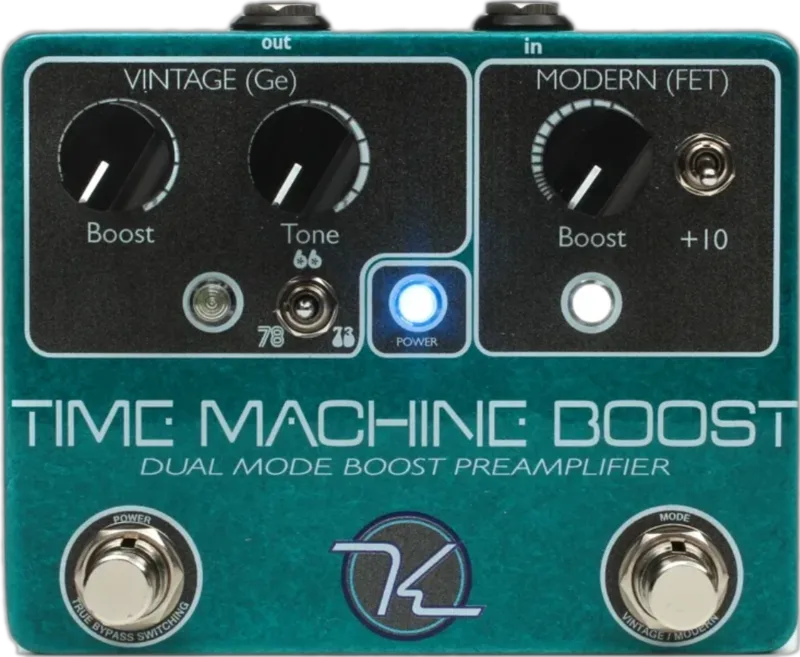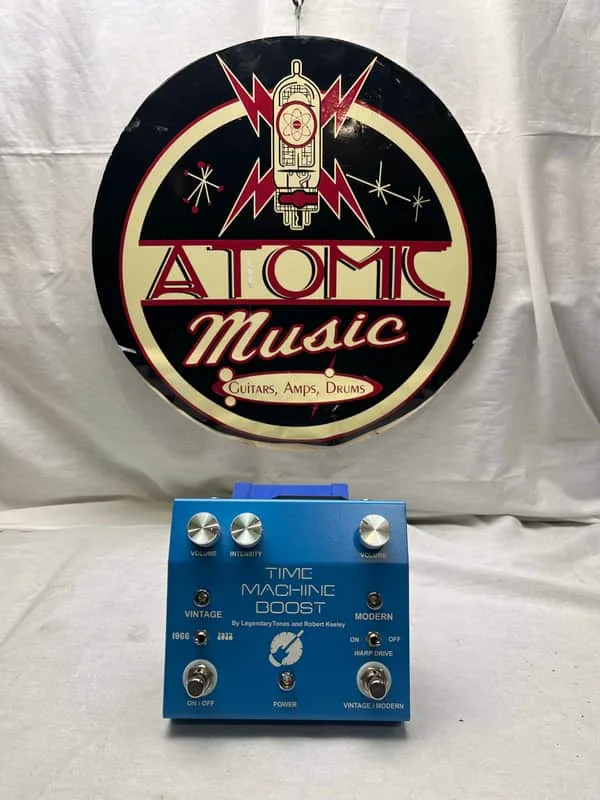

The Legendary Tones Time Machine Boost is a two-channel boost pedal built around a dual JFET circuit design. Vintage Guitar magazine, reviewing it in its March 2003 issue, called it a "Tri-Mode Signal Booster": a Modern channel for a clean, transparent boost, and a Vintage channel with two modes, "1966" and "1973", that reshape the tone in the manner of classic treble boosts1. The pedal came from Legendary Tones, a collaboration between David Szabados and Robert Keeley2, and Vintage Guitar's reviewer concluded that "this pedal does an outstanding job in all modes, and is one of the most usable pedals we've tried"1.
Controls and layout
The pedal is built around two footswitches and a small set of controls that split cleanly between the two channels1.
| Control | Channel | What it does |
|---|---|---|
| True-bypass on/off footswitch | Both | Switches the pedal in and out of the signal path1 |
| Channel selector footswitch | Both | Switches between the Vintage and Modern channels1 |
| Separate volume per channel | Vintage and Modern | Each channel has its own volume control1 |
| Intensity control | Vintage | Adjusts high frequencies and harmonic content1 |
| Toggle switch | Vintage | Selects between the "1966" and "1973" modes1 |
Three bright LEDs sit in chrome bevels on the face of the pedal: the power indicator is red, the Vintage channel is blue, and the Modern channel is white1. The housing is heavy duty metal with a powder blue baked enamel finish, and Vintage Guitar noted the sturdy stompswitches alongside it1.
The Modern channel
The Modern channel is the transparent side of the pedal. Vintage Guitar tested it with a Fender Esquire into a clean tube amp and found "a nicely boosted signal with transparent harmonics that made the amp come alive, sort of like a compressor livening the signal without affecting dynamics"1. Pushed harder, with a late-'70s Gibson SG into an all-tube half-stack at maximum volume setting, the Modern boost drove the amp's natural distortion into what the reviewer described as "a sweet, singing, harmonically complex sound that would please any pro," with extra volume for soloing1.
The 1966 and 1973 Vintage modes
The Vintage channel is where the pedal takes its character cues from British guitar history. A toggle switch selects between two modes1:
- 1966: inspired by Eric Clapton's famous treble-boost "Bluesbreakers tone" of that era. Vintage Guitar found it "dramatically brightened" the tone through a distorted half-stack1.
- 1973: a more midsy tone with increased low-end response, reminiscent of the early '70s1.
The Vintage side also carries the intensity control, which adjusts the treble boost and, with it, the high frequencies and harmonic content12. An independent review at AMZ Guitar Effects (muzique.com) makes the same distinction from the other direction: the vintage tones are not clean boosts at all. As that review puts it, "both of these tones are definitly tone/char[acter changers]"2. The basic function, in that review's words, is "to be able to flip between two boost tones 'Modern' and 'Vintage'"2.
Who makes it, and what reviewers said
The Time Machine Boost was built by Legendary Tones, the partnership of David Szabados and Robert Keeley2. A JHS Pedals video on YouTube also names "David Zabatos of Legendary Tones" in connection with the Time Machine Boost3. Vintage Guitar's review lists the company at Prunedale, California1.
"Overall, this pedal does an outstanding job in all modes, and is one of the most usable pedals we've tried."
The same review summed up the pedal's purpose as boosting "certain tonal frequencies in your setup, giving you a variety of sounds"1, and cautioned that to call it simply "a distortion pedal" would be "to sell it extremely short"1. For players weighing it against other overdrive pedals or distortion pedals, the reviewers' picture is of a boost that colors the amp rather than replacing it: transparent on the Modern side, deliberately voiced on the Vintage side.
Videos
guitarlory
Questions
Is the Legendary Tones Time Machine Boost true bypass?
Yes. The pedal has two footswitches, and the on/off switch is true bypass according to Vintage Guitar's review. The second switch selects between the Vintage and Modern channels, so you can change boost character without bending down to reach a toggle.
Who makes the Legendary Tones Time Machine Boost?
The pedal was made by Legendary Tones, a venture by David Szabados and Robert Keeley. Vintage Guitar's review lists the company in Prunedale, California, and a JHS Pedals video also names David Szabados of Legendary Tones as the designer behind the Time Machine Boost.
What power supply does the Time Machine Boost need?
It runs on a common 9-volt power supply, and the review unit shipped with a 9-volt adapter included. Vintage Guitar describes it as a common 9-volt supply, so it fits standard pedalboard power arrangements of its era.
What do the three LEDs on the Time Machine Boost mean?
The pedal has three bright LEDs set in chrome bevels: a red power indicator, a blue LED for the Vintage channel, and a white LED for the Modern channel. At a glance you can see whether the pedal is powered and which of the two channels is active.
Sources (3)
- Legendary Tones Time Machine Boost, Vintage Guitar magazine, 2006-02-01
- Reviews of boost pedals, muzique.com (AMZ Guitar Effects)
- The Keeley Manis: A Deep Dive on the Klon Centaur Circuit, JHS Pedals (youtube.com), 2025-06-15