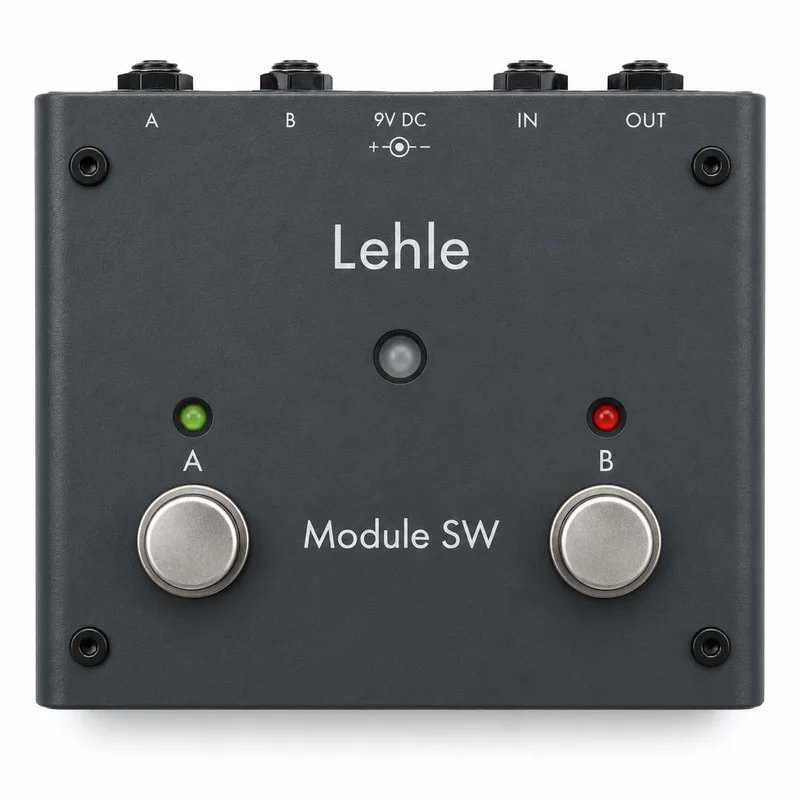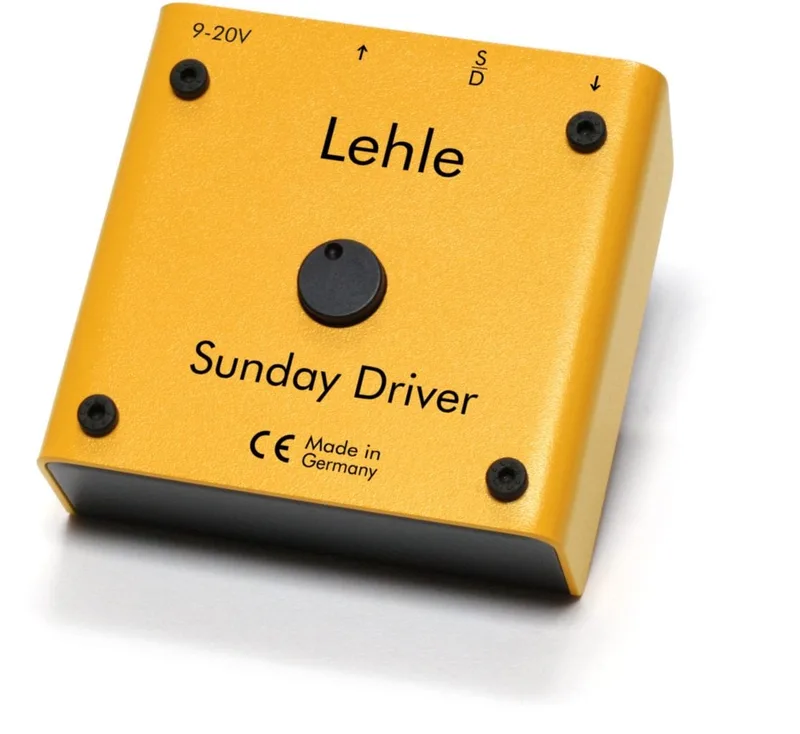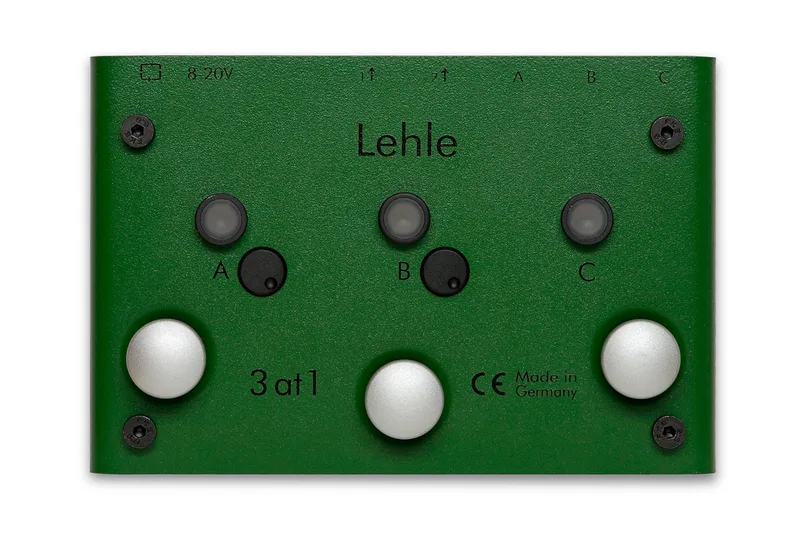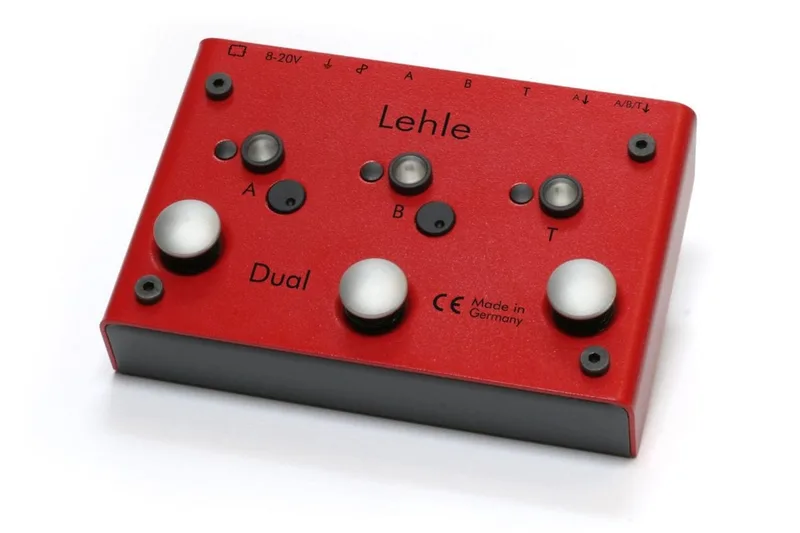


The Lehle Parallel SW II is a parallel effects looper and line mixer made by Lehle. Instead of running your effects in series, where the whole signal passes through each pedal, it splits the signal, sends a copy to your effects, and blends the wet result back in with the untouched dry signal. Lehle describes it as "a compact and versatile line mixer designed to meet the highest tonal standards," and it can sit either before an amp or in an amp's effects loop1.
The parallel approach matters most with time-based effects. A delay or reverb pedal in a series loop gets switched out of the chain entirely when bypassed, cutting its tails dead. In a parallel loop the dry signal never leaves the unit, so the effect is blended in and out rather than inserted and removed. The Parallel SW II also works as a straight line mixer: Lehle recommends it for active summing of two different signals from two different devices, and its Return socket can serve as an input for a second signal source or even a second pickup, with a 2 MOhm input impedance123.
What the Parallel SW II does
The unit has one effects loop. The Input socket takes your instrument or the Send output of an amplifier, and it is high impedance, accepting both low- and high-impedance signals. The Send socket feeds the input of your effects unit, with its own level control. The Return socket takes the effect's output back, and the Output socket carries the mixed signal to an amplifier, mixer, stage box or sound card1.
All connections are realized in stereo, so stereo effects pedals can be placed in the signal path. A mono-to-stereo switch at the input lets mono and stereo signals be combined, which means a mono source can feed both sides of a stereo rig1.
The audio path is analog throughout, with discrete Class A input stages built on JFET technology, which Lehle says lets the inputs handle high-impedance signals without loading them down. Switching is handled by a microcontroller driving an intelligent True-Bypass-Relay-Circuit with active pop suppression circuitry12.
| Specification | Value |
|---|---|
| Frequency range | 20 Hz to 100 kHz1 |
| Dynamic range | 122 dB, thanks to 30 V internal voltage4 |
| Max input level | +20 dBu1 |
| Max output level | +22 dBu1 |
| Level noise floor | -100 dBu (20 Hz to 20 kHz)1 |
| Total harmonic distortion | 0.003 % (0 dBu, 1 kHz)1 |
| Max gain | +/-15 dB1 |
| Input impedance | 2 MOhm1 |
| Return impedance | 2 MOhm1 |
| Send impedance | 220 Ohm1 |
| Output impedance | 220 Ohm1 |
The controls
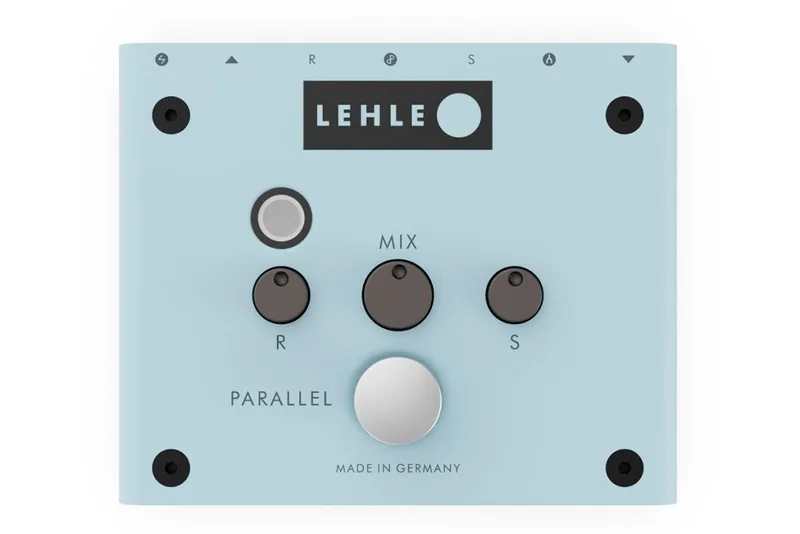
The front panel keeps things simple: two knobs, the MIX controller that sets the ratio for mixing the Input and Return signals and the Send controller that sets the level of the Send signal, two small switches, the Phase switch that reverses the phase of the return signal and the Mono-to-stereo switch that activates the mono-to-stereo function at the input socket, one LED indicating the switching status and one footswitch with its easy-action mushroom-shaped button mounted in the cover1.
| Control | What it does |
|---|---|
| Send controller (9) | Sets the level of the signal going to the Send socket. Center position is 1:1; turn left to cut up to 15 dB, right to boost up to 15 dB12 |
| MIX controller (10) | Sets the ratio between the Input and Return signals. The two signals have equal strength at the center position2 |
| Phase switch (4) | Reverses the phase of the return signal if necessary; gold-contacted2 |
| Mono-to-stereo switch (2) | Activates the mono-to-stereo function at the input socket2 |
| LED (8) | Shows switching status: white when the input is directly connected to the output, blue when the signal path or return is active2 |
| Footswitch (12) | Easy-action mushroom-shaped button mounted in the cover, with foot pressure transmitted indirectly via a spring2 |
The phase switch is the one players new to parallel loops should understand. Some effects invert the signal, and when an inverted wet signal is summed with the dry signal the two cancel, thinning the sound noticeably. Flipping the return's phase puts them back in alignment.
Footswitch modes and bypass options
The footswitch has three modes: Latching, Momentary and Mixed. In Latching mode it works like a conventional stomp switch, toggling on and off. In Momentary mode it is active only while held. In Mixed mode, a short press lets the footswitch act as latching, while a longer press is momentary12.
Each mode can run in true bypass or buffered bypass, and the two bypass types behave differently in a way that matters for time-based effects1:
- True-bypass mode: the Return is activated and deactivated. The effect path is switched in and out of the mix directly2.
- Buffered-bypass mode: the Send is activated and deactivated. Lehle says this mode works especially well with delay or reverb pedals, whose "trails", the decay of echoes or reverb, are not cut when the effect is deactivated12.
"This mode works especially well for the application with delay or reverb pedals, whose “trails"
The internal buffer works like Lehle's other buffers, with a 2 MOhm high-impedance input and a boost range of -15 dB to +15 dB, though it does without the S-MODE found on the Lehle Sunday Driver II4.
The operating mode can only be changed on units with serial numbers from "21.59321" onward. Earlier units do not support mode changes1.
Power and mounting
The Parallel SW II runs on a supply of 9 to 15 V DC, and polarity is of no importance: the supply voltage is internally rectified and stabilized, so center-positive and center-negative supplies both work. Internally the input voltage is transformed to 30 V, which Lehle credits for the 122 dB dynamic range142. Current consumption is 200 mA1, so it needs a proper power supply rather than a battery.
The pedal can be mounted to a pedalboard using Lehle's mounting kit2. Every assembly is made and tested in Germany1.
Videos
LehleSwitcher
Tri-Cloud Sync Gadgets
Questions
Is the Lehle Parallel SW II true bypass or buffered?
Both, and you choose. In every footswitch mode the Parallel SW II can work in true bypass or buffered bypass. True-bypass mode activates and deactivates the Return, while buffered-bypass mode activates and deactivates the Send. Switching is handled by a relay circuit with active pop suppression, controlled by a microcontroller.
Will the Parallel SW II cut delay and reverb trails?
Not in buffered-bypass mode. Lehle says that mode works especially well with delay or reverb pedals, because the trails, the decay of echoes or reverb, are not cut when you deactivate the effect. In true-bypass mode the effect path is switched out directly, which does interrupt the signal passing through it.
Does the Lehle Parallel SW II work in stereo?
Yes. All connections are realized in stereo, so stereo effects pedals can sit in the signal path. A mono-to-stereo switch at the input lets you combine mono and stereo signals, feeding a mono source into both sides of the stereo path.
Can the Parallel SW II be used in an amp's effects loop?
Yes. Lehle describes the Parallel SW II as mixing the signals from your effects units into your original signal, either before an amp or in its effects loop. The Input socket accepts the Send output of an amplifier as well as an instrument, and the Output socket feeds an amplifier, mixer, stage box or sound card.
Does power supply polarity matter on the Parallel SW II?
No. The Parallel SW II runs on 9 to 15 V DC, and polarity is of no importance because the supply voltage is internally rectified and stabilized. The input voltage is transformed internally to 30 V, which Lehle credits for the 122 dB dynamic range. Current consumption is 200 mA.
What does the phase switch on the Parallel SW II do?
It reverses the phase of the return signal. When an effect inverts the signal, the wet and dry paths can cancel each other when mixed back together, thinning the sound. Flipping the phase switch on the return path puts the two signals back in step. The switch is gold-contacted.
Sources (4)
- LEHLE PARALLEL SW II, Lehle (support.lehle.com)
- LEHLE PARALLEL SW II, Lehle (support.lehle.com)
- LEHLE LITTLE DUAL II, Lehle (support.lehle.com)
- LEHLE PARALLEL SW II: Parallel FX looper & stereo mixer, Lehle GmbH