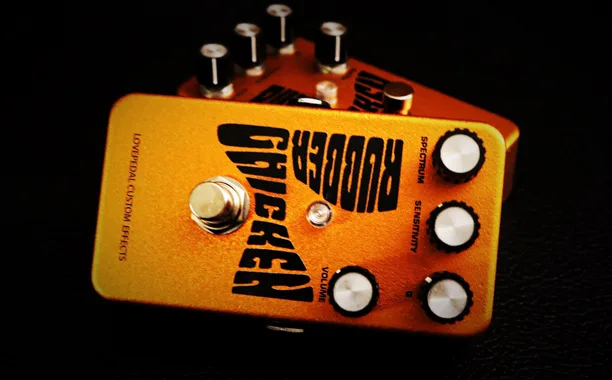


The Lovepedal Rubber Chicken is a compact analog pedal built around talk box-style filtering. Lovepedal describes it as "an extremely versatile TALK BOX!" that covers "a wide range of sounds from funky auto-wahs through more vocal/talk-box like tendencies." In practice that puts it in the same territory as filter pedals and wah-wah pedals: it shapes the harmonic content of your note dynamically, from tight funk quack to vowel-like, human-voice sounds, without the tube, driver and amplifier a traditional talk box requires12.
What it does to your sound
The Rubber Chicken sits in the filter family. Where a wah pedal sweeps a filter with a rocker pedal under your foot, the Rubber Chicken does its work in one box, moving between auto-wah-style funk filtering and vowel, talk-box-like tones. Lovepedal's own description frames the range exactly that way: funky auto-wahs at one end, more vocal and talk-box-like tendencies at the other2.
Because it is analog, the filtering happens in the analog domain rather than through digital processing1.
Controls and features
Lovepedal expanded the Rubber Chicken beyond the original design's capabilities. The added features, in the maker's words, are2:
- Sensitivity preamp
- Master volume control
- Q adjustment
- Spectrum leveler2
The Q adjustment sets how sharp and pronounced the filter peak is, which is what pushes the sound from a soft wah toward an aggressive, vocal quack. The sensitivity preamp sets how hard the filter responds to your picking, and the master volume lets you match the effect level to your clean tone. A volume control is listed among the pedal's controls2.
Power, bypass and practical details
The pedal runs on a 9VDC input2 and draws 85mA1. That draw is worth noting when planning a shared supply: a daisy chain or a low-output power brick output may not have 85mA to spare for one pedal.
With an 85mA current draw1, the Rubber Chicken needs more current than many vintage-style filter pedals. Make sure the output feeding it on your power supply can deliver that much.
Bypass is true bypass with an LED status indicator, so the circuit is removed from your chain when the pedal is off2. The enclosure is a compact die cast aluminum case measuring 4.37″ x 2.37″ x 1.07″, small enough for a crowded board2.
Demo
Lovepedal's product page links a demonstration video: "Let Sebastian Falvo walk you through a demonstration of this unique device!"2. Hearing the sweep from auto-wah to talk-box tones is the fastest way to judge whether the Rubber Chicken's range suits your playing.
Videos
Mike Hermans
Sebastian Falvo Music
Mike Hermans
Questions
Is the Lovepedal Rubber Chicken true bypass?
Yes. Lovepedal's product page lists the Rubber Chicken with true bypass and an LED status indicator, so the pedal's circuit is out of the signal path when it is switched off.
Is the Rubber Chicken analog or digital?
The Rubber Chicken is an analog pedal. RockBoard's PedalPedia entry lists its circuit type as analog, and it is a compact die cast aluminum enclosure pedal rather than a digital multi-effects unit.
What power supply does the Rubber Chicken need?
The Rubber Chicken takes a 9VDC input, as listed on Lovepedal's product page. Use a standard 9V DC pedal supply with the correct polarity, and note the pedal draws 85mA, which matters when sharing a supply with other pedals.
How much current does the Rubber Chicken draw?
Lovepedal's product page and RockBoard's PedalPedia both list the Rubber Chicken's current draw as 85mA. That is more than some simple filter pedals need, so check what your power supply can deliver per output.
Is the Rubber Chicken a real talk box or an auto-wah?
It is neither a traditional talk box with a tube and speaker driver nor a plain auto-wah. Lovepedal describes it as an extremely versatile talk box pedal that covers a wide range of sounds, from funky auto-wahs through more vocal, talk-box-like tendencies, all in a single effects pedal.
Sources (2)
- Rubber Chicken by Lovepedal, RockBoard PedalPedia, 2026
- RUBBERCHICKEN, Lovepedal (www.lovepedal.com)