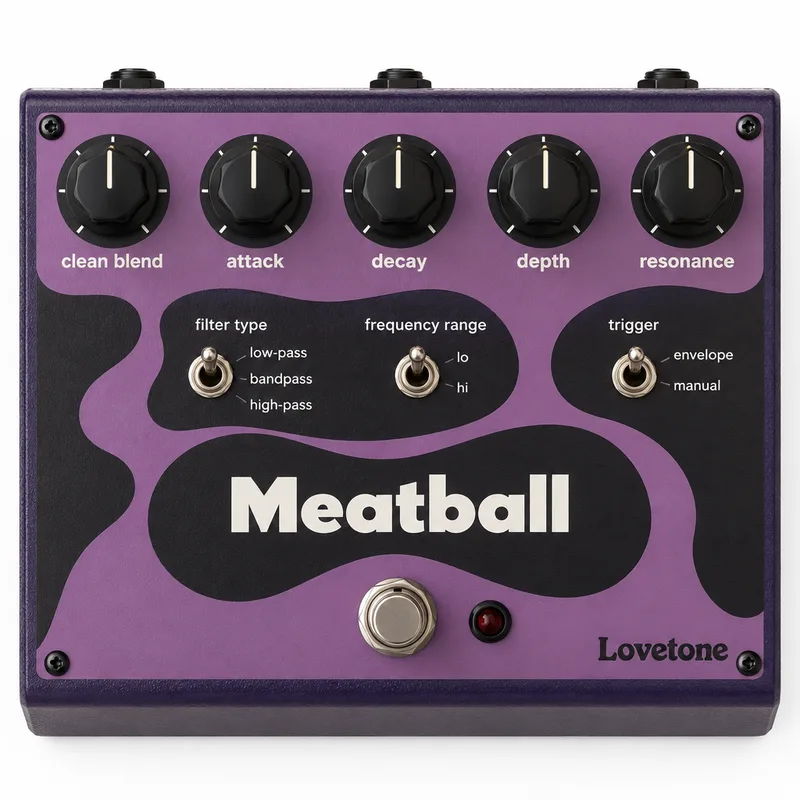


The Lovetone Meatball is a British-made analog envelope filter and the first of Lovetone's big-box modulation effects123. An envelope filter sets a filter's frequency from the dynamics of your playing, so picking harder sweeps the filter further; the Meatball takes that idea and builds one of the most feature-heavy versions of it ever put in a pedal. Its filter is a resonant low-pass design with selectable bandpass and high-pass options, which Lovetone says provides a broad palette of textures, from subtle, vowel-like tone shifts to wild, synth-like sweeps2.
A tweaked Mu-Tron III
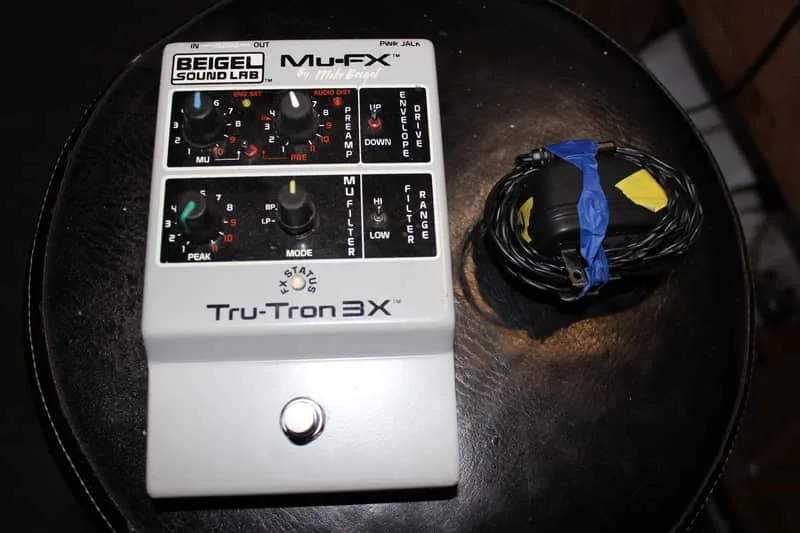
The Meatball's starting point is the Mu-Tron III, which Guitar World credits to designers Mike Beigel and Aaron Newman and which Premier Guitar calls the first voltage-triggered filter effect67. Aion FX describes the Meatball as "a heavily tweaked version of the very first commercial envelope filter pedal, the Mu-tron III"4. On top of that core it adds the features below4:
- A clean blend
- Attack and decay controls
- Two extra range modes in between the Hi and Lo settings
- Two expression controls
- An effects loop
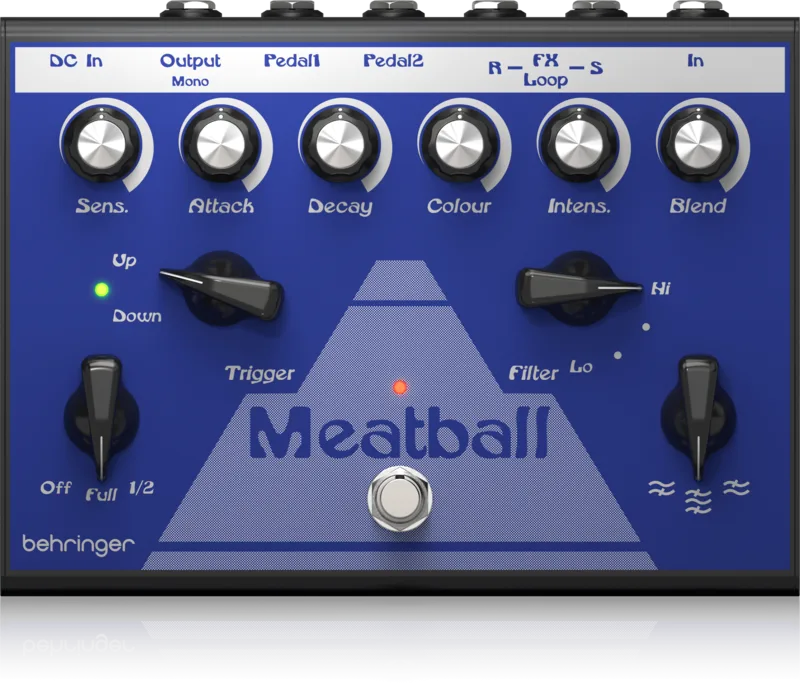
GuitarPlayer's writers Rod Brakes and Art Thompson summed up the control set this way: "Featuring four frequency ranges, multiple filter types (with depth and resonance controls), attack and decay knobs, a trigger section, and an effects loop"1. The filter itself is a resonant low-pass design with selectable bandpass and high-pass options, which gearnews says provides "a broad palette of textures, from subtle, vowel-like tone shifts to wild, synth-like sweeps"2. GuitarPlayer noted that "the British-made Meatball can do the funky-filter thing as readily as it dishes up animal snorts, bird whistles, insect" sounds and more1.
The effects loop is a big part of what separates the Meatball from a standard envelope filter. As JHS Pedals puts it: "You've also got effects loops that let you put other effects into it, so they're triggered into the envelope, expression" controls add to it5. Putting a fuzz or octave pedal inside the loop means the envelope reacts to that signal, opening up sounds a plain filter cannot reach.
History
The Meatball was the first of Lovetone's big-box modulation effects, a line of British-made pedals known for their depth of control4. Its filter is a resonant low-pass design with selectable bandpass and high-pass options, providing a broad palette of textures, from subtle, vowel-like tone shifts to wild, synth-like sweeps2. That breadth is what reviewers kept coming back to: as one put it, "even with the vintage price, you get fantastic bang for your buck with this pedal," calling the Meatball really versatile and extensive5.
What reviewers and players made of it
JHS Pedals' history of the brand is generous about the Meatball's value: "even with the vintage price, you get fantastic bang for your buck with this pedal," calling it really versatile and extensive5. Delicious Audio's Paolo De Gregorio described it as "a beast of a filter pedal selling for well over $1,500"8. RockBoard's pedal encyclopedia marks the original as rare3.
The Behringer Meatball and other descendants
Because the original is rare and expensive, the design has been revisited several times38:
| Pedal | Maker | What it is |
|---|---|---|
| Behringer Meatball | Behringer | Based on the Lovetone Meatball Envelope Filter; available at Thomann for $95 / £84 / €98 as of January 20262 |
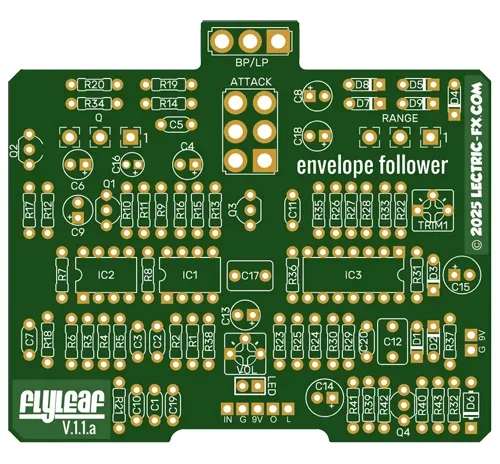
| FTelettronica Envelope Follower/Triggered Filter | FTelettronica | An Italian recreation of the Meatball concept8 |
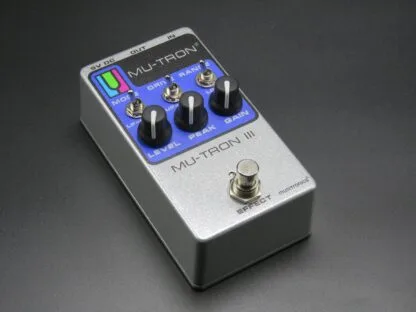
| Mu-Tron III | Mu-Tron | The original circuit the Meatball expands, still the reference point4 |
Behringer's product page notes you can "use an expression pedal for manual sweeps"9. For players who want the original Mu-Tron flavor rather than the Meatball's expansion of it, the Mu-Tron III itself remains the reference point4.
Videos
Dennis Kayzer
blondegraemey
jfusion10
Questions
Is the Lovetone Meatball based on the Mu-Tron III?
Yes. Aion FX describes the Meatball as a heavily tweaked version of the Mu-Tron III, the very first commercial envelope filter pedal. The core circuit follows the Mu-Tron III's voltage-controlled filter design, but Lovetone added a clean blend, attack and decay controls, two extra range modes, expression controls, and an effects loop on top of it.
Who designed the Lovetone Meatball?
The Meatball was designed and hand-built in the UK by Dan Coggins and Vlad Naslas. Coggins founded Lovetone in 1995, and the Meatball was the brand's debut pedal and the first of its big-box modulation effects.
Is the Lovetone Meatball analog?
Yes. The Meatball is a fully analog circuit. Writing about the later Behringer version of the design, gearnews described the fully analog circuit as delivering a rich, organic quality with robust headroom and a wide frequency response.
Why is the original Lovetone Meatball so expensive?
Original Meatballs are rare, since Lovetone stopped making pedals in 2000 and the company ceased trading around 2001. Supply is small and demand from players is steady, and used examples have sold for well over $1,500. Behringer now makes an affordable version of the design.
Does the Lovetone Meatball have an expression pedal input?
Yes. JHS Pedals notes that the Meatball has expression pedal compatibility, and its effects loops let you put other effects into the envelope-triggered path. The later Behringer Meatball also accepts an expression pedal for manual sweeps.
Who has used the Lovetone Meatball?
Aion FX lists a number of high-profile artists as Meatball users, including Kirk Hammett, Dan Auerbach, The Edge, Kevin Shields and J Mascis.
Sources (9)
- The Best Guitar Effects Pedals of All Time, GuitarPlayer (www.guitarplayer.com), 2021-06-25
- Behringer Meatball: Budget Take on a '90s Classic, gearnews.com, 2026-01-19
- Big Cheese by Lovetone, RockBoard (www.rockboard.de), 2026
- Spectron Dynamic Filter / Lovetone Meatball, Aion FX, 2021-07-02
- THE LEGEND OF LOVETONE, JHS Pedals
- Knight School Filter (Built Pedal), Catalinbread Effects
- EarthQuaker Devices Spatial Delivery Review, Premier Guitar, 2016-08-17
- FTelettronica Envelope Follower/Triggered Filter, Delicious Audio, 2022-01-13
- MEATBALL, Behringer