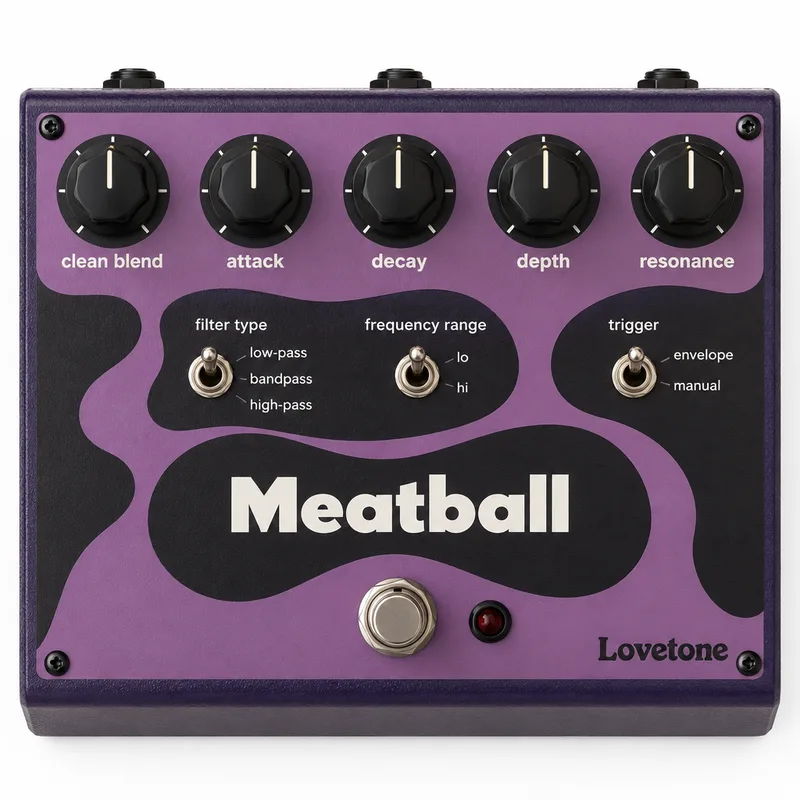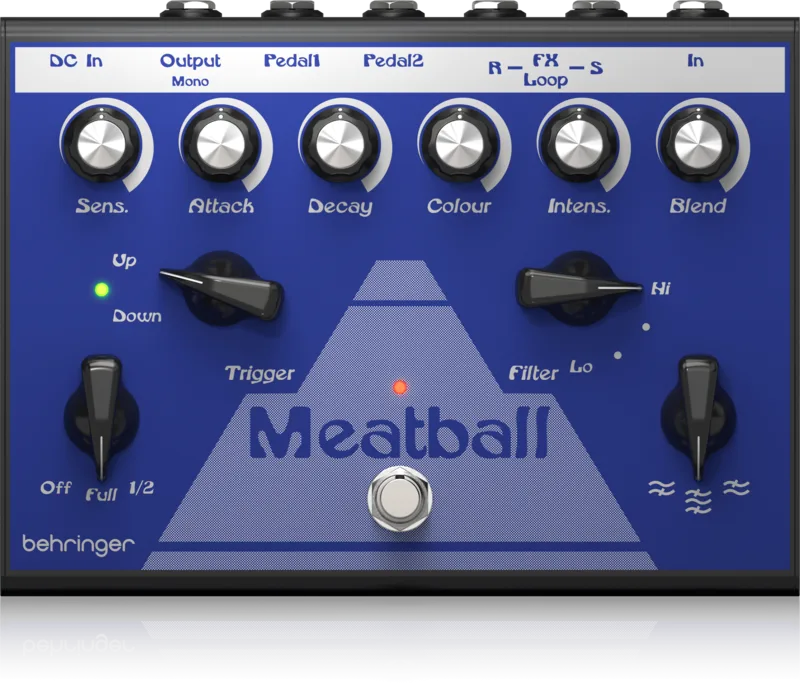


The Behringer Meatball is an envelope filter pedal, a design that opens and closes a filter according to how hard you play, producing the auto-wah and funk sounds that filter pedals are known for. Behringer describes its range of sounds as "from subtle vowel-like shifts to sharp, expressive peaks"1. gearnews reported in January 2026 that the pedal "is based on the Lovetone Meatball Envelope Filter", a '90s classic, and that it is aimed at "funk sounds, auto-wah, and experimental effects"2.
What it does and how it is controlled
An envelope filter tracks the dynamics of your playing and sweeps a filter in response, so picking harder moves the effect further. The Meatball's front panel carries three knobs: Behringer says you "Dial in Sensitivity, Attack and Decay to match your dynamics"1. Sensitivity sets how strongly the filter responds to your input, while attack and decay shape how the sweep rises and falls.
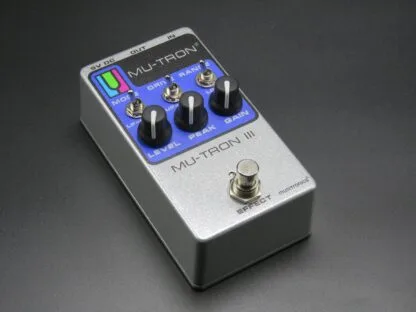
The filter can be set to low-pass, band-pass or high-pass, the same three filter types found on the Mu-Tron III, where a mode switch selects "Lowpass, Bandpass, Highpass"4. An expression pedal input allows manual sweeps, so you can drive the filter by foot rather than by picking dynamics alone1.
Where it came from: the Lovetone Meatball
The pedal it is modeled on has a history of its own. The Lovetone Meatball, "initially released in 1995" according to Aion FX, was "the first of Lovetone's legendary big-box modulation effects"3. Aion FX describes it as "a heavily tweaked version of the very first commercial envelope filter pedal, the Mu-tron III"3. On top of that core circuit, "the Meatball adds several new features including a clean blend, attack/decay controls, two extra range modes in between" the Hi and Lo settings, two expression controls, and an effects loop3.
GuitarPlayer, listing the original among its top 50 stompboxes, described it as featuring "four frequency ranges, multiple filter types (with depth and resonance controls), attack and decay knobs, a trigger section, and an effects loop"5. JHS Pedals notes that its effects loops "let you put other effects into it, so they're triggered into the envelope", alongside expression control6.
"On paper, at least, these look good, and if they offer the same ballpark tones as the originals, then they will sell like ‘hot meatballs’!"
Bass, and where it sits in Behringer's filter range
Behringer markets the Meatball to bass players directly, saying it can "give your bass lines a synth-like growl with every note"1. Because envelope filters respond to playing dynamics, the sensitivity control matters more on bass, where attack strength varies note to note.
The Meatball sits alongside Behringer's other recent filter releases, and it follows the same approach the company has taken with its reissues: bring back a well-known design at its own price point. On paper, at least, these look good, and if they offer the same ballpark tones as the originals, then they will sell like the originals did, as Guitar World's reviewer put it when assessing the range2. For players, the pitch is straightforward: Sensitivity, Attack and Decay controls to match your dynamics, and a range Behringer describes as running "from subtle vowel-like shifts to sharp, expressive peaks"1.
Videos
Adam Husk
Echo Kraft
Behringer
Questions
Does the Behringer Meatball work with an expression pedal?
Yes. Behringer's product page says you can use an expression pedal for manual sweeps, so instead of relying only on the envelope triggered by your playing dynamics, you can control the filter sweep by foot. The original Lovetone Meatball also had expression control, along with an effects loop that let other effects be triggered into the envelope.
Is the Behringer Meatball a clone of the Lovetone Meatball?
gearnews reported in January 2026 that the Behringer Meatball is based on the Lovetone Meatball Envelope Filter, a '90s classic first released in 1995. The Lovetone original was itself a heavily tweaked version of the Mu-Tron III, the first commercial envelope filter pedal, adding a clean blend, attack and decay controls, extra range modes, expression controls and an effects loop.
Can the Behringer Meatball be used on bass?
Behringer markets it for bass as well as guitar, saying it can give bass lines a synth-like growl with every note. Envelope filters respond to playing dynamics, which is why they have long been a staple of funk bass tones, and the Meatball's sensitivity control is there to match the filter to your attack.
How much does the Behringer Meatball cost?
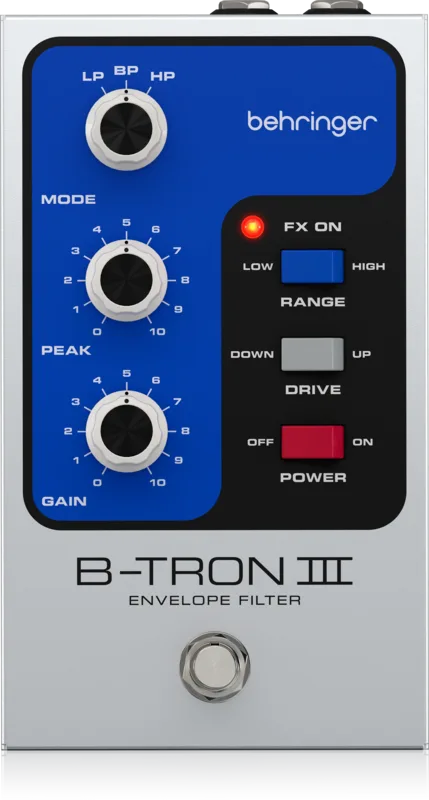
gearnews listed the Meatball at $95 / £84 / €98 at Thomann as of January 2026. That is a fraction of what the Lovetone originals command, and it sits alongside Behringer's other budget filter releases such as the B-Tron III Envelope Filter.
Does the Meatball have low-pass, band-pass and high-pass modes?
Yes. gearnews reports selectable low-pass, band-pass and high-pass filters. The same three filter types were on the Mu-Tron III, where a mode switch selects Lowpass, Bandpass or Highpass, and the Lovetone Meatball expanded on that with four frequency ranges and multiple filter types with depth and resonance controls.
Sources (6)
- MEATBALL, Behringer
- Behringer Meatball: Budget Take on a '90s Classic, gearnews.com, 2026-01-19
- Spectron Dynamic Filter / Lovetone Meatball, Aion FX, 2021-07-02
- Mu-Tron III, Musitronics Mu-Tron
- The Best Guitar Effects Pedals of All Time, GuitarPlayer (www.guitarplayer.com), 2021-06-25
- THE LEGEND OF LOVETONE, JHS Pedals