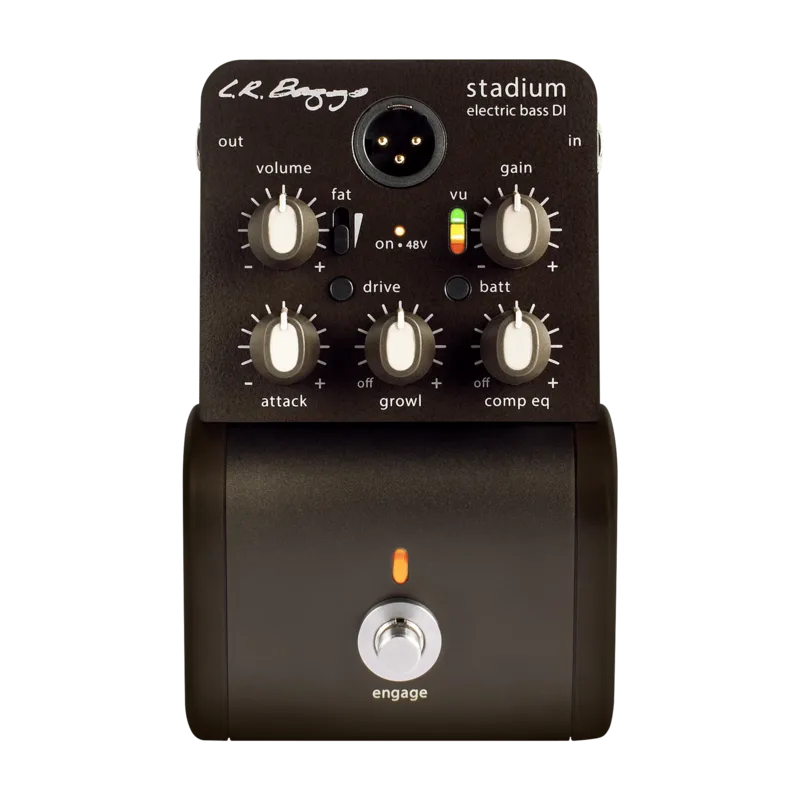


The Stadium DI is a floor preamp and DI from LR Baggs, built for electric bass. It combines a high-graded FET preamp with three separate bands of dynamic tone shaping under a Comp-EQ banner, plus a Growl saturation circuit aimed at the low end, and it sends a balanced signal to the PA from an all-discrete signal path with XLR and 1/4-inch outputs1. It sits in the preamp family, and for players thinking about a board of bass pedals, it is designed to be the front end and the direct box in one box.
Controls
LR Baggs lists ten controls on the Stadium DI1:
| Control | What it does |
|---|---|
| Volume | Output level |
| Gain | Input gain to the FET preamp |
| Attack | Tone shaping |
| Growl | Adds low end distortion for thickness and rich harmonic content; the circuit isolates and saturates a specific low-frequency band |
| Comp-EQ | Three separate bands of dynamic tone shaping; enhances the feel of playing while evening out your tone |
| Fat | Boosts 150Hz by +3dB or +6dB for a fuller, rounded tone |
| Drive | Pushes the Growl to a full overdrive |
| Pad | Boosts or cuts the XLR out (-10dBV or +4dBu) to meet the needs of the PA |
| Ground/Lift | Ground lift for the balanced output |
| Engage/Bypass | Engages or bypasses the unit |
The Growl and Drive pairing is the distinctive part: rather than a general overdrive or distortion stage, the saturation is applied to a selected low-frequency band, so a player can add grit to the fundamentals while keeping the upper mids clean. The Comp-EQ works in the opposite direction, with LR Baggs describing it as evening out tone and enhancing the feel of playing, in the territory of a compressor and EQ combined1.
Power and connections
The Stadium DI can be powered three ways: a 9V battery, a 9V 500mA power supply, or 48V phantom power1. Phantom power is the practical option for a gigging bassist: once the XLR is run to the console, the unit draws its power down that cable and no battery or adapter is needed. The Pad control sets the XLR output level between -10dBV and +4dBu to match whatever the PA or interface expects, and the Ground/Lift control deals with ground loop hum between the bass rig and the house system1.
The enclosure is described by LR Baggs as rugged, constructed of aluminum, steel, and ABS plastic, and the unit ships with a custom Baggs carrying case1.
From the Session DI to a bass preamp
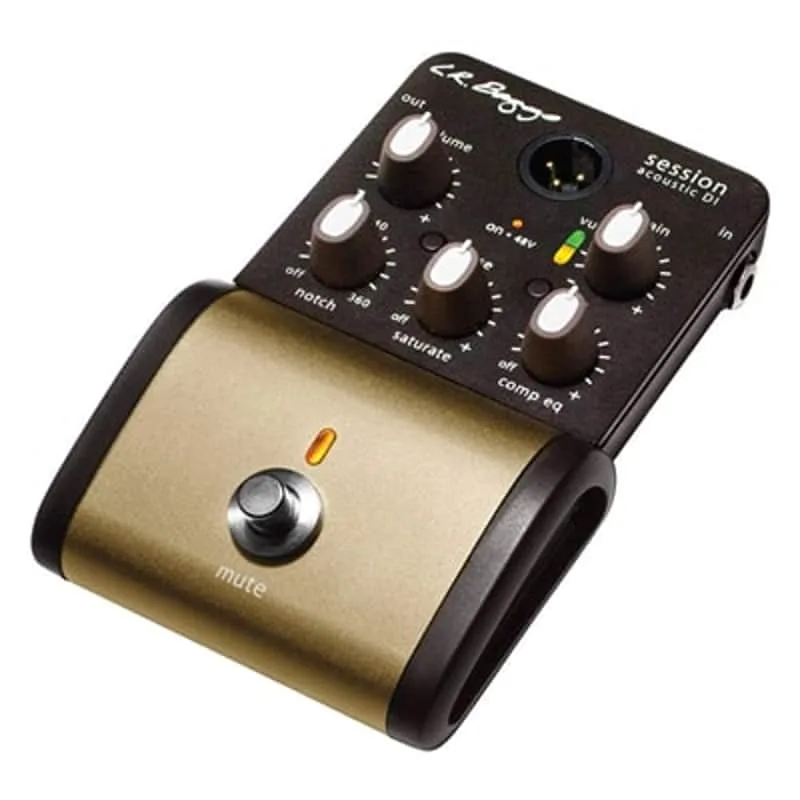
LR Baggs traces the Stadium's approach back to its acoustic-series Session DI. In adapting studio mixing and mastering tools for that pedal, the company says its engineers took features like harmonic saturation and multiband compression and turned them into highly effective tone-shaping tools for live performance1. The Stadium carries that idea over to electric bass, and LR Baggs says it was designed by its bass-playing engineering team to solve that live-performance problem1.
As a demonstration, LR Baggs published a demo of the Stadium Electric Bass DI prototype played by Gary Rink1.
The Growl circuit's saturation is band-limited by design. If you want distortion across the whole signal rather than just the low band, the Drive button takes the Growl to a full overdrive, but a dedicated distortion pedal after the Stadium is the other route.
Videos
Andertons Music Co
BassTheWorld.com
Patrick Hunter
Questions
Is the LR Baggs Stadium DI made for bass?
Yes. LR Baggs lists the Stadium DI for electric bass, and the company says it was designed by its bass-playing engineering team to solve a live-performance problem. It is a floor or pedalboard unit rather than a rack piece, and LR Baggs has demonstrated it with a prototype played by bassist Gary Rink.
Can the Stadium DI run on phantom power?
Yes. LR Baggs gives three powering options for the Stadium DI: 48V phantom power over the XLR connection, a 9V battery, or a 9V 500mA power supply. Phantom power means the unit can draw its power from the mixing console or interface it is plugged into, so no battery or adapter is needed once the XLR is connected.
What does the Growl control do on the Stadium DI?
Growl adds low end distortion for thickness and rich harmonic content. LR Baggs describes the circuit as isolating and saturating a specific low-frequency band, so the saturation is aimed at the bass fundamentals rather than the whole signal. The Drive button pushes the Growl further, into a full overdrive.
What does the Fat switch do on the Stadium DI?
The Fat switch boosts 150Hz by either +3dB or +6dB, which LR Baggs describes as giving a fuller, rounded tone. It is a fixed-frequency low boost rather than a sweepable control, so it is a quick way to add body to a thin-sounding bass or room.
Does the Stadium DI have an XLR output?
Yes. The Stadium DI has an all-discrete signal path with both XLR and 1/4-inch outputs. The Pad control boosts or cuts the XLR output between -10dBV and +4dBu to match the level the PA or interface expects, and a Ground/Lift control is also on board.
Sources (1)
- Stadium Electric Bass DI by LR Baggs, lrbaggs.com