

The Green Wonder is a high-output overdrive and booster pedal from Mad Professor, the Finnish amplifier and effects builder. Announced in August 2022 and set for release that October, it is an updated version of the company's popular Little Green Wonder, carrying over its high-headroom, low-compression drive character while adding a fuller EQ section123.
Mad Professor positions it as a pedal that does two jobs: with the Drive knob backed off it works as a clean boost with enough output level to push a tube amp's front end into natural clipping, and turned up it moves from bluesy crunch into rock overdrive1. The company says it is optimized to sound great with single coil and humbucking pickups, into clean, overdriven or distorted amplifiers12.
What it does to your sound
The Green Wonder is built around the idea of headroom: the ability to stay clean and open at higher signal levels before the drive kicks in. MusicRadar described it at announcement as Mad Professor's "improved low compression, high headroom, high output overdrive," a revised version of the Little Green Wonder2. Guitar.com reported the maker describing it as "the ultimate high-headroom overdrive/booster pedal"3.
That character comes from the Little Green Wonder's circuit. Guitar World's reviewer, Mike Hermans, noted that most players fairly assume the Little Green Wonder is a take on a Tube Screamer, but it differs: the gain range is similar, running from light breakup to a relatively driven overdrive, while the headroom is increased compared with a TS-type pedal5. The Green Wonder builds on that foundation. Guitar.com reported that everything loved about the classic Little Green Wonder is included in the new version, with added versatility drawn from customer wishes3.
The pedal is also voiced with a characteristic midrange hump, according to MusicRadar, and is intended for use with clean, overdriven or heavily distorted amps2.
The controls: Volume, Drive, Bass and Treble
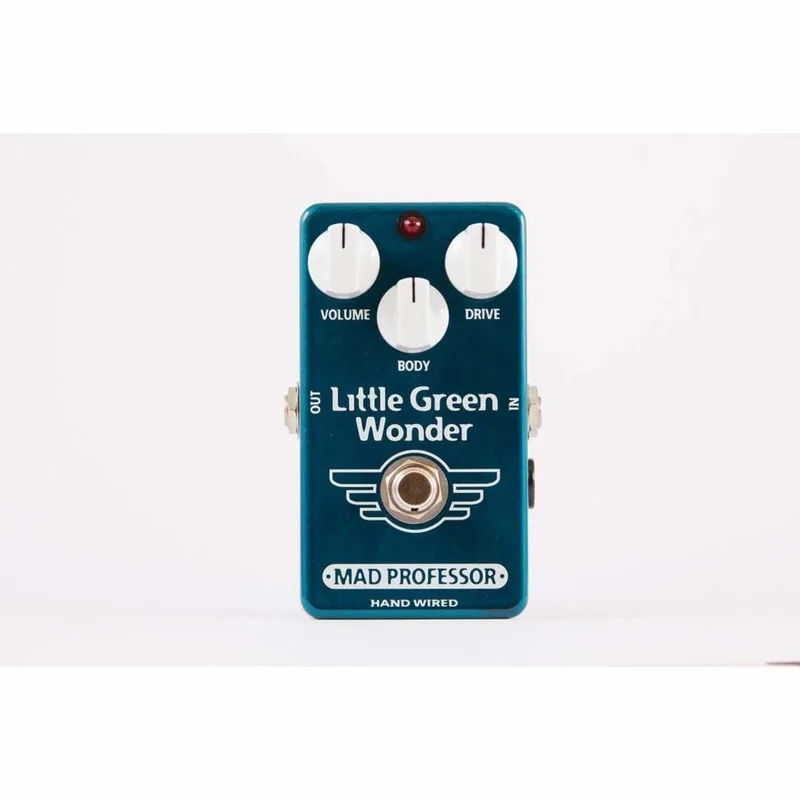
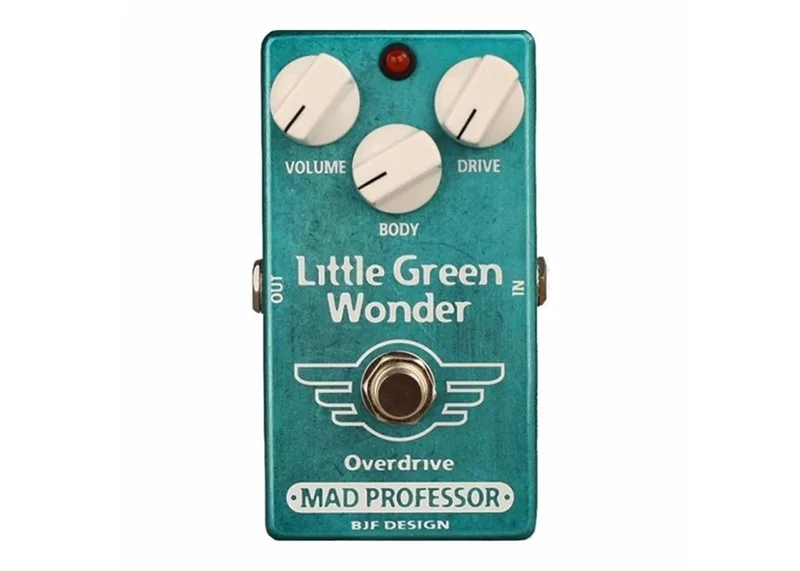
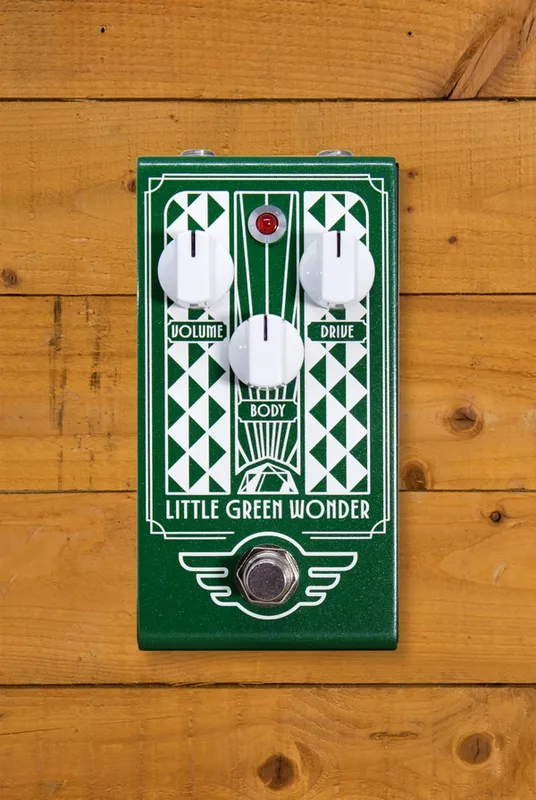
The Green Wonder carries four knobs, a step up from the Little Green Wonder's three. The original's standout Body control was replaced by separate Treble and Bass controls on this second iteration25.
| Control | What it does |
|---|---|
| Volume | Sets the overall output level. Even as a clean boost, the pedal provides enough level to push the front end of a tube amp into natural clipping1 |
| Drive | Sets the level of overdrive. Counterclockwise gives low overdrive or a boost; clockwise takes you from clean boost to bluesy crunch and into rock overdrive1 |
| Bass | Sets the low end, from a slight low-frequency cut to a significant low-frequency boost. Suggested starting point: 1 o'clock1 |
| Treble | Sets the brightness, from warm and smooth to bright and cutting tones. Suggested starting point: noon1 |
MusicRadar noted that the expanded EQ knobs let the player dial in low and high frequencies accurately, from gentle cuts to a hefty boost2. That two-band EQ is the practical answer to a job the original pedal handled differently: on the Little Green Wonder, the Body control let you tune the pedal for single coils or humbuckers, and cranked clockwise it acted as a treble booster6.
Power and connections
The Green Wonder runs on a supply voltage range of 7.5 to 18V DC, with a maximum current consumption of 4mA at 9V DC14. That draw is low enough that the pedal is easy on a typical pedalboard power supply. Input impedance is 500kOhm and output impedance is 10kOhm1.
The original Little Green Wonder shares the same electrical footprint: Guitar World listed it at 9V center negative, 4mA, noting it can take up to 18V but that Mad Professor recommends sticking to 9V for best results, with quarter-inch input and output jacks5. The current handwired Little Green Wonder lists the same 7.5 to 18V range and approximately 4mA at 9V DC4.
The Green Wonder's 7.5 to 18V DC range means it accepts 9V and higher-voltage supplies. The Little Green Wonder's guidance from Mad Professor, as reported by Guitar World, was to stay at 9V for best results even though the pedal tolerates up to 18V54.
History: from the Little Green Wonder
The Green Wonder's story starts with Bjorn Juhl of BJFe. Aion FX's project documentation records that in 2007 Mad Professor Amplification of Finland released the Little Green Wonder under license from BJFe, and that the Mad Professor version was based on the final BJFe circuit, the one Bjorn was most happy with. The IC in the circuit has always remained socketed, including in the Mad Professor version7.
The Little Green Wonder became a popular pedal, and its green box and "green" model name have long invited comparisons with an old green-colored classic from Ibanez6. The original version has since been discontinued, with its Body control replaced by the Treble and Bass controls on the second iteration, named The Green Wonder5.
Twenty years after its debut, the Little Green Wonder has also returned in an updated Handwired series version, built in Finland with the original layout, including its handwired construction58. Peach Guitars describes that reissue as a high-headroom overdrive and booster with a specially tuned EQ curve and focused drive that pairs with any guitar or amp setup8. MusicRadar's review noted that Mad Professor will still make a handwired version of these pedals on request6.
What reviewers said
Published reviews of the line have been positive. Of the Little Green Wonder, MusicRadar's review team wrote:
"This overdrive pedal is both versatile and addictive."
They also noted its flexibility beyond its day job as an overdrive: the company suggests using it as a booster pedal, or to calm down an overly bright amplifier or a raspy sounding fuzz6. Guitar World's Mike Hermans listed it as great as a boost or a standalone overdrive5, and Peach Guitars says that with plenty of gain available it works as a standalone overdrive, stacked alongside other drives, or pushing an amp over the edge8.
Videos
Mad Professor Amplification
Mad Professor Amplification
Mad Professor Amplification
Questions
Is the Mad Professor Green Wonder true bypass?
Yes. The Green Wonder uses complete bypass, which is true bypass, so the pedal is fully out of the signal path when switched off. The Little Green Wonder, both the original and the current handwired reissue, is also true bypass.
What is the difference between the Green Wonder and the Little Green Wonder?
The Green Wonder is an updated version of the Little Green Wonder. The original's single Body control, which shaped the tone for single coils or humbuckers, was replaced by separate Bass and Treble controls, giving a two-band EQ alongside Volume and Drive. Mad Professor also cites improved low compression and higher headroom in the new version.
Does the Green Wonder work with humbuckers?
Yes. Mad Professor says the Green Wonder is optimized to sound great with both single coil and humbucking pickups, with clean, overdriven or distorted amps. On the original Little Green Wonder, the Body control was the tool for matching the pedal to either pickup type; on the Green Wonder the Bass and Treble knobs do that job.
Can I stack the Green Wonder with another overdrive?
Yes. The design follows the Little Green Wonder, which reviewers found great as a boost or a standalone overdrive, and which Mad Professor suggests using as a booster pedal or to tame an overly bright amp or raspy fuzz. Its Volume control provides enough level to push a tube amp's front end into natural clipping.
Sources (8)
- Mad Professor The Green Wonder, Delicious Audio, 2022-08-17
- Mad Professor promises their new Green Wonder overdrive is the “ultimate green pedal!”, MusicRadar, 2022-08-09
- Mad Professor Amplification announces The Green Wonder, "the ultimate high-headroom overdrive pedal", Guitar.com, 2022-08-08
- Mad Professor Little Green Wonder Overdrive Pedal, South Shore Guitar Boutique
- Mad Professor Little Green Wonder review, Guitar World, 2026-06-23
- Mad Professor Little Green Wonder review, MusicRadar, 2011-03-30
- Viridian Dynamic Overdrive, Aion FX, 2020-08-28
- Mad Professor Handwired Little Green Wonder, Peach Guitars