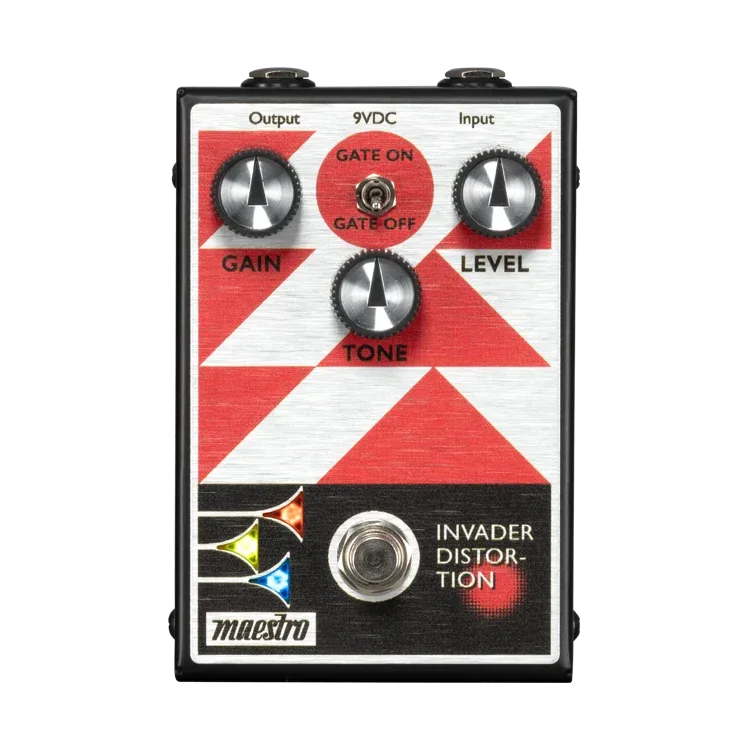


The Maestro Invader Distortion is a high-gain distortion pedal introduced in early 2022 as one of the five pedals Gibson used to relaunch the Maestro brand123. It is an all-analog pedal whose circuit uses discrete transistors and multiple gain stages to reach its high levels of distortion24. Delicious Audio describes it as delivering "a heavy, aggressive, dominant sonic character and loads of rich harmonics"2.
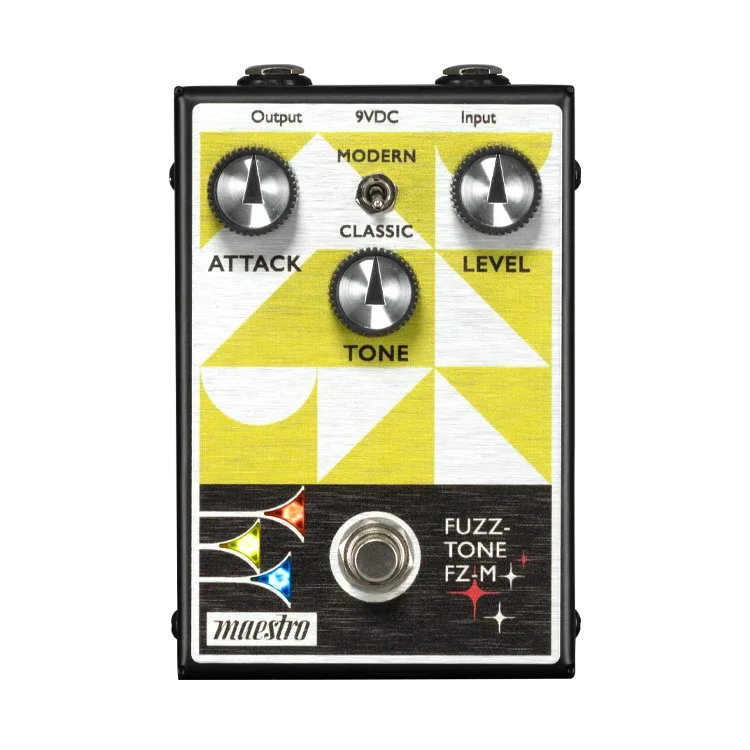
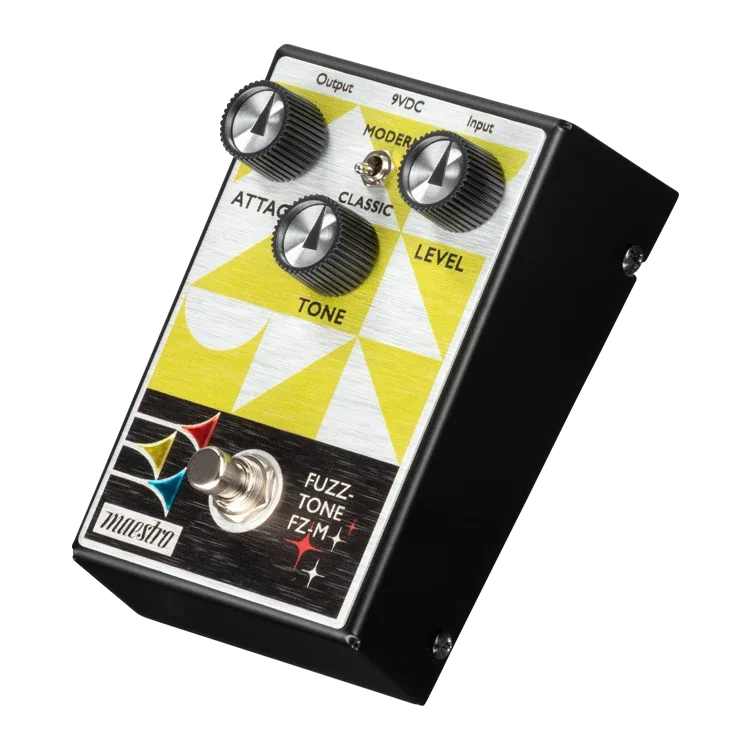
Unlike some of its siblings in the relaunched line, the Invader is not a reissue of a vintage circuit. Delicious Audio notes that while pedals like the FZ-M draw on Maestro circuits from the 1960s, "the Invader appears to be its own thing: a modern high gain distortion"2. It launched at $149 in the United States5.
What the Invader does to your sound
The Invader is built for saturated, high-gain distortion. Its circuit uses discrete transistors arranged in multiple gain stages to generate the distortion, rather than op-amp clipping or a digital model4. MusicRadar's review team found it "has a raw mid distortion character that is uniquely amp-like"7.
GuitarPlayer's Art Thompson found the pedal covers a wide range of gain, writing that it is "a high-gain machine that can cover a broad spectrum of distortion duties," and that it "is dynamically responsive and tracks guitar volume changes quite well at super-saturated settings"4. He also found the EQ "accommodating to humbuckers and single-coils alike"4. Performer Mag's Chris Devine characterized it as recalling "when a distortion pedal was meant to hurt the front end of an amp while still retaining some semblance" of the guitar8.
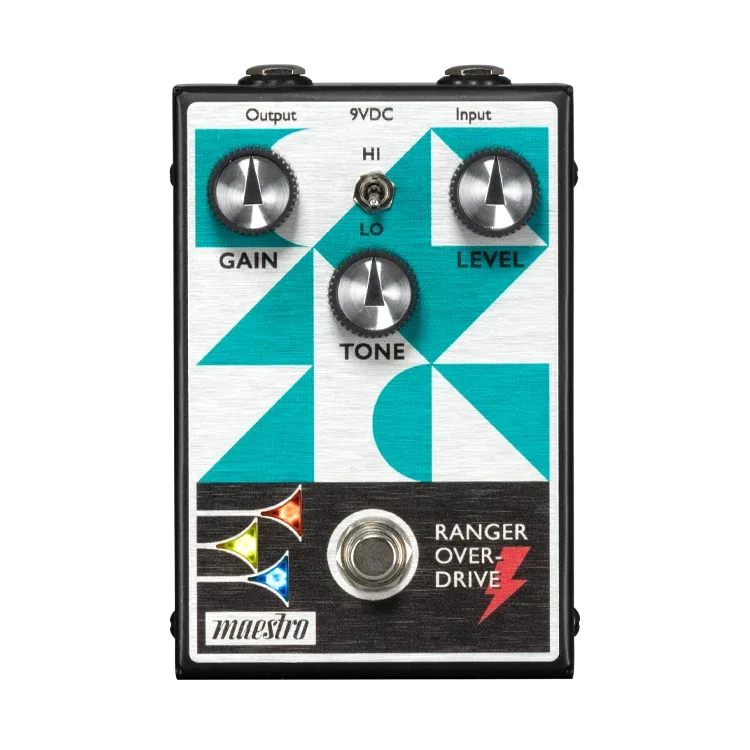
One pairing the press highlighted: Thompson found that running the Invader with the Maestro Ranger Overdrive boosting the front produced controllable feedback, "a cool way to get feedback that was controllable by picking adjustment even at very low volume"4.
Controls
The Invader keeps its control set simple: three knobs and one toggle36.
| Control | What it does |
|---|---|
| Gain | Sets the distortion amount, from slight overdrive to heavy distortion93 |
| Tone | Tweaks the EQ3 |
| Level | Sets overall output, with more than enough volume to push well past unity gain93 |
| Gate toggle | Turns the built-in noise gate on or off2 |
The true bypass footswitch also lights up the red, yellow, and blue bugles in the Maestro logo on the enclosure when the pedal is active2.
The built-in noise gate
High-gain distortion circuits generate hiss, so the Invader ships with a noise gate built in, engaged by the top panel toggle switch2. The gate's threshold is not set by an external knob: an internal trim pot mounted on the circuit board inside the pedal adjusts the threshold level26. Thompson found this useful in practice, writing that "the Gate quickly clamps down as notes begin to fade, which is handy if there's a lot of noise buildup from pedals" in the chain, and that "you can adjust the threshold sensitivity via an internal trimpot to make the gating feel more natural"4.
Not every reviewer loved the gate. Guitar.com's Richard Purvis scored the pedal 7/10 overall and wrote that "the noise gate's not the best, but this is a decent option for anyone who just wants high-gain fiendishness"6.
"The noise gate's not the best, but this is a decent option for anyone who just wants high-gain fiendishness."
Power and connections
The Invader runs on a 9V battery or a regulated 9V DC power supply with a 5.5 x 2.1 mm plug wired center negative2. A 2.1mm jack for an external adapter is provided, and the power on switch is incorporated into the input jack, so you need to unplug the input when the pedal is not in use to prevent battery drain24. At 56.7mA it draws more current than many analog distortion pedals, which is worth knowing if you run a daisy chain7.
The housing opens clamshell-style to make battery changes easy4. Input impedance is 100kΩ and output impedance is 100Ω7.
The power switch is built into the input jack. Leaving a cable plugged in will drain the battery, so unplug the input when you are done playing2.
Part of Gibson's relaunched Maestro line
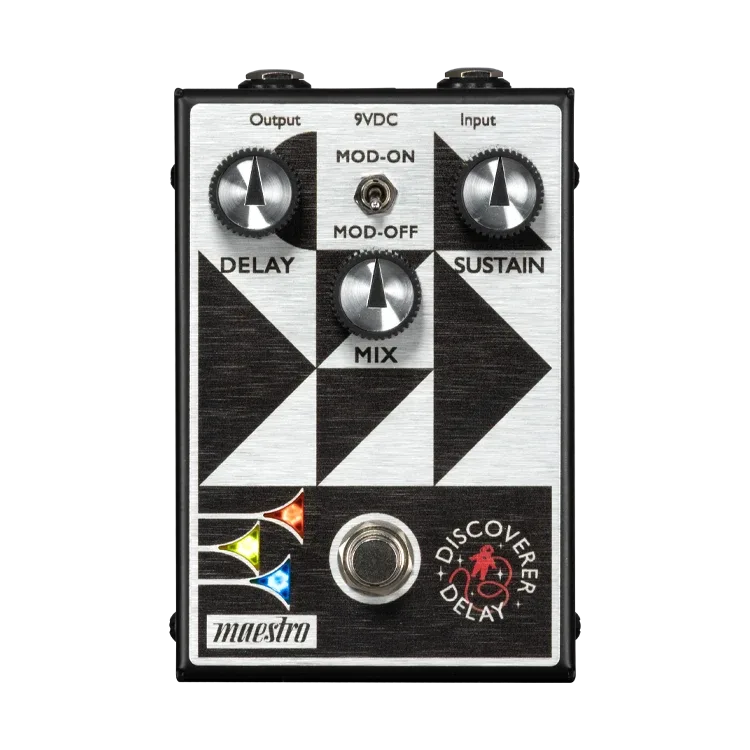
Gibson revived the Maestro brand in 2022 after decades out of production3. The Invader was one of the first five pedals in the relaunched Original Collection, alongside the Ranger Overdrive, FZ-M Fuzz-Tone, Comet Chorus and Discoverer Delay13. The line launched at $149 per pedal, with the Discoverer Delay at $1595. Pedal of the Day counted the Invader as the third pedal in the lineup it reviewed, after the Discoverer Delay and Comet Chorus9.
The Invader's gate switch has a small piece of design history behind it. In a MusicRadar interview, Craig Hockenberry, the designer behind the revived pedals, explained that the toggle was originally planned as Attack and Destroy settings before those modes became the Gate On and Gate Off noise gate that shipped on the pedal10.
What reviewers said
Published reviews of the Invader were broadly positive:
- GuitarPlayer (Art Thompson): "A high-gain machine that can cover a broad spectrum of distortion duties," with no reasons to avoid it; dynamically responsive even at super-saturated settings4.
- MusicRadar: A raw, amp-like mid distortion character7.
- Guitar.com (Richard Purvis): 7/10, with the noise gate called "not the best" but the pedal still "a decent option for anyone who just wants high-gain fiendishness"6.
- Performer Mag (Chris Devine): A pedal that recalls when distortion was meant to push an amp hard8.
Videos
Gibson TV
Xander Raymond Charles
Pedal of the Day
News
Questions
How do you adjust the noise gate threshold on the Invader?
The gate itself is turned on and off with a toggle switch on the top panel. Its threshold is set by an internal trim pot mounted on the circuit board inside the pedal, so you have to open the enclosure to change how sensitive the gating feels. GuitarPlayer's reviewer found the trimpot lets you make the gating feel more natural.
Is the Maestro Invader true bypass?
Yes. The Invader uses a true bypass footswitch, which also lights up the red, yellow, and blue bugles in the Maestro logo on the enclosure when the pedal is active. When bypassed, the pedal is out of your signal chain entirely.
Is the Maestro Invader based on a vintage circuit?
No. Unlike some other pedals in the relaunched Maestro line, such as the FZ-M, which draw on circuits from the 1960s, the Invader appears to be its own thing: a modern high-gain distortion built from discrete transistors with multiple gain stages.
Why was the Invader's gate switch first planned as Attack and Destroy?
According to a MusicRadar interview with Craig Hockenberry, the designer behind the revived Maestro pedals, the Invader's toggle was originally planned as Attack and Destroy settings. During development those modes became the Gate On and Gate Off noise gate switch that shipped on the pedal.
Sources (10)
- Maestro Knocks Out Another Batch of Classic Analog Stompboxes, GuitarPlayer, 2022-11-09
- Maestro Invader Distortion, Delicious Audio, 2022-01-19
- Gibson Launches Maestro Original Collection 2023, Premier Guitar, 2022-01-18
- Maestro Invader Distortion Review, GuitarPlayer, 2022-04-06
- Gibson revives Maestro as a fully-fledged pedal brand with five new stompboxes, Guitar.com, 2022-01-18
- The Big Review: Maestro Original Collection pedals, Guitar.com, 2022-02-10
- Maestro Original Collection pedals review, MusicRadar, 2022-05-25
- REVIEW: Maestro Original Collection Guitar Effect Pedals, Performer Mag, 2022-07-07
- Maestro Invader Distortion, Pedal of the Day, 2022-07-02
- Interview: "It's arguably the first guitar effects pedal ever", MusicRadar, 2022-02-21