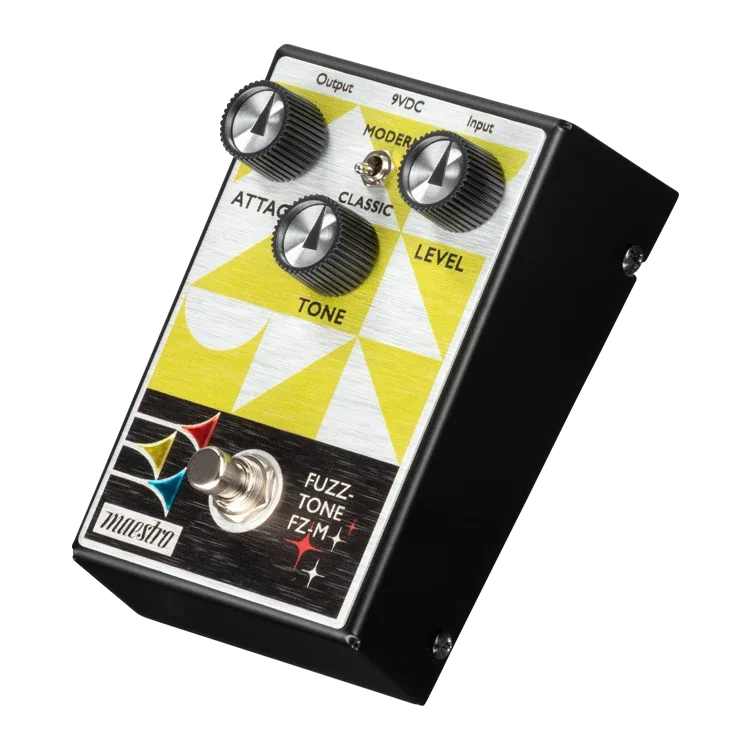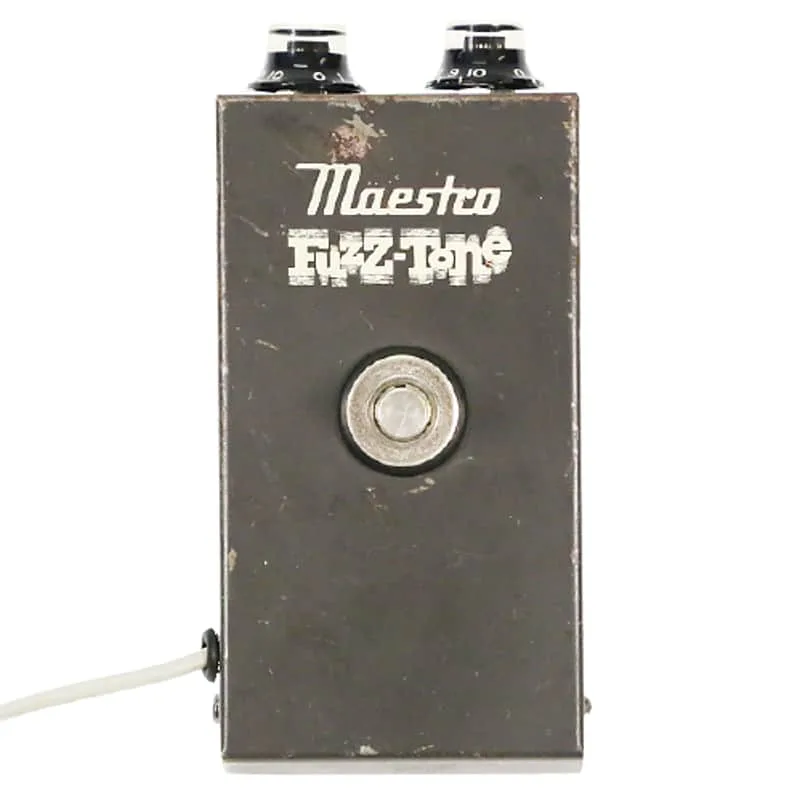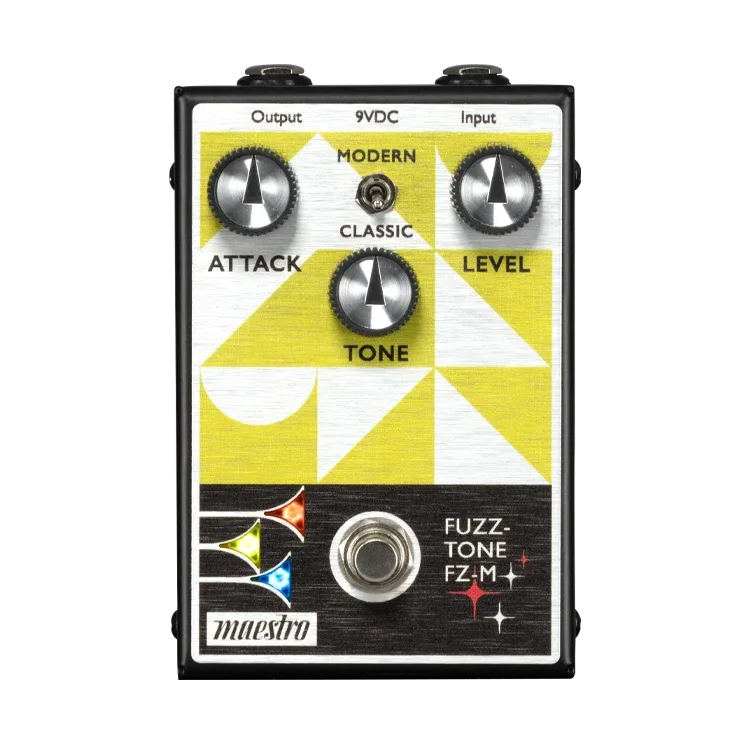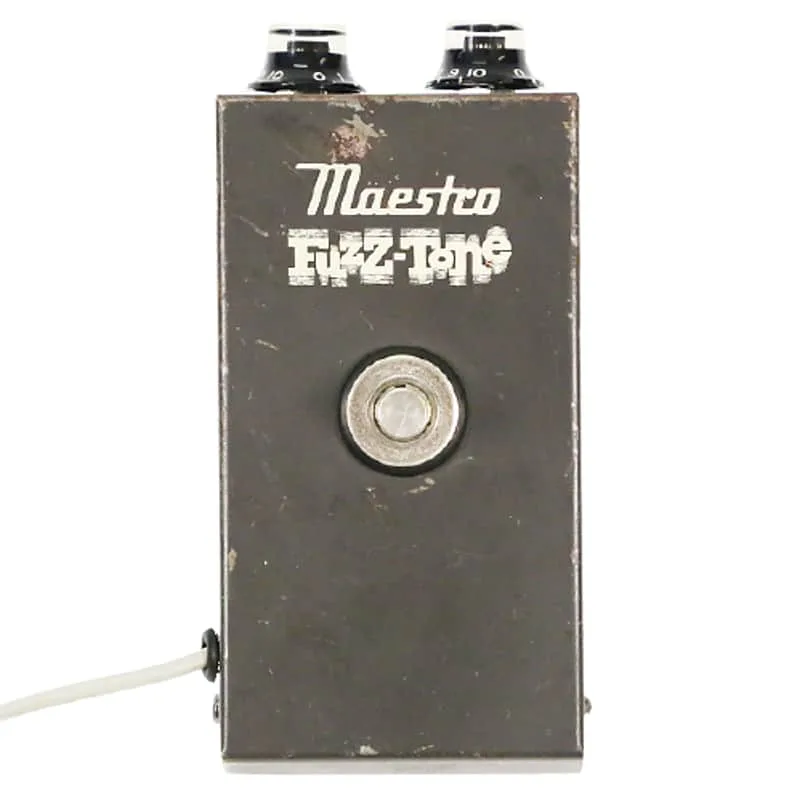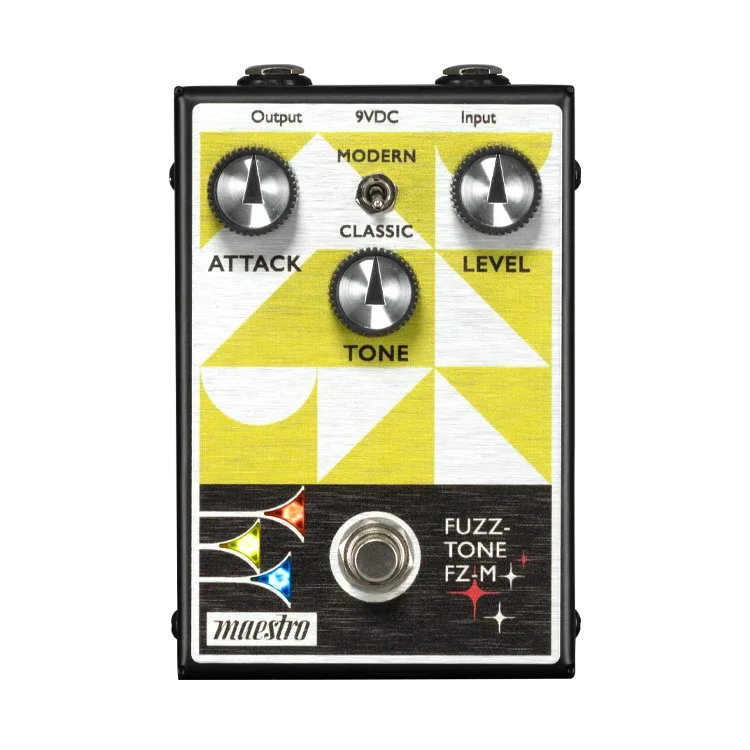


The Maestro Fuzz-Tone FZ-M is an all-analog fuzz pedal with two voices in one box: a Classic mode inspired by the early-1960s Maestro FZ-1 Fuzz-Tone, and a Modern mode with a thicker, more contemporary fuzz tone. Maestro describes it as "two pedals in one functionality," selected by a mode toggle switch1. It launched in January 2022 at $149 as part of the five-pedal Maestro Original Collection, the brand's first pedals since 1979, alongside the Ranger Overdrive, Invader Distortion, Comet Chorus and Discoverer Delay2.
The FZ-M is an update of the FZ-1 that harks back to the original's wedge-shaped enclosure, but it is not a straight clone. It adds a Tone control the original never had, a Modern voicing, and a Level control that can push well past unity gain134.
Classic and Modern fuzz voices
The core of the pedal is the two-position mini-toggle that selects between Classic and Modern sounds8. Maestro says the switch provides "both an FZ-1 inspired fuzz sound and a thicker, more modern fuzz tone"1.
- Classic mode is based on the FZ-1A, using discrete transistors8. GuitarPlayer's reviewers found it "sounds like an early Fuzz-Tone, with its slightly scooped response and frazzy fuzz sound"8. Gearnews describes it as "based on the exact FZ-1 raucous fuzz tone"9, and Premier Guitar notes that in Classic mode "it cuts through the mix like a hot knife through butter"6.
- Modern mode is thicker, with a slightly different voicing9. Performer Mag's Chris Devine found it "cleans things up a bit with more punch and presence"10, and Maestro says it also suits electric bass6.
Reviewers generally treated the two voices as complementary rather than redundant. Guitar.com's Richard Purvis found Classic mode had "a tightness to the bottom end that balances the raspy aggression of the treble," while Modern gave "a much thicker, less fizzy voicing that's instantly addictive and will probably prove more useful to most players"3. Devine found Classic "rich and can get plenty hairy at the same time," working well with both single-coil and humbucking pickups10.
"Gutsy and distinctive, this multi-voiced fuzz is much more than just a straight retro reboot."
Guitar.com scored the FZ-M 9/10, calling it "gutsy and distinctive" and "much more than just a straight retro reboot"3. GuitarPlayer's review summed it up as delivering "vintage-style Maestro tone plus modern fuzz"8, and MusicRadar's review team wrote that it "brings the slashing Fuzz Tone sound with fuller tones ready to dial in"11.
The controls: Attack, Volume and Tone
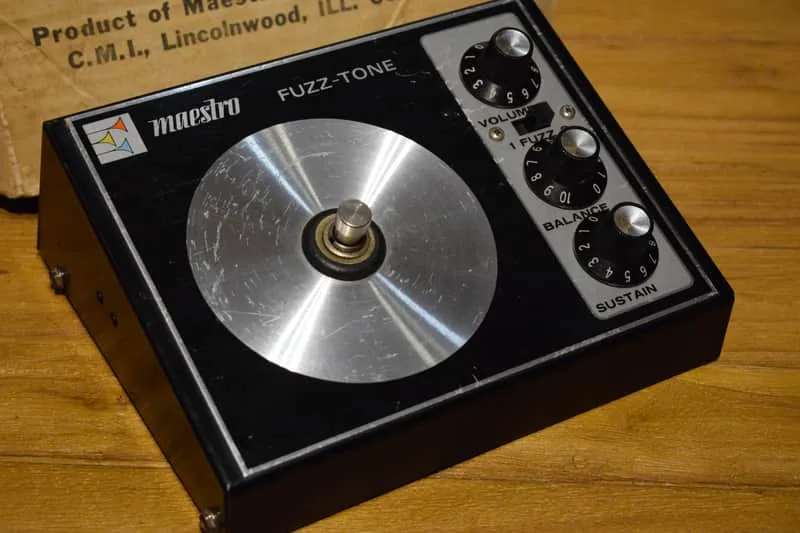
The FZ-M keeps the original Fuzz-Tone's control names but adds a third knob. Where the FZ-1 and FZ-1A carried only Volume and Attack12, the FZ-M has Attack, Tone and Level1.
| Control | What it does |
|---|---|
| Attack | Controls the amount of fuzz4. GuitarPlayer found it "unleashes a goodly amount of sustain as it's turned up to where the playing feel is starting to get a little" compressed at high settings8. |
| Tone | Adjusts the timbre "from bright and raspy to warm and wooly and anywhere in between"1. |
| Level | Sets the output volume; Maestro says it "can go way beyond unity gain when desired"1. |
| Mode toggle | Two-position mini-toggle selecting Classic and Modern sounds8. |
The Tone control is the notable addition for players comparing the FZ-M against the vintage units or their clones. Delicious Audio describes the FZ-M as "a 2022 relaunch of the original with an added Modern mode and a Tone control for more flexibility"4.
From the FZ-1 to the FZ-M
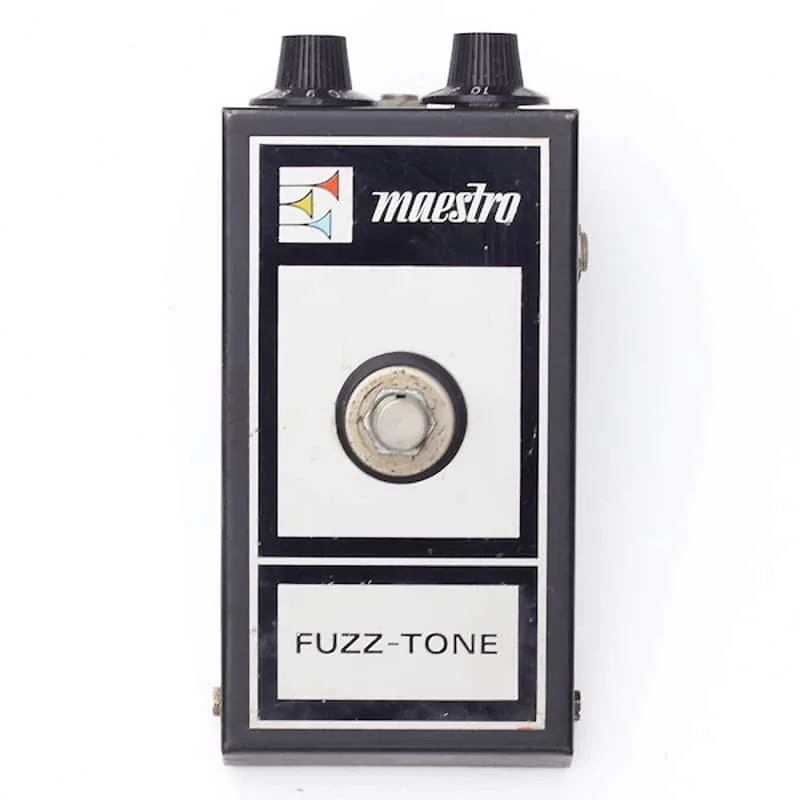
The FZ-M is the latest step in a lineage that began with the Maestro Fuzz-Tone FZ-1, which Gibson's Maestro division sold at a retail price of $4012. The design was refined in 1965 and reborn as the FZ-1A13, with a further transistor change in the FZ-1A in 19667. In 1968 the design changed again with the FZ-1B redesign14, and in the 1970s the FZ-1S Super-Fuzz updated the design with a different look and a distinctly different sound14.
The FZ-1's influence reached well beyond Maestro. Craig Hockenberry named the circuits it inspired: "Obviously, the Tone Bender and Fuzz Face, but there were so many others that followed suit"1516. Premier Guitar also groups the FZ-1 among lower-voltage vintage fuzzes, a class that behaves differently from higher-voltage designs15.
Gibson revived the Maestro brand in January 2022 with the Original Collection, timed around the FZ-1's 60th anniversary. GuitarPlayer's Rod Brakes wrote that the FZ-M "bridges the gap between those vintage sounds and contemporary tones by offering two distinct" voices85. MusicRadar noted the new iteration aims to deliver the reedy "Stones tones" of the original while using the voicing switch to give players more range17, and the pedal was later described as the FZ-1 "reissued for a new generation as the FZ-M"18.
Videos
Sweetwater
Gibson TV
guitarguitar
Questions
What is the difference between Classic and Modern mode on the Maestro FZ-M?
Classic mode is based on the FZ-1A and replicates the vintage unit's tone, with a slightly scooped response and a raspy, cutting fuzz character. Modern mode is thicker and less fizzy, with more punch and presence, and Maestro says it also suits electric bass. Reviewers at Guitar.com found Modern likely to be the more useful voice for most players.
How much does the Maestro FZ-M cost?
The FZ-M launched at $149 in January 2022 as part of the five-pedal Maestro Original Collection, and Delicious Audio still listed it at $149 in 2023. UK pricing was £139 at launch, while Gibson's own product page currently shows £110 including VAT with free shipping.
Does the Maestro FZ-M have a tone control?
Yes. The Tone control adjusts the timbre from bright and raspy to warm and wooly and anywhere in between. It is an addition over the original FZ-1 and FZ-1A, which carried only Volume and Attack controls, and Delicious Audio cites the added Tone control as a flexibility gain of the reissue.
Can the FZ-M volume go louder than unity gain?
Yes. Maestro says the Level control sets the output volume and can go way beyond unity gain when desired. Delicious Audio likewise notes the Volume knob controls the output, which in this version can go beyond unity gain if you want a boost on top of the fuzz.
Sources (18)
- Maestro Fuzz-Tone FZ-M, Gibson (www.gibson.com)
- Gibson revives Maestro as a fully-fledged pedal brand with five new stompboxes, Guitar.com, 2022-01-18
- The Big Review: Maestro Original Collection pedals, Guitar.com, 2022-02-10
- The Best Maestro FZ-1 Fuzz Tone Clones & Evolutions In 2023, Delicious Audio, 2023-05-15
- Maestro Knocks Out Another Batch of Classic Analog Stompboxes, GuitarPlayer, 2022-11-09
- Gibson Launches Maestro Original Collection 2023, Premier Guitar, 2022-01-18
- Maestro Fuzz-Tone FZ-M review, Guitar World, 2022-05-09
- Maestro FZ-M Fuzz-Tone Review, GuitarPlayer, 2022-04-06
- Gibson re-launches Maestro Electronics with Original Collection pedal range, gearnews.com, 2022-01-18
- REVIEW: Maestro Original Collection Guitar Effect Pedals, Performer Mag, 2022-07-07
- Maestro Original Collection pedals review, MusicRadar, 2022-05-25
- Maestro Fuzz-Tone, Vintage Guitar magazine, 2015-12-08
- BALTIC BLUE FUZZ (OC-BBFn), One Control USA
- The history and origins of the iconic Maestro FZ-1 Fuzz-Tone, Guitar World, 2021-10-20
- Electro-Harmonix Bender Royale Review, Premier Guitar, 2026-02-22
- Interview: "It's arguably the first guitar effects pedal ever", MusicRadar, 2022-02-21
- Gibson revives legendary Maestro pedals brand with five new stompboxes, including the Fuzz-Tone FZ-M, MusicRadar, 2022-01-18
- Hear the oldest guitar effects pedal demo ever from 1962, MusicRadar, 2023-03-30