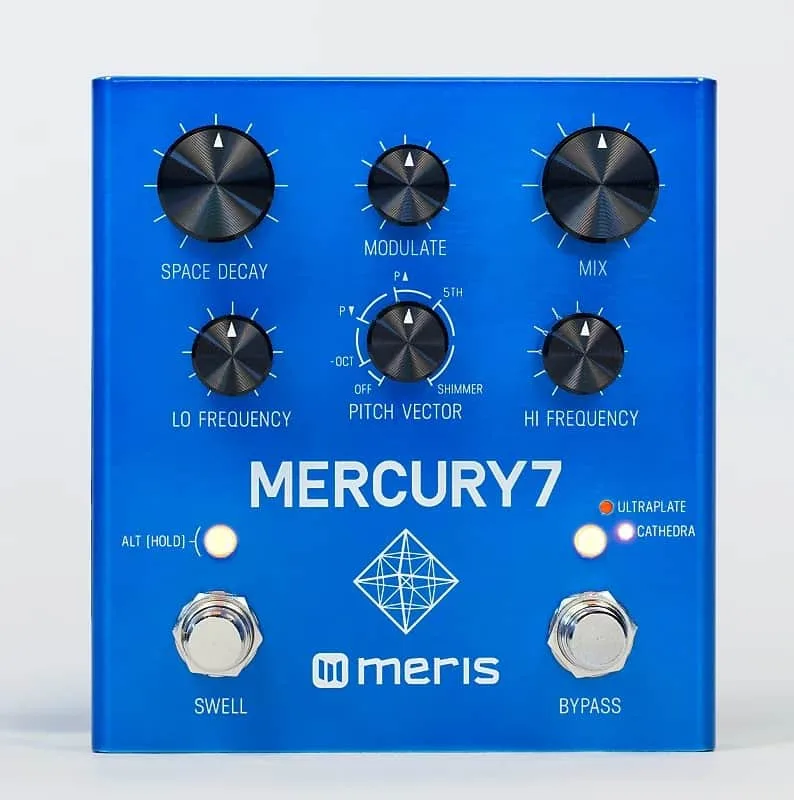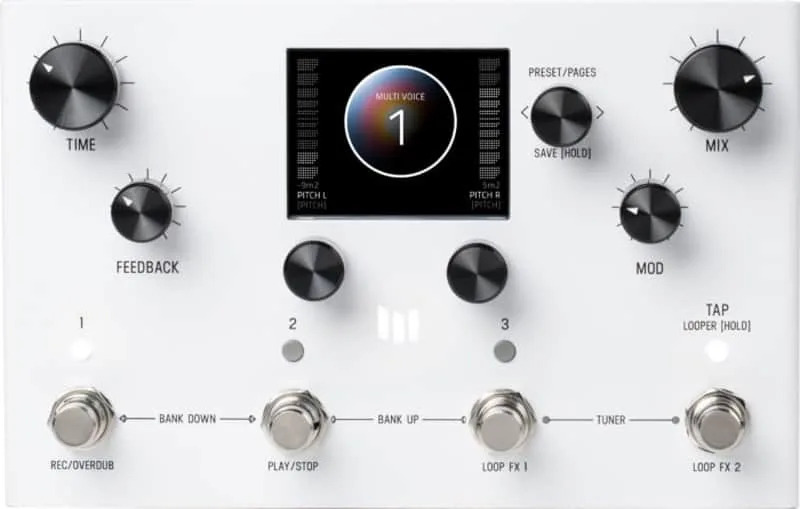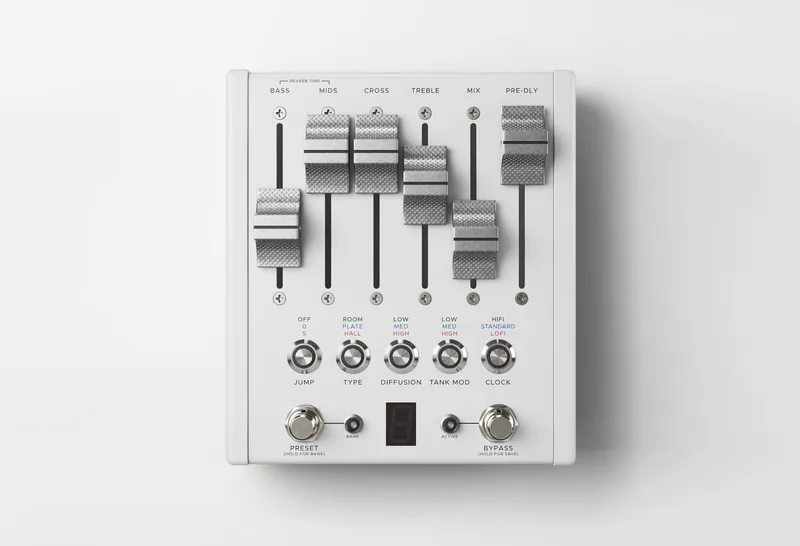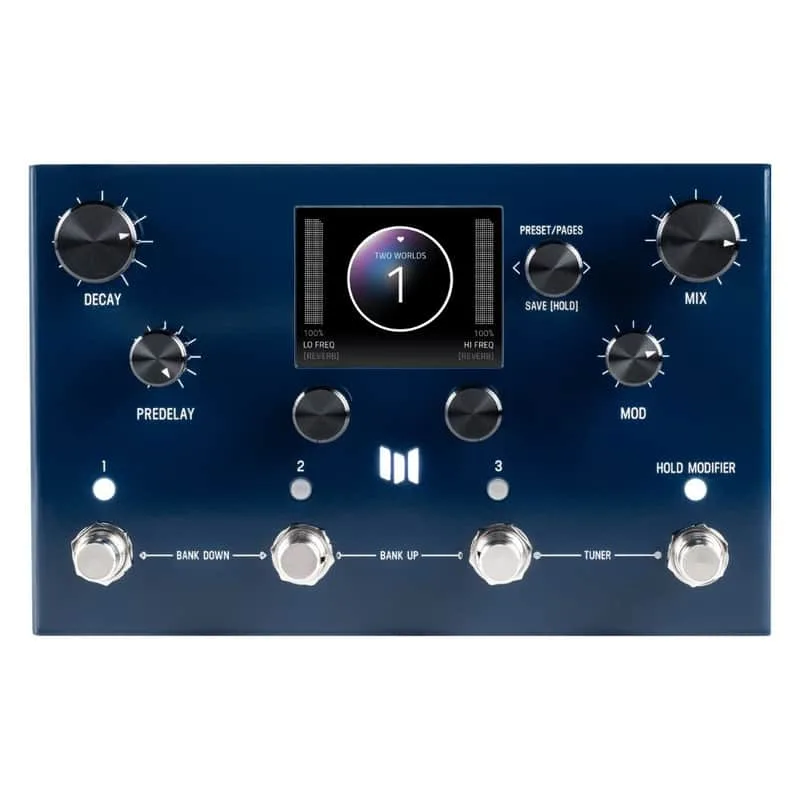


The Meris MercuryX is a Modular Reverb System in pedal form, built by Meris and designed and built in California, U.S.A.1 Released in October 20232, it takes the reverb voice of the earlier Mercury7 and places it inside the modular architecture Meris first introduced on its LVX delay pedal, so instead of picking one fixed reverb sound you configure reverb structures, types and processing elements yourself341.
Meris describes it as "the highest quality and most flexible studio reverb ever created in a pedal format"1. It runs eight custom reverb algorithms through a premium analog signal path with 24-bit conversion and 32-bit floating point DSP, on an advanced ARM processor15.
What it is and what it does
The MercuryX is a stereo reverb pedal with true stereo processing; the Prism algorithm uses discrete dual mono processing instead1. Its eight reverb algorithms can be combined with configurable structures, types and processing elements, including chorus, vibrato, vowel mod, tremolo and a hazy lo-fi element, plus gate envelope controls for every reverb type and an independent stereo freeze alongside the reverb41. An expanded stereo predelay offers up to 2.54 seconds with a modular feedback routing location, and each side of the stereo predelay has selectable note divisions45. The mix bus is digitally controlled analog4.
The core sound sources break down like this1:
| Algorithms | Origin |
|---|---|
| Ultraplate, Cathedra | From the Mercury7, inspired by the moody sci-fi reverbs featured in Blade Runner |
| 78 Room, 78 Plate, 78 Hall | Structures inspired by the venerable sounds of a studio classic |
| Spring, Prism, Gravity | Brand new structures unique to the MercuryX |
Premier Guitar's reviewer noted that the MercuryX contains eight distinct reverb algorithms, some ported from the Mercury7 and some new6, and Guitar Pedal X described the set as beefing up Meris's existing classic reverb algorithms and adding Prism Dual Tank and Gravity7.
Controls and screen
Navigation is through a dimmable color screen-based user interface8, with two footswitches and a row of knobs. The main knobs and their functions1:
| Control | What it does |
|---|---|
| Decay | Sets how long the reverb tails last |
| Predelay | Sets the time before reverberation begins |
| Mix | Balances dry and wet signals |
| Mod | Sets modulation depth for the predelay of the selected reverb type |
| C1 | Adjusts a favorite parameter on the Preset Page; selects in Edit Pages |
| C2 | Adjusts a favorite parameter on the Preset Page; edits values in Edit Pages |
| Footswitch 1 | Engages or bypasses the preset |
A deep Modifier section lets you route control signals to processing parameters, and an expressive Hold Modifier switch gives on-the-fly control51. There is also an instant access tuner with configurable reference and output mode4.
Presets
The MercuryX stores 99 preset locations in 33 banks, with a Favorite Preset Bank for instant access to your three favorite presets1. The footswitches let you save and reach those three presets swiftly3. That is a step up from the Mercury7, which holds up to 16 presets and needs an external MIDI device to call them up9.
Power and connections
The MercuryX runs on 9V DC center-negative at 300mA through a 2.1mm jack1. That current draw rules out a battery and means it needs its own adequate supply rather than a shared low-current daisy chain.
Connections are generous for a pedal: stereo input and output with separate jacks for each, MIDI In and Out over standard MIDI DIN jacks, and a dedicated expression pedal jack with assignable control over multiple parameters simultaneously1. MIDI covers continuous control parameters, preset send and receive, and beat clock synchronization1. Input and output headroom is switchable between Instrument and Synthesizer/Line levels, with maximum input of +9 dBu at the instrument setting and +12.5 dBu at the line/synth setting18.
Full specifications from the maker1:
| Specification | Value |
|---|---|
| Conversion | 24 bit A/D and D/A |
| DSP | 32 bit floating point |
| Sample rate | 48000 Hz |
| Input impedance | 1 Meg Ohm |
| SNR | 115 dB typical |
| Frequency response | 20Hz to 20kHz |
| Max input level | +9 dBu (instrument), +12.5 dBu (line/synth) |
Does it work with synths?
Yes, and Meris built for it deliberately. The switchable Instrument or Synthesizer/Line headroom levels on both input and output8, standard DIN MIDI with beat clock sync1, and the line-level maximum input of +12.5 dBu1 all point at keyboard and synth rigs as much as pedalboards. Gearnews placed the MercuryX in its guide to pedals for synths10, and Guitar.com later named it its pick for "Best synth-style ambient reverb" in a January 2025 ambient pedals guide10.
History: from the Mercury7 and LVX
The MercuryX follows the same form factor as the LVX delay, but focuses on reverbs8. It combines eight custom Meris reverb algorithms with the modular system UI and architecture first introduced on the LVX3, and Meris frames it as taking the heart and soul of the Mercury7 and expanding it346.
The Mercury7 lineage goes back further. It began as a 500 Series module, Meris's flagship reverb design, inspired by the 1982 Blade Runner film soundtrack11, with two stereo reverb algorithms inspired by that score and extensive modulation capability1213. Meris brought that rack heritage forward into the MercuryX, which carries the Ultraplate and Cathedra algorithms over from the Mercury71.
Angelo Mazzocco, DSP Engineer and VP at Meris, designed the MercuryX's reverb structures. In his words:
"I designed the reverb structures of MercuryX to build upon and expand the world of algorithmic reverbs made famous in those vintage racks."
MusicRadar notes the pedal comes from "some of the brains who were involved in Line 6 and Strymon"14. Firmware has continued to develop since launch, with version v1.5.5 offered as a free update1.
What reviewers said
Guitar.com's Jason Mays reviewed the MercuryX in July 2024 and rated it 9 out of 10, concluding:
"Far more than a scaled-up Mercury7, this is one of the most creative and expressive reverbs ever made."
Pedal of the Day called it "one of the most fun, most intriguing and most experimental effects units ever. EVER."4, and Guitar Pedal X included it among the best new time-based effects pedals of 20234. Gearnews has kept it in its reverb pedal buying guides, listing 99 preset slots among its reasons for inclusion16.
Videos
Sweetwater
Meris
The Pedal Zone
News
Questions
Is the Meris MercuryX true bypass?
Yes, and it is selectable. The MercuryX offers relay true bypass or analog buffered bypass, so you can choose whether the pedal's analog buffer stays in the signal chain when the effect is off1. The earlier Mercury7 used a 100% analog bypass11.
What reverb algorithms are in the MercuryX?
Eight custom Meris reverbs: Ultraplate, Cathedra, 78 Room, 78 Plate, 78 Hall, Spring, Prism and Gravity1. Ultraplate and Cathedra come from the Mercury7, the 78 structures draw on a studio classic, and Spring, Prism and Gravity are new structures unique to the MercuryX1.
Does the MercuryX work with synths?
Yes. Input and output headroom is switchable between Instrument and Synthesizer/Line levels, with a maximum input level of +12.5 dBu on the line/synth setting18. MIDI In and Out over standard DIN jacks and MIDI beat clock synchronization also make it straightforward to run from synth gear1.
Who designed the Meris MercuryX reverbs?
Angelo Mazzocco, DSP Engineer and VP at Meris, designed the reverb structures of the MercuryX1. He describes the goal as building upon and expanding the world of algorithmic reverbs made famous in vintage studio racks.
How many presets does the MercuryX store?
99 preset locations organized in 33 banks, plus a Favorite Preset Bank for instant access to three favorite presets1. The footswitches let you save and reach those three presets quickly3.
Sources (16)
- MercuryX, Meris (meris.us)
- Meris' Enzo X may have revolutionized guitar synth pedals, Guitar World, 2025-02-24
- Meris MercuryX Modular Stereo Reverb, Delicious Audio, 2025-07-17
- Meris MercuryX Modular Reverb System, Pedal of the Day, 2023-10-22
- Meris unveils the MercuryX Modular Reverb System Pedal, Meris, 2023-10-10
- Meris Mercury X Review, Premier Guitar, 2024-02-10
- Guitar Pedal X, Guitar Pedal X, 2023-12-20
- Meris MercuryX Modular Reverb System, gearnews.com, 2023-10-10
- Meris Ottobit Jr and Mercury7 Review, Guitar.com, 2018-12-03
- The best pedals for ambient music, from space-warping reverbs to experimental micro-loopers, Guitar.com, 2025-01-24
- Mercury7 Reverb, Meris (meris.us)
- Mercury7 Reverb, Meris
- The Best Ambient-Shoegaze Reverb Pedals In 2024, Delicious Audio, 2024-11-15
- Meris aims to shake up the ambient reverb pedal market with its MercuryX Modular Reverb System, MusicRadar, 2023-10-11
- Meris MercuryX review, Guitar.com, 2024-07-01
- The Best Reverb Pedals for Electric Guitar: From Budget to High-End, www.gearnews.com, 2026-06-08