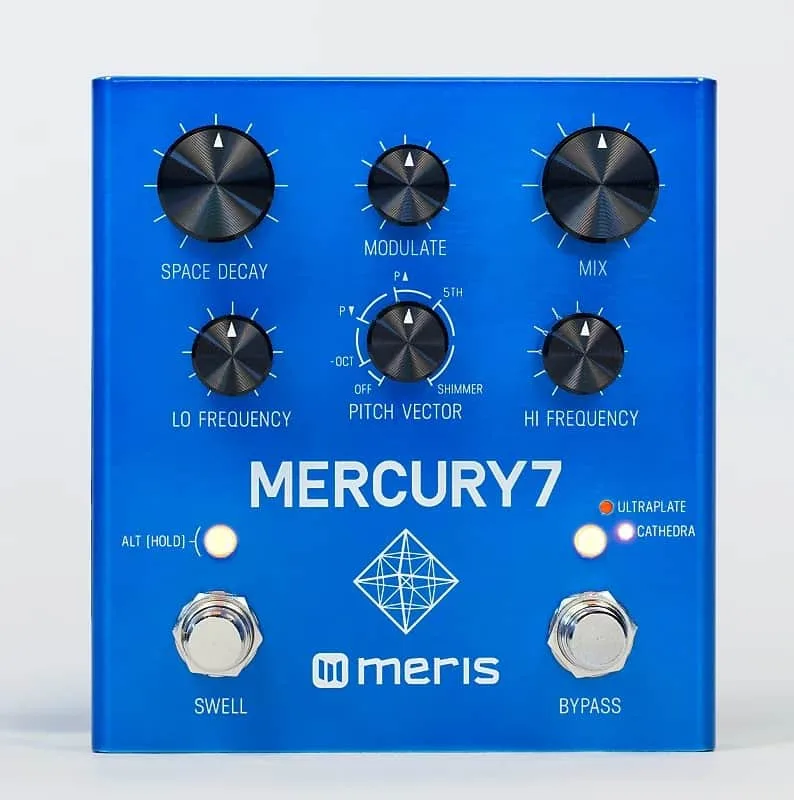


The Meris Mercury7 is a stereo reverb pedal built for ambient and shoegaze players, with algorithms Meris says are inspired by the reverb used by Vangelis in the score to the 1982 film Blade Runner1. It offers two reverb algorithms, Ultraplate and Cathedra, plus a Pitch Vector control that shifts pitch intervals inside the reverb itself, and a swell footswitch that fades notes in automatically. The pedal was designed and built in California by Meris, a team that MusicRadar notes includes a founder of Strymon2.
The circuit began life as a 500-series module: Meris says the Mercury7 was once only available as a mono rack module before arriving in a stereo pedal format32. MusicRadar's Trevor Curwen describes the pedal as derived from that 500-series module of the same name2.
Blade Runner-inspired ambient reverb
Meris pitches the Mercury7 as "off-world ambience inspired by the 1982 Bladerunner film soundtrack"1. The two algorithms cover very different spaces:
| Algorithm | Character |
|---|---|
| Ultraplate | Inspiring and lush plate with a fast build1 |
| Cathedra | Massive and ethereal algorithm with a slow build456 |
Delicious Audio's Paolo De Gregorio called Ultraplate a lush plate-style reverb with fast buildup and Cathedra a massive, ethereal, slow-building reverb, and the site included the pedal in its list of reverb pedals for shoegaze and ambient music6. Pedal of the Day noted that the Decay, Pitch Vector, Mix and Hi/Lo Frequency controls all interact to sculpt what it called the intra-tank pitch regeneration5.
The controls and their alt functions
Each knob on the Mercury7 has a primary function and an Alt function, reached by holding the Algorithm Select button4.
| Control | Primary function | Alt function |
|---|---|---|
| Space Decay | Sets decay energy of the reverberation space1 | Predelay: sets time before the onset of reverberation4 |
| Modulate | Sets overall modulation depth of the reverb algorithm1 | Mod Speed: sets dominant modulation speed1 |
| Pitch Vector | Selects pitch intervals within the reverb2 | Attack Time: sets attack time for the swell envelope4 |
| Mix | Sets reverb against dry signal, up to fully wet2 | |
| Hi Frequency | High frequency damping1 | Adds a vibrato effect, not unlike a rotary speaker, before the reverb2 |
MusicRadar's reviewer found the Mix control goes up to fully wet, so the pedal can be used in effects loops, and highlighted the Alt function of the Hi Frequency knob, which he described as adding "a cool vibrato effect, not unlike a rotary speaker, before the reverb"2. The pedal also carries High and Low Frequency Damping controls1.
Pitch Vector and the swell footswitch
The Pitch Vector knob is the Mercury7's signature control. MusicRadar describes it as offering a shift of five different pitch intervals within the reverb: octave down, slight pitch up, slight pitch down, 5th up, or octave up, the last of which delivers the classic shimmer effect2. Pedals and Effects wrote that the abilities of the pitch vector section enable the Mercury7 to go way beyond other reverbs, with high octave reverbs that can be modulated and warped with the Modulate knob7.
Artist Sarah Lipstate, who records as Noveller, put it more simply:
"It has this pitch vector parameter, which is basically just all of this modulation"8
She told Meris she went to the Mesa Boogie shop in Hollywood, played around with the stereo pedal, and immediately dropped about 300 bucks on it8.
The left footswitch is the Swell switch. Meris says pressing it engages the auto swell function, and holding it down maximizes the Space Decay sustain1. MusicRadar's reviewer explains that it works like a volume pedal, fading the sound up at an adjustable speed, which he found great for pad sounds2. Guitar.com's Richard Purvis described it as suppressing the note attack for reverb volume swells without the need for dextrous pinkie action on the guitar's volume knob9. The right footswitch is bypass: it processes signal when the LED is on and passes the dry signal entirely in analog, buffered or relay, when off1.
Power and connections: stereo, MIDI and presets
The Mercury7 has stereo input and output1. The multi-function EXP jack supports optional expansion: MIDI, a preset switch, an expression pedal or a tap switch, with compatible hardware that is not included1. MIDI in and out runs over TRS through that EXP jack with a compatible MIDI-to-TRS conversion box, also not included1. MusicRadar notes an expression pedal adds scope for such things as fading the pitch intervals into your reverb2.
The 16 internal presets can only be reached with external gear: a four-button footswitch covers the first four, and MIDI control reaches all of them2. Neither piece of hardware is included with the pedal.
The pedal runs on a 9V DC adapter, which Guitar.com's review notes is included, with a current draw under 150 mA19.
What reviewers said
The Mercury7 earned a Premier Guitar Premier Gear Award in September 20173. Sound On Sound's Hugh Robjohns reviewed it in the magazine's June 2016 edition and concluded it was far more than a straight digital reverb, calling it a really effective sound-design tool as well10. Pedal of the Day wrote that the pedal "stands right up there with the best of them" among ambient reverb pedals5. Delicious Audio found that, notwithstanding a rather stylized appearance, the Mercury7 is a very deep pedal6.
"the massive sound that gives you the feeling that you've entered into a wild and eerie future"
Videos
Pete Thorn
Meris
The Pedal Zone
Questions
Is the Meris Mercury7 true bypass?
It is selectable. The Mercury7 offers relay true bypass or analog buffered bypass, chosen by the user, and when the pedal is off the dry signal passes entirely in analog, either buffered or through the relay. Guitar.com's reviewer described it as switchable true or analog buffered bypass.
How do you access presets on the Mercury7?
The pedal holds 16 internal presets, but they are only reachable with external gear: a four-button preset footswitch covers the first four, and MIDI control reaches all of them. Meris notes presets are available via an external 4-Preset switch or MIDI, with the expansion hardware sold separately.
Does the Mercury7 need a MIDI box?
Only if you want MIDI. The EXP jack carries MIDI in and out over TRS, but you need a compatible MIDI-to-TRS conversion box, which is not included. The same jack also accepts an expression pedal, a preset switch or a tap switch with the right hardware.
What is the difference between the Mercury7 and the Ottobit Jr?
The hardware is exactly the same. Meris says the only difference between the Mercury7 and the Ottobit is the firmware loaded onto the EPROM, so the two pedals share one circuit and differ only in the effects software each runs.
Is the Meris Mercury7 discontinued?
The listed price is US $299.00 on one Meris product page and US $549.00 on another. The company has since released the MercuryX modular reverb system.
Sources (10)
- Mercury7 Reverb, Meris
- Meris Mercury7 review, MusicRadar, 2017-11-01
- MERCURY7 EARNS PREMIER GUITAR'S PREMIER GEAR AWARD, Meris, 2017-09-11
- Mercury7 Reverb, Meris (meris.us)
- Meris Mercury7 Reverb Effects Pedal, Pedal of the Day, 2018-01-05
- Meris Mercury7 Reverb, Delicious Audio, 2023-05-19
- "TOP DOG IN THE REVERB WORLD", Pedals and Effects (review republished by Meris), 2017-07-18
- Noveller (Sarah Lipstate) credits the Mercury7, Meris, 2017-09-14
- Meris Ottobit Jr and Mercury7 Review, Guitar.com, 2018-12-03
- NEW! SOS MAGAZINE REVIEWS MERCURY7 REVERB, Meris, 2016-05-24