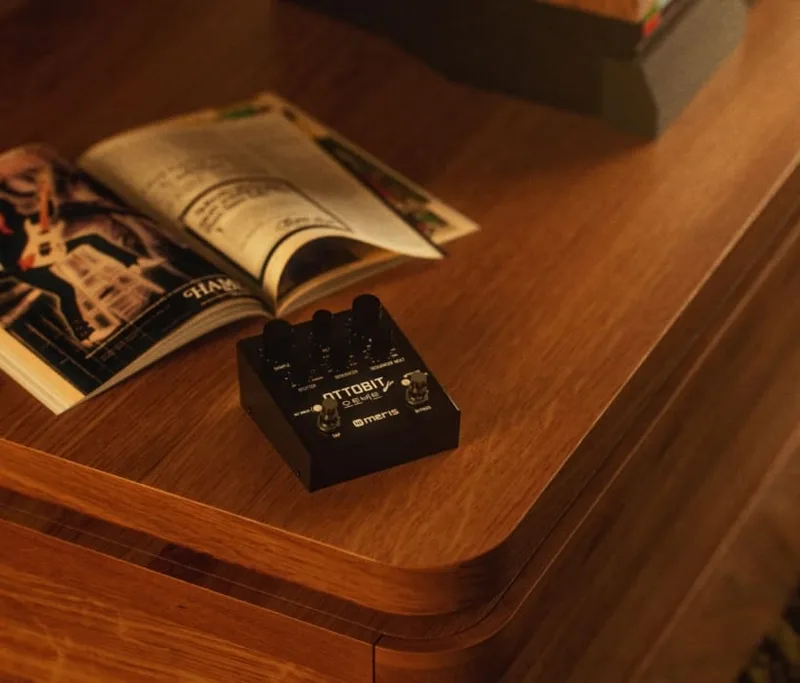


The Meris Ottobit Jr is a bitcrusher, sequencer and stutter pedal that takes your guitar signal and deliberately degrades it. At its heart is bitcrushing: reducing the sample rate and bit depth of the audio so it breaks up into lo-fi, digital-sounding textures, from metallic ring-mod-like tones to rumbly noise1. Around that core Meris has built stutter effects, a sequencer, a pitch shifter and a low-pass ladder filter, making the pedal what Pedal of the Day called "part pitch manipulator, part sampler, part sequencer and all bitcrusher"2.
The pedal began life as the Ottobit, a 500 series studio rack module Meris designed for engineers and producers, which the company then put into a dual-footswitch stompbox1. It was one of Meris's first two pedals, alongside the Mercury7, both converted from the company's 500 series units3.
Bitcrushing, sample rate reduction and stutter
Bitcrushing works by lowering the resolution of a digital audio signal. The Ottobit Jr gives you two main degradation controls: sample rate and bit depth. MusicRadar's reviewer, Trevor Curwen, describes how the top three knobs alter the timbre, with adjustable bit rate, sample rate and a low-pass ladder filter. With everything fully clockwise you get a normal guitar sound; as you reduce the bit depth you move into fuzz-like sounds that the filter can then shape1.
Reducing the sample rate on its own adds a metallic flavor, ranging from ring-mod-type sounds to rumbly noise1. The ladder filter, which Meris specifies as having fixed resonance7, rolls off the harshness so you can dial the degraded signal back toward something musical.
The stutter section is where the pedal gets more performative. The Stutter knob changes the play speed and length of the stutter5, and it is broken into three speed ranges (full, double and half speeds) plus a Random setting, giving 23 total positions to choose from2. Meris also specifies a quarter-note, tempo-synced stutter mode7, and the pedal carries a tap tempo footswitch alongside the bypass footswitch3.
The sequencer ties the pitch and stutter functions together. Meris lists a mono pitch shifter that is accessible only with the sequencer7, and the Sequencer Play Mode knob sets it to play once, play twice, play 4 times, play 8 times, or play continuously5.
The controls
| Control | What it does |
|---|---|
| Sample Rate knob | Adjusts sample rate; alt function is Step 1, the first step of the sequencer5 |
| Bits knob | Adjusts bit depth; alt function is Step 3, the third step of the sequencer5 |
| Filter knob | Low-pass ladder filter with fixed resonance, shapes the degraded tone71 |
| Stutter knob | Changes the play speed and length of the stutter; 23 positions across three speed ranges plus Random52 |
| Sequencer Play Mode knob | Sets the sequencer to Play Once, Play Twice, Play 4 Times, Play 8 Times, or Play Continuously5 |
The alt functions on the knobs mean the sequencer's steps are programmed by holding a modifier and turning the same knobs you use for timbre, which keeps the front panel small while doubling up the assignments5.
Expression, MIDI and stereo connections
The Ottobit Jr has a multi-function EXP jack for optional expansion: MIDI, a preset switch, an expression pedal or a tap switch, with compatible hardware (the expansion hardware is not included)5. MIDI runs in and out over TRS through that same EXP jack, using a compatible MIDI-to-TRS conversion box, also not included5.
An expression pedal can be set to morph between two complete sets of knob values, so you can sweep from one degradation setting to another in real time1. Presets are handled the same way: there are no presets directly onboard, but the pedal has 16 preset locations reachable through an external four-preset switch or MIDI, and you can send and receive presets over MIDI7.
The pedal is fully stereo, with stereo input and output5, a feature Pedal of the Day highlighted as adding to the growing number of things the Ottobit Jr is capable of2.
The EXP jack's MIDI implementation needs a separate MIDI-to-TRS conversion box, and expression, preset and tap functions need their own compatible hardware. None of this expansion hardware ships with the pedal5.
From a 500 series module to a pedal
Meris started in the studio world, and the Ottobit Jr is a direct descendant. The company took the essence of its Ottobit module, a 500 series unit aimed at studio engineers and producers, and put it into a dual-footswitch pedal1. On JHS Pedals' blog, Josh Scott describes how engineers Terry Burton and Angelo Mazzocco, with creative director Jinna Kim, put the circuit into a guitar pedal format8.
The pedal launched as one of Meris's first two stompboxes, alongside the Mercury7, both based on 500 series studio rack modules designed by the company and converted to stompbox format, tweaked for pedalboard use3.
What reviewers said
MusicRadar's Trevor Curwen found the pedal niche but rewarding:
"Niche it may be, but this classy and creative pedal exerts a strange allure to those yearning for something different."1
Guitar.com's review noted the 14-page manual included in the box and the pedal's 150mA current draw, advising that your power supply needs to be able to spare that much current3. Delicious Audio included the Ottobit Jr in its roundup of the best bitcrusher and sample rate reducer pedals, describing it as an "8-bit pedal on steroids"4.
Videos
Meris
Ricky Tinez
The Pedal Zone
Questions
Does the Meris Ottobit Jr come with a power supply?
Yes. The pedal is powered by a 9V DC adaptor, and Guitar.com's review notes that the adaptor is included in the box. It draws around 150mA, so it needs a power supply that can spare that much current rather than a low-current daisy chain output.
Does the Meris Ottobit Jr have onboard presets?
Not directly onboard. MusicRadar's reviewer notes there are no presets accessible from the pedal itself, but the pedal has 16 preset locations that can be reached through an external four-preset switch or MIDI, and presets can be sent and received over MIDI.
Is the Meris Ottobit Jr true bypass?
It is selectable. The pedal offers true bypass via a relay or an analog buffered bypass, and you can switch between the two depending on where it sits in your signal chain and how the rest of your board is wired.
Is the Meris Ottobit Jr stereo?
Yes. The Ottobit Jr has stereo input and stereo output, so it can process a stereo source or feed two amps, and reviewers have highlighted the stereo outputs as one of the pedal's strengths.
Where is the Meris Ottobit Jr made?
Meris designs and builds the Ottobit Jr in California, USA. The company's engineers, Terry Burton and Angelo Mazzocco, developed the original 500 series Ottobit module and adapted it into the pedal format.
Sources (8)
- Meris Ottobit Jr review, MusicRadar, 2017-09-26
- Meris Ottobit Jr. Pitch Sampler Sequencer Bitcrusher, Pedal of the Day (www.pedal-of-the-day.com), 2018-03-09
- Meris Ottobit Jr and Mercury7 Review, Guitar.com, 2018-12-03
- Meris Ottobit Jr. Bitcruser/Sequencer/Stutter Pedal, Delicious Audio, 2024-06-24
- Ottobit Jr., Meris
- 2023 UPDATE: The Best Bitcrusher Pedals, Delicious Audio, 2023-11-24
- Ottobit X, Meris
- HOW TO DESTROY YOUR GUITAR, JHS Pedals