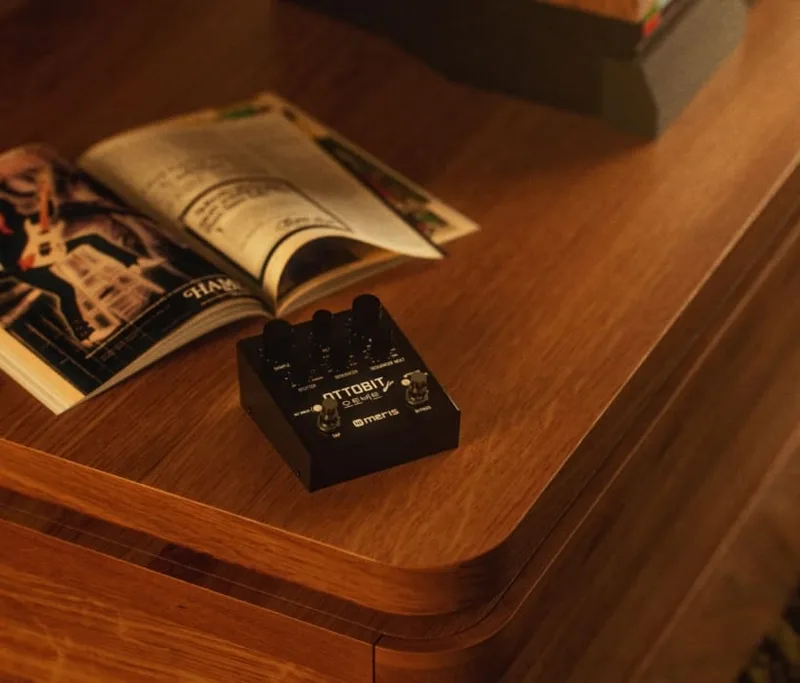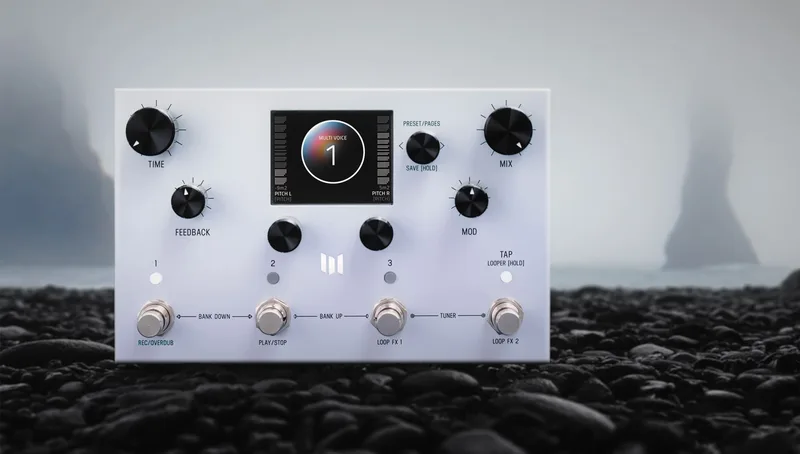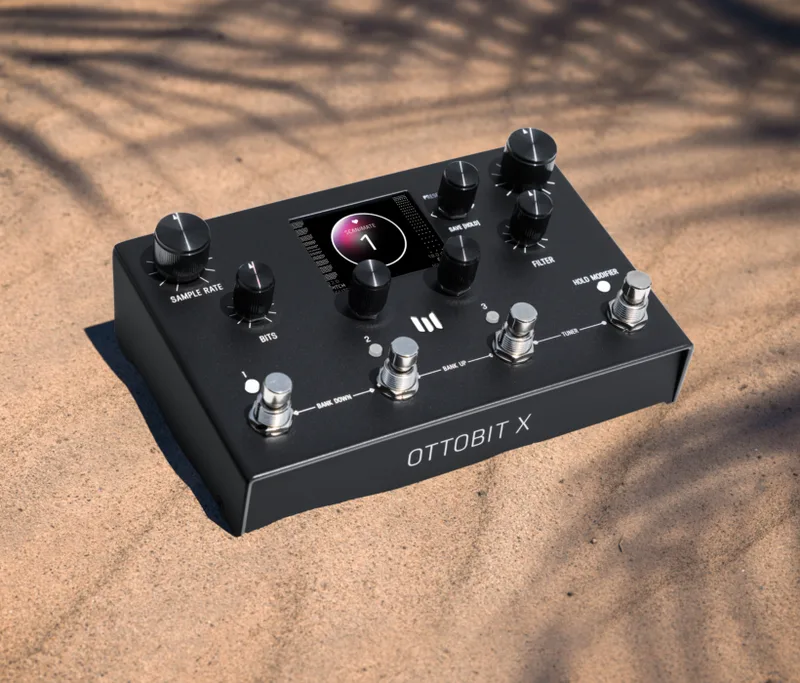


The Meris Ottobit X is a large-format stereo multi-effects pedal that Meris calls a "modular degradation and texture engine": a box built around bitcrushing, stepped stutter, glitch modes, filters, preamps, pitch shifting and modulation, plus a VHS-style delay and reverb, tape stop and stutter step1. It is the successor to Meris's earlier vintage-gaming-inspired glitch boxes, the Ottobit Jr. and Ottobit Sr., expanded with lo-fi sounds and a much deeper sequencer12. Where the Jr. was a compact mono stompbox, the X is a workstation: 99 preset locations, a full color LCD screen adapted from Meris's LVX and MercuryX pedals, and a 16-step sequencer assignable to roughly 48 parameters12.
Under the hood it is a digital pedal, but the digital signal processing is aimed backward in time: Meris and the press describe it as cutting-edge DSP used to recreate old-school analog and early digital sounds, the kind of degraded, 8-bit and 16-bit textures associated with vintage game consoles and VHS tape3. The signal path starts with a premium Analog Devices JFET input section, runs through 24-bit A/D and D/A conversion and 32-bit floating point DSP, and passes through a digitally controlled analog mix bus12.
What it does
The Ottobit X takes an instrument signal and degrades it on purpose. Its effect set covers bitcrushing, filters, preamps, pitch, modulation, glitch, VHS delay and reverb, tape stop and stutter step4. Bitcrushing lowers the sample rate and bit depth of the audio so it resembles the crude converters of early digital hardware and game consoles; the filter, pitch and modulation sections then shape what the crusher spits out. Meris pitches the whole thing as an "'80s DREAM REBORN"1.
The pedal holds 90 factory presets plus 18 artist presets, and 99 preset locations organized in 33 banks for storing your own12. A dedicated expression pedal jack is assignable to multiple parameters at once, and each preset can run on its own tempo or follow a global tempo1. The full color LCD screen, adapted from the LVX and MercuryX, handles navigation and editing2.
The controls
The front panel combines knobs, footswitches and a screen. Meris documents the main controls as follows1:
| Control | What it does |
|---|---|
| Level knob | Controls the overall output level |
| Filter knob | Sets the filter's cutoff frequency |
| C1 knob | Adjusts a favorite parameter on the Preset Page; selects on Edit Pages |
| C2 knob | Adjusts a favorite parameter on the Preset Page; edits values on Edit Pages |
| Footswitch 1 | Engages or bypasses the preset |
| LED button 1 | Activates or bypasses the preset; mimics footswitch 1 for desktop use |
There are four footswitches in total. Three of them navigate and switch between presets, while the right footswitch activates the looper5.
Power and connections
The Ottobit X runs on a 9V DC center-negative supply drawing 300mA through a 2.1mm jack1.
At 300mA this is not a low-current pedal. It needs a proper isolated or high-current output on a power supply, and it cannot run on a battery.
Connections are generous for a pedal: stereo input and output with separate jacks for each, MIDI in and out over standard DIN jacks or USB-C, and a dedicated expression pedal jack1. The input impedance is 1 megohm, and the frequency response is 20 Hz to 20 kHz with a typical signal-to-noise ratio of 115 dB1. Two input level settings match the source: +9 dBu maximum for instruments and +12.5 dBu for line or synth level sources1.
How it differs from the Ottobit Jr.
The Ottobit Jr. was a compact mono pedal with variable sample rate and bit crushing, a ladder filter with fixed resonance, 16 factory presets in 16 preset locations, and a mono pitch shifter that was only accessible through the sequencer16. The X keeps the same core idea and scales everything up:
| Ottobit Jr. | Ottobit X | |
|---|---|---|
| Presets | 16 factory presets, 16 locations1 | 90 factory presets, 99 locations in 33 banks1 |
| Sequencer | 6 steps2 | 16 steps, assignable to roughly 48 parameters12 |
| Pitch shifter | Mono, sequencer access only1 | Poly pitch shifter (operates in mono)1 |
| Delay | Not part of the Jr.'s feature set | Dual 2500 msec VHS delay with play speed manipulation1 |
| Stereo | Mono | True stereo processing1 |
| Tempo | Not specified | Selectable preset tempo or global tempo per preset1 |
Delicious Audio's launch report highlighted the jump from 6 to 16 sequencer steps and the assignable parameter count as the headline changes, along with the LCD screen and the JFET input section2. The Jr. remains in Meris's line as the compact option, powered by an included 9V DC adaptor7.
Versions and price
The Ottobit X ships in two finishes: a standard run in smooth matte black and a limited edition small run in Multidimensional Pink1. The pink version sold out at launch4, and Meris notes that the limited edition is a final sale with no returns, exchanges or negotiations1. The standard black version is ready to ship with no preorders1.
On price, the maker's page lists $599.00 USD1, which matches the $599 launch MAP/RRP reported by Guitar Pedal X alongside €649 and £6194. A later Thomann listing reported by gearnews.com showed $659.00 / £589.00 / 699.00€ for the black edition5, so street pricing has moved around since launch.
What reviewers said
Published coverage of the Ottobit X has been positive about the pedal itself while raising one practical question. Guitar Pedal X's reviewer wrote4:
"There's no doubt that this is a killer device."
He counted a large effects library in its favor but questioned whether he would get enough use from it as an occasional-use device for his own rig4. MusicRadar's launch coverage framed it as a high-end lo-fi pedal whose digital processing is leveraged to recreate old-school analog and early digital sounds3.
The smaller Jr. drew a warmer verdict on everyday usefulness: MusicRadar's review of the Ottobit Jr. called it "A world of possibilities"8, and Guitar.com's earlier review of the Jr. described it as opening a world of possibilities for glitch and lo-fi textures8. The X inherits that territory with far more depth, at the cost of a much bigger footprint and a bigger price.
Videos
Andertons Music Co
Meris
Meris
News
Questions
Does the Meris Ottobit X have a looper?
Yes. The right footswitch of the four activates the looper, while the other three footswitches navigate and switch between presets. The looper sits alongside the bitcrushing, glitch, pitch, filter and delay processing in the same box.
Is the Meris Ottobit X stereo?
Yes. It has stereo input and output with separate jacks for each, and Meris specifies true stereo processing. One exception: the poly pitch shifter operates in mono. Everything else in the signal path runs in stereo.
Can the Ottobit X be set to true bypass?
Yes. Bypass is selectable between true bypass, switched by a relay, and analog buffered bypass. You can choose whichever suits the rest of your pedalboard, and the setting is made from the pedal's menus.
Does the Ottobit X work with synths?
Yes. It has a line/synth level setting with a maximum input level of +12.5 dBu, alongside the instrument level setting at +9 dBu, so it accepts hotter line-level sources without clipping. MIDI over DIN or USB-C also makes it easy to sync with a synth setup.
Is the pink Ottobit X limited edition still available?
The Multidimensional Pink limited edition was a small run that sold out at launch, and Meris sells it as a final sale with no returns or exchanges. The standard run in smooth matte black is the version that remains available.
Sources (8)
- Ottobit X, Meris
- New Pedal: Meris Ottobit X, Delicious Audio, 2026-06-02
- Meris unveils Ottobit X, MusicRadar, 2026-06-04
- Guitar Pedal X, Guitar Pedal X, 2026-06-04
- Meris Ottobit X: Shoegaze, Lo-Fi, Game Music, '80s Vibes in One Pedal, gearnews.com, 2026-06-30
- Ottobit Jr., Meris
- Meris Ottobit Jr and Mercury7 Review, Guitar.com, 2018-12-03
- Meris Ottobit Jr review, MusicRadar, 2017-09-26