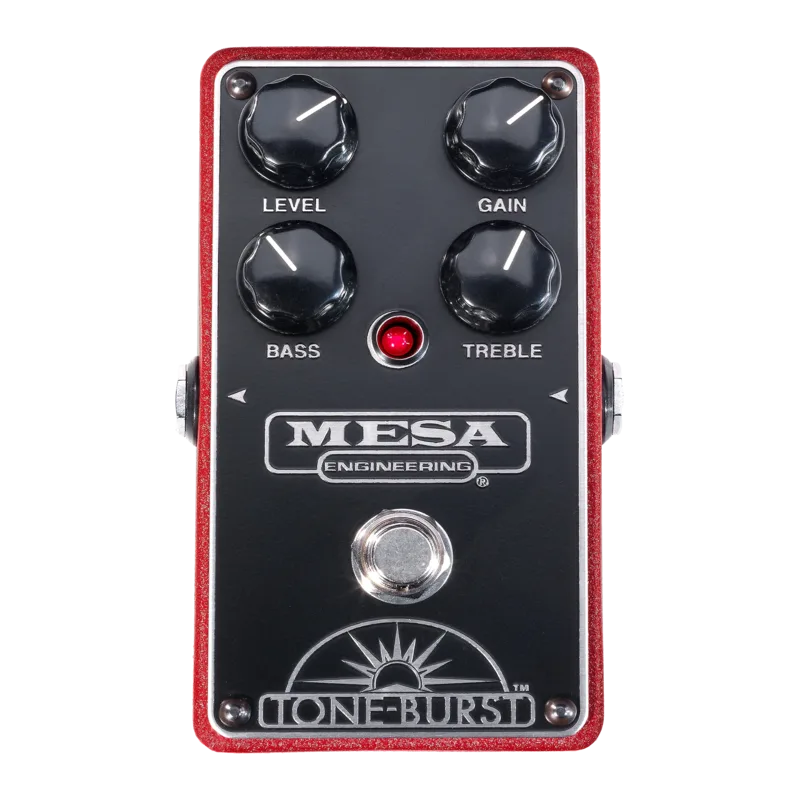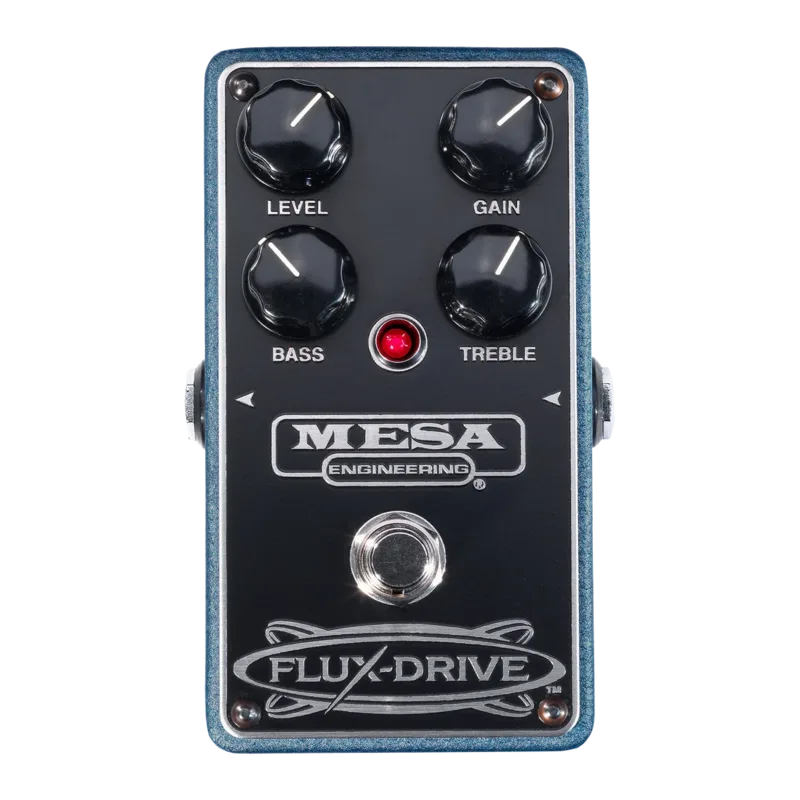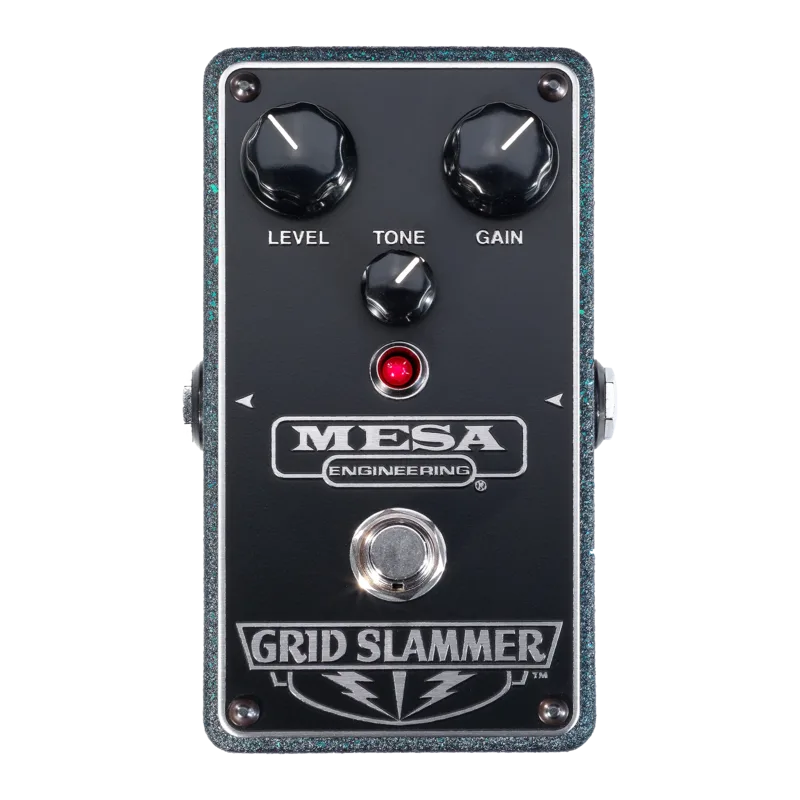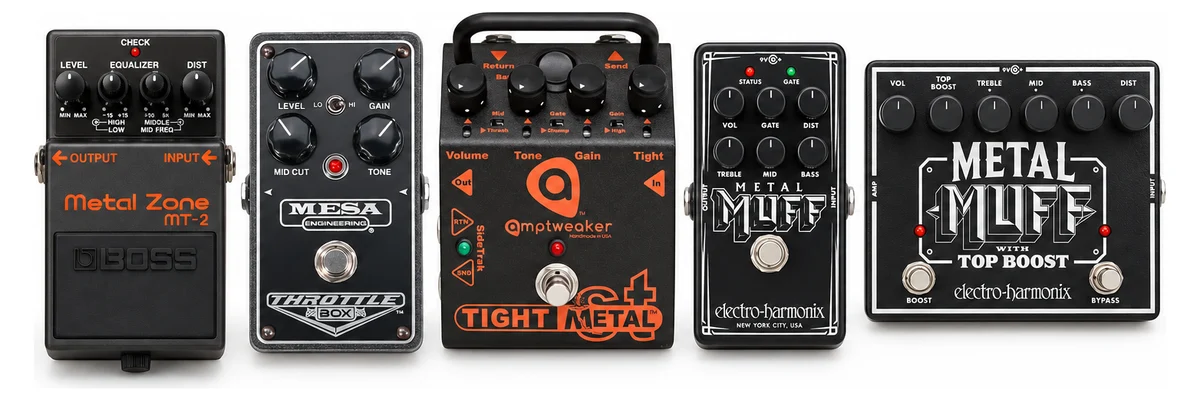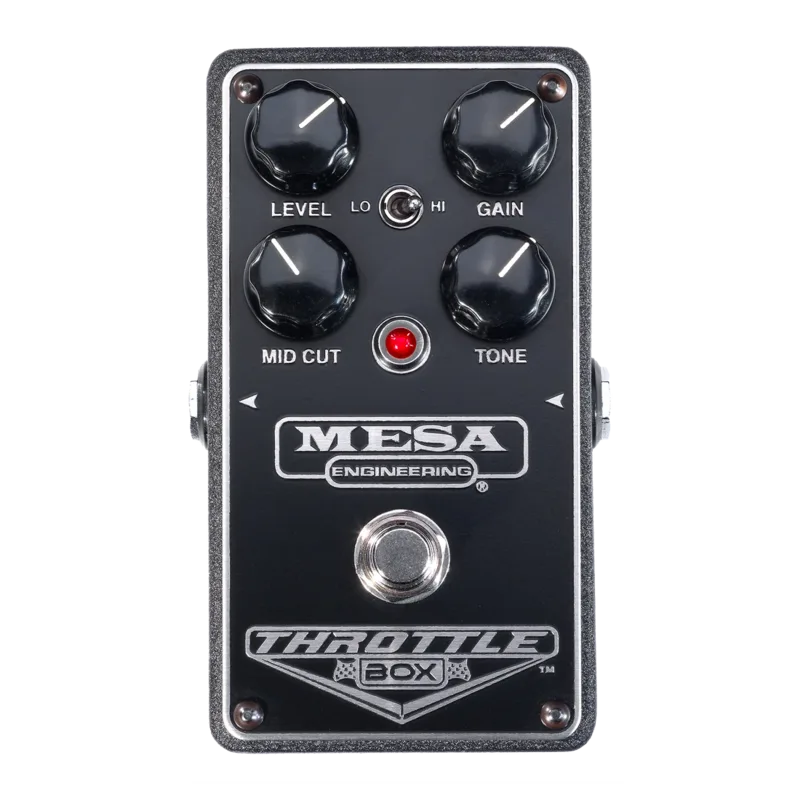


The Mesa/Boogie Throttle Box is an analog distortion pedal aimed squarely at rock players. Mesa/Boogie describes it as a pedal that "serves up all genres of ROCK with cut and aggression, but retains the signature warmth and organic sonic quality found in Mesa/Boogie amplifiers," with its main strengths in higher-gain sounds and lower gain options for classic rock or blues1. It was announced in late 2012 as one of four drive pedals in Mesa/Boogie's first stompbox line, alongside the Tone-Burst, Grid Slammer and Flux-Drive2, and carried a list price of $199 at launch2.
What sets it apart from most distortion pedals is its mid cut control, which scoops midrange to produce the signature Boogie "V" EQ curve, the same voicing idea that made Mesa/Boogie's high-gain amplifiers recognizable1.
Controls and the two gain modes
The Throttle Box keeps its control set simple. Four knobs and two switches cover the ground51:
| Control | What it does |
|---|---|
| Gain | Dials in the amount of distortion, from classic to modern high-gain1 |
| Tone | Balances the amount of high frequencies1 |
| Volume | Sets the output level2 |
| Mid Cut | Provides a powerful mid-scoop for modern high-gain styles1 |
| Lo/High Gain switch | Selects between classic crunch and modern meltdown1 |
| Internal EQ-Boost switch | An added style and voicing option, set inside the pedal1 |
The Lo/High gain switch is the heart of the pedal's range. Premier Guitar's reviewer found the lo-gain mode "serves up great '70s high-gain tones," while the hi-gain mode makes the controls very sensitive, so small changes to the mid cut and tone knobs produce drastic tonal shifts, "from scooped Metallica tones to mid-heavy Southern metal or the industrial grind of Meshuggah"5.
The mid cut knob is the feature Mesa/Boogie built the pedal around. It scoops out midrange to produce the signature Boogie "V" EQ curve1, the scooped-mid voicing Premier Guitar noted "put Mesa on the map"5. In practice it works as a continuously variable scoop: at one end the tone stays mid-forward, at the other it flattens into the classic scooped high-gain shape. Premier Guitar's reviewer called the mid cut control "very useful and sensitive"5.
One practical note: the EQ-Boost switch is internal, reached through the battery compartment. Premier Guitar's reviewer listed this as the pedal's main drawback, since it cannot be changed mid-gig5.
The EQ-Boost voicing switch lives inside the pedal, accessible through the battery compartment, so it is a set-and-forget adjustment rather than a performance control5.
Power and connections
The Throttle Box runs on a 9V battery or an external supply. The external supply must be 9V DC with a center negative plug and a 2.1mm x 5.5mm jack, the standard configuration used by most pedalboard power supplies1. Current draw is 15mA at 9V DC1, low enough that it can share a daisy chain with other standard pedals without straining the supply.
Input impedance is 1M Ohm (500k Ohm minimum), which preserves the high end of a guitar's signal, and output impedance is 10k Ohm1.
Where it came from
Mesa/Boogie announced the Throttle Box in December 2012 as part of its first effects pedal line, four drive pedals ranging from boost to high-gain distortion: the Tone-Burst, Grid Slammer, Flux-Drive and Throttle Box4. Vintage Guitar reviewed the four pedals in May 2013, and its reviewer heard the Throttle Box as retaining "some of that raw, rough quality of the Flux-Drive while adding to its hard and punchy in-your-face sound"6.
In 2014, Mesa/Boogie followed it with the Throttle Box EQ, a gain pedal built on the same core circuit with a five-band graphic equalizer added74.
The Throttle Box EQ
The Throttle Box EQ keeps the core circuit of the original and adds a Boogie Five-Band Graphic Equalizer, the slider-based EQ associated with Mesa/Boogie's amplifiers74. Where the original's two gain modes are set by an internal-style switch, the EQ version selects its HI/LO gain regions with a footswitch, so you can switch between two gain settings live7. The graphic EQ can be assigned to either or both gain modes, so it becomes active automatically when you select a mode7. It also keeps a MID CUT control for global mid scooping on top of whatever the sliders are doing7.
MusicRadar reviewed the Throttle Box EQ and found that "with a saturated, yet responsive chunk, the hi mode puts Foo Fighters, Metallica and Dream Theater at your feet," with EQ that can sparkle and scoop without harshness8. The reviewer summed it up as "a pro-quality pedal" with "bomb-proof construction"4, though its UK list price of £250 drew the comment that it is "a lot for an overdrive pedal"4.
What reviewers said
Published reviews of the original Throttle Box have been largely positive, with a few caveats5:
- Premier Guitar called it "signature Mesa grind in a box," praising the lo-gain mode's '70s tones and the sensitivity of the mid cut and tone controls5.
- The same reviewer found it "cleans up really nicely when rolling down the guitar's volume pot," a useful trait for players who ride the guitar's volume knob5.
- On transparency: "It's transparent enough that your tones will retain the natural color of your amp, no matter how hot you run the pedal"5.
- The drawbacks named were the internal placement of the boost switch and a tendency to sound strident through amps with a strong high end5.
- Vintage Guitar heard it as hard, punchy and in-your-face, while retaining some of the Flux-Drive's raw, rough quality6.
For a player shopping the wider field, the Throttle Box sits on the high-gain end of Mesa/Boogie's pedal line, distinct from the company's lower-gain offerings and from overdrive pedals in general by virtue of its mid-scoop voicing and meltdown-capable hi-gain mode15.
Videos
Sweetwater
MESA/Boogie
MESA/Boogie
Questions
What does the mid cut knob do on the Mesa Boogie Throttle Box?
The mid cut control scoops midrange out of the distortion, producing the signature Boogie V EQ curve that Mesa/Boogie is known for. Premier Guitar's reviewer found it very useful and sensitive, noting that small changes to it can shift the tone from scooped Metallica-style sounds to mid-heavy Southern metal or industrial grind.
Is the Mesa Boogie Throttle Box analog?
Yes. The Throttle Box is an analog distortion pedal. Mesa/Boogie describes it as retaining the warmth and organic sonic quality found in the company's amplifiers, and reviewers have noted it is transparent enough that tones keep the natural color of your amp even at high gain settings.
What is the difference between the Throttle Box and the Throttle Box EQ?
The Throttle Box EQ keeps the same core circuit as the original Throttle Box but adds a five-band graphic equalizer. Its HI/LO modes are selected by a footswitch rather than a toggle, and the graphic EQ can be assigned to either or both gain modes so it becomes active when you switch modes.
What power supply does the Throttle Box need?
It runs on a 9V battery or an external supply. The external supply must be 9V DC with a center negative plug and a 2.1mm x 5.5mm jack. Current draw is 15mA at 9V DC, so it is easy on most pedalboard power supplies.
What are the Throttle Box's low and high gain modes?
A Lo/High gain switch selects between two gain regions. Mesa/Boogie describes the range as classic crunch to modern meltdown. Premier Guitar's reviewer found the lo-gain mode serves up great 1970s high-gain tones, while the hi-gain mode makes the controls very sensitive to small changes.
Sources (8)
- Mesa/Boogie Throttle Box, Gibson (www.gibson.com)
- Pedal News: Mesa Boogie Announces 4 Overdrive Pedals, Delicious Audio, 2012-12-04
- Throttle Box by Mesa Boogie, RockBoard PedalPedia, 2026
- Mesa/Boogie Throttle Box EQ review, MusicRadar, 2014-10-23
- Mesa/Boogie Pedal Reviews: Tone-Burst & More, Premier Guitar, 2012-12-18
- Mesa/Boogie Drive Pedals, Vintage Guitar magazine, 2014-12-19
- Mesa/Boogie Launches New EQ Pedals Series 2023, Premier Guitar, 2014-03-17
- Walrus Eras Five-State Distortion review, MusicRadar, 2022-05-03