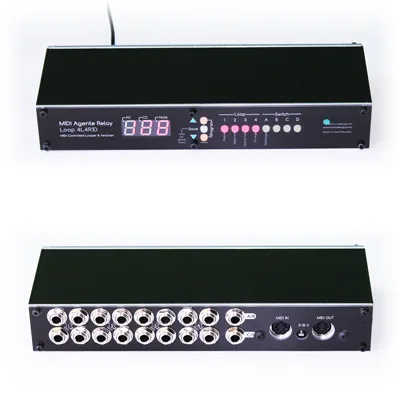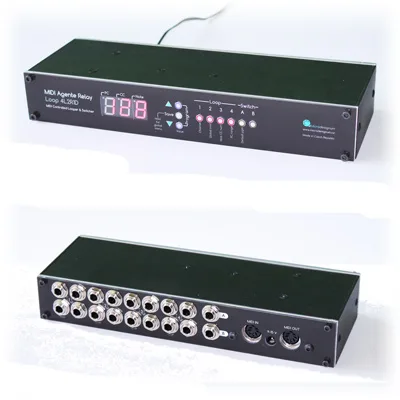
The Microdesignum MIDI Agente Relay Loop 4L2R1D is a MIDI-controlled looper and amp channel switcher in an aluminum box: it switches four mono effect loops and two amplifier channels, and it is driven entirely by MIDI from a foot controller rather than by its own footswitches12. It belongs to the wider MIDI Agente Relay Loop family, which Microdesignum describes as a programmable switcher of guitar effects and channels on a guitar amp, responding to incoming Program Change, Control Change or Note On messages3.
For a player, the point of a unit like this is that one MIDI program change from a controller can bring a whole pedalboard state and an amp channel change alive at once: loops 1 to 4 engage or bypass effects, and Switch A and Switch B replace the amp's own footswitch. The signal path is mono, the unit has one display, and it is currently listed by the maker as temporarily unavailable2.
Four loops in two sections, or one serial chain
The looper contains two sections, I and II, each with two loops, and the two sections can work fully independently in parallel1. Each loop has a Send and Ret pair (Send 1/Ret 1 through Send 4/Ret 4) wired with mono 6.3 mm Jack patch cables1. When a loop is on, its front-panel LED lights, the signal goes out of Send, returns through Ret and continues; when it is off, the LED is dark, the effect is bypassed, and the signal passes straight to the next loop or the output15.
The jacks between the sections decide the routing:
| Jack | Role |
|---|---|
| In 1 | Main guitar signal input to the looper1 |
| In 3 | Optional input to section II (loops 3 and 4); if unconnected, signal is fed automatically from Out 21 |
| Out 2 | Optional output from section I (loops 1 and 2)1 |
| Out 4 | Main signal output to the amplifier1 |
Leave Out 2 and In 3 unconnected and the two sections join into one section of four loops, giving the classic serial connection of four effects16. Use them and you can split the board, for example running loops 1 and 2 into one destination and loops 3 and 4 into another.
Never switch on a loop with no effect connected between its Send and Ret. It breaks the whole signal chain, can switch off an entire parallel section (loops 2 or 4), and the floating Ret connector may pick up interference from the surroundings1.
Amp channel switching with Switch A and Switch B
Switch A and Switch B replace the amplifier's footswitches and let MIDI automate channel switching1. They are connected to relays and are galvanically isolated from each other and from the whole device: they generate no signal of their own, they only close two wires, exactly like ordinary footswitches16. You wire them with mono 6.3 mm Jack cables into the amp's channel switching connectors, such as Clean/Lead or Volume 1/Volume 21. The relay switch connectors are TRS2.
Amp compatibility is worth checking before you buy:
- Some amps use one mono connector per switching function16.
- Some, such as Engl, combine functions in stereo connectors with one common wire16.
- Mesa Boogie strictly requires galvanic isolation of all control switches, which the isolated relays here provide16.
- Some Laney amplifiers use a special five-pin connector that is unrelated to MIDI16.
The related MIDI Agente Relay Plus takes the same idea further, with relays usable for amp channels and a note that amps with pair channel switching on TRS jacks need an appropriate Y-cable7.
Programs and the global menu
The unit stores 128 programs, numbered 1 to 128, and any combination of loops and switches can be programmed on each program number13. Editing follows a fixed order:
- Set the program to edit with the Program down and Program up buttons (1 to 128)1.
- Set the combination of loops and switches with buttons 1 to 4 and A and B15.
- Save permanently with the Save button; the display shows SAV1.
At power-on the switcher enters working mode and goes to the default program, normally program 1, closing the relays set for that program1.
Press and hold Save to enter the global menu, navigated with buttons 1 to 4 and A; global mode always starts by editing the channel parameter16. The menu holds the MIDI configuration:
| Parameter | What it sets |
|---|---|
| Channel | Receiving MIDI channel, 1 to 16 or all (ALL)16 |
| Global cmd | Global MIDI command: PC (Program Change), CC (Control Change) or Not (Note On), default PC6 |
| Global CC num | Controller number, used only when the global command is Control Change, 0 to 127, default 206 |
| Default pgm | Program number loaded at power-on, 1 to 1286 |
| PC range | Display format for Program Change values, technical (0 to 127) or user (1 to 128), default 128; display only, does not affect sending6 |
Beyond the global command, each loop or switch can be assigned its own Control Change number (0 to 127) for individual control. Hold that loop's or switch's button for about five seconds until the display shows IND, set the number, and save with Save. The default is "---", no Control Change assigned16.
Dots in the upper part of the display indicate reception of a Program Change, Control Change or Note On message16. The looper also resends all data from MIDI IN to MIDI OUT, so further MIDI devices can be controlled from one source5.
Due to internal wiring, when a button is pressed in global mode the corresponding loop or switch relay also closes together with its LED1.
Power
The unit runs from a power adapter into its 9 to 15 V AC/DC connector1. The maker specifies a wide supply range of 9 to 15 V, AC or DC, and recommends the supply be rated for a draw of 250 mA or more4. There is no preamp section in this version2.
Other Agente Relay Loop versions
Microdesignum builds the Agente Relay Loop in several sizes. The 4L2R1D sits between the smaller 4L1R1D (four loops, one switch) and the eight-loop versions48:
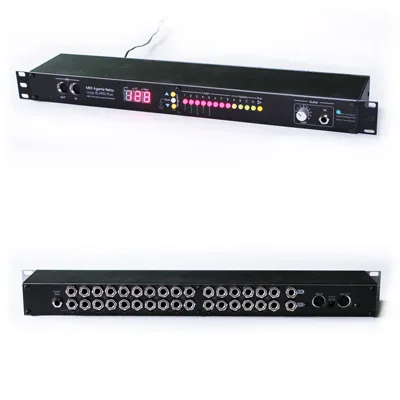
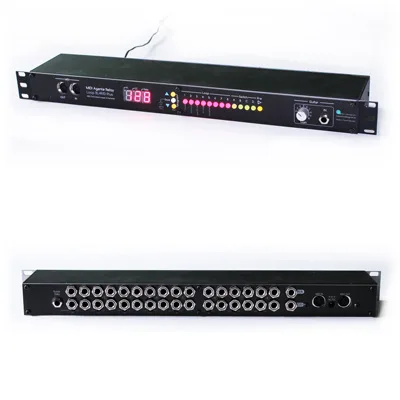
The 8L4R1D is the variant with 8 loops and 4 relay switches, and its MIDI interface is on both the front and rear panel8. The range also includes an 8L0R1D with 8 loops and no relay switches, and an 8L2R1D with 8 loops and 2 relay switches8. The 4L4R1D Rack is the same four-loop, four-switch concept on a 19-inch rack panel9, and the 8L4R1D Plus is a further variant in the family10. An 8L4R loop switcher was used in the rack of a custom pedalboard system Microdesignum built in 201911. For switching amp channels only, without loops, there is also the MIDI Agente Relay Uno12.
Questions
What MIDI messages does the Microdesignum Agente Relay Loop respond to?
It responds to Program Change, Control Change and Note On messages. Dots in the upper part of the display light up whenever one of these messages is received. The global menu lets you set which MIDI channel it listens on, from 1 to 16 or all channels, and whether the global command is Program Change, Control Change or Note On.
Will the Agente Relay Loop switch channels on an Engl or Mesa Boogie amp?
Switch A and Switch B are relay contacts that are galvanically isolated from each other and from the rest of the unit, which is what Mesa Boogie amps strictly require. Some amps, including Engl, combine several switching functions in stereo connectors with a common wire, so check your amp's switching jacks. Some Laney amps use a special five-pin connector that is unrelated to MIDI.
Why does my signal cut out when I turn on an empty loop?
A loop that is switched on with no effect connected between its Send and Ret breaks the signal chain, because the unit routes the signal out of Send and waits for it at Ret. It can also switch off a whole parallel section, and the floating Ret connector can pick up interference from the surroundings. Leave empty loops off.
How many presets does the MIDI Agente Relay Loop 4L2R1D store?
It stores 128 programs, numbered 1 to 128, and each program holds any combination of the four loops and the two switches. You pick a program with the Program down and Program up buttons, set the combination, and save it permanently with the Save button, at which point the display shows SAV.
What power supply does the Agente Relay Loop 4L2R1D need?
It runs from a 9 to 15 V power adapter, either AC or DC, through its power connector. Microdesignum recommends a supply rated for at least 250 mA. Because it accepts AC or DC in that range, it is more flexible than pedals that require a specific DC polarity, but the supply should still meet the current rating.
Sources (12)
- Návod k použití spínače MIDI Agente Relay Loop 4L2R1D, Microdesignum (www.microdesignum.cz)
- MIDI spínač 4 smyček kytarových efektů a 2 kanálů zesilovače, Microdesignum (www.microdesignum.cz)
- MIDI controlled looper for guitar effects, Microdesignum (www.microdesignum.cz)
- MIDI spínač 4 smyček a 4 kanálů zesilovače, Microdesignum (www.microdesignum.cz)
- Manual for MIDI Agente Relay Loop, Microdesignum
- Návod k použití spínače MIDI Agente Relay Loop 4L2R1D, Microdesignum (www.microdesignum.cz)
- Manual for MIDI Agente Relay Plus, Microdesignum
- MIDI spínač 8 smyček a 4 kanálů zesilovače, Microdesignum (www.microdesignum.cz)
- MIDI spínač 4 smyček kytarových efektů a 4 kanálů zesilovače na 19" rackovém panelu, Microdesignum (www.microdesignum.cz)
- MIDI spínač 8 smyček kytarových efektů a 4 kanálů zesilovače s předzesilovačem, Microdesignum (www.microdesignum.cz)
- Systém MIDI pedalboard, Microdesignum
- MIDI Relay Switcher Uno, Microdesignum