MIDI switching is the practice of using one controller, usually a floor unit with footswitches, to turn effects on and off, recall presets and adjust parameters across a whole pedalboard at once. Instead of bending down to tap each pedal's footswitch mid-song, you press one switch and every MIDI-equipped pedal on the board does what it was told. Morningstar's beginner guide to pedalboard MIDI describes the basic arrangement: most, but not all, MIDI-capable pedals have MIDI In and MIDI Thru ports, which allows you to daisy chain them from a single controller output1.
The payoff is bigger than convenience. On a switching-based pedalboard, Voodoo Lab's guide recommends assigning each digital pedal its own MIDI channel, for example delay on channel 1 and reverb on channel 2, so the controller can send different instructions to each pedal simultaneously2. One press can change a delay preset, kick in a reverb and mute a tuner, all on separate channels. Player Joseph Wu, whose board was featured in Origin Effects' readers' pedalboards series, described his Musicomlab switcher's MIDI functions for his Strymon pedals: "does the whole one touch preset thing so I'm not tap dancing"3.
This page covers the three pieces of a MIDI-switched rig: the switchers and pedal switches that move MIDI around, the pedals that can actually be controlled over MIDI, and the modules that add MIDI control to pedals that were never built with it.
What MIDI switching does on a pedalboard
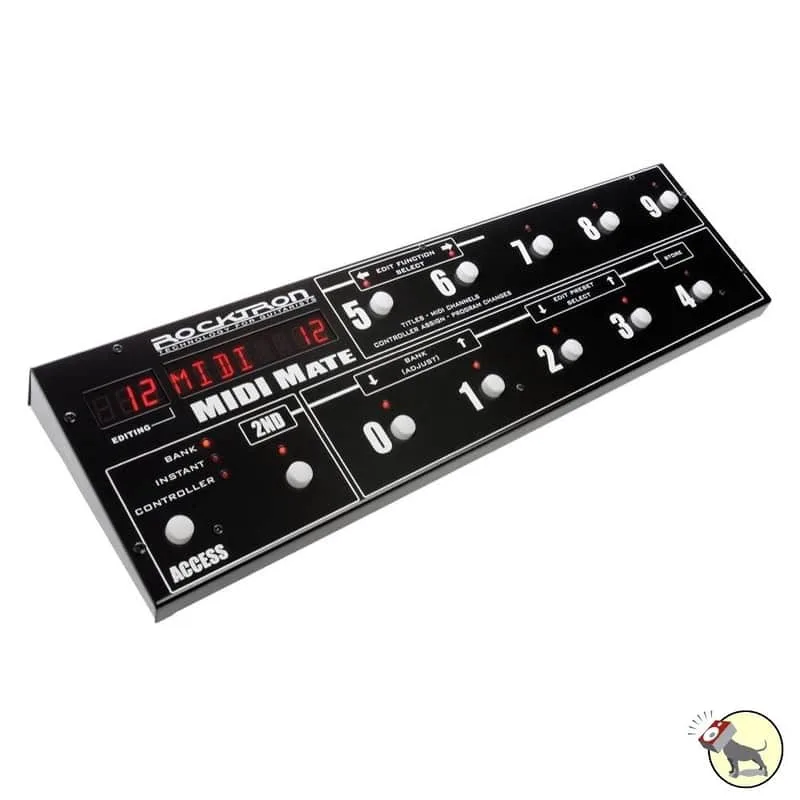
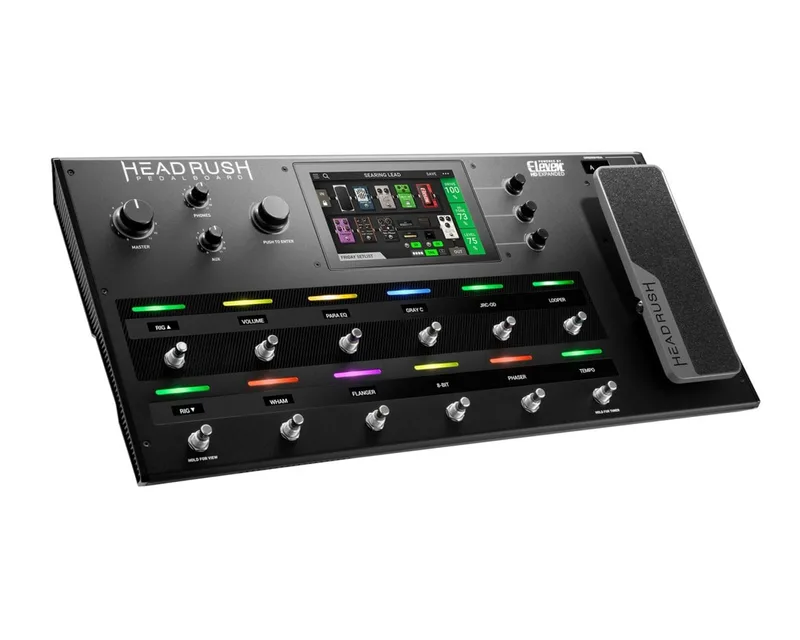
A MIDI-switched pedalboard has a controller at the front. The Rocktron MIDI Mate is one example, a footswitch controller unit that Rocktron's manual describes as "a MIDI transmitter, capable of changing parameters on MIDI receivers"4. The HeadRush Pedalboard, a multi-effects floor unit, carries MIDI In and Out for slave/master use and for controlling outboard MIDI gear over 5-pin connections5. Controllers send two main kinds of message: Program Change, which recalls a stored preset on the receiving pedal, and Control Change, which sets a parameter to a value between 0 and 127.
MIDI cables and connections come in more than one physical form. Some gear uses 5-pin DIN connectors, some uses 7-pin, and some, like Universal Audio's UAFX pedals, receives MIDI through its USB device ports, which means the controller needs a USB host port to talk to them6.
What the controller can actually switch falls into two categories:
- Pedals with MIDI built in. These listen to Program Change and Control Change directly through their own MIDI ports.
- Pedals without MIDI. These need either a relay-based switcher that physically opens and closes their footswitch circuit, or a retrofit module installed inside the pedal.
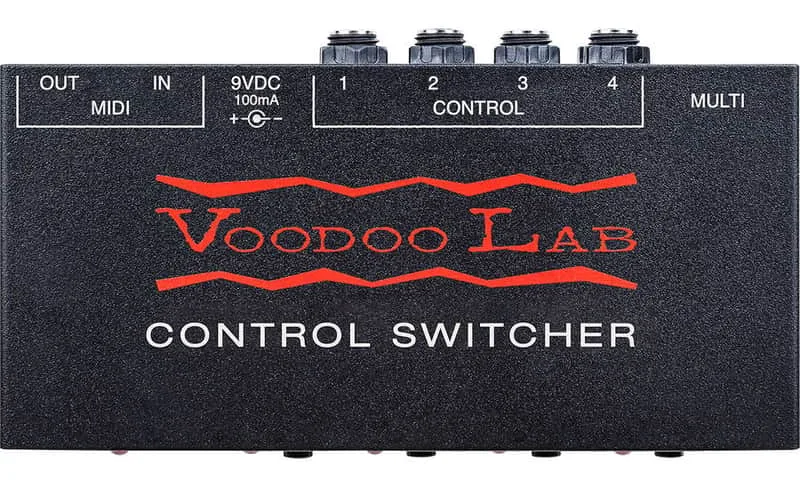
For amplifiers, Voodoo Lab's guide is blunt about the limit: a MIDI controller can switch an amp only if the amp is MIDI-compatible, and standard amplifiers need a MIDI-to-analog converter like the Voodoo Lab Control Switcher2. The Control Switcher sits between the controller and the amp, converting MIDI commands into the switch closures a normal amp channel selector expects, and it also passes MIDI commands through its MIDI Out to other MIDI devices downstream7.
MIDI pedal switches and switchers
Between the controller and the pedals sit a handful of small utility boxes. Some route MIDI, some convert it, and some just kill it.
| Product | Maker | What it does |
|---|---|---|
| MIDI Pedal Switch | American Loopers | Turns a MIDI signal on or off with one stomp8 |
| 1 MIDI In to 2 MIDI Out | American Loopers | Splits one input to two outputs, each switched on or off individually9 |
| MIDI SPLITTY | Molten Voltage | Amplifies, buffers and repeats MIDI signals for long cable runs and multi-device boards10 |
| Control Switcher | Voodoo Lab | Converts MIDI commands to analog switch closures for amps and non-MIDI gear2 |
| Minimal Series MIDI Input Selector | One Control | Switches between two input sources via footswitch or MIDI11 |
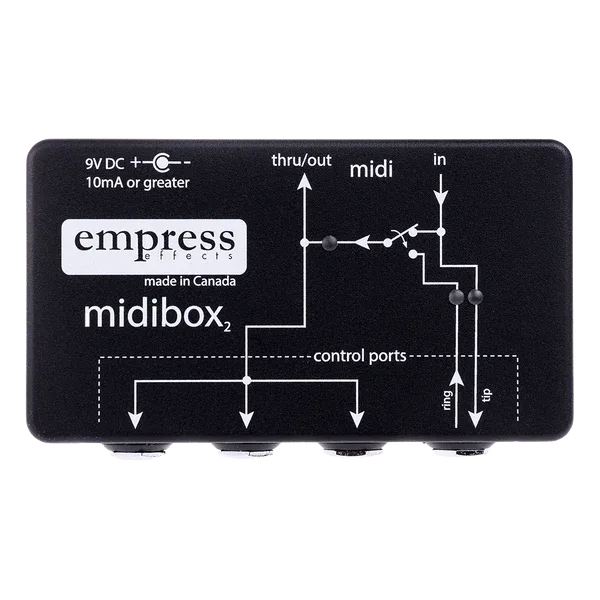
| Midibox2 | Empress Effects | Connects Empress pedals with a control port to MIDI12 |
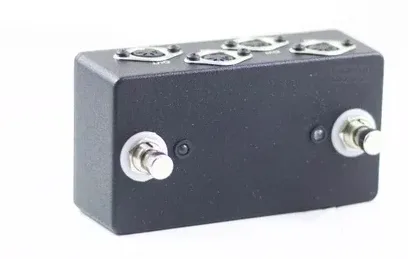
The simplest of these is the American Loopers MIDI Pedal Switch. The maker describes it plainly: "With this pedal, you'll be able to plug in any MIDI signal. Turn it ON or OFF."8 Its larger sibling takes a MIDI In jack and provides two MIDI outputs, each with its own footswitch, so you can mute the feed to one part of the board while leaving the other live. An LED on each switch shows the state: when the LED is on, the MIDI signal is passing through; when it is off, the signal is killed9. The unit is built with military spec wiring9.
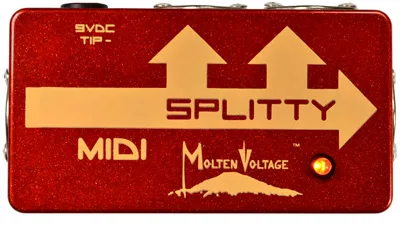
The Molten Voltage MIDI SPLITTY addresses a different problem. MIDI is a serial signal that degrades over distance and fan-out, and the SPLITTY is designed to amplify, buffer and repeat MIDI signals for extended cable runs and pedalboards with multiple MIDI devices10. If your controller's signal gets unreliable by the fourth pedal in the chain, a repeater of this kind is the fix.
The One Control Minimal Series MIDI Input Selector is an A-B box with a MIDI twist: it switches between two input sources, such as two guitars or a guitar and a synthesizer, either by its own footswitch or under MIDI command11. That makes it possible to change instruments as part of a MIDI preset rather than with a separate stomp.
Retrofit modules: adding MIDI to ordinary pedals
Not every pedal worth switching has a MIDI port. Microdesignum builds a range of universal MIDI modules that install inside a guitar pedal and replace its mechanical footswitch with an electronically controlled relay that responds to MIDI Program Change and Control Change messages13. The relays can also be operated by substitute footswitches that are part of the module, so the pedal still works by hand when you want it to13.
The modules come in relay configurations that match how the original switch was wired:
- A 4PDT relay version, for pedals whose stock switch is a 4PDT14
- A DPDT relay version, for pedals with a simpler DPDT switch15
- A version with 4 digipots and 1 footswitch, which electronically simulates turning and pressing control knobs or encoders, so MIDI can move the pedal's actual settings rather than just its on/off state16
Control is straightforward. On the 4PDT module, Control Change number 1 with a value of 0 to 63 switches the relay off, and a value of 64 to 127 switches it on; Program Change messages are also supported14. The MIDI channel is set with DIP switches on the board14. Microdesignum also makes pedal-specific modules, including one for the EHX Ring Thing, and notes that using their modules, some guitar pedals can be controlled by Program Change or Control Change MIDI messages17.
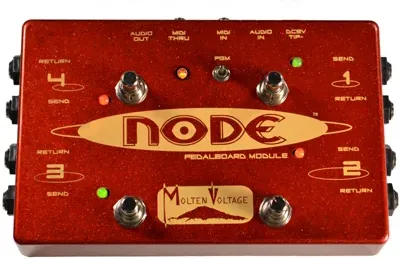
Molten Voltage took a similar approach with its PedalSync system. The PedalSync NODE is a MIDI-controlled audio switching module designed for use on musician pedalboards18, and the Master Control Development Board is backwards-compatible with MIDI, sending standard MIDI Start, Stop, Clock, Song Select and Program Change messages on channel 1519. These are kit-oriented products aimed at builders; see DIY pedal kits and mods if installing a module inside a pedal is the direction you want to go.
MIDI-compatible pedals
A pedal is MIDI-compatible when it has a port that listens. What that buys you varies by pedal.
| Pedal | Maker | MIDI capability |
|---|---|---|
| DD-500 | Boss | MIDI I/O for control options with effects switching systems and other devices20 |
| SY-300 | Boss | MIDI In and Out/Thru jacks for interfacing with switchers, drum machines and other MIDI gear21 |
| SY-200 | Boss | MIDI I/O to interface with MIDI-equipped pedals and devices like the ES-8 and ES-5 loop switchers22 |
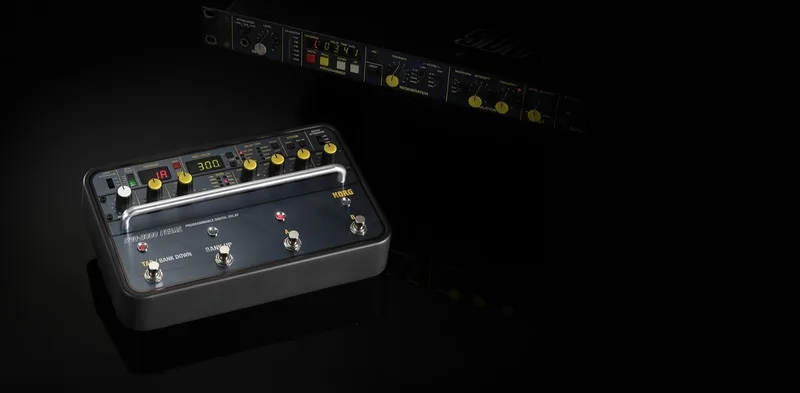
| SDD-3000 Pedal | Korg | MIDI connectors for triggering program changes from an external device and transmitting program data as a bulk dump23 |
| Parting | Old Blood Noise Endeavors | MIDI control over everything in the pedal, including MIDI clock in and out for external syncing24 |
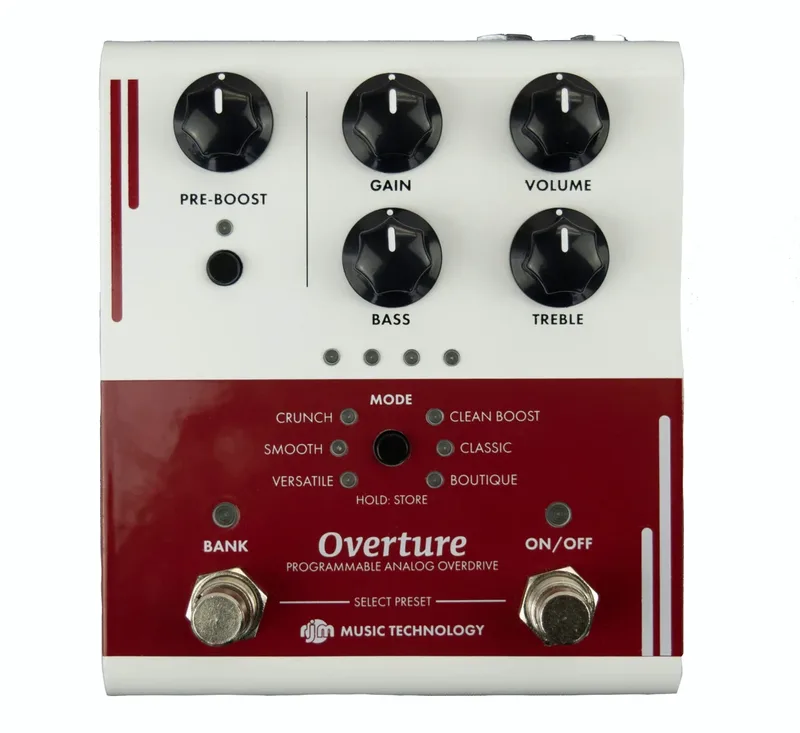
| Overture | RJM Music | MIDI support with external controller parameter adjustment and expression pedal support25 |
| UAFX pedals | Universal Audio | Preset recall and parameter adjustment from a MIDI foot controller, via USB device ports6 |
The depth of control differs. The Boss DD-500's MIDI I/O "opens up many additional control options for advanced setups with effects switching systems and other devices"20, and the SY-200 is explicitly designed to interface with Boss's own ES-8 and ES-5 loop switchers22. The Korg SDD-3000 Pedal goes further than most, able to transmit its program data as a bulk dump to and from other units23. The Old Blood Noise Parting exposes everything, including MIDI clock in and out for syncing to external tempo sources24. Universal Audio's UAFX pedals gained MIDI control that lets users recall presets and adjust effect parameters from a MIDI foot controller6.
Empress handles MIDI differently. Their pedals with a control port do not have MIDI jacks of their own; the Midibox and Midibox2 act as the interface. The Midibox2 "allows you to connect Empress Pedals equipped with a control port to MIDI"12, and the original Midibox's pitch is simple: "Use MIDI to control any Empress pedal equipped with a control port"26.
Expression and footswitches over MIDI
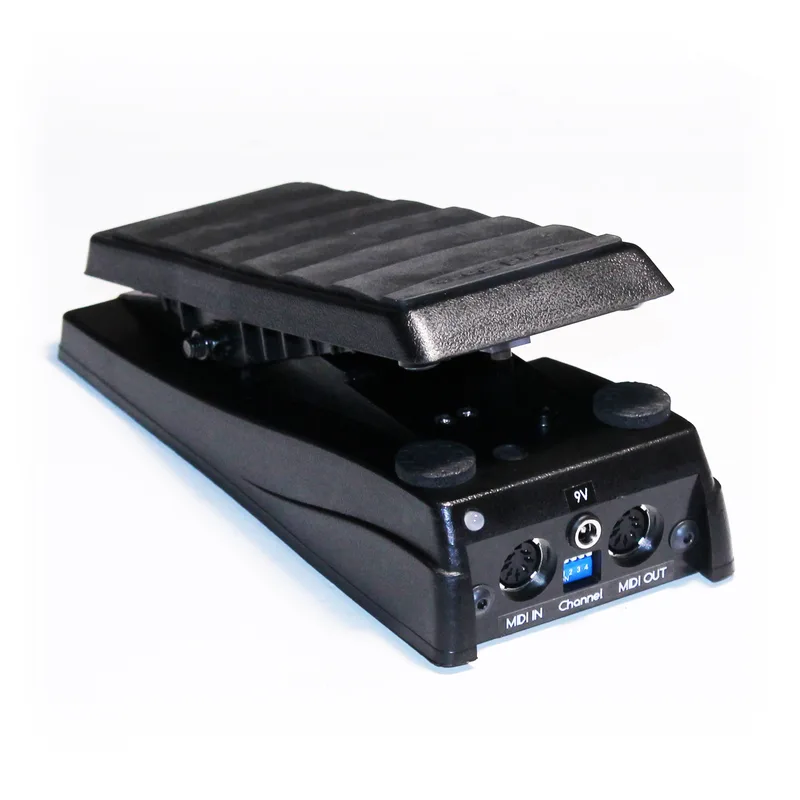
MIDI switching also covers expression. The Microdesignum MIDI Expressione 1A1F is an expression pedal with a built-in MIDI module that sends Control Change messages matching the pedal's position, 0 to 127, and the switch state, 0 or 12727. The MIDI Solutions Pedal Controller does the same job for any passive pedal plugged into it: it can be programmed to send a Control Change message in response to pedal movement, with a selectable Control Change number, MIDI channel, and minimum and maximum values28. It is MIDI-powered, requiring no batteries or power supply to operate29.
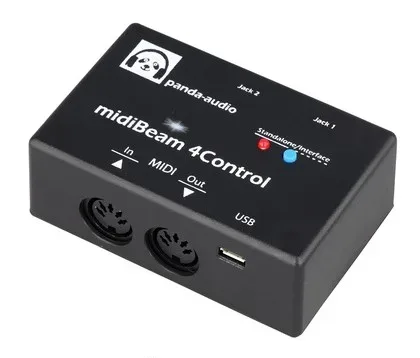
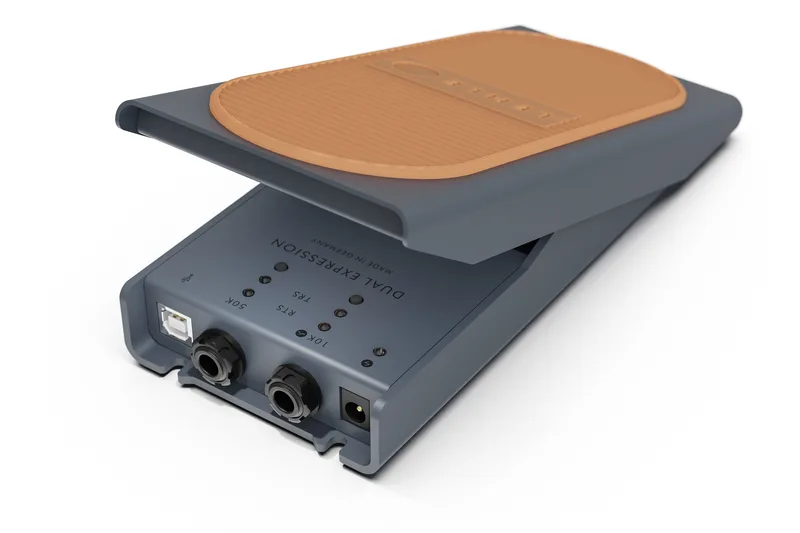
The Panda-Audio midiBeam 4Control works as either a class-compliant USB-to-MIDI interface or as a converter for passive TRS expression pedals or footswitches30. In its standalone mode, messages from connected pedals or switches pass to the DIN MIDI Out, and messages arriving at the DIN MIDI In pass through as well30. The Lehle Dual Expression sends MIDI data through its USB socket to a computer, to control MIDI-compatible software or any hardware device offering a USB host31. And the RJM Overture has special support for MIDI controllers with expression pedals, letting you set knob positions for heel down and toe down that transition smoothly25.
For more on the pedals themselves, see MIDI pedals and switching pedals.
Splitting and routing MIDI
Once more than one pedal listens to MIDI, routing becomes a real question. Morningstar's guide notes that because most MIDI-capable pedals have both MIDI In and MIDI Thru, you can daisy chain them, one pedal's Thru feeding the next pedal's In1. That works for modest boards. For larger ones, the American Loopers 1 MIDI In to 2 MIDI Out box splits a single feed into two independently switchable outputs9, and the Molten Voltage MIDI SPLITTY buffers and repeats the signal so it holds up across long runs and multiple devices10.
A worked example of the whole chain, from Origin Effects' feature on a reader's board: the player's Musicomlab switcher handles audio loops and sends MIDI to his Strymon pedals for one-touch preset recall3. That is the shape of most MIDI-switched rigs: a controller or switcher at the front, MIDI running down the board to the pedals that listen, and relay-based switching or converters for the gear that does not.
Pedals on this page
Questions
Can a MIDI switch turn a MIDI signal on and off with one footswitch?
Yes. American Loopers makes a MIDI pedal switch that lets you plug in any MIDI signal and turn it on or off with one stomp. Their larger unit takes one MIDI in and gives two MIDI outs, each with its own footswitch and an LED that shows whether the signal is passing or killed.
How do I split one MIDI in to two MIDI outs?
American Loopers' 1 MIDI In to 2 MIDI Out box gives you two outputs, each switched on or off individually by its own footswitch. For longer cable runs or boards with many MIDI devices, the Molten Voltage MIDI SPLITTY amplifies, buffers and repeats the MIDI signal so it survives the trip.
Which pedals can be controlled over MIDI?
Pedals with their own MIDI ports, such as the Boss DD-500, SY-300 and SY-200, the Korg SDD-3000 Pedal and the Old Blood Noise Parting. Empress pedals with a control port can be controlled through the Midibox or Midibox2. Pedals without MIDI can sometimes be retrofitted with modules from Microdesignum or Molten Voltage.
Do I need a MIDI controller to switch pedals?
If the pedals themselves respond to MIDI, a MIDI foot controller is what sends the commands. A standard amplifier is different: Voodoo Lab's guide notes an amp can only be switched directly if it is MIDI-compatible, and standard amps need a MIDI-to-analog converter such as the Voodoo Lab Control Switcher.
Sources (31)
- The ABSOLUTE Beginner's Guide to Pedalboard MIDI, Morningstar (www.morningstar.io), 2021-09-10
- Guitar Effects Switching System Guide, Voodoo Lab, 2026-06-24
- Readers’ Pedalboards #3 Going Loopy, Origin Effects, 2016-06-20
- Rocktron MIDI MATE Manual, Rocktron (www.rocktron.com), 2024-08-28
- Amp Modeling Guitar Effects Processor, HeadRush FX (www.headrushfx.com), 2026
- The Evolution of Universal Audio Pedals: MIDI Control Unleashed, www.morningstar.io, 2025-11-12
- Control Switcher MIDI Amp Commander, Voodoo Lab
- MIDI Pedal Switch: Turn MIDI Signal On or Off With One Stomp, American Loopers (www.americanloopers.com)
- 1 MIDI In to 2 MIDI Out With On or Off Switches, American Loopers (www.americanloopers.com)
- MIDI SPLITTY™ .:. MIDI PedalBoard Splitter / Repeater .:. by Molten Voltage, Molten Voltage
- Minimal Series MIDI Input Selector (OC-M-MIS), One Control USA
- Midibox2, Empress Effects Inc.
- Universal MIDI modules for guitar pedals, Microdesignum
- Universal MIDI module for pedals with footswitch and a 4PDT relay, Microdesignum.cz
- Universal MIDI module for pedals with a footswitch and a DPDT relay, Microdesignum.cz
- Universal MIDI module for guitar pedals with 4 digital potentiometers and 1 footswitch, Microdesignum
- MIDI module for EHX Ring Thing, Microdesignum.cz
- PedalSync .:. MIDI pedalboard kits .:. by Molten Voltage, Molten Voltage
- PedalSync®, Molten Voltage, 2013
- BOSS - DD-500 | Digital Delay, boss.info
- BOSS - SY-300 | Guitar Synthesizer, BOSS (www.boss.info)
- BOSS - SY-200 | Synthesizer, BOSS (boss.info)
- SDD-3000 PEDAL, KORG (USA)
- Old Blood Noise Endeavors, Old Blood Noise Endeavors
- Overture, RJM Music
- Midibox - Empress Effects Inc., Empress Effects Inc.
- MIDI expression pedal with a toe switch, Microdesignum
- MIDI Solutions Pedal Controller; Continuous MIDI Data Generator, MIDI Solutions Inc., 2026
- E:\Corel8\OPNewest\Ped_www_page01.cdr, MIDI Solutions Inc., 2023
- 4Control Quick-Start Guide B, Panda-Audio Ltd., 2026
- LEHLE DUAL EXPRESSION: Light, small, and twice the precise, Lehle GmbH