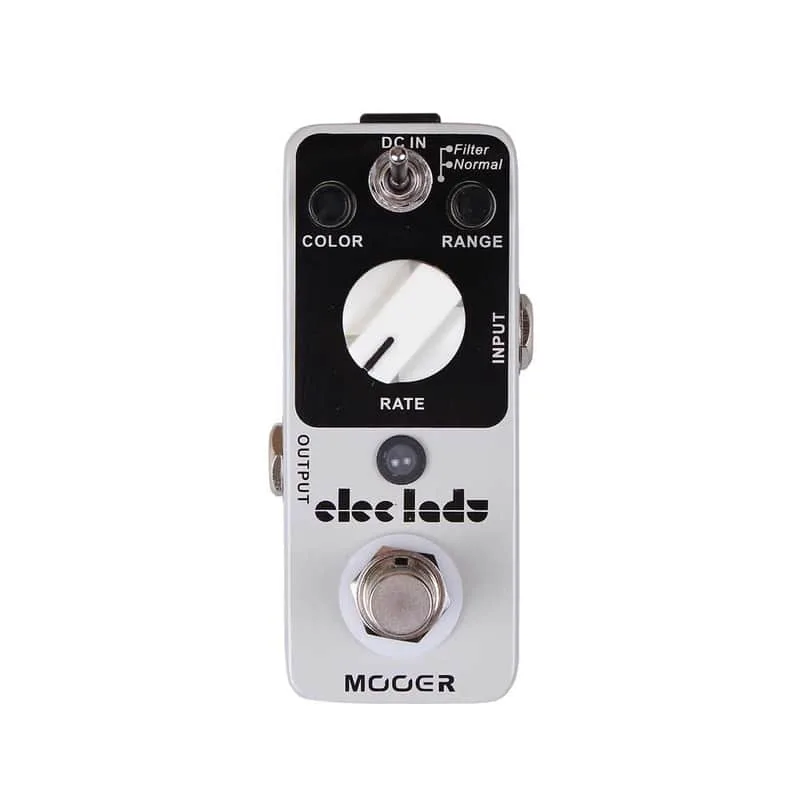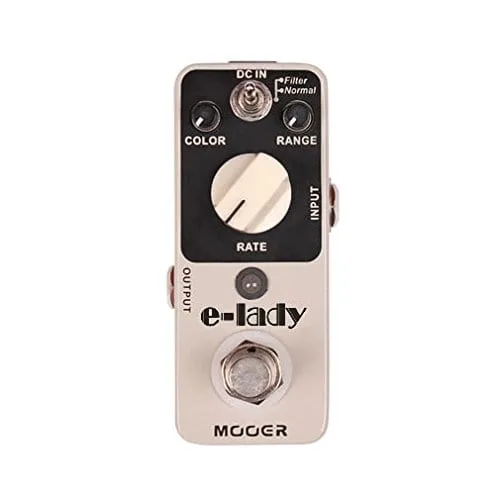


The Mooer E-Lady is a mini flanger pedal from Mooer Audio, built to deliver a classic analog flanger sound in a very small and compact enclosure. Mooer describes it as a "classic analog flanger sound with filter mode and oscillator effects," with two working modes, Normal and Filter, selected by a small switch1. It is openly inspired by the Electro-Harmonix Electric Mistress: MusicRadar called it a mini flanger "inspired by the legendary EHX Electric Mistress" that "delivers classic flanger tones in a mini stompbox form"2.
For a player, that means 70s-style jet sweeps and through-zero style whooshes without giving up much pedalboard space. Trevor Curwen's MusicRadar review of the earlier ElecLady put it plainly32:
"The ElecLady provides 70s-style flanging at about one-sixth of the usual size"
What the E-Lady does to your sound
A flanger works on time delay: it takes two signals, mixes them, and plays one back at a slower speed, with an LFO (low-frequency oscillator) modulating the timing of the delay to give a sweeping, whooshing effect6. That sweep is the jet-plane sound associated with 70s recordings, and it is what the E-Lady's Normal mode produces.
Filter mode is different. It stops the sweep and leaves the flanger's comb filtering static, so instead of motion you get a fixed, resonant tonal color. The idea comes straight from the Electric Mistress, whose "filter matrix" setting, as Guitar World's modulation history explains, "deactivates the delay modulation"7. Guitar.com's Huw Price describes the same setting as a way to hear comb filtering on its own, before flanging8. On the E-Lady, the small mode switch chooses between the two1.
The Electric Mistress's delay line range also reaches into chorus territory, though as MusicRadar's Alex Lynham notes, "it's not a true chorus, as it retains the resonant feedback of a flanger"9. Guitar World's beginner pedal guide says the E-Lady, being based on that circuit, "can also cover several chorus-type sounds"10, so players looking for light modulation as well as full flanging can get both from one mini box.
In short, the two modes give a player:
- Normal mode: a sweeping, jet-style analog flange, from subtle motion to deep whooshes16
- Filter mode: a static, resonant comb-filter color with the sweep frozen, in the spirit of the Electric Mistress filter matrix17
- Chorus-type territory: light modulation sounds reachable from the same circuit, though not a true chorus910
Controls and power
The control layout is where published descriptions differ. Gearnews' 2025 flanger roundup describes the current E-Lady sparingly: "You only get one footswitch and one control (rate)"5. MusicRadar's mini pedal roundup, by contrast, says "all the controls mirror those of the iconic" Electric Mistress2, which would mean more than a single knob.
| Control or feature | What it does | Who says so |
|---|---|---|
| Footswitch | Engages and bypasses the effect | Gearnews5 |
| Rate control | Sets the speed of the flange sweep | Gearnews5 |
| Mode switch | Selects Normal or Filter mode | Mooer1 |
| Full control set | Mirrors those of the Electric Mistress | MusicRadar2 |
Power comes from a 9V DC adapter with a center negative plug, drawing 10 mA1.
The E-Lady takes no battery. Mooer lists DC 9V adapter power supply only1, so it needs a wall supply or a powered pedalboard, and its 10 mA draw is light enough for most daisy-chain or isolated supplies.
Where it came from: the Electric Mistress connection
The E-Lady's lineage is no secret. Curwen's MusicRadar review of the original ElecLady opened with: "No prizes for guessing where the Eleclady derives her inspiration - the pedal even has its name in the same font as Elec[tric Mistress]"3. JHS Pedals, writing about its own 3 Series Flanger, groups the Electric Mistress among "the classic (and absurdly expensive) analog flangers of the past"11, which is the market gap a compact, affordable version addresses.
The family line, in order:
- Electro-Harmonix Electric Mistress: the original analog flanger with a filter matrix setting, the circuit the design is based on7
- Mooer ElecLady: the original mini version, named and styled after the Mistress3
- Mooer E-Lady: the same design rebranded after the Electro-Harmonix lawsuit over the POG clone10
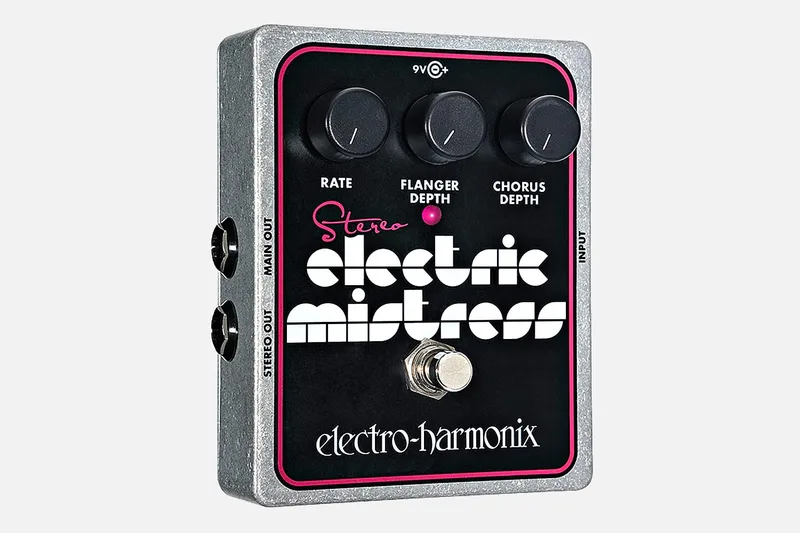
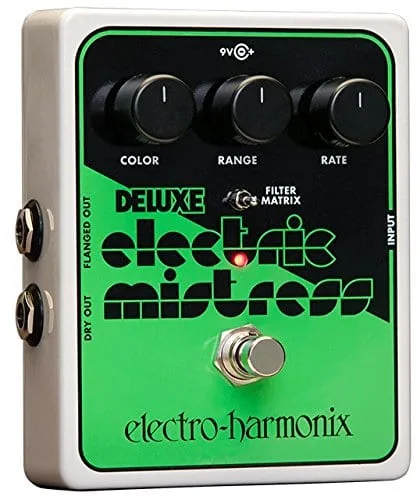
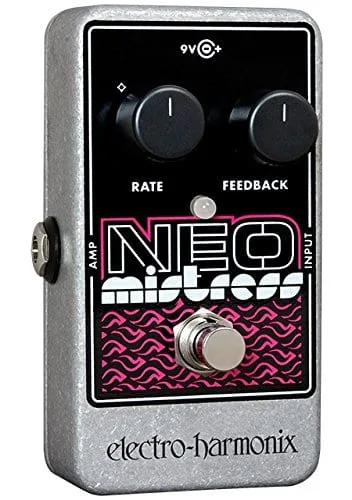
If you want to compare it with the pedal it descends from, see the Electro-Harmonix Electric Mistress, the Deluxe Electric Mistress or the compact Neo Mistress.
What reviewers said
Published opinions on the E-Lady have been positive:
- Gearnews' Julian Schmauch wrote in October 2025 that "The Mooer E-Lady has become a bit of a sleeper hit among guitarists in recent years"5
- Guitar World's Alex Lynham, in a guide to pedals for live guitarists, called it "a fully analogue pedal that sounds fantastic"4
- Guitar World's beginner guide recommends it as an affordable flanger choice, noting its Electric Mistress inspiration and chorus-type range10
- MusicRadar's mini pedal roundup highlights it as a way to get classic flanger tones in a mini stompbox2
At $62.00 USD list (October 2025)5, it sits well below vintage analog flangers and most full-size reissues, which is the core of its appeal: Electric Mistress-style analog flanging, plus a static filter mode, in a 160g box that fits almost anywhere on a board1.
Videos
MOOER Audio
Ferdi Floyd
Eric Haugen Guitar
Questions
Is the Mooer E-Lady true bypass?
Yes. Mooer lists true bypass on the E-Lady's product page, so when the pedal is off your signal passes through without active circuitry in the way. That suits small boards where the pedal may sit unused for long stretches of a set.
Does the Mooer E-Lady take a battery?
No. Mooer specifies DC 9V adapter power only, with a center minus (center negative) plug, drawing 10 mA. There is no battery option, so it needs a power supply or an isolated output on your pedalboard power brick.
What does filter mode do on the Mooer E-Lady?
Filter mode freezes the sweeping motion and leaves the flanger's comb filtering static, the same idea as the filter matrix setting on the Electro-Harmonix Electric Mistress the E-Lady is based on. Instead of a whooshing sweep you get a fixed, resonant tonal color you can dial in with the controls.
Is the Mooer E-Lady analog?
Yes. Guitar World's Alex Lynham described the E-Lady as a fully analogue pedal, and Mooer itself calls it a classic analog flanger sound. That puts it in the same circuit family as the vintage Electric Mistress rather than the digital modeling camp.
Sources (11)
- E-lady_MOOER Audio, MOOER Audio
- Best mini pedals: Small-scale stompboxes, MusicRadar, 2023-02-23
- Mooer ElecLady review, MusicRadar, 2013-02-02
- 15 essential pedals for live guitarists, Guitar World, 2021-07-13
- The 7 Best Flanger Pedals: From Gilmour to Van Halen, gearnews.com, 2025-10-06
- The Great Modulator: A Guide to EarthQuaker Devices Modulation Pedals, EarthQuaker Devices, 2022-05-16
- Everything you need to know about modulation pedals, Guitar World, 2025-01-08
- All About… Modulation, Guitar.com, 2016-04-18
- Electro-Harmonix Andy Summers Walking On The Moon Analog Flanger / Filter Matrix pedal review, MusicRadar, 2023-12-14
- Best guitar pedals for beginners: kickstart your 'board, Guitar World, 2020-12-01
- 3 SERIES FLANGER, JHS Pedals