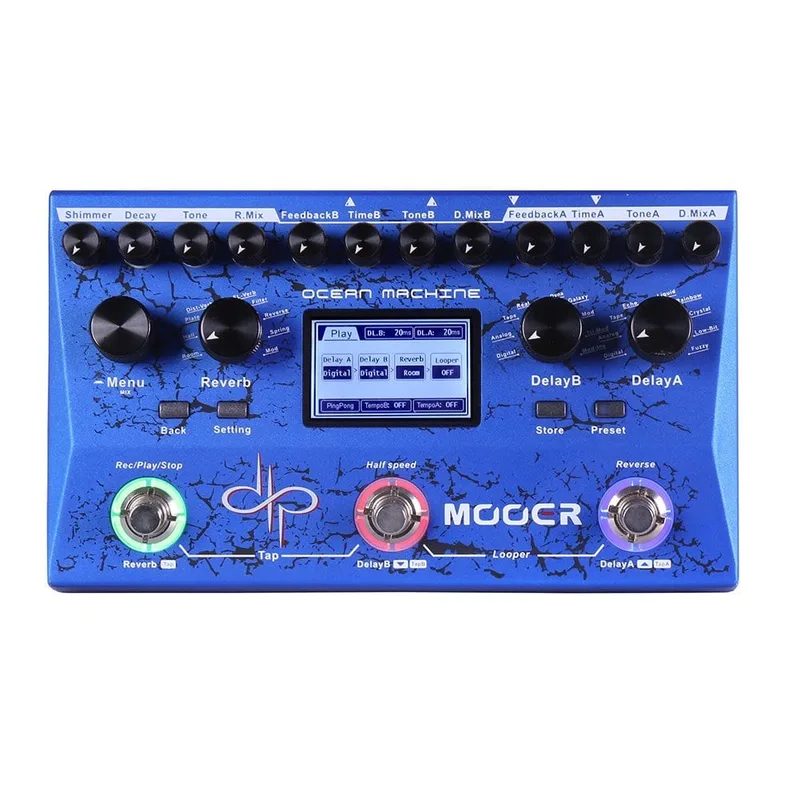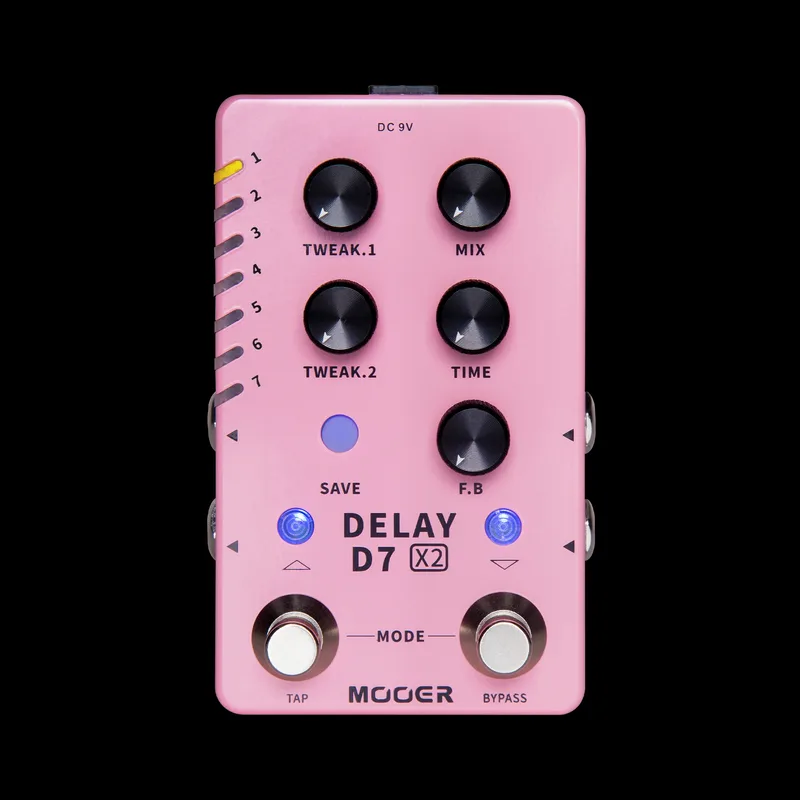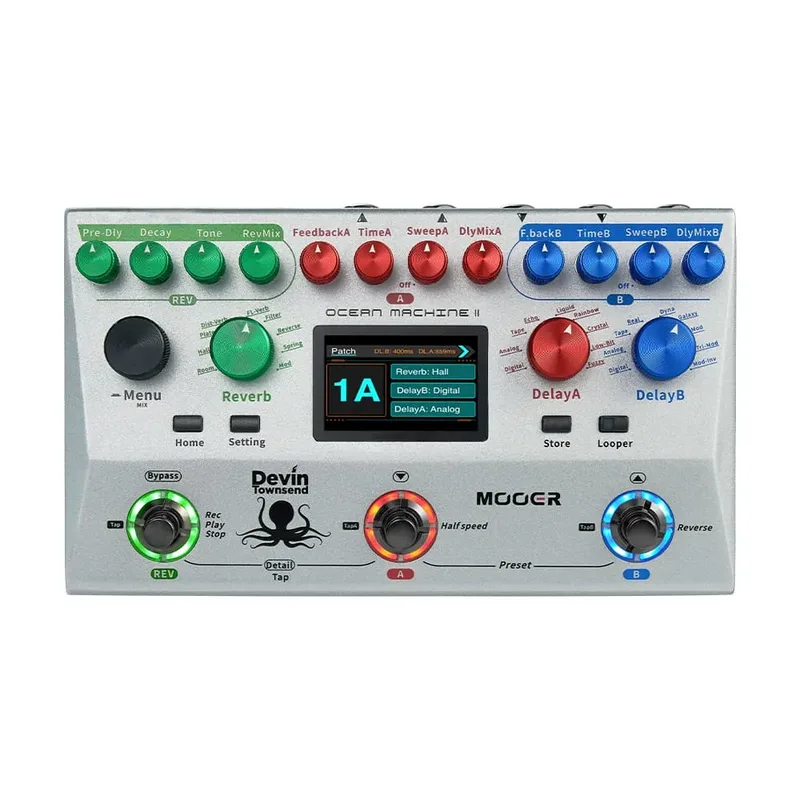


The Mooer Ocean Machine II is a digital delay and reverb pedal with a built-in looper, made by Mooer in collaboration with Devin Townsend1. At its core are two fully independent delay engines, each offering nine delay types, plus a reverb section and a 120-second looper, all in one enclosure12. It is the successor to the original Ocean Machine, which debuted about eight years earlier, in 201731.
Where a basic delay pedal gives you one set of repeats, the Ocean Machine II is built for layering: two delays that can run in parallel or series, a reverb alongside them, and a looper to capture the results. Guitar World's reviewer called it much more than a dual-delay/reverb/looper effect, describing it as a sophisticated ambient soundscape-generating device that is like an instrument unto itself3.
Two delays, a reverb and a looper in one pedal
The pedal's engine room is its pair of delay sections, delay A and delay B. Each is fully independent, with nine delay types apiece: digital, analog, tape, echo, liquid, rainbow, crystal, low-bit and fuzzy, supporting up to 2 seconds of delay time1. Alongside them sit a reverb section and the looper, which MusicRadar reported as an upgrade to 120 seconds, replacing the original's 44 seconds2.
Each section, both delays and the reverb, has a nine-position rotary switch for selecting the effect type3. The delays and reverb can also be frozen, creating static ambient drones, as MusicRadar noted at launch6. Tap tempo is available as standard2.
Routing is where the two delays become flexible. Patch Mode allows instant access to 24 presets across eight banks, with hybrid parallel and serial routing for the signal chain1. Gearnews described this plainly: you can customize your signal chain by routing effects in parallel or series5.
The controls
Control comes through 12 dedicated knobs for real-time parameter adjustments, a large LCD screen, and three multifunction footswitches1. The delay sections each carry feedback, time, sweep and mix controls3.
| Control | What it does |
|---|---|
| 12 knobs | Real-time parameter adjustment across the engines1 |
| LCD screen | Display for editing and navigation1 |
| Three footswitches | Multifunction switching for effects, looper and presets1 |
| Nine-position rotary switches | Select delay or reverb types in each section3 |
| Delay A/B controls | Feedback, time, sweep and mix per delay3 |
| Tap tempo | Set delay time in real time, standard2 |
External control is well covered. There is external expression pedal support via a TRS cable, and synchronizable and mappable MIDI In and Thru1. Mooer describes the enclosure as designed for durability and reliability in both studio and live environments1.
Power and connections
The Ocean Machine II runs on 9V DC through a center negative input, drawing 500mA43. That is a substantial draw for a single pedal, comparable to a small multi-effects unit rather than a compact analog stompbox.
At 500mA, this pedal needs a power supply output rated for that current on its own. A typical low-current daisy chain output will not run it4.
Connections on the rear panel include expression, Left/Mono In, Right In, Left/Mono Out, Right Out, MIDI Thru, MIDI In, USB-C and the 9V DC input4. Guitar World lists the same set: quarter-inch stereo inputs and outputs, quarter-inch TRS expression, MIDI Thru, MIDI In, center negative DC input and USB-C3. Full stereo inputs and outputs round out the connectivity1.
Ocean Machine vs Ocean Machine II
The original Ocean Machine, released in 2017, was Mooer's first artist collaboration, a highly complex digital product developed with Devin Townsend over two years78. It offered 15 delay types, a 44-second looper with 32 MB of storage memory, two standard modes of operation and MIDI programmability98.
The II keeps the same dual-delay, reverb and looping foundation but brings improved DSP algorithms, expanded specs, enhanced performance and better reliability3. The looper grows from 44 seconds to 120 seconds2, and the II adds USB-C and updated MIDI support alongside its new metallic gray enclosure and color-coded knobs41.
| Ocean Machine (2017) | Ocean Machine II (2024) | |
|---|---|---|
| Delay types | 159 | 9 per delay engine1 |
| Looper | 44 seconds8 | 120 seconds2 |
| MIDI | Programmable8 | Synchronizable and mappable In and Thru1 |
| USB | Not listed | USB-C4 |
| Bypass | Not listed | True bypass or DSP bypass, selectable1 |
What reviewers said
Guitar World's review found the pedal excels at shimmer and resonance effects where long reverb tails swell like accompanying synth parts, and that it can also generate hallucinatory delay effects, with textures ranging from silky smooth to gritty distortion3. The same review's overall verdict:
"Much more than a dual-delay/reverb/looper effect, the Mooer Ocean Machine II is a sophisticated ambient soundscape-generating device that is like an instrument unto itself, which can inspire hours of sonic exploration and composition creation."
MusicRadar's review of the original Ocean Machine praised it as a fully functioned delay, reverb and looper in one unit9, a foundation the II builds on with its retooled DSP3.
Guitar Pedal X reported the Ocean Machine II at $299 MAP/RRP in September 20244, Guitar World gave a launch price of $2993, and Gearnews listed it at $215 at launch5. In the UK, MusicRadar reported a £231 street price2 while Gearnews listed £1985.
Videos
MOOER Audio
Mooer Mania
Mooer Mania
Questions
What are the differences between the Ocean Machine and the Ocean Machine II?
The Ocean Machine II keeps the same foundation of two delays, a reverb and a looper, but adds improved DSP algorithms, expanded specs and better reliability. The onboard looper grows from 44 seconds on the original to 120 seconds, and the II adds USB-C, updated MIDI support and a new metallic gray enclosure with color-coded knobs. The original offered 15 delay types, while the II has nine types per delay engine.
How long is the looper on the Mooer Ocean Machine II?
The Ocean Machine II has a 120-second onboard looper, upgraded from the original Ocean Machine's 44 seconds. That is enough room for long ambient layers and repeated phrases, and it sits alongside the two delay engines and the reverb section in the same signal chain.
Can the Ocean Machine II run delays in series or parallel?
Yes. Patch Mode offers hybrid parallel and serial routing, so the two delay engines and the reverb can be arranged in parallel or in series to shape the signal chain. Parallel routing keeps the repeats and reverb tails separate, while series stacks them for denser layers.
Is the Mooer Ocean Machine II true bypass?
It supports both. The bypass is selectable between true bypass and DSP bypass, so you can choose a fully hard-wired signal path when the pedal is off, or keep the DSP in the chain for gap-free switching and trailing repeats.
What power supply does the Ocean Machine II need?
It runs on 9V DC with a center negative input and a 500mA current draw. That draw is well above what a typical small pedal supply or daisy chain delivers, so it needs a power source rated for at least 500mA on its own output.
Did Devin Townsend design the Ocean Machine II?
It is a collaboration. Mooer presents the Ocean Machine II as a pedal made in collaboration with Devin Townsend, continuing the partnership that produced the original Ocean Machine in 2017, which Mooer says was designed and developed over two years with him.
Sources (9)
- Ocean Machine II_MOOER Audio, MOOER Audio
- “Each delay and reverb effect can also be 'frozen,' creating static ambient drones”: Mooer Audio adds upgraded 144-second looper to version two of Devin Townsend's Ocean Machine, MusicRadar, 2024-09-13
- Mooer Ocean Machine II review, Guitar World, 2025-03-05
- Guitar Pedal X, Guitar Pedal X, 2024-09-13
- Mooer Ocean Machine II: Time for a Change, gearnews.com, 2024-09-10
- Mooer Devin Townsend Ocean Machine delay pedal (finally) ready, gearnews.com, 2017-01-11
- About us-MOOER Audio, MOOER Audio, 2016
- Ocean Machine_MOOER Audio, MOOER Audio
- Mooer Ocean Machine review, MusicRadar, 2018-02-07