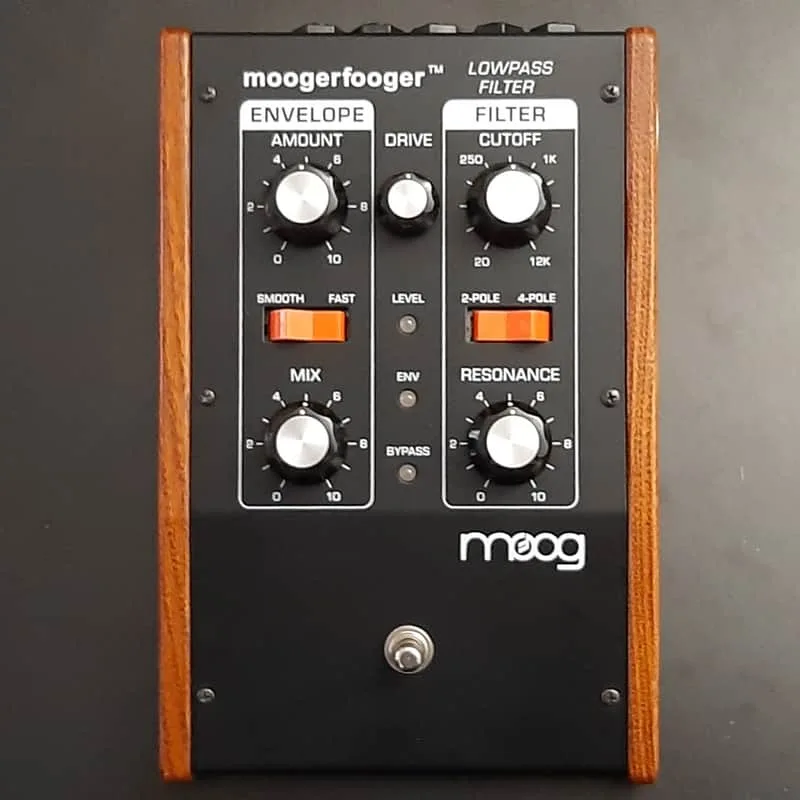


The Moog MF-101 Lowpass Filter is an analog voltage-controlled lowpass filter and envelope follower in a stomp-box format, designed by Bob Moog himself1. It is a direct descendant of Moog modular synthesizers, built around a classic Moog Ladder filter section paired with an envelope follower, and Vintage Synth Explorer describes it as a stomp-box style Minimoog VCF12. First produced in 1998, it was one of the first two Moogerfoogers to reach shelves13.
The Moog MF-101 is an analog lowpass filter pedal from Moog's Moogerfooger line. It is a voltage-controlled filter in pedal form: the harder you play, the more the sound is affected2. Alongside its knobs, it carries four expression pedal inputs for remote control of the knob parameters, and reviewers have described this near-20-year-old Moogerfooger as a benchmark, earning a space in studios and pedalboards worldwide4.
What it does to your sound
A lowpass filter lets frequencies below a cutoff point through and rolls off what sits above it. On the MF-101 the cutoff is voltage controlled, so it can be swept by hand, by an expression pedal, or automatically by the built-in envelope follower, which tracks the level of whatever you play into it. Moog's description of the interaction is simple: the harder you play, the more the sound is affected2. The envelope follower can be switched between fast and smooth attack modes for producing sweeps1.
Because it accepts any mono source, the MF-101 is not just a filter pedal for guitar. Moog positions it as an all-analog instrument for thickening synths, funkifying bass guitars and distorting drum samples, and Vintage Synth Explorer notes it works with any synth, sampler, DAT, record or microphone12.
The controls: cutoff, resonance, envelope and mix
The front panel carries knobs for filter cutoff, resonance, envelope amount and mix1. The envelope follower section provides Fast and Smooth switching, Envelope Amount and a Dry/Wet Mix control1.
| Control | What it does |
|---|---|
| Cutoff | Sets the frequency where the filter begins rolling off highs1 |
| Resonance | Emphasizes the cutoff point, from gentle shaping to pronounced sweep1 |
| Envelope Amount | Sets how strongly your playing level drives the filter cutoff1 |
| Mix (Dry/Wet) | Blends the filtered signal with the unfiltered one1 |
| Fast/Smooth switch | Chooses the envelope follower's attack character1 |
| 2-pole/4-pole switch | Selects filter slope, up to 24dB per octave in 4-pole mode1 |
The 2-pole and 4-pole switch is the key tonal choice. In 4-pole mode the filter operates at 24dB per octave, the steep response associated with the classic Moog ladder sound; 2-pole mode gives a gentler slope and a subtler effect1.
Beyond the knobs, the MF-101 carries multiple CV and expression pedal inputs and outputs, allowing each parameter to be manipulated and allowing modular interconnection between Moogerfooger effects12. Four expression pedal inputs give remote control of the knob parameters1.
The MF-101 draws 500mA at 9V DC, center negative2. That is far beyond a typical compact pedal, so it needs a supply rated for the draw rather than a shared daisy chain.
Where it came from
The MF-101 shipped in 1998, alongside the MF-102 Ring Modulator, as the first Moogerfoogers to hit shelves3. The Moogerfoogers were voltage-controlled analog effects inspired by original Moog synth modules, and the MF-101 and MF-102 were based on those original synth-module designs67. The MF-101's enclosure echoes the Minimoog, with wood panels, a black panel, bold white print and a few big colorful buttons1.
The MF-101 is an analog design, described as a great analog VCF (filter) from the Man himself1. Its place in studios and pedalboards worldwide has made it a benchmark among filter pedals, one that reviewers have found hard to beat, built to last and, unsurprisingly, holding its value overall4.
Who uses it
The MF-101 has been used by Fatboy Slim and The Crystal Method1. PastFX notes it is known for its use on the Red Hot Chili Peppers song Dani California5.
What reviewers said
MusicRadar reviewed the MF-101 in a 2017 hardware filter group test, priced at £279 at the time4:
"This near-20-year-old Moogerfooger has become a benchmark, earning a space in studios and pedalboards worldwide."
MusicRadar's verdict continued that it was hard to beat, built to last and, unsurprisingly, holds its value overall4. A review roundup compiled by Sherman quotes a simpler summary: "This is a simple but great sounding filter with envelope following abilities"8.
Clones and recreations
The MF-101's reputation has kept the circuit relevant long after it left production. Reviewers have found it hard to beat, built to last and, unsurprisingly, holding its value overall, which speaks to the lasting appeal of its analog filter design among players4.
Videos
Sweetwater
BassTheWorld.com
Fabio Pesce
Questions
Is the Moog MF-101 discontinued?
Yes. Moog retired the Moogerfooger line in August 2018 after 20 years, and the MF-101 was one of the last three models in production at the time. Final units were built in limited quantity while parts lasted. The MF-101 first shipped in 1998 as one of the first two Moogerfoogers released.
Is the MF-101 a Moog ladder filter?
Yes. The MF-101 contains a classic Moog Ladder filter section, the same topology that descends from Moog modular synthesizers and the Minimoog VCF. Vintage Synth Explorer describes the pedal as a stomp-box style Minimoog VCF, and it pairs the ladder filter with an envelope follower in one unit.
Can you use the MF-101 on guitar and synth?
Yes. The MF-101 works with any mono sound source, including synths, samplers, microphones and records as well as guitar and bass. Moog describes it as an all-analog instrument for thickening synths, funkifying bass guitars and distorting drum samples. It is a mono input and mono output device.
What is the difference between 2-pole and 4-pole on the MF-101?
The filter is switchable between 2-pole and 4-pole operation. A 2-pole setting gives a gentler slope, while the 4-pole setting gives the steeper 24dB per octave response associated with the classic Moog ladder sound. The switch lets a player choose between a subtler and a more pronounced filtering effect.
How much current does the MF-101 need?
The MF-101 runs on 9V DC with a center negative plug and draws 500mA. That is far more than a typical compact pedal, so it needs its own adequate power supply rather than a shared daisy chain, and it rules out a standard 9V battery.
Is there a clone of the Moog MF-101?
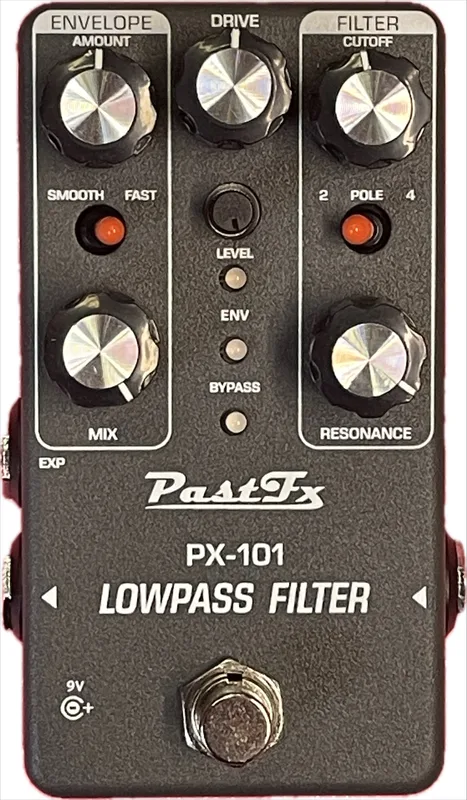
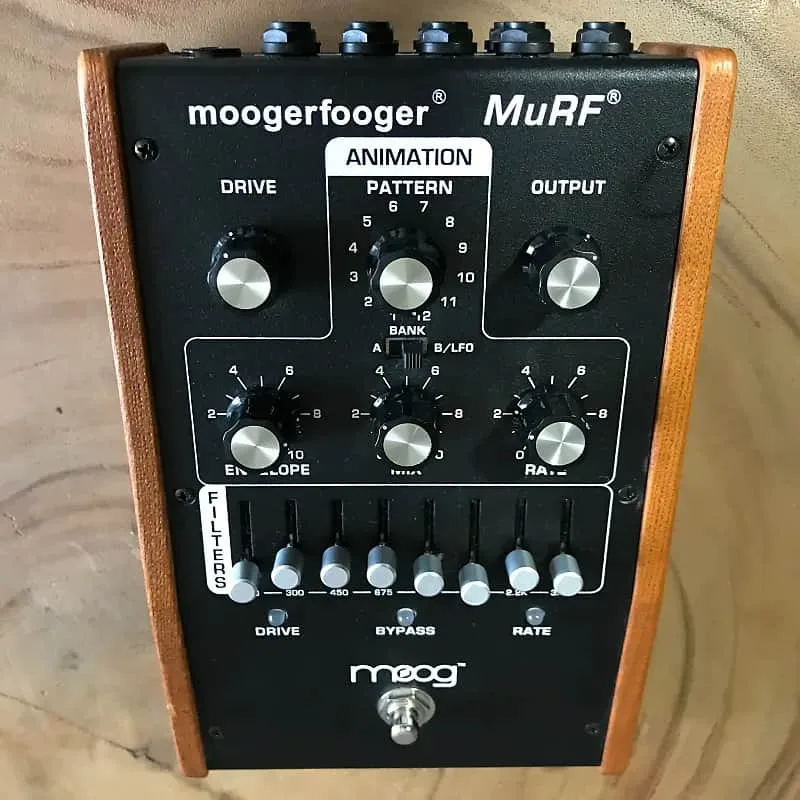
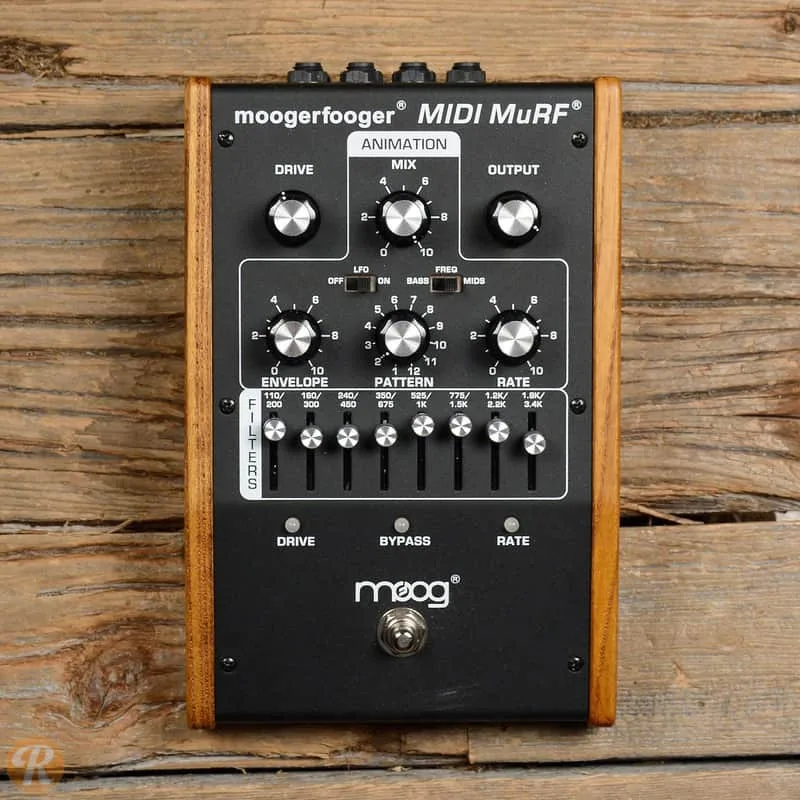
Yes. PastFX makes the PX-101 Lowpass Filter, a compact replica of the discontinued MF-101 that adds an Output Level control. Behringer has cloned other Moogerfoogers, including the MF-102 Ring Modulator and the MuRF, and Warm Audio released the Ringer Bringer recreation of the MF-102 in 2024.
Sources (8)
- Moog MF-101 Lowpass Filter, Vintage Synth Explorer, 2026
- MF-101 Low Pass Filter (Black) by Moog, RockBoard PedalPedia, 2026
- Behringer's new ring modulator will literally fill the gap left by Moog's Moogerfooger, Guitar World, 2023-02-22
- Tech group test: Hardware Filters, MusicRadar, 2017-07-14
- PX-101 LOWPASS FILTER, pastfx.com, 2026
- Moog sunsets Moogerfooger effects, Guitar.com, 2018-08-28
- Moog Music announces that Moogerfooger has reached the end of the line, gearnews.com, 2018-08-27
- Reviews, Sherman (www.sherman.be)