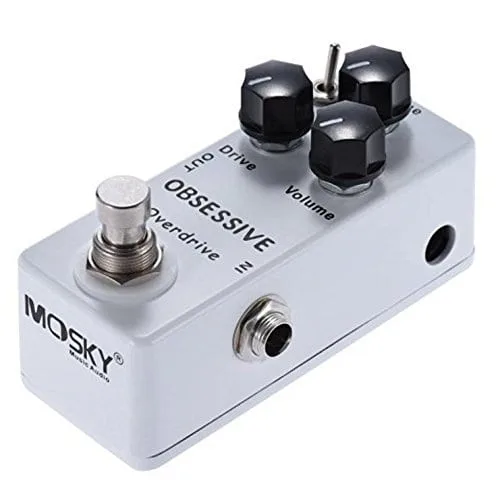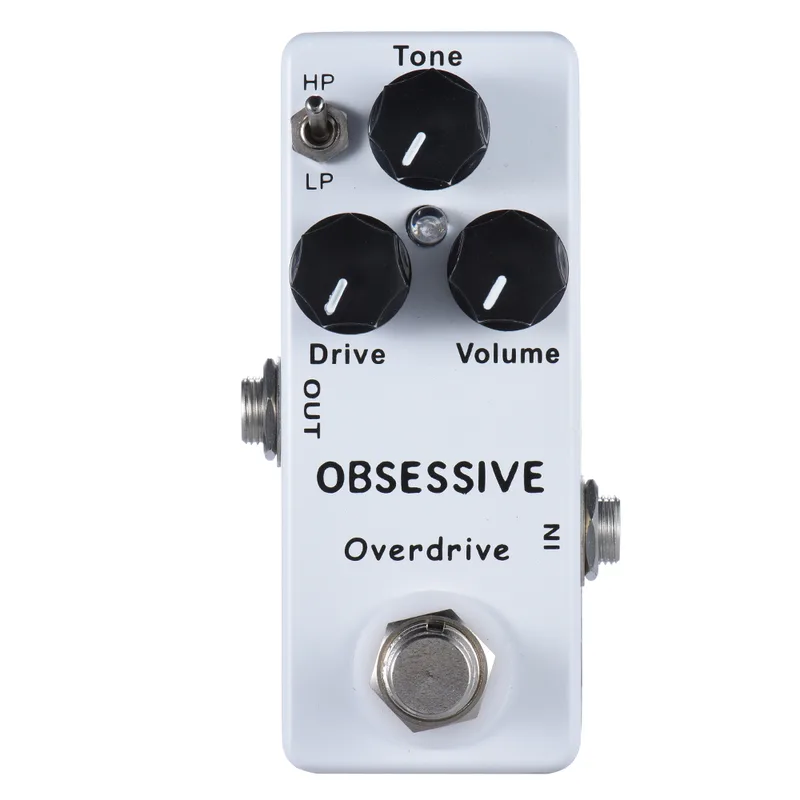


The Mosky Obsessive Drive, listed by the maker as the Obsessive Overdrive, is a mini overdrive pedal built to capture the high-gain stompbox tone of a well-known American original in a much smaller and cheaper package. Delicious Audio's Paolo De Gregorio writes that it "does a good job at recreating that brand's responsive high-gain stompbox" tone, and that "the Mosky Audio Obsessive Overdrive is a lot smaller and a lot cheaper than the original."1
A smaller take on a high-gain stompbox
The pedal takes its cues from a high-gain stompbox made by what Delicious Audio calls "a controversial American company whose name is inspired by a psychological condition affecting obsessive-compulsive people."1 MusicRadar, reviewing a different pedal in the same family, notes that the original American design is handmade in the US, which is one of the differences the Mosky's Chinese-built, mini-format approach trades on.3
For a player, the pitch is simple: a pedal that does a good job of recreating a responsive high-gain stompbox tone, in a mini enclosure that is a lot smaller and a lot cheaper than the original. It sits among distortion pedals as much as overdrives, given how much gain it carries12.
The controls
The control set is deliberately small, which suits a mini pedal.
| Control | What it does |
|---|---|
| Drive | Dials in the gain21 |
| Volume | Adjusts the output volume21 |
| Tone | Finds the tonal balance21 |
| HP/LP switch | High-Peak or Low-Peak voicing, see below21 |
The HP/LP switch is the pedal's distinguishing feature. In HP, or High-Peak, the pedal "gives you increased distortion and low-end, thickening up your sound for a more 'British' flavor."21 In LP, or Low-Peak, it "gives you a more accurate rendition of your sound with very little coloration of your tone."21 In practice, HP is the higher-gain, midrange-forward voice, while LP leans toward a cleaner, more transparent boost character.
Power: 9-volt or 18-volt
The Obsessive Overdrive runs on either a standard 9-volt adapter or an 18-volt power supply. Mosky states that plugging in an 18-volt supply gives the pedal even more headroom, which matters if you run hot signals or heavy gain and want the circuit to stay clean longer before it compresses.1
The pedal runs on "a standard 9-volt adapter," or you can "plug in an 18-volt power supply for even more headroom."21 The 18-volt option is worth knowing about if you run a shared power supply: it can change how the pedal behaves at the top of its range, giving more room before the circuit clips.
The maker's page lists 9-volt or 18-volt power but gives no current draw figure, so check your power supply's output against the pedal before adding it to a daisy chain.
Videos
Doctor McFarland Studios
northtownsound
Budget Pedal Chap
Questions
What pedal is the Mosky Obsessive Drive based on?
Delicious Audio's Paolo De Gregorio describes it as a smaller, cheaper take on a high-gain stompbox made by a controversial American company whose name is inspired by a psychological condition affecting obsessive-compulsive people, and says the Mosky does a good job at recreating that pedal's responsive high-gain stompbox tone.
What does the HP/LP switch do on the Mosky Obsessive Drive?
The HP position, High-Peak, gives increased distortion and low-end, thickening up the sound for a more British flavor. The LP position, Low-Peak, gives a more accurate rendition of the input signal with very little coloration of the tone.
Is the Mosky Obsessive Drive true bypass?
Yes. Both Mosky's own product page and Delicious Audio list the pedal as having true bypass switching, so the signal passes through unaltered when the effect is off.
Where is the Mosky Obsessive Drive made?
Delicious Audio describes the Mosky Obsessive Drive as Chinese-built. By contrast, MusicRadar notes that the original American pedal it takes after is handmade in the US.
Sources (3)
- Mosky Audio Obsessive Drive, Delicious Audio, 2021-03-01
- Obsessive Overdrive_Mini Guitar Pedals_Effect Pedals_Products_mosky pedal, moskyaudio.com
- Warm Audio ODD Box V1 Hard-Clipping Overdrive Pedal review, MusicRadar, 2023-07-19