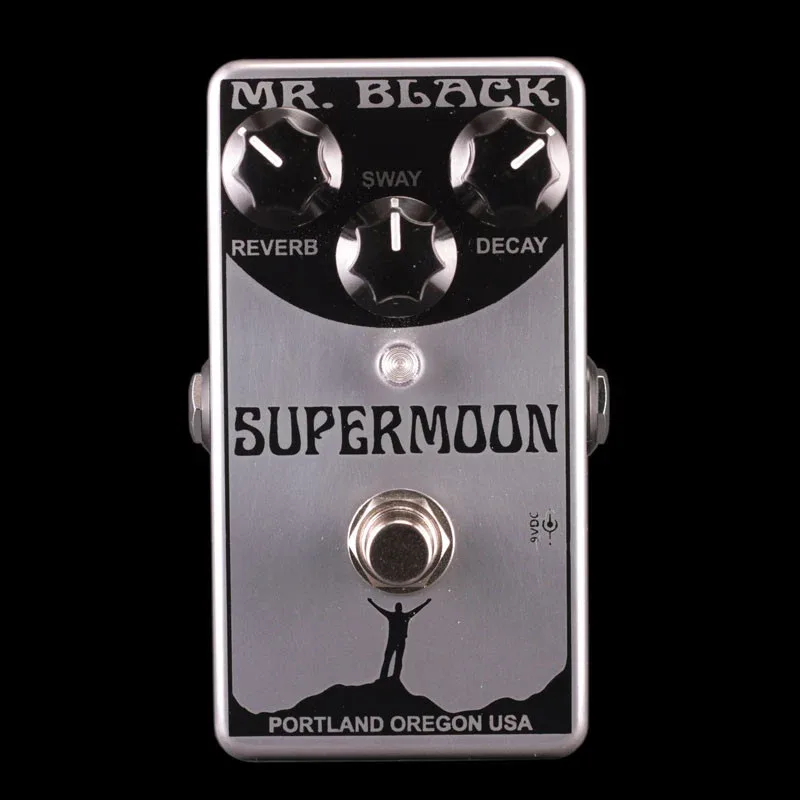


The Mr. Black SuperMoon is an ambient modulated reverb pedal designed by Jack DeVille and built under the Mr. Black name, a subdivision of Jack DeVille Electronics1. Premier Guitar's reviewer described its digital circuit as built for "vast-sounding, lo-fi reverberation with precise control over decay rates"1, and Mr. Black's own copy calls the sound "Cavernous, vast and orbital"2. What sets it apart from most reverb pedals is its Sway control, a modulation section that pitch-shifts the reverb tail for an eccentric, atmospheric character1.
The pedal is hand-built in Portland, Oregon1, and the current product pages state it is made in the U.S.A.2. Premier Guitar listed its street price at $179 at the time of its review1; the current Mr. Black product page lists a regular price of $219.95, with B-stock units sold at $149.95 as final sale2.
What it does: a cavernous modulated reverb
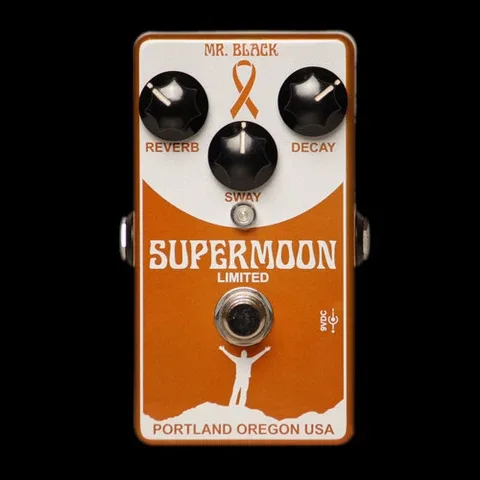
The SuperMoon is built for big, ambient reverb. Its digital circuit is aimed at lo-fi, spacious reverberation with control over how long the tail hangs in the air1. The three controls are simple:
| Control | What it does |
|---|---|
| Reverb | Sets the reverb mix level; maximum wetness is 1:11 |
| Sway | Sets the modulation, a pitch-shift that lends the effect an eccentric twist13 |
| Decay | Sets the length of the reverb tail3 |
The pitch-shift character of the Sway control is the pedal's signature. Premier Guitar's reviewer called the pitch-shifting tones one of the pedal's strengths, alongside how easy it is to dial in sounds and its small footprint1. That reviewer auditioned it with a Fender Classic Player Strat and a Mesa/Boogie Dual Rectifier, with the pedal connected through the amp's effects loop1.
"Easy to dial in sounds. Small footprint. Exciting pitch-shifting tones."
The pedal has found its way onto pro boards. In a 2026 Premier Guitar interview, Jack DeVille noted that Keith Urban uses a SuperMoon for a couple of songs, calling it "such a unique, cool-sounding 'verb"4.
Power and connections
The SuperMoon runs on a 9VDC 2.1mm negative center-pin power supply, the standard pedalboard connector, or on an internal 9VDC battery, which is not included2. Premier Guitar's review confirms both supply options, describing it as powered "by either a 9V battery or a Boss-style power supply"1. Current draw is under 60mA2, light enough that it shares comfortably with other pedals on most supplies.
Electrically, the pedal presents a ~500KΩ input impedance and ~2KΩ output impedance, with a frequency response of about 15.6Hz to 22KHz2. It uses true-bypass switching, so the dry signal passes untouched when the pedal is off21.
Mr. Black sells B-stock SuperMoon units at $149.95. These have minor cosmetic defects but the internal components are the same as a standard pedal, and they carry the standard 1-year Mr. Black warranty. All B-stock sales are final: no returns, exchanges or refunds2.
History and versions
The SuperMoon began as a small run that outgrew itself. DeVille initially planned to make only 100 pedals, but those sold in five days and demand continued to grow, so a second batch of 100 followed and also sold fast4. In the same interview DeVille said the pedal was priced low enough that he felt he could have charged more for it4.
The family has since grown into several versions:
| Version | What it is |
|---|---|
| SuperMoon | The original modulated reverberator; cavernous, vast and orbital2 |
| SuperMoon Chrome | An expansion of the original with additional brighter early reflections and a reverb tail of more than 30 seconds5 |
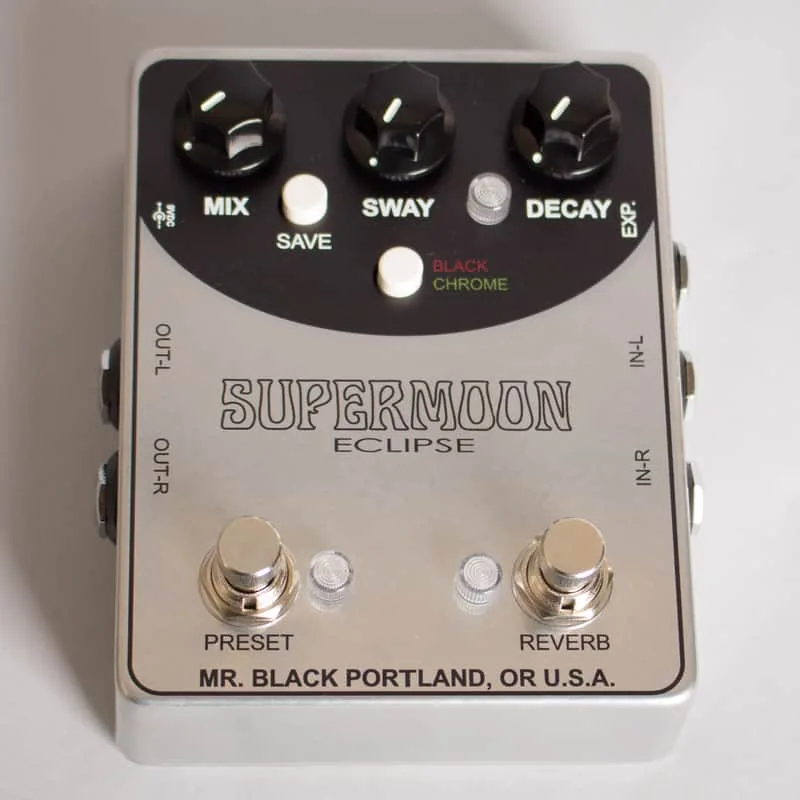
| SuperMoon Eclipse | Expands the SuperMoon to a true-stereo format with two fully independent channels; buffered bypass with trails6 |
| SuperMoon MS Limited | A 100-piece special edition based on the Chrome, with proceeds donated to the National MS Society7 |
The SuperMoon Chrome takes the original circuit further, with Mr. Black describing it as "a haunting expansion of the legendary, coveted SuperMoon Modulated Reverberator," adding brighter early reflections and a staggering 30-plus-second reverb5. It can be dialed back for a touch of space or extended into a lush wash of micro-reflections, and Mr. Black says it sounds phenomenal with distortion5. It lists at $219.95 regular price, $199.95 on sale, with the same true-bypass switching, 9VDC power and <60mA current draw as the original5.
The SuperMoon Eclipse is the stereo member of the family, with a true-stereo audio path of two fully independent channels, full-wet capability on the Chrome side, and daisy-chain-friendly 9VDC power6. Unlike the others it uses buffered bypass so reverb trails ring out after the pedal is switched off8.
The SuperMoon began as a small run: Jack DeVille initially planned to make only 100 pedals, but those sold in five days and demand continued to snowball, so a second batch of 100 followed and also sold fast4.
Videos
ProGuitarShopDemos
ProGuitarShopDemos
ProGuitarShopDemos
Questions
Does the Mr. Black SuperMoon take a battery?
Yes. The SuperMoon runs on a 9VDC 2.1mm negative center-pin power supply or an internal 9VDC battery, which is not included. Premier Guitar's reviewer confirmed both options when reviewing the pedal. Current draw is under 60mA, so it is easy on most pedalboard power supplies.
Is the Mr. Black SuperMoon true bypass?
Yes. The standard SuperMoon and the SuperMoon Chrome both use true-bypass switching, and Premier Guitar's review confirms it. The SuperMoon Eclipse is the exception in the family: it uses buffered bypass so the reverb trails continue after you switch the effect off.
What is the difference between the SuperMoon and the SuperMoon Chrome?
The Chrome is an expansion of the original SuperMoon Modulated Reverberator. It adds brighter early reflections and a reverb tail of more than 30 seconds, where the standard SuperMoon is voiced as a cavernous, vast ambient wash. Both are true bypass and share the same Sway modulation.
What was the SuperMoon MS Limited?
A special edition of 100 pedals based on the SuperMoon Chrome, priced at $179.95, with 100 percent of the proceeds donated directly to the National MS Society. It sold out on 15 July 2016, according to the Mr. Black product page.
Is the Mr. Black SuperMoon analog or digital?
It is digital. Premier Guitar's reviewer described its digital circuit as designed for vast-sounding, lo-fi reverberation with precise control over decay rates. The pedal is hand-built in Portland, Oregon, and made in the U.S.A.
Sources (8)
- Mr. Black SuperMoon Reverb Review, Premier Guitar, 2013-09-06
- SuperMoon B-Stock, Mr. Black
- The Best Reverb Pedals With Modulation Or Fuzz/Distortion In 2023, Delicious Audio, 2023-01-30
- Mr. Black Pedals' Jack DeVille on Building His Brands, Premier Guitar, 2026-08-25
- SuperMoon Chrome, Mr. Black
- SuperMoon Eclipse B-stock, Mr. Black
- SuperMoon MS Limited, Mr. Black, 2016-07-15
- SuperMoon Eclipse, Mr. Black