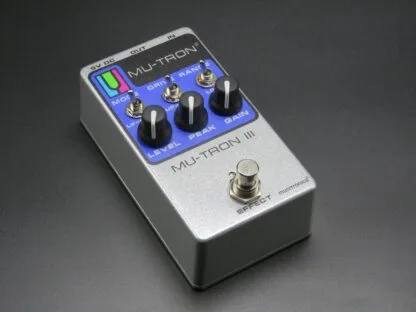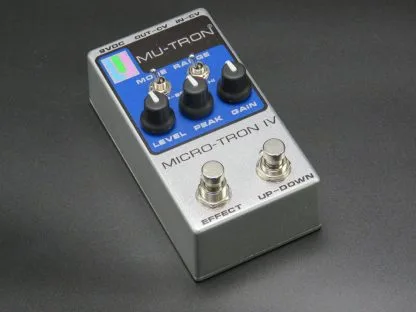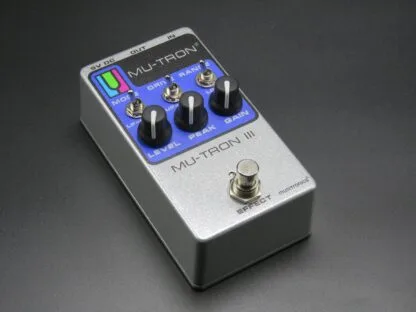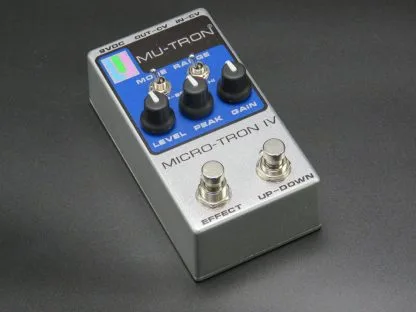


The Musitronics Mu-Tron Micro-Tron IV Vintage Silver is a compact envelope filter pedal, an effect that sweeps a filter across your sound in response to how hard you play. Musitronics describes it as a compact, convenient and affordable version of the classic Mu-Tron III envelope filter, and as the newest reincarnation of that circuit, providing what the maker calls "all the classic Jerry tone and Bootsy funk, in a pedalboard-friendly size"12. It is based on the award winning Micro-Tron III and improves on it with the maker's MU Opto-Mod technology, swappable optical modules that change the pedal's response12.
The Vintage Silver finish is one version of the Micro-Tron IV. It is made in the USA, carries a 1 year limited warranty, and is listed by the maker at a list price of $279.0013.
Controls and what they do
The pedal's MODE switch selects the filter type, offering LP (lowpass filter), BP (bandpass filter) or HP (highpass filter) positions, while the RANGE switch selects LO (low filter sweep range) or HI (high filter sweep range)1.
| Control | What it does |
|---|---|
| GAIN | Controls the envelope and filter audio drive, that is, how sensitive the filter is to your picking1 |
| PEAK (or Q) | Controls the filter audio response from very weak to very strong1 |
| LEVEL | Controls the output volume of the effected signal1 |
| MODE switch | Selects LP (lowpass), BP (bandpass) or HP (highpass) filter1 |
| RANGE switch | LO sets a low sweep range for most rhythm guitar, bass and lower fret uses; HI sets a high range1 |
| UP/DOWN footswitch | Selects the sweep direction (see below)1 |
| ON/OFF footswitch | Engages or disengages the envelope filter effect1 |
The three MODE positions shape which frequencies the filter emphasizes. LP passes all the signals below the peak and attenuates signals above it; HP passes all signals above the peak and attenuates those below; BP sits between them, passing a band around the peak12.
The UP/DOWN switch
The UP/DOWN footswitch chooses which way the filter travels as you play harder. In UP, the pedal produces the familiar auto-wah sound, which Musitronics likens to a heel-to-toe sweep on a wah pedal. In DOWN, it produces a "down swoop" sound, like a toe-to-heel sweep, where the filter falls instead of rises12. DOWN is the less common direction and gives the quacky, closing-lid character heard on many funk records.
Power and connections
The Micro-Tron IV runs on 9V DC with a 52 mA draw, the same industry-standard power as the Micro-Tron III, so it fits a normal pedalboard supply15. Alongside the 1/4" input and output jacks it has 1/8" CV input and output jacks1.
The CV connections are where the pedal reaches beyond a standard envelope filter:
- CV input: a standard control voltage input that accepts an expression pedal such as the Dunlop DVP4 without modification, letting you sweep the filter by hand or foot instead of with your attack6
- CV output: sends the envelope control voltage out to other units, such as Mu-Tron's Phasor III and Bi-Phase pedals, so those effects can follow your playing dynamics6
The CV jacks are 1/8" (mini), not the 1/4" jacks most expression pedals use, so a cable or adapter with a 1/8" plug is needed to connect one1.
Opto-Mod modules
What separates the IV from the III most clearly is MU Opto-Mod technology. These are new parts Musitronics developed as direct replacements for original Musitronics parts that are no longer made6. The Opto-Mod modules are swappable, and the maker says the technology "allows you to change the overall ADSR (Attack, Decay, Sustain, Release) characteristics of your Micro-Tron IV"7. They come in Gold, Red and Blue versions, sold as accessories7.
Where it comes from
The Micro-Tron IV carries the Mu-Tron III lineage forward in a pedalboard-friendly size: Musitronics describes it as providing "all the classic Jerry tone and Bootsy funk" in that compact format, and says it works on guitar, bass, keys, horns and harmonica1. The maker builds it with its own MU Opto-Mod technology, which it presents as an improvement on the earlier circuit1.
The line runs in three steps:
- Effect type: envelope filter, auto wah and envelope follower, the categories Musitronics tags the pedal with1
- Core technology: MU Opto-Mod technology, which the maker describes as improving on the earlier design1
- Connectivity: a 1/4" input and output alongside a 1/8" CV input jack and 1/8" CV output jack for control-voltage connections2
Aion FX summarizes the difference plainly: the Micro-Tron IV is "an updated version of the Mu-tron III, with modernized circuitry, CV input and output, and swappable optical modules for different reaction times and filter characteristics"8.
Availability
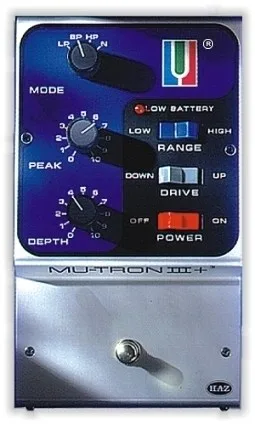
The Vintage Silver version is listed at $279.00 on the maker's store13. Guitar World reported in February 2025 that "only a Micro-Tron IV in Vintage Silver ($279) is currently in stock on its website"9. Players comparing options may also want to look at the maker's other filter pedals, including the Mu-Tron III Vintage Silver reissue.
Videos
PJ and the Beard
Low-End Reviews - Bass Pedals and Gear
The Record Company
Questions
Does the Micro-Tron IV work on bass?
Yes. The maker describes the pedal as providing the classic Jerry tone and Bootsy funk, and says it sounds great on guitar, bass, keys, horns, harmonica and more. The RANGE switch has a LO setting aimed at most rhythm guitar, bass and lower fret uses, so bass players can set the filter sweep to a range that suits the instrument.
What is the difference between the Micro-Tron III and Micro-Tron IV?
The Micro-Tron IV is based on the award winning Micro-Tron III but adds MU Opto-Mod technology, swappable optical modules that change the pedal's attack, decay, sustain and release characteristics, plus a CV input and output. The III is a compact reincarnation of the original Mu-Tron III, while the IV modernizes the circuitry on a new platform.
What does the UP/DOWN switch do on the Micro-Tron IV?
It selects the direction of the filter sweep. UP produces the familiar auto-wah sound, like a heel-to-toe sweep on a wah pedal. DOWN produces a down swoop, like a toe-to-heel sweep, where the filter falls as you play harder instead of rising.
Can I use an expression pedal with the Micro-Tron IV?
Yes. The pedal has a standard CV input on a 1/8 inch jack that accepts an expression pedal such as the Dunlop DVP4 without modification. It also has a CV output that can send envelope control voltage to other units, such as Mu-Tron's Phasor III and Bi-Phase pedals.
Is the Micro-Tron IV made in the USA?
Yes. Musitronics states that the Micro-Tron IV Vintage Silver is made in the USA, and it carries a 1 year limited warranty from the maker.
Sources (9)
- Micro-Tron IV Vintage Silver, Musitronics Mu-Tron (mu-tron.com)
- Micro-Tron IV, Musitronics Mu-Tron
- Mu-Tron III Vintage Silver, Musitronics Mu-Tron (mu-tron.com)
- Mu-Tron Opto-Mod Modules for Micro-Tron IV, Musitronics Mu-Tron
- Micro-tron III by Mu-Tron, RockBoard PedalPedia, 2026
- Mu-News November, 2019, Musitronics Mu-Tron, 2019-11
- Mu-Tron Opto-Mod Modules for Micro-Tron IV, Musitronics Mu-Tron
- Lumitron Resonant Filter / Mu-tron® III, Aion FX, 2023-09-08
- Behringer blasted by Mu-Tron III maker over $69 replica, Guitar World, 2025-02-17