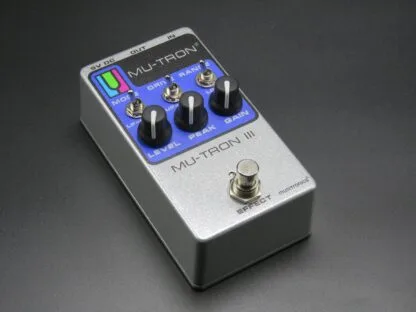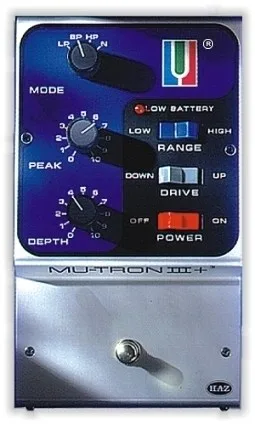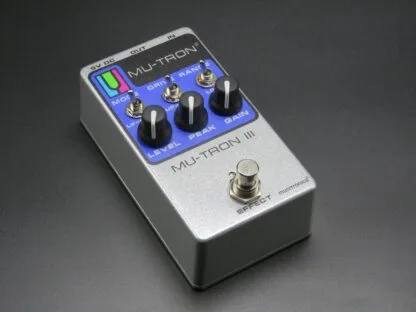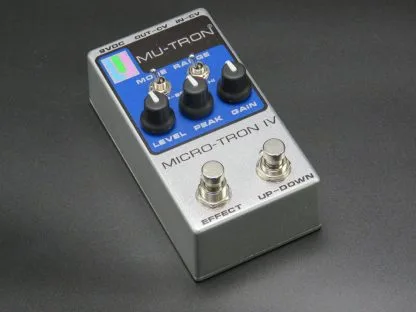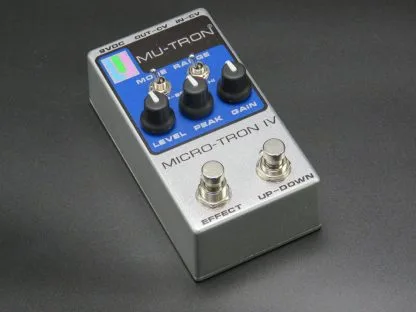


The Musitronics Mu-Tron Micro-Tron IV is an envelope filter pedal: a filter whose frequency peak moves in response to how hard you play, the effect often called an autowah. Musitronics calls it "a compact, convenient and affordable version of the classic Mu-Tron III™ envelope filter," and says it "provides all the classic Jerry tone and Bootsy funk, in a pedalboard-friendly size and powered by industry-standard 9V DC"1.
The pedal is a compact, convenient and affordable version of the classic Mu-Tron III envelope filter, as its maker describes it1. Like the Micro-Tron III before it in the line, it packs the envelope filter effect into a small enclosure, measuring 4.75" x 2.5" x 2.25" and weighing 1 lb, with a single ON/OFF footswitch that engages or disengages the effect1.
An envelope filter with LP, BP and HP modes
An envelope filter listens to the level of your playing and uses it to sweep a resonant filter up and down, so a hard-plucked note opens the filter and a quiet one lets it close. The Mu-Tron III circuit that the Micro-Tron IV builds on is the classic example of the type, sometimes called an autowah4.
The MODE switch selects one of three filter types, and each shapes the sound differently1:
| MODE position | What it does |
|---|---|
| LP (lowpass) | Passes all the signals below the peak and attenuates signals above the peak |
| BP (bandpass) | Passes signals only near the peak |
| HP (highpass) | Passes all signals above the peak and attenuates signals below the peak |
LP is the most common choice for the familiar funk quack, since it keeps the low end while sweeping the top. BP narrows the effect to a vocal-like band around the moving peak, and HP thins the signal out by cutting lows as the filter moves1.
The controls
The control set is small and shared with the rest of the Micro-Tron line1:
| Control | What it does |
|---|---|
| GAIN knob | Controls the envelope and filter audio drive, setting how sensitive the sweep is to your attack |
| LEVEL knob | Controls the output volume of the effected signal |
| MODE switch | Selects LP, BP or HP filter mode |
| RANGE switch | Selects LO or HI filter sweep range |
| ON/OFF footswitch | Engages or disengages the envelope filter effect |
The RANGE switch is where the pedal adapts to different instruments and playing positions. LO sets the filter sweep to a low range for most rhythm guitar, bass and lower fret uses; HI sets it to a high range for accenting string harmonics or for up-the-neck and solo work1. GAIN works with this: more gain makes the filter react to a lighter touch, less gain demands a harder attack before the sweep opens up.
Power and connections
The Micro-Tron IV runs on 9V DC with a 52 mA draw1, which means it works with the standard center-negative power supplies most pedalboards already use, unlike the original Mu-Tron III, which was a larger AC-powered unit. Alongside the 1/4" instrument input and output jacks, the pedal carries a 1/8" CV input jack and a 1/8" CV output jack1. These control-voltage jacks let the filter's sweep be driven from outside the pedal and sent to other CV-equipped gear, an option the original design did not have5.
A Mu-Tron III variant with Opto-Mod parts
The Micro-Tron IV is the newest reincarnation of the classic Mu-Tron III envelope filter, based on the award winning Micro-Tron III1. Aion FX describes it as "an updated version of the Mu-tron III, with modernized circuitry, CV input and output, and swappable optical modules for different reaction times and filter characteristics"5.
The original Mu-Tron III circuit used photo-couplers, the light-dependent components also known as optocouplers or vactrols, to control the filter sweep6. Those original Musitronics parts are no longer made, so for the Micro-Tron IV the company developed its own replacements, which it calls MU Opto-Mod technology3.
"improves it with our very own MU Opto-Mod technology"
The Opto-Mod parts are also sold separately as the Mu-Tron Opto-Mod Modules for Micro-Tron IV, in Gold, Red and Blue versions. Because they are swappable, a player can change the overall ADSR (attack, decay, sustain, release) behavior and filter character of the pedal without tools or soldering, tailoring the reaction time and filter characteristics to their playing6.
Where it came from
The Micro-Tron IV comes from Musitronics, the maker behind the Mu-Tron III envelope filter it is based on278. The pedal itself is a small unit, at 4.75" x 2.5" x 2.25" and 1 lb, built around one control for the player: an ON/OFF footswitch that engages or disengages the envelope filter effect1. It carries a 1 Year Limited Warranty from the maker1.
A Vintage Silver finish version, the Micro-Tron IV Vintage Silver, shares the same circuit, controls and specifications2.
What reviewers and players say
Published reviews of the closely related Micro-Tron III give a sense of how the family sounds in use. Pedal of the Day found that "it sounds great not only on guitar, but on bass, keys, horns, harmonica and more as well"9, which matches the maker's own description of the line's range910. Musitronics itself frames the pedal's sound by reference to its best-known users, promising "all the classic Jerry tone and Bootsy funk"1.
Videos
PJ and the Beard
Low-End Reviews - Bass Pedals and Gear
The Record Company
Questions
Is the Micro-Tron IV the same as the original Mu-Tron III?
No. Musitronics describes it as the newest reincarnation of the classic Mu-Tron III envelope filter, based on the award winning Micro-Tron III. It keeps the same envelope-filter concept but adds modernized circuitry, a CV input and output, and swappable optical modules for different reaction times and filter characteristics.
What does the CV input jack do on the Micro-Tron IV?
The pedal has a 1/8 inch CV input jack alongside its 1/4 inch instrument input, plus a matching 1/8 inch CV output jack. The CV jacks let the filter's control voltage be driven externally and sent out to other gear, which the original Mu-Tron III design did not offer in this pedalboard format.
Does the Micro-Tron IV work with bass?
Yes. The maker says it provides the classic Jerry tone and Bootsy funk, and the LO range setting is described as suiting most rhythm guitar, bass and lower fret uses. The related Micro-Tron III was also noted by reviewers as working well on bass, keys, horns and harmonica.
What is the difference between the LO and HI range settings?
LO sets the filter sweep to a low range, which Musitronics recommends for most rhythm guitar, bass and lower fret playing. HI sets the sweep to a high range, aimed at accenting string harmonics and at up-the-neck and solo work.
Where is the Micro-Tron IV made?
Musitronics states that the Micro-Tron IV is made in the USA. The pedal carries a 1 year limited warranty from the maker.
Sources (10)
- Micro-Tron IV, Musitronics Mu-Tron
- Micro-Tron IV Vintage Silver, Musitronics Mu-Tron (mu-tron.com)
- Mu-News November, 2019, Musitronics Mu-Tron, 2019-11
- VFE_SPS_MiniMu.pdf, madbeanpedals.com, 2024-04-25
- Lumitron Resonant Filter / Mu-tron® III, Aion FX, 2023-09-08
- Mu-Tron Opto-Mod Modules for Micro-Tron IV, Musitronics Mu-Tron
- Beigel Sound Lab/Mu-FX Tru-Tron 3X Review, Premier Guitar, 2014-08-03
- Mu-FX Tru-Tron 3X™ Envelope Filter, pedal-of-the-day.com, 2016-04-19
- Mu-Tron Micro-Tron III Envelope Filter, Pedal of the Day (pedal-of-the-day.com), 2019-07-10
- Micro-tron III by Mu-Tron, RockBoard PedalPedia, 2026