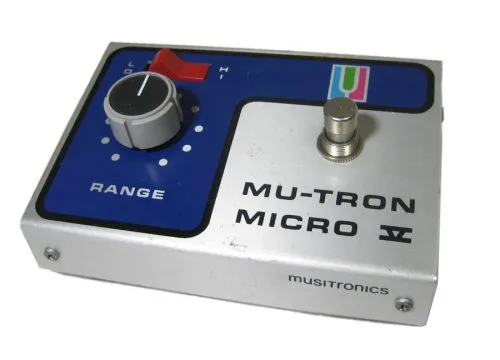


The Mu-Tron Micro V is an envelope-controlled filter pedal from the mid-1970s, built by Musitronics as a smaller and cheaper alternative to the company's landmark Mu-Tron III. Like the III, it is an automatic wah: instead of rocking a footswitch, the pedal follows the volume shape of what you play and sweeps a filter in response, so the sound opens up as you play harder and closes as you back off. Musitronics described it as delivering "the touch-controlled wah effect pioneered by the original envelope follower, Mu-tron III"12.
The Micro V was discontinued in 1980, along with the rest of the Mu-tron lineup, not long after the company's sale to ARP2. Original units are vintage pieces, though the circuit has lived on in replica kits from other builders.
What it does to your sound
The Micro V is an envelope follower driving a voltage-controlled filter. The filter's peak response frequency varies with the envelope of your input signal, which is what produces the automatic wah effect: pick hard and the filter sweeps wide, play gently and it barely moves. Guitar World describes the Mu-tron approach as optocouplers responding to playing dynamics to sweep an EQ filter, "resulting in a funky wah sound" that is expressive and responsive4.
Musitronics advertised the Micro V's two controls as allowing "a wide range of effects suitable for a funky bass guitar, a screaming lead guitar, or anything in between," including electric keyboards and electrified wind instruments1. That makes it one of the more instrument-agnostic pedals of its era, and the Hi/Lo range switch is what lets a bass player keep the sweep in a useful register.
Controls and connections
The control set is minimal compared with the Mu-tron III:
| Control | What it does |
|---|---|
| Hi/Lo switch | Sets the frequency range in which the filter moves1 |
| Second control | Works with Hi/Lo to set the effect's response across instruments and playing styles1 |
The enclosure is described by the maker as "a very compact and rugged housing of painted steel and heavy-gauge aluminum"1, and at 1 pound it is a genuinely small box for its era.
Specifications from Musitronics1:
| Specification | Value |
|---|---|
| Input impedance | 200,000 ohms |
| Output impedance | Low, designed to operate into 600 ohms or more |
| Minimum input for full wah effect | 45 mV RMS |
| Signal-to-noise ratio | 85 dB below 1V input |
Power
Power comes from an internal 9-volt battery, not included with the pedal. An optional external 9-volt AC adapter can be connected through a mini-jack on the unit1. Note that the mini-jack is not the center-negative barrel connector found on modern pedals, so powering an original unit today takes an adapter to suit.
How it differs from the Mu-tron III
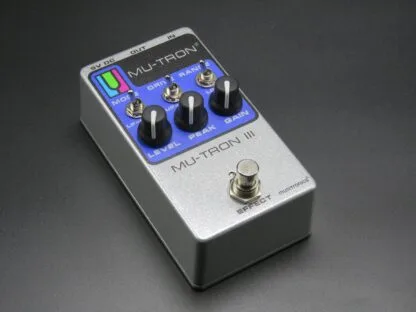
The Mu-Tron III, designed by Mike Beigel and released in 1972, was the original envelope follower and voltage-controlled filter that produced automatic wah effects changing timbre in response to playing5. The Micro V carries that lineage in a stripped-down form: two controls instead of the III's larger panel, a smaller steel-and-aluminum enclosure, and a lower price.
According to Aion FX's technical history, the Micro V was designed with two goals in mind: to use up surplus CA3080 chips left over after the Phasor I was discontinued, and to fill a gap in Musitronics' lineup for a low-cost pedal2. The CA3080 is a transconductance amplifier that was central to how these voltage-controlled filters swept.
The family resemblance is recognized by builders today. General Guitar Gadgets sells a replica kit of the Micro V and says it gets "some of the same sounds as the Mu-tron III"6, and Jed's Peds offers a Mewtron Micro V kit described as an auto wah filter effect that "compares to the Mutron Envelope Filter," with a toggle switch added for extra variety7.
Where it came from
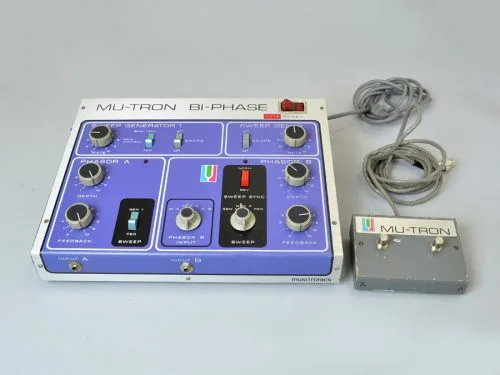
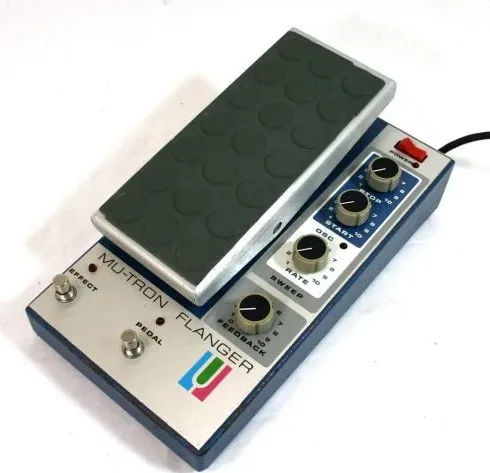
Musitronics was founded around the Mu-tron III and became known for a range of effects including the Bi-Phase, the Flanger and Phasor, the Vol-Wah, and the Mu-tron III3. The Micro V arrived in the mid-1970s as the lower-cost entry in that line2, advertised in original Musitronics ads from the 1970s1.
Mike Beigel designed both the III and the Micro V. Looking back, he has been candid about how the smaller pedal fit the company's plans528:
"we sold a lot fewer of those than the regular Mu-trons, so it was not really a step forward"8
Mike Beigel, in a Premier Guitar builder profile on the Mu-Tron story8
The pedal was discontinued in 1980 along with the other pedals in the Mu-tron lineup, not long after the company's sale to ARP2. Its origin was practical in another way too: it was designed to use surplus CA3080 chips left after the Phasor I was discontinued, and to fill the company's lack of low-cost pedal offerings2.
The Micro V's place among compact Mu-Trons
The Micro V itself came out of a practical problem: it was designed to use surplus CA3080 chips left after the Phasor I was discontinued, and to fill the company's lack of low-cost pedal offerings2. That made it the low-cost entry in the Mu-tron lineup, and when the company was sold to ARP the whole line, Micro V included, was discontinued in 19802.
Videos
dwenius
Vintage Stompboxes
Pprovo1
Questions
Does the Mu-Tron Micro V take a battery?
Yes. Power comes from an internal 9-volt battery, which is not included with the pedal. An optional external 9-volt AC adapter can also be connected through a mini-jack on the unit, so it can run either way.
Is the Mu-Tron Micro V analog?
Yes. Musitronics described it as a sophisticated solid-state circuit design, and it uses the same kind of analog envelope-following approach as the Mu-tron III. There is no digital processing in the original 1970s unit.
How is the Micro V different from the Mu-tron III?
The Micro V is a smaller, lower-cost envelope filter built around the touch-controlled wah effect pioneered by the Mu-tron III. It has two controls instead of the III's larger control set, and it was designed partly to use surplus CA3080 chips left over after the Phasor I was discontinued.
Who designed the Mu-Tron Micro V?
Mike Beigel, the designer of the original Mu-tron III, also designed the Micro V. It was first released in the mid-1970s as a lower-cost alternative to the Mu-tron III.
Can you use the Micro V with bass?
Yes. Musitronics advertised it as suitable for a funky bass guitar, a screaming lead guitar, or anything in between, including electric keyboards and electrified wind instruments. The Hi/Lo switch sets the frequency range the filter moves in, which helps with bass.
Why did the Micro V sell fewer units than other Mu-trons?
Mike Beigel has said the company sold a lot fewer Micro Vs than the regular Mu-trons and that it was not really a step forward. It was discontinued in 1980 along with the rest of the Mu-tron lineup after Musitronics was sold to ARP.
Sources (8)
- Mu-Tron Micro V, mu-tron.com
- Minima Resonant Filter / Mu-tron® Micro V, Aion FX, 2023-09-08
- Beigel Sound Lab/Mu-FX Tru-Tron 3X Review, Premier Guitar, 2014-08-03
- How the Mu-Tron III became a vintage pedalboard icon, Guitar World, 2026-02-09
- Lumitron Resonant Filter / Mu-tron® III, Aion FX, 2023-09-08
- Mu-Tron™ Micro V™ Clone: Envelope Filter Kit, PCB & Schematic, General Guitar Gadgets, 2014-05-14
- Mewtron Micro V, Jed's Peds (jedspeds.co.uk)
- Builder Profile: The Mu-tron Story, www.premierguitar.com, 2013-09-12