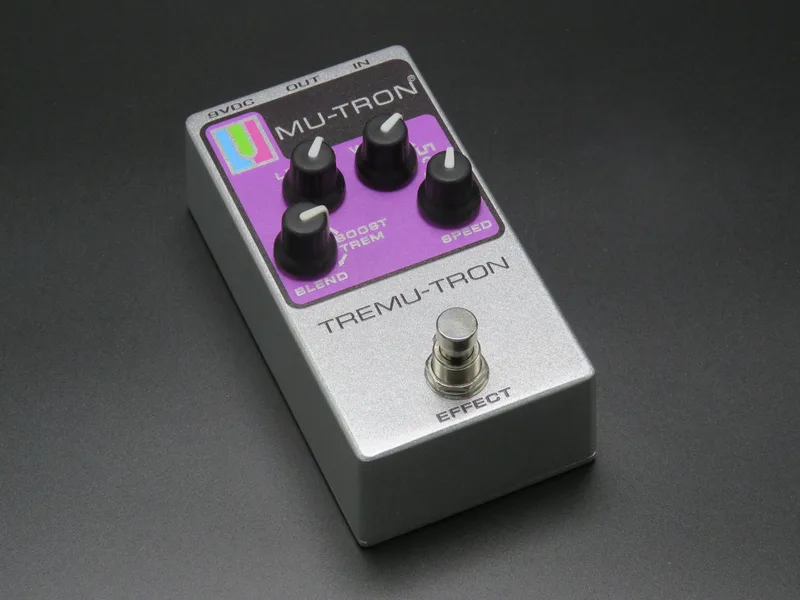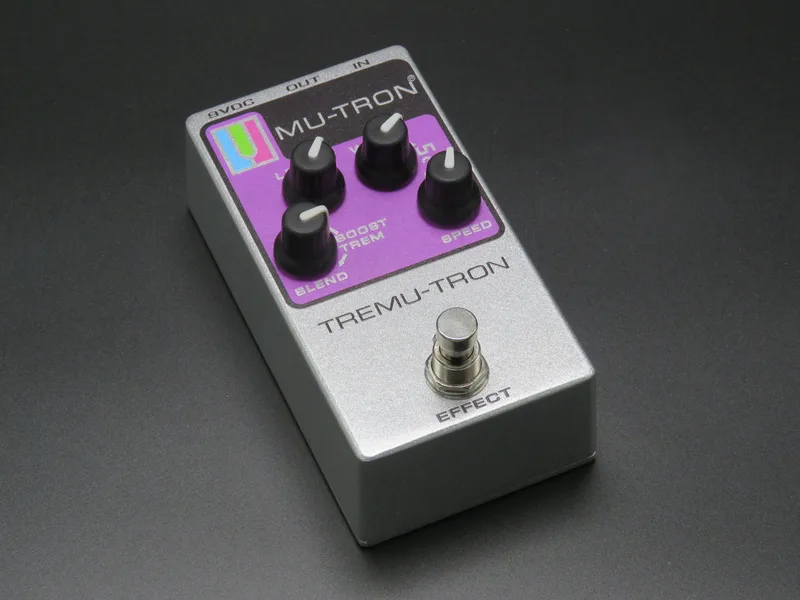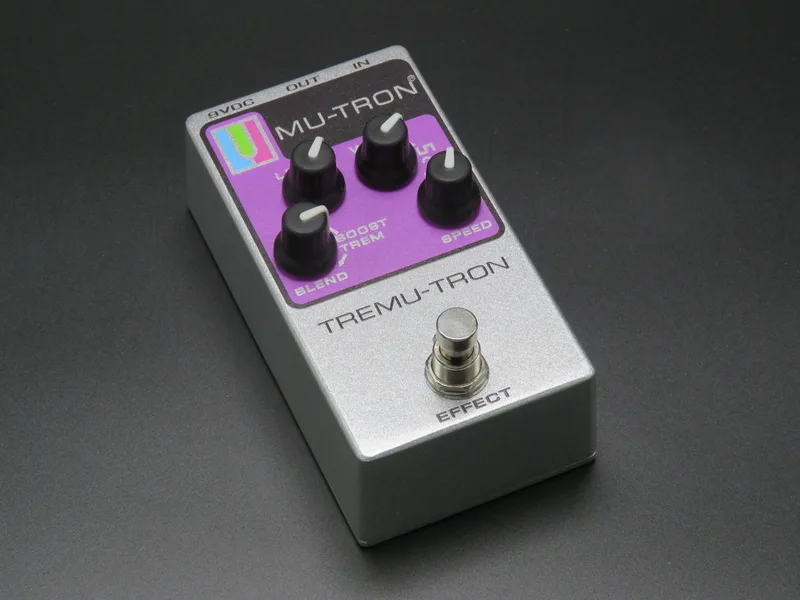


The Mu-Tron Tremu-Tron is an optical tremolo pedal that can also be used as a clean boost, made by Musitronics Mu-Tron and built in the USA1. It is designed to give non-tremolo tube and solid-state amplifiers the same rich tremolo found in vintage Fender and Vox amplifiers, and Mu-Tron says it may also be used to push the tubes on traditionally clean amps such as Fender blackface types, or to beef up the front end of sterile solid-state amplifiers or mixing consoles1.
The circuit carries over hardware with a real pedigree: the Mu-Drive preamp from the original Mu-Tron III envelope filter, the pedal that made the company's name in the 1970s1. The tremolo itself comes from Mu-Tron's patented opto-mod technology, which the maker says provides classic, hi-fidelity attenuation without extra noise artifacts1.
What it does to your sound
Tremolo raises and lowers the volume of your signal in a repeating cycle, the effect built into many vintage amplifiers. The Tremu-Tron brings that to amps that lack it, and because it is optical, the volume change is done with light: the signal drives a light source, and a light-dependent component attenuates the output in time with an oscillator. Mu-Tron calls its version of this opto-mod technology, and says it delivers hi-fidelity attenuation without extra noise artifacts1.
Pedal of the Day reviewed the pedal in January 2022 and described it as delivering on all modulation fronts2:
"the Tremu-Tron Optical Tremolo + Boost delivers on all modulation fronts, awakening both your amplifier and your musical muse"
The same review noted the practical benefit of the internal power design: "By utilizing an 18 volt dual-rail internal power supply, this effect provides a crisp, clean signal and high headroom"2.
The controls
Four knobs govern the effect, and each does one clear job1:
| Control | What it does |
|---|---|
| Rate | Controls LFO speed, how fast the tremolo pulses |
| Shape | Controls the waveform from sine to square |
| Blend | Controls the amount of tremolo applied to the dry signal |
| Level | Controls the overall output level of the signal |
Shape is the control that sets the character: at the sine end the volume swells smoothly, at the square end the effect switches abruptly between loud and quiet. Blend lets you keep some dry signal in the mix, which softens the effect, and Level is what turns the pedal into a boost when you want it to be one13.
Power and connections
The pedal runs from a 9V DC supply in a rugged Mu-Tron enclosure, and internally it generates an 18 volt dual-rail power supply from that input1. The dual rail is what gives the clean signal and high headroom the maker and reviewers describe12. Connections are simple: one 1/4" input jack and one 1/4" output jack1.
Mu-Tron gives the weight as 1 lb and the dimensions as 4.75" x 2.5" x 2.25", though the product listing table on the same page lists 1 oz and 5 x 5 x 4 in, so the two figures on the maker's page disagree1.
The Mu-Drive preamp and opto-mod circuit
The input stage is the Mu-Drive preamp taken from the original Mu-Tron III envelope filter, which Mu-Tron describes as famous1. The Mu-Tron III was Musitronics' 1970s envelope-controlled filter; Vintage Guitar magazine notes that by 1979/'80 the original Mu-Tron was history, and Premier Guitar has described a range of well-known envelope filter sounds as created with an original Musitronics Mu-Tron III45. Carrying that preamp into the Tremu-Tron means the pedal has the same input gain character at its front end.
The modulation side uses the same opto-mod family of parts Mu-Tron uses across its range, photo-couplers the maker also lists under the tags optocoupler, photocoupler and vactrol6. In the Tremu-Tron these components do the attenuation that produces the tremolo, driven by the LFO whose speed and waveform you set from the front panel.
Where it goes in the signal chain
Mu-Tron says the Tremu-Tron pedal should be placed after overdrive and before reverb in the signal chain1. That is the conventional placement for tremolo: after your drive pedals so the tremolo modulates the driven sound, and before reverb so the reverb tail is not chopped up by the volume pulses.
The A Stock version
Mu-Tron also sells the Tremu-Tron A Stock, the same optical tremolo and boost pedal offered at a lower price because of very minor cosmetic case blemishes on the enclosure3. It has the same Rate, Shape, Blend and Level controls, the same opto-mod circuit, the same 9V DC power with the 18 volt dual-rail internal supply, and the same made-in-the-USA construction as the standard pedal3.
Videos
Mu Tron
Pedal of the Day
Questions
Where should a tremolo go in the signal chain?
Mu-Tron says the Tremu-Tron should be placed after overdrive and before reverb in the signal chain. That keeps the tremolo modulating a signal that has already been shaped by drive, and keeps reverb tails from being chopped up by the effect.
Can the Tremu-Tron be used as a boost on a clean amp?
Yes. Mu-Tron says it may be used as a boost to push the tubes on traditionally clean amps such as Fender blackface types, or to beef up the front end of sterile solid-state amplifiers or mixing consoles. Pedal of the Day noted the same use, calling it a clean boost.
Where is the Mu-Tron Tremu-Tron made?
Mu-Tron states that the Tremu-Tron is made in the USA. The same applies to the A Stock version, the maker's discounted variant with minor cosmetic case blemishes.
What is the Tremu-Tron A Stock?
The A Stock is the same optical tremolo and boost pedal sold at a lower price because of very minor cosmetic case blemishes on the enclosure. It has the same controls, the same opto-mod circuit, and the same USA construction as the standard Tremu-Tron.
Sources (6)
- Tremu-Tron, Musitronics Mu-Tron
- Mu-Tron Tremu-Tron Optical Tremolo + Boost, Pedal of the Day, 2022-01-26
- Tremu-Tron A Stock, Musitronics Mu-Tron
- Mu-FX Tru-Tron 3X, Vintage Guitar magazine, 2015-09-04
- Beigel Sound Lab/Mu-FX Tru-Tron 3X Review, Premier Guitar, 2014-08-03
- Mu-Tron Opto-Mod Modules for Micro-Tron IV, Musitronics Mu-Tron