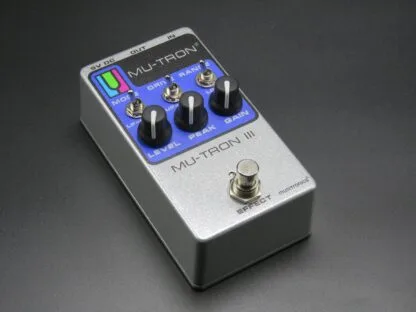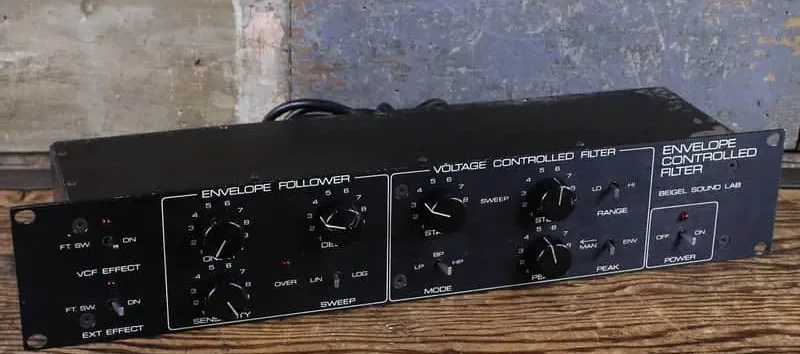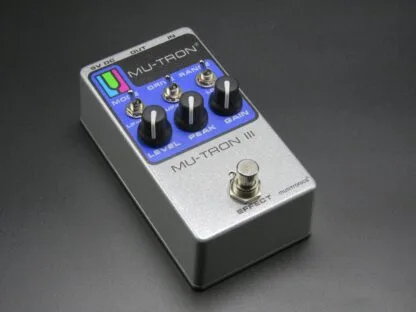


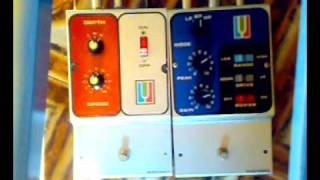
The Musitronics Mu-Tron III is an envelope filter pedal, the box that reads how hard you pick and sweeps a filter accordingly, the effect often called an autowah. Released in 1972 by Musitronics Corp. of Rosemont, New Jersey, it was the first commercial envelope filter pedal12. Instead of rocking a footswitch like a wah, the Mu-Tron III opens and closes its filter from the volume envelope of your own signal: pick hard and the filter sweeps up, let the note decay and it settles back down.
The vocal-like effect was quickly embraced by musicians and became a characteristic sound of entire genres, particularly funk2. Notable users include Bootsy Collins on bass, Jerry Garcia on guitar, and Stevie Wonder2. Musitronics even hired guitarist Larry Coryell to record a Mu-Tron III demo album, released in 19753.
The first commercial envelope filter
Mike Beigel and Aaron Newman founded Musitronics in 1972, and the Mu-Tron III came out that same year1. Aion FX describes it as "the very first commercial envelope filter pedal, also called an autowah"2. The circuit used optocouplers to dynamically control a series of frequency filters based on the level of the input signal2, and its patent describes a voltage-controlled filter whose peak response frequency is varied in accordance with the envelope of the input signal2.
The circuit uses optocouplers (also called photocouplers or vactrols) to dynamically control a series of frequency filters based on the level of the input signal2. In the words of the patent description, "the filter peak response frequency is thus varied in accordance with the varying envelope of the sound generating signal"6. That is the whole trick: the pedal is a voltage-controlled filter whose cutoff tracks your playing dynamics, so no footwork is needed.
The vocal-like effect was quickly embraced by musicians and soon became a characteristic effect of entire genres, particularly funk2. Despite the name, versions "I" and "II" never existed: the Roman numeral III was Beigel's favorite number, adopted from the start7. The original unit's PEAK control had its maximum at about 8 on the dial8.
There was never a Mu-Tron I or II. The Roman numeral III was reportedly Beigel's favorite number and was adopted from the start, so the company's first envelope filter carried a "III" from day one7.
The controls
The Mu-Tron III has six controls, three knobs and three switches, which allow you to tweak the filter in a number of ways7.
| Control | What it does |
|---|---|
| Gain knob | Controls the envelope and filter audio drive, setting how responsive the sweep is to your picking9 |
| Peak knob | Controls the volume of the cutoff frequency peak; on the original, peak maximum was at about 8 on the dial4 |
| Mode control | Selects a low pass, band pass or high pass filter sweep7 |
| Range and Drive switches | Set the frequency range and the sweep direction, up or down10 |
The mode selection was originally a rotary switch with three positions6. The Drive switch chooses between up and down sweep11; in the down position, builders on the Guitar FX Layouts blog found they could get "some cool phaser like sounds controlled with picking velocity"6.
What reviewers said
Guitar World's history of the pedal found that "the phenomenal sound of this pedal makes it very easy to love. Every one of its settings leads to one of those classic filter tones reminiscent of P-Funk tracks"7. A separate Guitar World review noted that "the wah sounds go well beyond those of a typical wah pedal, producing a wide variety of textures that include duck-like quacks, vowel-like vocal tones, piercing synth squeals and bowel-shaking bow wows"12. The same article reports that the pedal works fantastically well with any other pedal, including an octaver7.
DIY builders on the Guitar FX Layouts blog, working from a verified layout of the circuit, were enthusiastic but pointed out quirks. One described it as "a Mt. Everest build" that is "amazing" with "so many tonal variations"6. Another warned that the circuit is picky about its LDRs (light-dependent resistors), working well with GL5539 parts but sounding bad with different ones, and one builder found the low pass mode sounded amazing while band pass and high pass came out warbly and distorted in the high end6.
Later versions and reissues
The original pedal is long out of production, but the circuit has been revived several times572:
- Mu-Tron III+ by HAZ Laboratories, a reissue of the Envelope Controlled Filter with a depth control described as "a sensitivity control for optimum operation from any musical source," plus an inverted snap the maker calls perfect for funky bass13
- Mu-FX version (2014), a modified version released by Beigel's then-new company Mu-FX7
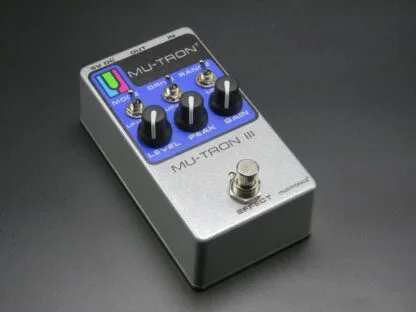
- Mu-Tron III Vintage Silver, the current reincarnation from Mu-Tron, built with the same circuit as the 1972 original and aimed at guitar, bass, clavinet and synths111
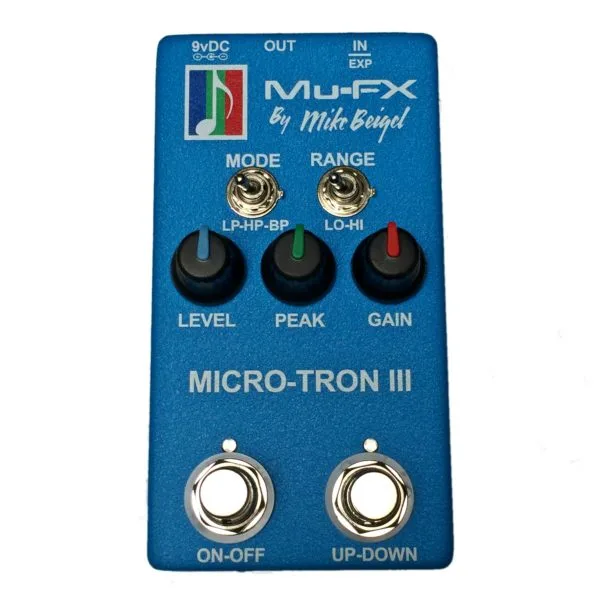
- Mu-FX Micro-Tron III, a pedalboard-friendly reincarnation that keeps the original's Mode, Peak and Gain knobs and Range and Drive switches, and adds an OUTPUT level control91410
Pedal of the Day reviewed the Micro-Tron III as "an innovative take on a classic, and one that we've all been wanting to see reissued"10. The maker says it provides "all the classic Jerry tone and Bootsy funk, in a pedalboard-friendly size," and that it sounds amazing on guitar, bass, keys, horns, harmonica and more9.
Videos
BassTheWorld.com
Soultron
elswan64
Questions
Who designed the Mu-Tron III?
Mike Beigel, inventor of the original Mu-Tron III and principal developer of the Mu-Tron product line. He co-founded Musitronics with Aaron Newman in 1972 after Guild cancelled his synthesizer project, and the Mu-Tron III was the company's first and most famous pedal.
Were there Mu-Tron I and II pedals?
No. Versions I and II never existed. The Roman numeral III was reportedly Beigel's favorite number and was adopted from the start, so the first envelope filter the company shipped was already called the Mu-Tron III.
How does the Mu-Tron III work?
It is a voltage-controlled filter whose peak response frequency follows the envelope of your input signal. Optocouplers dynamically control a series of frequency filters based on how hard you pick, so the filter sweeps open and closes as your note decays, without any foot rocking.
Is the Mu-Tron III still made?
The original ran from 1972 until Musitronics sold the product line to ARP around 1979, and production ended by 1980. Reissues and descendants followed, including HAZ Laboratories' Mu-Tron III+, a 2014 Mu-FX version, and the current Mu-Tron III Vintage Silver with the same circuit.
What is the Mu-Tron III used for on bass?
It is the classic funk-bass sound. Bootsy Collins used it on bass, and the maker says it delivers an inverted snap suited to funky bass. It also works as an automatic wah, and the maker recommends it for guitar, clavinet and synths too.
What is the Micro-Tron III?
A pedalboard-sized reincarnation of the classic Mu-Tron III envelope filter made by Mu-Tron (Mu-FX). It keeps the original's Mode, Peak and Gain knobs plus Range and Drive switches, and adds an OUTPUT level control.
Sources (14)
- Mike Beigel, Musitronics Mu-Tron (mu-tron.com)
- Lumitron Resonant Filter / Mu-tron® III, Aion FX, 2023-09-08
- Favored by Frank Zappa and Jerry Garcia, the Musitronics Mu-Tron III Combined Wild Sonics and Creative Usability, GuitarPlayer (www.guitarplayer.com), 2023-03-03
- Mu-Tron III, Musitronics Mu-Tron
- Mu-FX Tru-Tron 3X, Vintage Guitar magazine, 2015-09-04
- Guitar FX Layouts: Mutron III, Guitar FX Layouts (tagboardeffects.blogspot.com), 2014-06-19
- The Mu-Tron III: “Without it, there ain't no Bootsy”, Guitar World, 2023-03-17
- Mu-FX Tru-Tron 3X, Musitronics Mu-Tron
- Mu-FX Micro-Tron III, Musitronics Mu-Tron
- Mu-Tron Micro-Tron III Envelope Filter, Pedal of the Day (pedal-of-the-day.com), 2019-07-10
- Mu-Tron III Vintage Silver, Musitronics Mu-Tron (mu-tron.com)
- How the Mu-Tron III became a vintage pedalboard icon, Guitar World, 2026-02-09
- Mu-Tron III+ Envelope Controlled Filter, Musitronics Mu-Tron
- Micro-tron III by Mu-Tron, RockBoard PedalPedia, 2026